 SUPPORT


 3EX United States
 Blog
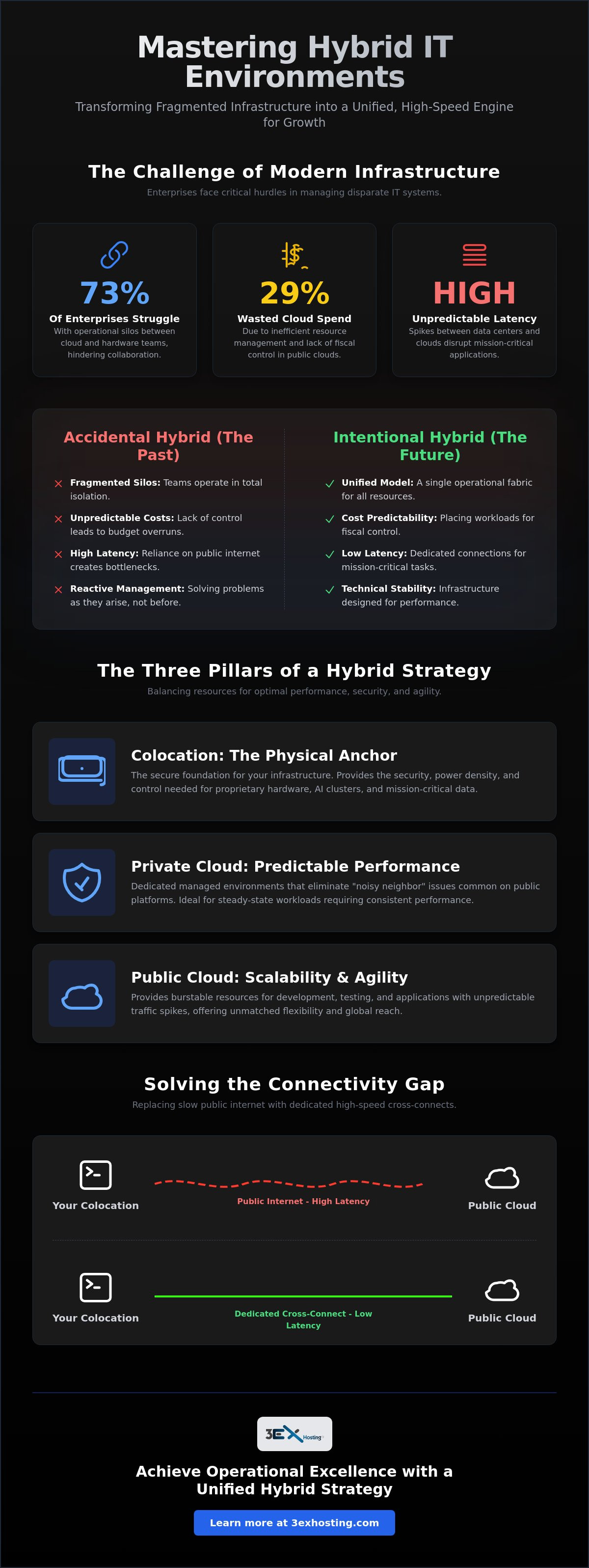
Why are 73% of enterprises still struggling with operational silos when their hybrid strategy was supposed to break them down? Many IT leaders find that managing hybrid IT environments creates more complexity than it solves, especially when unpredictable latency spikes between remote data centers and public clouds. It’s frustrating to watch cloud and hardware teams work in isolation while mission-critical applications suffer. With wasted cloud spend hitting 29% this year, the need for a more disciplined, unified approach has never been more urgent.
We agree that fragmentation isn’t sustainable for businesses scaling AI or high-density loads. This guide provides a roadmap to master these complexities by integrating high-performance colocation with managed cloud for maximum scalability and control. You’ll learn how to implement a unified operational model that reduces latency and eliminates the guesswork of remote hardware management. We’ll examine how to build intentional hybrid architectures that prioritize technical stability and cost predictability over simple cloud-first mandates. By the end, you’ll have the framework needed to turn disparate infrastructure into a high-speed, reliable engine for growth.
Key Takeaways
- Transition from fragmented silos to an intentional hybrid strategy that balances colocation and cloud services for better resource control.
- Utilize full cabinet colocation in carrier-neutral facilities to create a high-performance physical anchor for your enterprise infrastructure.
- Reduce latency for mission-critical applications by replacing public internet connections with dedicated, high-speed cross-connect services.
- Master the complexity of managing hybrid IT environments through unified observability and standardized security protocols across all platforms.
- Integrate managed cloud and disaster recovery solutions to build a scalable foundation capable of supporting AI and high-density workloads.
What is Managing Hybrid IT Environments in the Modern Enterprise?
Managing hybrid IT environments isn’t just about owning a few servers and maintaining a public cloud account. It’s the deliberate orchestration of hybrid cloud resources, high-performance colocation, and managed services into a single operational fabric. In previous years, many organizations suffered from “accidental hybrid” setups. These were fragmented silos where cloud teams and hardware teams operated in total isolation. By 2026, the industry has shifted toward intentional hybrid models. This involves designing infrastructure from the ground up to ensure every workload sits exactly where it performs best.
Modern enterprises are increasingly adopting a private-first hybrid approach. With wasted cloud spend reaching 29% in 2026, businesses are repatriating steady-state workloads to full cabinet colocation to regain fiscal control. It’s about more than just cost. High-density infrastructure is now a strict requirement for AI and data-heavy workloads. Standard public cloud instances often lack the specialized power density or the specific GPU configurations needed for large-scale model training. A unified strategy ensures these high-performance assets remain accessible and secure.
The Three Pillars of Hybrid Infrastructure
- Public Cloud: Provides the agility and burstable resources needed for non-sensitive development environments or applications with unpredictable traffic spikes.
- Private Cloud: Offers dedicated managed environments for predictable performance. It eliminates the “noisy neighbor” issues common in multi-tenant public platforms.
- Colocation: Acts as the physical foundation. It provides the security sovereignty and power density required for proprietary hardware and specialized AI clusters.
Drivers for Hybrid Adoption in 2026
Data sovereignty is a primary driver for managing hybrid IT environments today. With the EU AI Act in full effect and a growing list of U.S. state-level privacy laws, enterprises must have absolute certainty about where their data resides. Cost optimization is another critical factor. Moving large datasets out of public clouds often triggers massive egress fees. By housing data in a secure Florida data center and using direct interconnections, you avoid the “cloud tax” entirely. Finally, performance dictates the architecture. Placing compute power physically closer to your data sources ensures the low-latency execution that mission-critical applications require. Technical stability isn’t optional; it’s the baseline for success.
The Physical Anchor: Why Colocation is Vital for Hybrid Success
Managing hybrid IT environments effectively requires more than just a slick dashboard. It’s about where your high-value data actually lives. Many IT leaders find that relying solely on public cloud providers leads to performance bottlenecks and unpredictable latency. By utilizing full cabinet colocation, you create a stable, high-performance core that supports your entire network. This physical presence in a carrier-neutral facility allows for maximum network flexibility. You can switch between carriers or connect directly to cloud on-ramps without being locked into a single provider’s ecosystem.
Integrating your physical hardware with managed cloud hosting creates a seamless operational model. It allows you to keep mission-critical databases on dedicated hardware while pushing burstable workloads to the cloud. This approach is essential for hybrid cloud management success. It ensures that your most sensitive assets remain under your direct control, even as you leverage the global reach of public cloud providers. Technical stability becomes the foundation for your business growth. If you’re ready to secure your physical anchor, you can request a custom colocation quote today.
Security and Compliance Sovereignty
For regulated industries, security sovereignty is non-negotiable. Private suites and cage solutions datacenter environments provide the physical control needed to meet strict compliance standards like the EU AI Act or local state privacy laws. You maintain absolute control over data-at-rest while still using the cloud for transient processing tasks. This balance ensures you don’t sacrifice security for scalability. It’s a professional approach to risk management that public-only models simply can’t match.
Scaling with High-Density Infrastructure
Scaling for AI requires specialized infrastructure that goes beyond standard server racks. In 2026, managing power and cooling for enterprise racks means preparing for densities between 20kW and 50kW. Standard colocation setups often struggle with these thermal demands. Moving to high-density GPU hosting is a logical step for firms managing hybrid IT environments that include heavy machine learning workloads. This transition ensures your hardware stays cool and operational even under maximum load. For a deeper dive into these technical requirements, see our guide on High-Density GPU Colocation: The Enterprise Guide to AI Infrastructure in 2026. We focus on providing the technical excellence your AI projects demand.
Solving the Connectivity Gap with Cross-Connect Services
Relying on the public internet for managing hybrid IT environments is a recipe for performance degradation. While public internet VPNs are sufficient for basic office tasks, they lack the technical stability required for mission-critical enterprise workloads. Jitter and unpredictable routing can turn a high-performance application into a bottleneck for your users. Dedicated cross-connect services bridge this gap by providing a private, physical path between your infrastructure and your network providers. These links bypass the congestion of the open web, ensuring your data moves with maximum speed and security.
The strategic advantage of housing your hardware in a carrier hotel is the ability to scale your network footprint almost instantly. In these facilities, hundreds of carriers and cloud on-ramps are already present. Adding bandwidth or connecting to a new cloud region doesn’t require weeks of construction. It only requires a physical fiber patch within the facility. This rapid scalability is vital for businesses that need to adjust their infrastructure to meet changing market demands without technical delays.
Cost control is another area where cross-connects outperform traditional internet-based connections. Public cloud providers often charge significant egress fees for data that leaves their network via the public internet. By utilizing a direct interconnection, you can often access lower, more predictable data transfer rates. With wasted cloud spend hitting 29% in 2026, optimizing these egress paths is a practical way to protect your budget. You gain better performance and more transparent billing in one move. If you’re ready to optimize your connectivity, you can request a quote for our interconnection services.
Low-Latency Interconnections for Real-Time Apps
Sub-millisecond latency is the benchmark for modern enterprise hybrid environments. When your compute nodes in the cloud need to query a proprietary database in cabinet colocation, every millisecond counts. Cross-connects are physical fiber links between providers in a carrier hotel. This direct path eliminates the multiple “hops” found on the public internet. It ensures your real-time applications, from financial tools to AI inference engines, stay responsive and reliable for your end users.
Redundancy and Network Failover
Building a resilient network backbone requires a strategy that spans both physical and cloud sites. You can’t rely on a single carrier if you want to ensure high availability. Utilizing multi-carrier diversity prevents single points of failure from crippling your operations. Cross-connects facilitate this by allowing you to maintain active-active connections across different network backbones. A 2025 analysis showed that significant outages cost over $100,000 for half of all respondents. Investing in a redundant, cross-connected backbone is a professional safeguard for your business continuity.
Best Practices for Managing Hybrid IT Environments
Operational discipline is the difference between a high-performing system and an expensive mess. Effectively managing hybrid IT environments requires a unified observability strategy. You can’t manage what you can’t see. Your monitoring tools must pull data from physical server health, virtual machine performance, and public cloud instances into a single pane of glass. This visibility allows your team to identify bottlenecks before they impact the end user. Standardizing security protocols is equally vital. Whether data is at rest in your full cabinet colocation or moving through a public cloud, the encryption and access rules should remain identical to ensure technical stability.
Establishing a clear lifecycle management policy prevents your hybrid mix from becoming a graveyard of legacy hardware. Physical assets eventually lose their efficiency and increase your power costs. Regular audits help you decide when to refresh hardware or migrate specific workloads to managed cloud hosting. Professional teams use these audits to maintain high performance and ensure the infrastructure supports modern AI requirements without unexpected downtime. It’s a proactive approach that prioritizes reliability over reactive fixes.
The ROI of Remote Hands Support
Physical hardware management shouldn’t require constant travel. Utilizing remote hands support provides you with on-site technical expertise without the overhead of relocating staff. These professionals act as a direct extension of your IT team. They handle cabling, hardware swaps, and visual inspections in real time. This reduces downtime and travel costs significantly. For a deeper look at maximizing your operational budget, read our sibling article: Remote Hands Support: The Enterprise Guide to Data Center Efficiency in 2026. Learn how our remote hands support can optimize your infrastructure management.
Governance and Cost Control
Centralizing your billing and resource tracking is the only way to prevent “shadow IT” from bloating your budget. In 2026, wasted cloud spend rose to 29% because many organizations lost track of orphaned virtual assets. Regular audits of both physical and virtual environments are essential for technical health. Develop a tiered data strategy to determine where workloads belong. High-egress data and proprietary AI models should stay in colocation for better TCO. Burstable, non-sensitive tasks belong in the cloud. This logic-driven approach ensures your processes stay efficient and your costs remain predictable.
Achieving Operational Excellence with 3EX Hosting
Achieving stability in a complex architecture requires a partner who understands both the physical and digital layers. 3EX Hosting provides the high-performance foundation needed for managing hybrid IT environments at scale. By combining full cabinet colocation with managed cloud hosting and disaster recovery solutions, we eliminate the operational gaps that typically hinder enterprise growth. Our facility operates as a premier carrier hotel. This position gives your business the advantage of national network scalability through direct access to major carriers and cloud on-ramps.
Managing hybrid IT environments is a technical challenge that demands a disciplined approach. 3EX Hosting simplifies this by offering a single point of accountability for your physical and virtual assets. Our infrastructure is built for high-density loads, including AI and GPU-intensive workloads that require specialized cooling and power. We provide the stability you need to stop reacting to infrastructure bottlenecks and start focusing on your core business goals. Technical excellence isn’t just a goal; it’s the baseline for every solution we deploy.
Tailored Infrastructure Solutions
Every enterprise has unique requirements for security and performance. We offer everything from private colocation suites to customizable cage configurations to meet your specific compliance needs. Our clients benefit from high-performance cross-connects that ensure sub-millisecond latency between their hardware and the cloud. Technical support is available to assist with complex deployments, ensuring your systems remain online and efficient. Explore our full range of 3EX Data Center Services to find the right fit for your organization.
Get Started with Your Hybrid Strategy
The first step toward a unified infrastructure is a thorough audit of your current readiness. Our experts work with you to design an optimal hybrid mix that balances cost, performance, and control. We help you identify which workloads belong in colocation and which are best suited for the cloud. To streamline your transition, we offer comprehensive move-in assistance to handle the logistics of your hardware migration. This professional support ensures your deployment is fast and error-free. Get a custom quote for your hybrid IT environment today.
Future-Proofing Your Enterprise Infrastructure
Transitioning to a unified model is the only way to maintain technical stability as AI and data demands grow. By anchoring your strategy in high-density colocation and utilizing carrier-neutral connectivity, you eliminate the performance bottlenecks that plague cloud-only setups. Professional oversight through 24/7 remote hands support ensures that your physical assets are managed with the same precision as your virtual instances. It’s about creating a seamless bridge between your hardware and the cloud to ensure consistent reliability.
Mastering the art of managing hybrid IT environments requires a shift from accidental fragmentation to an intentional, unified architecture. This approach protects your budget from unpredictable cloud fees while providing the high-density GPU ready infrastructure needed for modern workloads. You don’t have to sacrifice control for scalability when you have the right technical foundation. Your journey toward a more resilient and efficient infrastructure starts with a clear plan and the right partner at your side.
Build your unified hybrid IT foundation with 3EX Hosting
Frequently Asked Questions
What are the main challenges of managing hybrid IT environments?
Operational silos and unpredictable network latency are the primary hurdles. When cloud and hardware teams work in isolation, it’s difficult to maintain a unified security posture or consistent performance. Many organizations also struggle with managing physical hardware in remote locations, which can lead to longer recovery times during equipment failures. Effectively managing hybrid IT environments requires breaking these silos through unified observability and standardized protocols across all platforms.
How does colocation differ from private cloud in a hybrid setup?
Colocation involves renting space for your own physical hardware in a data center, while a private cloud is a virtualized environment dedicated to a single tenant. In a colocation model, you maintain absolute control over the server specifications and lifecycle. A private cloud offers more software-defined flexibility but often runs on managed infrastructure you don’t physically own. Both serve as the “private” side of a hybrid strategy depending on your need for hardware sovereignty.
Why is latency a critical factor in hybrid IT management?
Latency dictates the responsiveness of real-time applications that must pull data from both cloud and physical sites. If your database sits in a colocation cabinet and your application runs in a public cloud, high latency will cause noticeable lag for end users. Technical stability depends on keeping this delay as low as possible. Sub-millisecond latency is the standard for mission-critical enterprise apps to ensure data moves between environments without bottlenecks.
Can I manage my physical colocation hardware remotely?
Yes, you can manage your physical assets through out-of-band management tools and professional remote hands support. Remote hands services act as a direct extension of your IT team. They perform physical tasks like server reboots, cable swaps, and hardware inspections on your behalf. This eliminates the need for your staff to travel to the data center, reducing both operational costs and potential downtime during an incident.
What is the role of a carrier hotel in hybrid IT?
A carrier hotel acts as a central interconnection hub where hundreds of network providers and cloud on-ramps meet. By placing your infrastructure in one of these facilities, you gain immediate access to a massive ecosystem of connectivity options. It’s the most efficient way to scale your network footprint because you don’t have to wait for new fiber construction. You simply request a patch to the provider you need within the same building.
How do cross-connect services improve hybrid cloud performance?
Cross-connects improve performance by providing a direct, private physical link between your hardware and your service providers. This connection bypasses the public internet entirely. It eliminates the congestion and jitter that often plague web-based VPNs. For businesses managing hybrid IT environments, these dedicated links are essential for maintaining the speed and security required for high-density AI workloads and proprietary data transfers.
Is hybrid IT more secure than a pure public cloud environment?
Hybrid IT offers superior security sovereignty because it allows you to keep sensitive data on physical hardware you control. While public clouds are secure, they operate on a shared responsibility model where you don’t have physical access to the underlying metal. A hybrid approach lets you house proprietary models and regulated data in a private cage while still using the cloud for non-sensitive, burstable processing tasks. This setup provides a more granular level of risk management.
How do I control costs when managing multiple IT environments?
Cost control requires centralizing your resource tracking to eliminate underutilized virtual and physical assets. Wasted cloud spend often comes from orphaned instances that were never shut down after a project ended. Regularly auditing your environment helps you identify which workloads are cheaper to run in colocation versus the cloud. Moving steady-state, high-egress workloads to colocation is a professional strategy to avoid the “cloud tax” and keep your budget predictable.