 SUPPORT


 3EX United States
 Blog
What if the cloud elasticity you rely on for growth is the same factor that makes your restoration costs skyrocket during a crisis? It’s a frustrating reality for many enterprises that find themselves locked into a single provider’s ecosystem. You already know that a single outage can paralyze your operations, yet the “all eggs in one basket” risk remains because physical alternatives often seem complex. Integrating colocation for cloud disaster recovery isn’t about moving away from the cloud; it’s about anchoring your virtual assets with a sovereign, physical foundation.
We’ll show you how to bridge the gap between dedicated hardware and cloud scale to eliminate downtime and regain control over your data. You’ll learn how a hybrid resilience strategy helps you avoid massive egress fees and meet the strict requirements of regulations like ISO/IEC 27001:2022. This guide provides a clear roadmap for building a zero-trust architecture that delivers predictable RTO and RPO targets. We’ll explore how to turn your infrastructure into a fail-safe bridge that secures your business continuity for 2026 and beyond.
Key Takeaways
- Understand why relying solely on a single cloud provider creates a “single point of failure” and how a physical site restores true sovereignty.
- Discover how cross-connect services and carrier-neutral facilities eliminate the high latency and egress costs typically associated with data restoration.
- Learn to select the optimal architecture between hot, warm, and cold sites to balance your budget with specific RTO and RPO targets.
- Identify the non-negotiable infrastructure standards, such as N+1 power redundancy, required to sustain long-term disaster recovery operations.
- Explore how integrating colocation for cloud disaster recovery with managed hosting and remote hands support creates a seamless, high-performance hybrid bridge.
Why Colocation is the Missing Link in Cloud Disaster Recovery Strategy
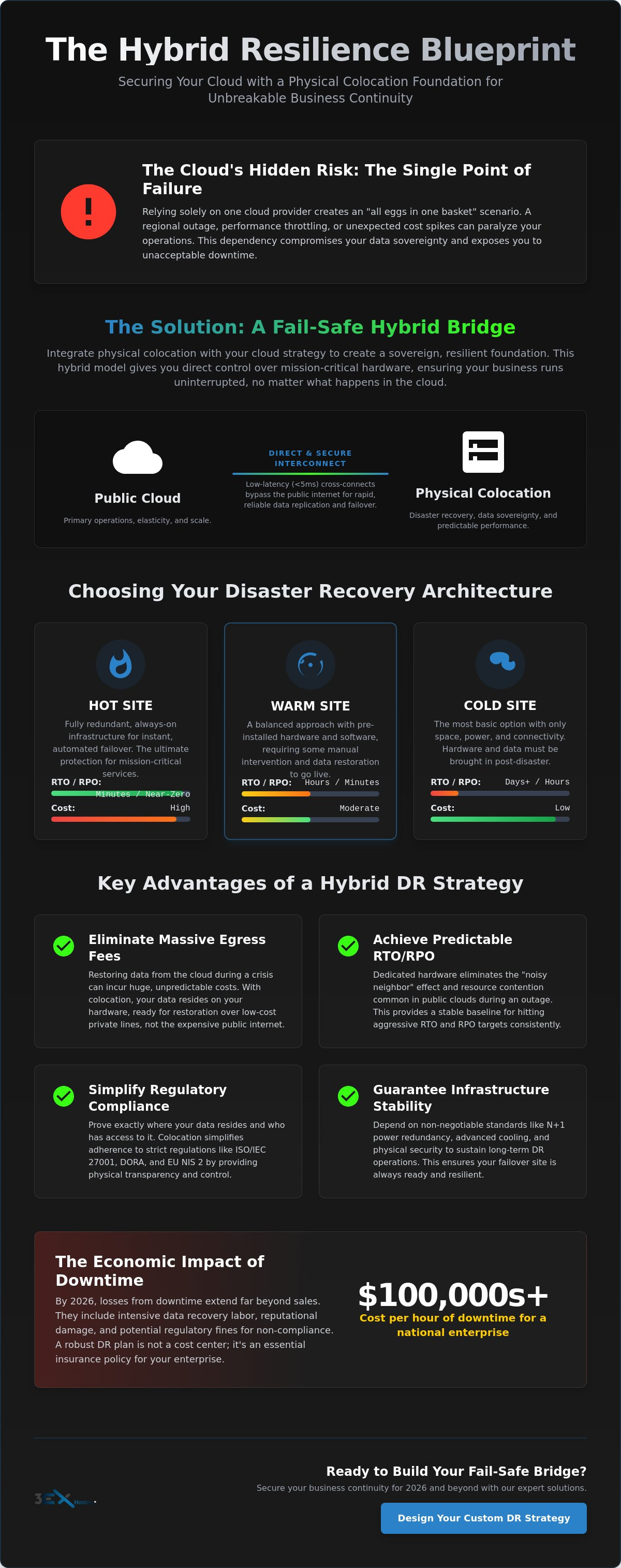
The hybrid disaster recovery (DR) model treats physical colocation as the ultimate destination for cloud-native workloads when primary services fail. Relying solely on a single cloud provider creates a dangerous “all eggs in one basket” scenario. If a specific cloud region goes dark, your business goes dark too. A provider-neutral physical site breaks this dependency. It ensures that your mission-critical data remains under your direct control, regardless of what happens to third-party virtual environments. Colocation for cloud disaster recovery provides the sovereignty you need. You aren’t just renting a slice of a server; you’re securing an immutable environment where your core systems can continue to run without interruption.
Regional cloud outages aren’t just theoretical. They happen. When they do, the demand for resources in neighboring regions spikes, often leading to performance throttling or failed deployments. Colocation bypasses this entirely by providing pre-provisioned, dedicated hardware that’s ready to take the load the moment your primary cloud fails. This setup supports Business Continuity (BC) by ensuring that your failover plan doesn’t rely on the same infrastructure that just failed. It gives you a stable baseline that remains unaffected by the volatility of public cloud availability.
The Economic Impact of Downtime in 2026
By 2026, the cost of a single hour of downtime for a national enterprise can easily exceed hundreds of thousands of dollars. These losses aren’t just about lost sales. They include the intensive labor required for data recovery and potential regulatory fines. Achieving a tight Recovery Point Objective (RPO) is much simpler when you have a dedicated physical target. You aren’t competing for shared resources in a multi-tenant cloud during a global outage. Our 3EX Hosting data center overview shows how localized infrastructure provides the speed needed to hit these aggressive targets. Fast data replication requires high-bandwidth, low-latency pipes that only a top-tier facility can provide.
Bridging the Gap Between Virtual and Physical Assets
Physical hardware offers a level of predictability that virtualized instances can’t match. When you use hot, warm, and cold DR sites within a colocation facility, you eliminate the “noisy neighbor” effect. You know exactly how many IOPS your storage can handle and how your CPU will perform under stress. Dedicated hardware also simplifies compliance with regulations like DORA or the EU NIS 2 Directive, as you can prove exactly where your data resides and who has access to it. This level of transparency is often impossible in purely virtual environments. Colocation DR serves as the physical insurance policy for virtual enterprises.
Interconnection and Latency: The Mechanics of Cloud-to-Colo Failover
Successful failover isn’t just about having a backup site. It’s about the speed and reliability of the path between your cloud environment and your physical hardware. When an outage occurs, your network must reroute traffic with surgical precision. Relying on the public internet for this transition is a gamble that most enterprises can’t afford. Strategic colocation for cloud disaster recovery relies on direct, private interconnections that ensure your data remains accessible even when major regional backbones are congested. These links provide the stability needed to maintain operations during a crisis.
Automated BGP routing serves as the primary mechanism for this traffic shift. By configuring your routers to detect cloud unreachability, you can trigger an instant update to the global routing table. This directs incoming requests to your colocation racks instead of the failed cloud instance. This process must be seamless to avoid session drops. If you need assistance setting up these complex network paths, our team can help you design a custom interconnection strategy that fits your specific RTO requirements.
The Power of Cross-Connects for Rapid Data Sync
Cross-connect services are the dedicated fiber links that physically join your colocation equipment to cloud on-ramps. These connections bypass the public internet entirely. This is vital for real-time data replication. Synchronous replication requires extremely low latency, usually under 5 milliseconds, to ensure that every transaction is recorded at both sites simultaneously. For distance-heavy setups, asynchronous replication handles the data sync with a slight delay. This is particularly important when managing High-Density GPU Colocation workloads, where the volume of data moving between AI clusters and storage can overwhelm standard network paths.
Carrier Hotels as Connectivity Hubs
A carrier hotel is a specialized facility that houses hundreds of different network providers. These buildings are the central nervous system of national network resilience. Inside, the Meet-Me Room (MMR) allows different carriers to interconnect their networks directly. This environment is essential for a robust DR plan because it provides diverse pathing. If one fiber provider suffers a physical cut, your traffic can automatically fail over to a different provider within the same building. Understanding the relationship between Interconnection and Latency is key to building a network that doesn’t have a single point of failure. Multiple fiber entries and redundant hardware ensure that your DR site remains reachable from anywhere in the world.
Architecture Selection: Hot, Warm, and Cold DR Sites
Selecting the right architecture for colocation for cloud disaster recovery isn’t a one-size-fits-all technical decision. It’s a strategic choice that dictates how fast your business can resume operations after a catastrophic failure. You must evaluate your workloads based on their criticality to the bottom line. A hybrid approach often yields the best results, allowing you to allocate resources where they’re needed most without overspending on idle capacity. Each site type offers a different level of readiness and cost.
Hot sites offer real-time synchronization. They maintain a mirror image of your production environment at all times. Every database transaction and file change is replicated instantly across high-speed interconnections. This architecture is essential for mission-critical applications where even seconds of downtime result in significant financial loss. It provides a near-zero Recovery Time Objective (RTO), ensuring that users barely notice a transition has occurred.
Warm sites strike a functional balance. The hardware is pre-configured and waiting in your racks, but applications may not be running in a live state. Data updates happen periodically rather than in real-time. This reduces idle infrastructure costs while still allowing for a recovery window of a few hours. It’s an ideal solution for core business systems that are important but don’t require instantaneous failover.
Cold sites are the most cost-effective long-term option for non-essential data. They provide unconfigured space with power and cooling readiness. If a disaster strikes, you must install hardware or activate dormant systems and restore data from off-site backups. This results in the longest RTO, making it suitable only for business functions that can remain offline for a day or more without causing permanent damage.
Comparing RTO and RPO Across Site Types
Evaluating which business units require “Hot” site replication involves a rigorous impact analysis. Financial systems and customer-facing portals usually demand synchronous replication and high-performance SAN storage to meet aggressive RPO targets. Back-office tools might function well with a “Warm” setup using cloud tiering for older data. The choice between hot and cold sites is a direct calculation of the cost of one hour of downtime versus the cost of idle infrastructure.
The Role of Managed Cloud Hosting in DR
Managed cloud services act as a dynamic “Warm” layer in a modern resilience strategy. During a failover event, these virtual resources scale up instantly to handle the initial surge of traffic while your physical systems stabilize. Integrating 3EX Hosting Cabinet Colocation with managed cloud environments creates a unified resilience fabric. You get the security of physical isolation for your primary databases and the rapid scalability of the cloud for your application front-ends. This combination ensures that your infrastructure is never the bottleneck during a recovery operation.
Critical Infrastructure Standards for Disaster Recovery
Infrastructure is the silent partner in your resilience strategy. If the facility fails during a cloud outage, your entire failover plan collapses. High-quality colocation for cloud disaster recovery requires more than just rack space. It demands a facility engineered for 100% uptime through rigorous power and cooling standards. These physical foundations ensure that when you trigger a failover, your hardware is ready to perform at full capacity without the risk of environmental failure.
Power redundancy is the most critical factor in this equation. N+1 redundancy means there’s at least one backup component for every system in use. While this is a baseline, a 2N configuration is the enterprise gold standard. It provides two completely independent power paths from the utility to the server. This ensures that even a total failure of one power distribution unit or generator won’t disrupt your DR operations. It’s the difference between a theoretical plan and a guaranteed recovery.
Auditing Power and Cooling Redundancy
Verifying a provider’s claims starts with their testing logs. Ask for documented proof of monthly generator load tests and UPS battery health checks. High-density cooling is equally critical, especially as AI workloads increase rack temperatures. Modern enterprise server stacks require sophisticated airflow management to prevent thermal throttling during extended DR events. For teams managing these systems from across the country, utilizing Remote Hands services allows for physical adjustments without the need for travel. This ensures your cooling and power configurations remain optimal even when you can’t be on-site.
Security and Compliance at the Edge
Physical security must be as robust as your digital firewalls. Multi-factor authentication, including biometric scanners and man-traps, ensures that only authorized personnel reach your hardware. 24/7 CCTV monitoring and on-site security staff provide a layer of sovereign protection that purely virtual environments lack. These physical controls are vital for maintaining SOC2, HIPAA, or PCI compliance during a disaster when your primary site is compromised. Adhering to the ISO/IEC 27001:2022 standard is no longer optional; it’s a requirement for modern data governance. You can find more details on operational efficiency in our Remote Hands Support Guide.
Remote hands support is the bridge between a disaster event and full recovery. During a crisis, your local IT team might be focused on software restoration or may even be physically unable to reach the data center. On-site technicians act as your eyes and ears. They can swap failed drives, check cable integrity, or cycle power on frozen hardware. This service transforms colocation from a passive storage site into a dynamic, managed extension of your infrastructure. If you’re ready to secure your mission-critical data in a facility built for maximum resilience, request a quote for our Florida colocation services today.
Scaling Your Resilience with 3EX Hosting Solutions
3EX Hosting provides the technical stability required to anchor your hybrid infrastructure. We don’t just offer rack space; we provide a comprehensive resilience ecosystem. By integrating Full Cabinet Colocation with our Managed Cloud Hosting, we create a unified platform where physical and virtual assets work in tandem. This setup is the gold standard for colocation for cloud disaster recovery. It allows you to maintain your core databases on dedicated hardware while leveraging the cloud for burstable front-end capacity during a failover event. This dual-layer approach ensures that your most sensitive data remains in a sovereign environment without sacrificing the agility your users expect.
Our 24/7 Remote Hands support acts as a direct extension of your national IT department. In a crisis, time is your most valuable asset. Our on-site technicians handle the physical layer so your team can focus on data integrity. Because we operate carrier-neutral facilities, your failover is never limited by the performance of a single network provider. You have the freedom to choose from multiple fiber paths, ensuring your colocation for cloud disaster recovery strategy remains resilient against external network outages. For enterprises with extreme security needs, our custom cages and private suites offer the physical isolation required to meet the most stringent compliance audits.
Seamless Onboarding and Migration
Setting up a secondary site shouldn’t be a logistical burden. Our Move-In Assistance program is designed to reduce the friction of physical migration. We handle the heavy lifting, from rack and stack to initial cabling, ensuring your equipment is online and ready for synchronization as quickly as possible. As your cloud footprint grows, our full cabinet solutions scale with you. You can start with a single rack and expand into private colocation suites or custom cages as your data sovereignty requirements evolve. Our experts are available to guide you through complex failover configurations, ensuring every connection is optimized for speed and reliability.
Building Your 2026 Disaster Recovery Roadmap
Building a resilient roadmap for 2026 requires moving beyond a cloud-only mentality. Start by auditing your current RTO and RPO targets against the reality of regional cloud outages. Identify which mission-critical workloads require the physical isolation of a dedicated server. Once you’ve mapped your dependencies, consult with an infrastructure specialist to design a custom failover architecture. We’re here to help you bridge the gap between physical security and cloud elasticity. If you’re ready to secure your business continuity and eliminate the risks of single-provider dependency, Request a Custom Disaster Recovery Quote and let’s build a foundation that won’t fail when you need it most.
Securing Your Sovereign Hybrid Future
A resilient disaster recovery plan for 2026 requires moving beyond the limitations of single-provider cloud environments. By integrating colocation for cloud disaster recovery, you secure a physical anchor that guarantees data sovereignty and predictable performance when virtual networks fail. We’ve established that the combination of carrier-neutral interconnection hubs and a strategic selection of hot or warm sites provides the flexibility needed to meet modern RTO and RPO targets. This hybrid bridge is what separates a vulnerable enterprise from a resilient one.
Your business continuity depends on the stability of the underlying infrastructure. Our facilities are engineered with N+1 redundant power and cooling systems to ensure your hardware remains operational through any crisis. With 24/7 on-site remote hands support, you gain a managed extension of your IT team that responds instantly to physical needs. Transitioning to this hybrid model doesn’t just protect your data; it provides the peace of mind that your operations are built on a fail-safe foundation. Secure Your Infrastructure with a Custom DR Quote and take the first step toward true hybrid resilience today.
Frequently Asked Questions
How does colocation improve disaster recovery compared to cloud-only backups?
Colocation provides a sovereign environment that remains independent of your cloud provider’s regional health. Unlike cloud-only backups, which share resources with thousands of other users, colocation gives you dedicated hardware. This ensures that you aren’t throttled during a widespread outage. It’s a critical component of colocation for cloud disaster recovery because it eliminates the risk of a single provider’s failure paralyzing your entire operation.
What is the difference between an RTO and an RPO in colocation DR?
Recovery Time Objective (RTO) measures the duration of downtime until your systems are back online. Recovery Point Objective (RPO) defines the maximum age of files that must be recovered from backup storage. In a colocation environment, you can achieve near-zero RTO and RPO targets by using high-speed interconnections and dedicated storage arrays that don’t compete for IOPS with other tenants.
Can I use colocation for disaster recovery if my primary site is in the cloud?
Yes, using a physical facility as a failover target for cloud workloads is a standard hybrid resilience strategy. This setup prevents your business from being locked into a single provider’s ecosystem. By implementing colocation for cloud disaster recovery, you can replicate your cloud data to physical servers. This allows for a faster and more cost-effective restoration process compared to downloading massive datasets over the public internet.
What are the network requirements for a colocation disaster recovery site?
You need dedicated fiber cross-connects and carrier-neutral network access. These requirements ensure that your data sync isn’t interrupted by public internet congestion. A robust DR site should utilize multiple fiber entry points and diverse carrier paths. This prevents a single network cut from isolating your backup infrastructure. Low-latency paths are especially vital if you’re running synchronous data replication between sites.
Is colocation for disaster recovery cost-effective for mid-sized enterprises?
It’s often more affordable than maintaining a secondary office or paying unpredictable cloud egress fees during a crisis. Mid-sized enterprises can optimize costs by selecting a “Warm” site architecture. This approach keeps essential hardware pre-configured but not fully powered until needed. It provides a professional-grade recovery environment without the high overhead costs of maintaining a fully mirrored, live production site.
How does Remote Hands support help during a disaster recovery event?
Remote Hands technicians act as a physical extension of your IT department. During a disaster, your internal team might be focused on software restoration or unable to travel. On-site staff can perform hardware resets, cable patches, and drive replacements. This immediate physical presence ensures that infrastructure issues don’t delay your recovery process, allowing your experts to work remotely on high-level tasks.
What security certifications should I look for in a DR colocation provider?
ISO/IEC 27001:2022 is the most important certification to verify. It proves the provider follows the latest international standards for information security management. Depending on your industry, you should also verify SOC 2 Type II reports for operational security and HIPAA or PCI DSS compliance for data handling. These certifications ensure that the facility meets the strict audit requirements necessary for enterprise-grade disaster recovery.
How far away should my colocation DR site be from my primary data center?
Your DR site should be far enough to avoid the same localized disaster but close enough to maintain low latency. A distance of 50 to 100 miles is usually sufficient to place the site on a different power grid or weather path. This range allows for synchronous data replication, which is necessary for Hot site architectures. If the distance is too great, latency increases, which may force you to use asynchronous replication.