 SUPPORT


 3EX United States
 Blog
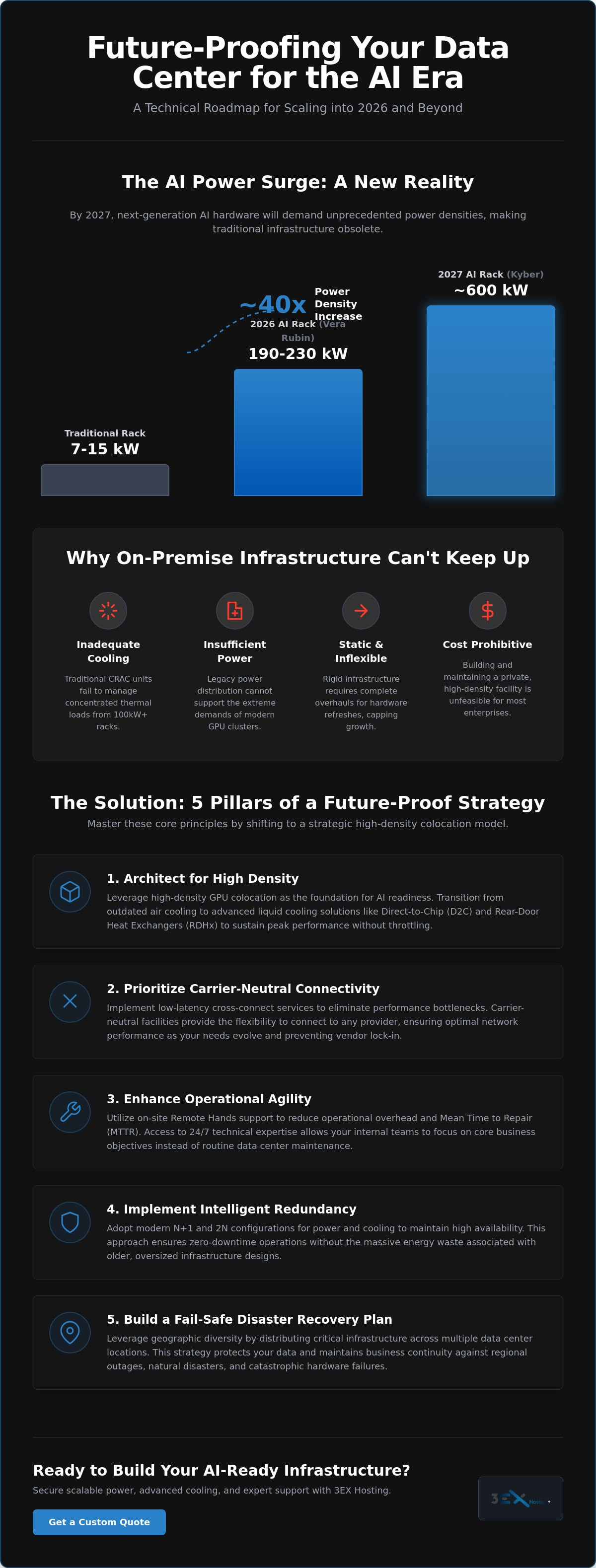
By 2027, a single NVIDIA Kyber rack will consume approximately 600 kW of power, which is nearly 40 times the density of traditional enterprise setups. You likely recognize that your current infrastructure wasn’t built for these extreme AI workloads or the strict reporting requirements of the EU Energy Efficiency Directive. Successfully future-proofing your data center strategy requires more than just adding more power; it demands a shift toward elastic, high-density environments that can scale as fast as the hardware evolves.
We understand the frustration of managing unpredictable GPU power demands and the latency issues common in legacy network configurations. It’s difficult to maintain peak performance when your physical hardware is scattered across national locations. This guide provides a technical roadmap for building a scalable power distribution model and using managed support to reduce your operational overhead. You’ll discover how to integrate high-density colocation and zero-downtime disaster recovery protocols to ensure your systems remain stable, secure, and ready for the 2026 enterprise landscape.
Key Takeaways
- Learn how to adapt your infrastructure to handle the massive power requirements of next-generation GPU racks without requiring a physical migration.
- Discover why high-density GPU colocation is the foundation for AI readiness and how to implement redundancy that maintains operational efficiency.
- Master the core principles of future-proofing your data center strategy by prioritizing carrier-neutral connectivity and low-latency cross-connect services.
- See how leveraging remote hands support and on-site technical expertise can significantly reduce your mean time to repair (MTTR).
- Build a fail-safe disaster recovery plan that utilizes geographic diversity to protect your data against regional outages and hardware failures.
The Strategic Shift: Defining Data Center Future-Proofing in 2026
In 2026, the definition of success has changed. Future-proofing your data center strategy no longer means simply leasing extra square footage. It means securing the ability to scale power and cooling density within your existing footprint without the disruption of a physical migration. AI and machine learning workloads have shattered traditional infrastructure standards. With NVIDIA Vera Rubin (VR200) platforms entering volume shipments in the second half of 2026, a single NVL72 rack can now demand between 190 and 230 kW. Legacy designs simply cannot keep up.
The “DIY” data center is in decline. Most on-premise facilities lack the power distribution and specialized liquid cooling required for these high-performance environments. Enterprises are shifting toward strategic cabinet colocation to gain access to infrastructure that would be cost-prohibitive to build and maintain independently. In this environment, flexibility in rack space and power allocation is the primary currency for enterprise growth. If your strategy is tied to static power limits, your growth is already capped.
From Reactive to Proactive Infrastructure
Infrastructure rigidity often manifests as an inability to support a sudden hardware refresh or a new AI pilot program. If your current setup requires a complete overhaul to add a single high-density rack, your model is reactive. Modern Data center management relies on modular designs that allow for incremental upgrades. This approach balances capital expenditure (CAPEX) with operational agility. It lets you pay for the capacity you need today while maintaining a clear path for tomorrow’s hardware. Successful leaders prioritize facilities that offer data center environments designed for rapid deployment and seamless scaling.
The 2026 Density Benchmark
Standard power densities of 7 to 15 kW per rack are no longer sufficient for modern enterprises. For 2026, the baseline has moved toward 20kW+ per cabinet as a minimum requirement. This shift is a direct response to the hardware refresh cycles of 2027 and beyond. For example, the upcoming NVIDIA Kyber rack is expected to consume approximately 600 kW. Preparing for these demands requires a proactive assessment of your provider’s cooling capabilities and power overhead. You must ensure your infrastructure can support direct-to-chip cooling and high-voltage power delivery before the hardware arrives on your loading dock.
Architecting for Density: Power and Cooling in the AI Era
High-density racks are no longer outliers; they’ve become the new standard for enterprise operations. As you evaluate future-proofing your data center strategy, high density GPU colocation stands as the bedrock of AI readiness. Traditional Computer Room Air Conditioning (CRAC) units are reaching their physical limits as power consumption per rack climbs toward 100kW. Managing these concentrated thermal profiles requires a shift toward advanced cooling methodologies that can sustain high-performance compute clusters without throttling.
The transition toward liquid cooling readiness is a primary driver in data center modernization. Direct-to-chip (D2C) systems and rear-door heat exchangers (RDHx) handle thermal loads far more effectively than air-based systems. These technologies allow for stable AI GPU hosting even during peak processing cycles. Redundancy remains critical, but it must be implemented intelligently. Modern facilities utilize N+1 and 2N configurations that maintain high availability without the massive energy waste associated with older, oversized infrastructure.
Efficiency in 2026 is measured by the ability to maintain stability under extreme load. If your infrastructure cannot dissipate heat as fast as your GPUs generate it, your hardware investment is underutilized. Consider requesting a custom quote to assess how high-density environments can support your specific hardware roadmap.
Power Distribution and Scalability
Metered power provides the transparency required for precise cost management. It eliminates the guesswork by providing real-time data on actual consumption levels. Opting for full cabinet colocation ensures your business has the physical headroom for 3-phase power delivery. This level of electrical infrastructure is essential for supporting the high-voltage requirements of modern enterprise-grade hardware. Planning for this scalability now prevents expensive power upgrades later in the hardware lifecycle.
Securing Sovereignty with Private Suites
Data sovereignty and physical isolation are major concerns for enterprises training proprietary models. private colocation suites offer a dedicated environment that shared cages cannot match. These suites allow you to customize cooling and power layouts to fit your unique cluster requirements. Beyond technical flexibility, they provide the enhanced physical security and compliance benchmarks necessary for protecting sensitive intellectual property. This dedicated approach is a key component in future-proofing your data center strategy against evolving data privacy regulations.
Connectivity as a Growth Engine: The Role of Cross-Connects
High-density power is only half of the equation. Without a robust network architecture, even the most advanced GPU clusters will face performance bottlenecks. Carrier neutrality is a non-negotiable requirement for any enterprise looking at future-proofing your data center strategy. It ensures you aren’t restricted to a single provider’s pricing or service limitations. By building a multi-carrier ecosystem, you gain the leverage to switch providers or balance traffic based on performance and cost, effectively preventing vendor lock-in. Establishing a resilient network is a core pillar of future-proofing your data center strategy, as it allows your infrastructure to adapt to shifting traffic patterns without physical relocation.
Cross-connect services provide the physical foundation for this flexibility. These direct cable connections between your equipment and a network provider bypass the public internet entirely. This results in a massive reduction in network latency and an increase in data security. High-speed interconnections are particularly vital for hybrid cloud architectures, where data must move seamlessly between private suites and public cloud platforms. Integrating these low-latency paths is a central component of a comprehensive data center modernization strategy that supports real-time AI inference and large-scale data synchronization.
The Carrier Hotel Advantage
Strategically placing your infrastructure in a carrier hotel provides immediate access to a global network fabric. This location significantly reduces the “hop count” between your data and your end users. Fewer hops mean lower latency and a more responsive user experience. It also allows you to leverage diverse fiber paths. If one path is compromised, your traffic can be rerouted through another provider within the same facility, ensuring maximum network uptime without the need for complex external routing.
Optimizing Network ROI
Relying on the public internet for enterprise workloads often leads to unpredictable performance and hidden costs. While private cross-connects require an initial setup, they offer a much higher return on investment through consistent throughput and reduced transit fees. To maintain this ROI, you must implement redundant network failover protocols at the hardware level. This ensures that a single port failure doesn’t disrupt your entire operation. As we move through 2026, your infrastructure must also be ready for 400G and 800G network standards. Preparing your cabinet colocation setup for these speeds today prevents costly hardware overhauls when bandwidth demands inevitably spike.
Operational Agility: Remote Hands and Managed Support
A resilient infrastructure is only as good as the team maintaining it. When hardware fails at 3:00 AM, the speed of your response determines the impact on your bottom line. This is why future-proofing your data center strategy must extend beyond power and cooling to include the “human factor.” High-density environments require specialized on-site technical expertise to manage complex liquid cooling systems and high-voltage power distribution. Relying on internal staff to travel to a facility is no longer a viable option for mission-critical workloads.
Remote hands support has evolved from a simple convenience into a strategic asset. On-site technicians can perform immediate physical tasks like power cycling, cable management, and hardware swaps. This presence significantly reduces your Mean Time To Repair (MTTR) by eliminating travel time and logistical delays. By outsourcing physical maintenance, your internal engineering teams can stop worrying about rack-and-stack logistics and focus on core innovation and software optimization. It’s about ensuring your hardware is always accessible, even when you aren’t physically there.
If you’re managing hardware across multiple national locations, having a reliable partner on the ground is essential. Explore how our remote hands services can streamline your daily operations and protect your uptime.
The ROI of Technical Expertise
The cost of sending a senior technician to a remote site includes airfare, lodging, and hours of lost productivity. In contrast, leveraging remote hands for complex deployments provides immediate access to skilled professionals already on the floor. This model is particularly effective for large-scale rack-and-stack projects where precision is paramount. 24/7/365 monitoring is a prerequisite for mission-critical operations, ensuring that any anomaly is addressed before it escalates into a full-scale outage. This proactive stance is fundamental to future-proofing your data center strategy.
Managed Cloud Integration
A balanced hybrid strategy bridges the gap between physical colocation and managed cloud environments. Managed cloud hosting allows you to offload the management of the hypervisor and OS layers, reducing your organization’s technical debt. Seamless data flow between managed services and private cages ensures that your AI training data remains secure while benefiting from the scalability of the cloud. This integrated approach provides the operational agility needed to pivot as your business requirements change throughout 2026. It ensures your infrastructure stays lean, efficient, and ready for sudden shifts in compute demand.
The Ultimate Fail-Safe: Disaster Recovery and Continuity
Disaster recovery isn’t a separate IT project; it’s the foundation of a resilient operation. When future-proofing your data center strategy, you must account for regional outages that could take an entire power grid offline. Relying on a single location creates a single point of failure that no amount of internal redundancy can fix. Geographic diversity is the only way to ensure your data remains accessible during large-scale crises. By distributing your primary and secondary workloads across different power grids, you protect your enterprise from localized disasters and unexpected utility failures.
Modern recovery plans often integrate managed cloud hosting to provide an elastic buffer during failover events. This hybrid approach allows you to maintain a lean primary footprint while having the ability to spin up resources instantly in a secondary environment. The key to success is conducting non-disruptive disaster recovery testing. In a colocation environment, you can simulate a failure without impacting live production traffic. This ensures your protocols work exactly as intended before a real emergency occurs, giving your team the confidence that the failover will be seamless.
Business Continuity in the Digital Age
Defining your Recovery Time Objective (RTO) and Recovery Point Objective (RPO) is essential for 2026 standards. As data volumes grow, these metrics become harder to meet without high-speed cross-connects. These direct links facilitate rapid data restoration between sites, bypassing the latency and congestion of public networks. Automating these failover processes is equally important. It minimizes the risk of human error during high-stress crises, allowing your systems to pivot to backup infrastructure in seconds rather than hours. This level of automation is a core requirement for any modern future-proofing your data center strategy.
Scaling for the Unexpected
A disaster event often triggers a sudden spike in resource demand as traffic is rerouted. You need to plan for rapid expansion by ensuring your provider can accommodate additional hardware or bandwidth on short notice. Using a cage solutions datacenter provides the physical security and dedicated space needed for your DR hardware. This isolation prevents unauthorized access and ensures your backup systems are as secure as your primary production environment. It’s about building a fortress that remains standing even when the surrounding landscape shifts. Ready to secure your infrastructure? Get a custom quote for your future-proof infrastructure today and ensure your business stays online no matter what happens.
Securing Your Infrastructure for the Next Decade
The 2026 enterprise landscape doesn’t tolerate infrastructure that can’t scale. Successfully future-proofing your data center strategy requires a transition from static, legacy models toward dynamic, high-density environments. You’ve seen how carrier neutrality and low-latency cross-connects provide the network agility needed for hybrid cloud success. You also understand that geographic diversity and automated failover are no longer optional for business continuity in a world of unpredictable power demands.
It’s time to move beyond reactive maintenance and DIY management. Density is the baseline. By prioritizing technical stability and professional operational support, you ensure your hardware is ready for the 2027 refresh cycles and the next generation of GPU clusters. 3EX Hosting provides the high-density AI-ready infrastructure and carrier-neutral connectivity your mission-critical workloads demand. With our 24/7/365 on-site remote hands support, your systems remain in expert hands every minute of the year.
Secure your enterprise’s future with 3EX Hosting’s Full Cabinet Colocation. Your roadmap to a scalable, secure, and high-performance data strategy starts with a partner who understands the technical demands of the AI revolution. We’re ready to help you build the foundation for your next decade of growth.
Frequently Asked Questions
What is the most important factor in future-proofing a data center?
The most critical factor is the ability to scale power and cooling density without requiring a physical migration of your hardware. As hardware requirements evolve, your facility must support higher kW per rack within your existing footprint. This flexibility is a core pillar of future-proofing your data center strategy, as it prevents costly downtime and logistical hurdles during hardware refresh cycles.
How much power density do I need for AI workloads in 2026?
In 2026, enterprise AI workloads typically require between 20kW and 100kW per rack, depending on the specific GPU configurations. While traditional workloads operated at lower densities, modern AI clusters demand significantly more power to maintain performance. You should look for a provider that can support these densities today while having the overhead to handle the much higher requirements expected in the coming years.
Why is carrier neutrality important for enterprise colocation?
Carrier neutrality ensures you have access to a diverse ecosystem of network providers within the same facility. This prevents vendor lock-in and allows you to choose the best combination of cost, speed, and reliability for your specific traffic needs. It also simplifies the implementation of redundant network paths, which is essential for maintaining uptime during provider-specific outages or maintenance windows.
Can I transition from a full cabinet to a private suite later?
Yes, most enterprise-grade facilities allow you to scale from full cabinet colocation to private colocation suites as your infrastructure grows. This transition is usually managed through a phased migration plan to ensure minimal service disruption. Starting with a cabinet allows you to manage initial costs while securing a path toward the enhanced security and customization of a dedicated private environment.
What is the difference between remote hands and managed IT support?
Remote hands support involves on-site technicians performing physical tasks like cable management, hardware swaps, and power cycling. Managed IT support focuses on the higher layers of the stack, such as operating system updates, hypervisor management, and security patching. Combining both services allows your internal team to focus entirely on application development and core business logic while experts handle the physical and virtual infrastructure.
How do cross-connects improve my data center’s ROI?
Cross-connects improve ROI by providing direct, private connections that bypass the public internet, significantly reducing latency and data transit fees. These direct links offer predictable performance for data-intensive applications and hybrid cloud architectures. Over time, the savings on bandwidth costs and the performance gains in application responsiveness provide a substantial return on the initial setup investment.
What should I look for in a disaster recovery partner?
A reliable disaster recovery partner must offer geographic diversity across different power grids to protect against regional outages. You should also evaluate their Recovery Time Objective (RTO) and Recovery Point Objective (RPO) benchmarks to ensure they align with your business requirements. Look for facilities that offer high-speed cross-connects and automated failover protocols to minimize the impact of human error during a crisis.
Is high-density cooling necessary for all enterprise racks?
No, high-density cooling is generally only necessary for racks consuming more than 15-20kW, such as those used for AI training or large-scale analytics. Standard enterprise servers often remain efficient with traditional air-cooling methods. However, future-proofing your data center strategy means choosing a facility that can support liquid cooling upgrades for specific rows or cabinets as you integrate more powerful hardware into your environment.