 SUPPORT


 3EX United States
 Blog
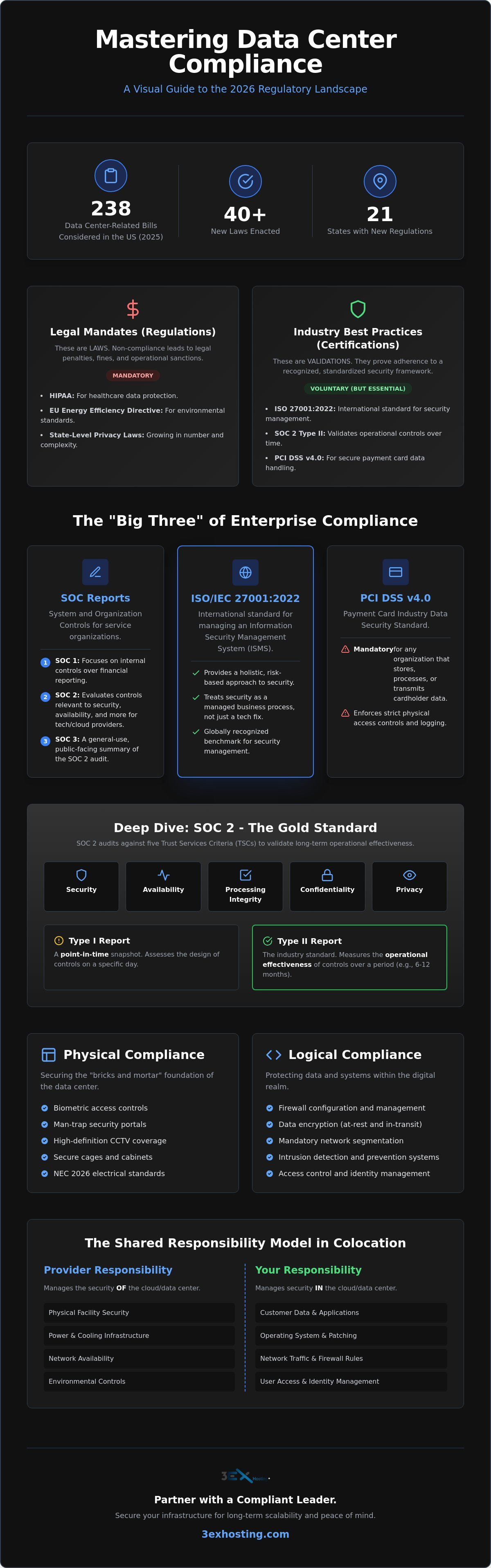
In 2025, US lawmakers across all 50 states considered 238 data center-related bills, enacting over 40 of them in 21 states. This legislative surge makes keeping up with data center compliance standards feel like chasing a moving target. It’s understandable if you feel overwhelmed by the shifting requirements of ISO 27001:2022 or the mandatory network segmentation in the 2026 HIPAA update. You’re likely balancing the need for technical stability with the fear of massive non-compliance fines. We agree that the “alphabet soup” of SOC, ISO, and PCI DSS v4.0 is enough to stall any enterprise’s infrastructure strategy.
This guide will help you master these certifications to ensure your infrastructure meets the highest security and legal requirements. You’ll gain a clear understanding of the ROI of compliant infrastructure and learn how to mitigate legal risks through a shared responsibility model. We’ll provide a definitive checklist for auditing providers and a breakdown of the 2026 regulatory landscape. This clarity allows you to move forward with confidence and technical peace of mind.
Key Takeaways
- Differentiate between legal mandates and industry certifications to prioritize your organization’s audit efforts.
- Align your infrastructure with current data center compliance standards including ISO 27001:2022 and PCI DSS v4.0.
- Identify the physical and logical safeguards necessary for mission-critical sectors like healthcare and federal contracting.
- Establish a clear shared responsibility model to understand exactly where the provider’s control ends and your security begins.
- Evaluate potential partners using a technical checklist that focuses on audit transparency and historical performance.
Navigating the Landscape of Data Center Compliance Standards
Data center compliance standards aren’t just a checklist. They represent the intersection of physical security, rigorous operational protocols, and data sovereignty. In 2026, the regulatory environment is more complex than ever. Governments and industry bodies have moved beyond simple guidelines. They now enforce strict rules that dictate how information is stored and protected. A modern data center must balance these requirements to maintain enterprise trust.
It’s essential to distinguish between regulatory requirements and industry certifications. Regulations are laws, such as HIPAA or the EU’s Energy Efficiency Directive, where non-compliance leads to legal penalties. Industry certifications, like ISO 27001:2022 or SOC 2, are best practices. While voluntary, these certifications serve as a universal language for security. They prove to stakeholders that your infrastructure follows a validated framework. Compliance has shifted from a “nice-to-have” feature to a non-negotiable enterprise requirement. This change stems from the surge in state-level regulations and the implementation of the 2026 HIPAA Security Rule update. Third-party audits play a critical role here. They provide an objective validation of a data center facility’s claims, ensuring that technical specifications match operational reality.
The Business Impact of Regulatory Alignment
Alignment with recognized standards directly affects the bottom line. Many insurance providers now offer reduced premiums for enterprises that host their assets in fully compliant facilities. There’s also a clear link between rigorous compliance and 99.999% uptime. Standards like the NEC 2026 update ensure that power systems are grounded and bonded correctly, reducing the risk of electrical failure. Compliance is a risk-mitigation tool that protects both brand reputation and bottom-line revenue.
Physical vs. Logical Compliance: Where the Lines are Drawn
Physical compliance focuses on the “bricks and mortar” security. This includes biometrics, man-traps, and high-definition CCTV coverage. For many enterprises, cage solutions datacenter options bridge the gap by providing a private, physically segregated environment within a shared facility. Logical compliance moves into the digital realm, involving firewalls, encryption, and the mandatory network segmentation required by new 2026 standards. Physical compliance remains the foundation. Without a secure perimeter, even the most advanced software encryption is vulnerable to local tampering.
The “Big Three” of Enterprise Compliance: SOC, ISO, and PCI DSS
Enterprise trust rests on three foundational pillars: SOC, ISO, and PCI DSS. While many frameworks exist, these three represent the core of modern data center compliance standards. They provide a standardized way to measure security, availability, and processing integrity. For organizations utilizing full cabinet colocation, seeing these certifications on a provider’s audit report is the first step toward verifying technical stability. These standards don’t just exist in isolation. Many organizations map these certifications against the NIST Cybersecurity Framework to ensure no gaps exist between physical and logical security.
SOC (System and Organization Controls) reports come in three varieties. SOC 1 focuses on internal controls over financial reporting. SOC 2 is the operational heavyweight, designed for technology and cloud service providers. SOC 3 is a simplified, public version of the SOC 2 report. ISO/IEC 27001 provides an international framework for an Information Security Management System (ISMS), ensuring that security isn’t just a technical fix but a managed business process. Finally, PCI DSS v4.0 is mandatory for any facility handling payment card data. It enforces strict physical standards, including restricted access to server rooms and rigorous logging of every individual who enters the data hall.
Decoding SOC 2 Type II: The Industry Standard for Cloud and Colocation
SOC 2 audits evaluate five Trust Services Criteria: Security, Availability, Processing Integrity, Confidentiality, and Privacy. While a Type I report is a snapshot of controls at a specific moment, Type II is the gold standard for long-term validation. SOC 2 Type II measures the effectiveness of controls over a 6 to 12 month period, not just a single point in time. This provides enterprises with the assurance that security protocols are consistently followed, rather than just prepared for an audit date.
ISO 27001: Global Interoperability for National Enterprises
ISO 27001 is essential for businesses that operate across international borders. The core of an ISO audit is the Statement of Applicability (SoA). This document defines exactly which security controls the facility has implemented and why. It supports business continuity by requiring documented disaster recovery plans and regular testing. Integrating these ISO standards with managed IT infrastructure allows your business to scale without outgrowing your security framework. If your current setup lacks this level of validated security, requesting a custom colocation quote can help you baseline your technical requirements.
Specialized Regulatory Frameworks for Mission-Critical Sectors
Healthcare and federal sectors demand more than baseline security. HIPAA and HITECH require specific physical safeguards for Protected Health Information (PHI). If a facility can’t prove exactly who accessed a specific server rack, it isn’t HIPAA compliant. For federal contractors, FISMA and NIST SP 800-53 set an even higher bar. These data center compliance standards involve hundreds of individual security controls. Selecting a facility that aligns with the Uptime Institute’s Tier Classification System adds a layer of performance validation that these mission-critical sectors expect for 99.999% availability.
AI infrastructure introduces new variables that traditional audits often miss. The rise of high density GPU colocation requires specialized audits for cooling and power distribution. These systems generate immense heat and draw massive power, often exceeding 30kW per rack. Compliance now includes verifying that liquid cooling or advanced air containment systems can handle these loads without failure. Sustainability is also becoming a legal requirement. In 2026, frameworks like ISO 14001 and LEED certification are essential for enterprises meeting strict ESG reporting mandates.
Healthcare and Financial Services: Beyond Basic Security
Private data requires physical isolation. While cages work for many, private suites offer the dedicated environment necessary for high-compliance sectors. These suites allow for custom audit trail requirements. You can implement your own biometric logs and 24/7 monitoring to satisfy FINRA and SEC infrastructure guidelines. This level of control ensures that sensitive financial data remains isolated from other tenants, providing a clear boundary for auditors.
AI Infrastructure and Data Sovereignty
Training AI models requires massive data sets, and regulatory bodies now scrutinize where this data lives. Sovereignty laws require that sensitive data stays within national borders. Compliance in 2026 means verifying data residency at the physical layer. Additionally, high-density setups require specialized metered power compliance. This ensures billing accuracy and load safety. It prevents the electrical overages and thermal risks that can occur with GPU-heavy workloads, protecting both your hardware and your legal standing.
The Shared Responsibility Model in Colocation Environments
The boundary between a provider’s duties and a tenant’s obligations is often the most misunderstood aspect of infrastructure management. Compliance is a partnership. You aren’t just buying rack space; you’re entering an agreement where security duties are split. The facility provides the hardened shell, but the responsibility for what happens inside your rack remains yours. Understanding this distinction is vital for meeting modern data center compliance standards without leaving gaps in your audit trail.
For enterprises requiring higher isolation levels, cage solutions datacenter options bridge the gap between shared space and private security. These cages provide a physical barrier that allows you to implement secondary access controls, such as biometric scanners or local CCTV, which are often required for PCI DSS or HIPAA compliance. Beyond the physical cage, Remote Hands Support acts as a technical extension of your team. Every time a technician swaps a drive or re-seats a cable, they must generate a log entry. This creates a documented chain of custody for every physical hardware change. Even the initial setup requires a compliant approach. Professional Move-in Assistance ensures that hardware is handled by personnel trained in security protocols, preventing unrecorded entry or accidental breaches during the critical transition phase.
Audit Support and Physical Access Logs
Providers assist clients by providing the evidence needed for internal or third-party audits. This includes detailed visitor logs and strictly enforced “escorted access” policies for non-authorized personnel. In a shared responsibility model, the provider’s SOC 2 report covers the building, while the client’s SOC 2 covers the hardware and data. This clear division allows auditors to verify the facility’s perimeter security while focusing their deeper scrutiny on your specific logical controls and data management practices.
Leveraging Remote Hands for Compliant Maintenance
Technicians must follow strict Standard Operating Procedures (SOPs) that match your internal compliance needs. In high-security environments, video-verified maintenance adds an extra layer of accountability. This ensures that every action taken on your hardware is recorded and can be reviewed during an audit. Linking remote hands support to your operational strategy improves efficiency and ensures that maintenance never compromises your regulatory standing. If you’re ready to secure your infrastructure within a compliant environment, request a custom colocation quote today.
Selecting a Compliant Partner for Long-Term Infrastructure Scalability
Choosing a provider requires looking past basic hardware specifications. You need a partner that treats data center compliance standards as a dynamic operational goal, not a static badge. Start by vetting the facility’s audit transparency. A reliable provider will share their latest SOC 2 Type II or ISO 27001:2022 executive summaries without hesitation. These documents prove that the technical stability and security protocols you’re paying for are actually in place and functioning correctly. If a provider is vague about their audit cycles, it’s a red flag for your legal and security teams.
A comprehensive vetting process should include a specific checklist. Verify that the facility maintains current certifications for your specific industry, whether that’s PCI DSS v4.0 for payments or HIPAA for healthcare. Ask about the frequency of their internal audits and how they handle physical access logs. You should also ensure their environmental monitoring systems are integrated into their compliance reporting. When you get a quote, make sure it explicitly outlines the compliance support services they provide, including how they assist during your own third-party audits.
Compliance also dictates the design of your disaster recovery solutions. Standards like ISO 27001 require rigorous business continuity testing and documented recovery time objectives. Your backup infrastructure must mirror the security level of your primary site. If your production environment is HIPAA compliant but your disaster recovery site lacks those same physical safeguards, you’re still at risk for regulatory fines. A compliant partner ensures that every node in your network meets the same high-bar requirements.
Future-Proofing Your Compliance Strategy
Preparing for the next wave of regulations is essential for long-term growth. New laws like the Data Act and evolving AI-specific governance will require even greater transparency in data handling. Modular infrastructure plays a key role here. It allows you to adapt to new physical security requirements, such as enhanced biometric zones or specialized cage configurations, without disrupting your entire operation. 3EX Hosting maintains an enterprise-grade environment that’s ready for mission-critical audits, giving you the flexibility to scale as regulations shift.
Conclusion: Compliance as a Competitive Advantage
Standard alignment drives trust with your end-users. When your infrastructure follows recognized data center compliance standards, it signals to your customers that you prioritize their security and privacy. This technical excellence becomes a competitive advantage, allowing you to win contracts in highly regulated sectors that smaller, non-compliant competitors can’t touch. It’s about more than just avoiding fines; it’s about building a reputation for reliability and professional integrity.
For enterprises scaling in 2026, the recommendation is clear. Don’t treat compliance as an afterthought. Build your infrastructure on a foundation of validated security and operational excellence. Consult with 3EX Hosting experts today to design a colocation or managed hosting solution that meets your technical needs and legal obligations. Expert support ensures your systems stay secure, fast, and fully aligned with the future of global data regulations.
Mastering Infrastructure Alignment for 2026
Aligning with data center compliance standards transforms a legal necessity into a strategic advantage. By mastering the shared responsibility model and choosing frameworks that match your industry’s specific needs, you ensure your infrastructure is audit-ready and technically stable. This alignment isn’t just about avoiding fines. It’s about building a foundation of trust that allows your enterprise to scale without the fear of security gaps or operational downtime.
3EX Hosting provides a SOC 2 Type II audited environment designed for maximum reliability and performance. We offer carrier-neutral interconnectivity and 24/7 professional Remote Hands support to keep your systems running at peak efficiency. Secure your mission-critical infrastructure with a compliant partner and get a 3EX Hosting quote today. We’re here to help you navigate the technical complexities of compliance so you can focus on your next breakthrough. Your path to a stable and audit-ready future starts with the right technical foundation.
Frequently Asked Questions
Is SOC 2 compliance mandatory for all data centers?
SOC 2 isn’t a legal requirement, but it’s a non-negotiable industry standard for enterprise-grade facilities. Most corporate risk management teams won’t consider a provider without a current SOC 2 Type II report. It provides the necessary validation that data center compliance standards for security, availability, and privacy are consistently met over time.
What is the difference between HIPAA-compliant and HIPAA-ready data centers?
HIPAA-ready means a facility has the physical infrastructure and protocols in place to support healthcare data but hasn’t necessarily undergone an audit. A HIPAA-compliant facility has successfully completed a third-party assessment and will sign a Business Associate Agreement (BAA). This agreement is a legal requirement that defines the provider’s responsibility for protecting health information.
How does ISO 27001 differ from SOC 2 in a colocation setting?
ISO 27001 is an international framework focused on the management system and continuous improvement of security processes. SOC 2 is an attestation report that focuses on the effectiveness of specific technical controls. ISO is often preferred by global enterprises for its interoperability, while SOC 2 is the primary standard for North American service providers.
Can a colocation provider be PCI DSS compliant if they don’t see my data?
Yes, because PCI DSS v4.0 includes strict physical security requirements for the environment where payment data is processed. The provider must secure the halls, racks, and cages to prevent unauthorized physical access. This includes maintaining 90 days of video surveillance and restricted entry logs for any area containing payment processing hardware.
What physical security standards are required for NIST 800-53 compliance?
NIST 800-53 requires high-level physical and environmental (PE) controls, including multi-factor authentication at all entry points. This often involves a combination of biometrics, key cards, and professional security personnel. It also mandates that the facility has hardened perimeters and detailed logs for every visitor, ensuring a complete audit trail for federal-grade security.
How often should a data center undergo a compliance audit?
Annual audits are the standard for maintaining data center compliance standards and ensuring technical stability. A SOC 2 Type II report typically covers a 12-month period to prove that controls aren’t just in place, but are functioning correctly. If a provider’s audit report is older than 18 months, it’s generally considered expired by enterprise auditors.
Does using a compliant data center make my application automatically compliant?
No, because compliance follows a shared responsibility model. The provider secures the physical building, power, and cooling, but you’re responsible for the security of your OS, applications, and data encryption. You must combine the facility’s physical certifications with your own logical security controls to achieve full regulatory alignment for your specific application.
What role does N+1 redundancy play in data center compliance?
N+1 redundancy is a technical requirement that supports the “Availability” criterion in SOC 2 and other reliability frameworks. It ensures that if a critical component like a generator or cooling unit fails, a backup is ready to take the load immediately. This redundancy is essential for meeting the 99.999% uptime requirements often mandated in service level agreements for mission-critical sectors.