 SUPPORT


 3EX United States
 Blog
With vacancy rates in primary data center markets falling below 2% in 2026, the leverage in negotiations has shifted, often leaving enterprises stuck with rigid, outdated terms. You likely feel that most SLAs are treated as marketing fluff rather than enforceable technical protections. It’s a common concern that vendor lock-in and opaque power billing will eventually compromise your ability to scale. Understanding colocation contracts and SLAs is now a vital skill for ensuring that your high-density AI and GPU workloads don’t outpace your legal protections or your budget.
We’ll show you how to transform these complex documents into an operational blueprint that guarantees maximum uptime and infrastructure scalability. This guide provides a clear framework for evaluating Master Service Agreements, decoding PUE clauses, and securing the technology-proofing terms your hardware lifecycle demands. You’ll learn exactly how to protect your systems while maintaining predictable operational costs in an increasingly crowded market.
Key Takeaways
- Distinguish between the legal framework of a Master Service Agreement (MSA) and the performance metrics of an SLA to ensure comprehensive infrastructure protection.
- Mastering the nuances of understanding colocation contracts and SLAs allows you to move beyond basic uptime claims and enforce specific technical benchmarks for latency and packet loss.
- Secure contractual guarantees for high-density power and cooling to prevent performance bottlenecks during intensive AI and GPU workload deployments.
- Define the exact scope of remote hands support and physical security protocols, such as biometrics and access logs, to maintain operational transparency and compliance.
- Implement future-proofing strategies like technology refresh clauses and expansion rights to ensure your infrastructure scales seamlessly as hardware requirements evolve.
The Anatomy of a Colocation Agreement: MSA vs. SLA
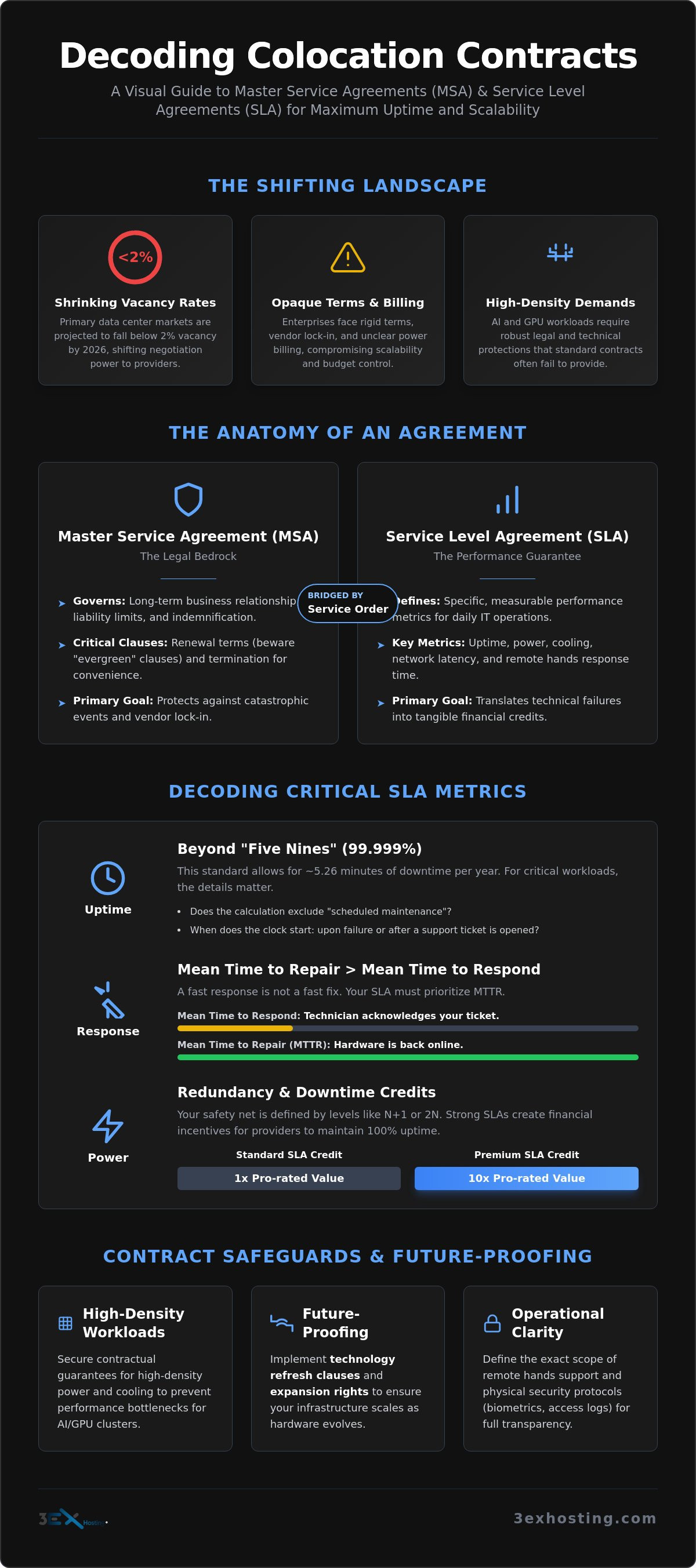
A standard agreement for a Colocation centre is a multi-layered structure. It isn’t a single file. It’s a stack of documents that govern everything from legal liability to the specific temperature of your server aisle. Understanding colocation contracts and SLAs requires recognizing how these layers interact. If there’s a conflict between a sales promise and the legal text, the “Order of Precedence” clause determines which document wins. Usually, the Service Order or SLA overrides the general MSA for technical specifics. This hierarchy ensures that the most specific technical requirements take priority over general legal boilerplate.
Master Service Agreement (MSA) Fundamentals
The MSA is your long-term legal bedrock. It doesn’t change often. It covers the “what ifs” of the business relationship. Liability limits and indemnification are the most critical parts here. They protect your enterprise data if a catastrophic event occurs. You should also watch for renewal options. Many providers use “evergreen” clauses that renew automatically at higher market rates. Negotiating a fixed renewal cap or a clear “termination for convenience” window gives you an exit strategy if your infrastructure needs shift. This protects you from vendor lock-in as the market evolves.
The SLA as a Performance Guarantee
While the MSA handles the lawyers, the SLA handles the engineers. It’s the most critical document for daily IT operations. It translates technical failures, like a power drop or cooling spike, into tangible financial credits. A Service Level Agreement is a contractually binding promise of specific performance metrics. It’s not just about “five nines” of power. It should cover network latency, humidity levels, and response times for remote hands support. If the facility fails to meet these benchmarks, the SLA defines the exact rebate you receive. This ensures the provider has skin in the game regarding your uptime.
Service Orders act as the bridge between these documents. They link the legal terms to your physical hardware. A Service Order specifies the exact cabinet, the power draw in kilowatts, and the monthly recurring cost. Without a signed Service Order, the MSA is just a framework without a subject. By aligning these three components, you create a stable environment where technical expectations and legal protections work in tandem. This structure provides the clarity needed to manage complex infrastructure without constant legal friction.
Decoding the SLA: Critical Metrics for Enterprise Reliability
Marketing brochures often highlight “Five Nines” (99.999%) uptime as the gold standard. In reality, this allows for roughly five minutes of downtime per year. For an enterprise running mission critical AI clusters, even those five minutes can result in significant data synchronization issues. True proficiency in understanding colocation contracts and SLAs requires looking past the percentage. You must examine how the provider calculates that uptime. Does it include scheduled maintenance? Does the clock start when the failure occurs or only after you’ve opened a manual support ticket? These distinctions determine whether your contract is a shield or just a piece of paper.
Technical teams often overlook the difference between Mean Time to Respond and Mean Time to Repair (MTTR). A provider might guarantee a 15 minute response time, but that only means a technician acknowledged your email. It doesn’t guarantee a fix. Your SLA should prioritize MTTR to ensure hardware is back online within a specific window. Additionally, environmental metrics are becoming more granular. As power densities rise, maintaining strict temperature and humidity ranges is vital for hardware longevity. You can see how these metrics are structured in detail by reviewing the State of Oregon Colocation SLA, which serves as a benchmark for enterprise level performance requirements.
Power Availability and Redundancy Clauses
Redundancy levels like N+1 or 2N define your safety net. In a 2N environment, every component has a mirrored backup, ensuring no single point of failure. When power interruptions occur, the calculation for credits is vital. While standard contracts might offer a pro-rated refund for the hour of downtime, high performance agreements often scale more aggressively. Some premium providers offer credits worth 10x the pro-rated value of the downtime. This creates a strong financial incentive for the facility to maintain absolute stability. If you’re ready to see how these protections apply to your specific setup, you can request a customized technical profile for your deployment.
Network Performance and Connectivity
Network reliability isn’t just about being “online.” It’s about latency and packet loss. For high performance applications, your contract should specify maximum latency thresholds for cross-connect services. Carrier neutrality is another non-negotiable clause. It ensures you aren’t forced into using a specific provider’s bandwidth at inflated prices. Look for transparency in bandwidth burstability terms. You don’t want to be penalized for temporary traffic spikes with hidden overage fees that double your monthly bill. Clear, tiered pricing for overages keeps your operational costs predictable even during peak demand periods.
High-Density Safeguards: Contracts for AI and GPU Workloads
Traditional enterprise environments typically run at 5kW per rack. AI workloads now regularly demand power densities exceeding 50kW per rack. This massive jump in thermal output makes understanding colocation contracts and SLAs a matter of hardware survival, not just legal compliance. If your contract doesn’t explicitly guarantee the facility’s ability to dissipate this heat, your expensive GPU clusters will face thermal throttling. You need a contract that defines specific power density limits per cabinet and outlines the provider’s responsibility for maintaining cooling capacity as you scale.
Power Usage Effectiveness (PUE) clauses are also essential for cost control. These clauses determine who pays for the facility’s cooling inefficiency. A high PUE means the data center uses more energy for cooling than for running servers. Your agreement should include a “Right to Audit” clause. This allows you to verify real-time power consumption and cooling performance data. Without this transparency, you’re essentially paying a blank check for the provider’s operational overhead. Clear contractual thresholds for PUE protect your budget from rising energy costs in high-density environments.
Scaling Power for Full Cabinet Colocation
Metered power billing is usually the safer choice for AI workloads compared to fixed-fee models. It ensures you only pay for the energy your GPUs actually consume during training cycles. High-performance hardware often requires specialized 3-phase, 415V power circuits to operate efficiently. Contractually, high density GPU colocation requires specific cooling-to-power ratios in the SLA to prevent localized hot spots from damaging sensitive components. Ensure these electrical specifications are listed in your Service Order to avoid deployment delays.
Environmental Control for High-Performance Hardware
Your contract should reference ASHRAE standards to define acceptable thermal thresholds. If the provider fails to maintain these levels, the consequences often include hardware damage or reduced lifespan. The SLA must specify the penalties for thermal excursions that force your systems to throttle performance. For those utilizing a cage solutions datacenter, custom cooling requirements like cold-aisle containment or specialized floor tiles should be documented. These physical modifications ensure that airflow is optimized for your specific rack layout, maintaining the technical stability your enterprise requires.
Operational Clauses: Remote Hands and Physical Security
Operational efficiency is often the first thing to suffer when a contract is vague about on-site support. Understanding colocation contracts and SLAs requires a precise definition of what happens when your team isn’t physically at the facility. Remote hands support shouldn’t be a “best effort” promise. It needs to be a codified set of tasks with guaranteed response times. If your agreement doesn’t distinguish between basic power cycling and complex cable management, you’ll likely face unpredictable billing. Industry benchmarks for 2026 show these services typically range from $50 to $150 per hour; your contract must specify which tier applies to your needs.
Physical security is the other half of the operational equation. It’s not enough for a provider to claim they’re “secure.” You need to codify the use of biometrics, 24/7 CCTV monitoring, and detailed access logs in the agreement. These logs are vital for incident reporting and root cause analysis (RCA) obligations. If a hardware failure occurs, you need a contractual right to receive a full RCA report within a set timeframe. This transparency ensures that technical stability remains the priority. To ensure your deployment meets these rigorous standards, you can request a technical security overview for your hardware.
Managed Support and Response Times
Your SLA should define clear response tiers for emergency and non-emergency requests. Emergency support must have a punchy, short window, often measured in minutes. Remote hands usually covers physical tasks like swapping a drive or checking a status light. More complex configurations often fall under professional services, which carry different rates. For a deeper look at optimizing these workflows, see our Remote Hands Support: The Enterprise Guide. Clear definitions prevent scope creep and keep your maintenance costs under control.
Security and Compliance Audits
Compliance alignment is a legal necessity for enterprises handling sensitive data. Your contract must explicitly state that the facility maintains certifications like SOC 2, HIPAA, or PCI-DSS. For those utilizing private colocation suites, you should secure the right to conduct independent physical facility tours and security audits. Data breach notification timelines are also critical. Most modern regulations require notification within 24 to 72 hours of discovery. Aligning your contract with these legal windows ensures your business stays compliant without manual intervention during a crisis.
Future-Proofing: Negotiation Strategies and Exit Clauses
A contract signed today must account for the infrastructure needs of tomorrow. Mastery in understanding colocation contracts and SLAs involves planning for your eventual growth and your eventual exit. With vacancy rates in primary data center markets falling below 2% in 2026, securing a “Right of First Refusal” (ROFR) for adjacent rack space is a strategic necessity. Without this clause, you might find yourself unable to expand when a new AI project launches because a competitor leased the cabinet next to yours. Secure this right early to ensure your deployment remains contiguous and manageable as your power needs increase.
Technology refresh clauses are equally vital. GPU lifecycles are shrinking, often requiring power and connectivity upgrades every 24 to 36 months. Your agreement should allow for these adjustments mid-contract without triggering massive change order fees or extending the term length indefinitely. Additionally, consider decommissioning protocols. Codifying how hardware is removed and how data is destroyed at the end of the term protects your intellectual property from physical security gaps. You can often leverage competitive bids to force better SLA credit structures, ensuring the provider is financially motivated to maintain peak performance throughout the contract’s life.
Negotiating for Scalability
Locking in pricing for future cabinet growth during the initial negotiation prevents “market rate” surprises three years down the line. This is also the best time to define move-in assistance terms to ensure the provider handles the logistics of your initial deployment with expert care. Scalability clauses prevent “fragmented infrastructure” by ensuring your hardware stays in contiguous racks rather than being scattered across different facility floors as your footprint grows. This logical layout is essential for maintaining efficient cable management and cooling airflow.
Securing Your Infrastructure with 3EX Hosting
At 3EX Hosting, we provide the technical stability and legal clarity your enterprise needs to thrive. Our enterprise-grade SLAs are specifically designed for high-density and mission-critical loads, moving past marketing fluff to offer real financial protection. We prioritize transparent billing and 24/7 technical expertise to ensure your systems remain fast and secure. We understand the nuances of understanding colocation contracts and SLAs, and we’re here to help you build a foundation that lasts. Our team works in the background to ensure your systems remain fast, secure, and ready for the demands of the next decade.
Request a customized colocation quote today to see how our infrastructure can support your next-generation workloads.
Building a Resilient Infrastructure Foundation for 2026
Mastering the technical and legal nuances of your data center agreement is no longer optional in a market with sub-2% vacancy. You’ve seen how a well-structured hierarchy between the MSA and SLA ensures that performance benchmarks take priority over legal boilerplate. By prioritizing high-density power configurations and auditing PUE clauses, you protect your AI and GPU clusters from thermal throttling and unpredictable billing. Proficiency in understanding colocation contracts and SLAs turns a standard lease into a strategic asset that scales with your hardware lifecycle.
Your infrastructure deserves a partner that values technical stability as much as you do. We provide carrier-neutral carrier hotel connectivity and 24/7 on-site Remote Hands support to keep your systems running at peak performance. Whether you’re deploying legacy enterprise apps or power-hungry AI models, our facility provides the reliability you need. Secure your enterprise infrastructure with a 3EX Hosting Full Cabinet Colocation plan and build your future on a stable, high-performance foundation. We’re ready to help you scale with confidence.
Frequently Asked Questions
What is the difference between a 99.9% and 99.999% uptime SLA?
A 99.9% uptime guarantee allows for approximately 8.77 hours of downtime per year, while a 99.999% guarantee limits downtime to just 5.26 minutes annually. For mission critical enterprise applications, this difference is the gap between a minor inconvenience and a catastrophic service disruption. High performance facilities prioritize the “five nines” standard to ensure nearly continuous availability for your hardware.
How are SLA credits typically calculated in a colocation contract?
SLA credits are usually calculated as a percentage of your Monthly Recurring Charge (MRC) based on the duration of the outage. Most providers use a tiered structure where the credit percentage increases as the downtime exceeds specific thresholds. Some premium agreements offer aggressive “10x credits,” where the rebate is ten times the pro-rated value of the time the service was unavailable.
What are the common exclusions in a data center uptime guarantee?
Standard exclusions typically include scheduled maintenance windows, force majeure events, and outages caused by your own hardware or staff errors. Outages resulting from third party carrier failures outside the provider’s direct control are also frequently excluded. You should ensure the contract defines a minimum notice period, such as 48 to 72 hours, for any scheduled maintenance that could impact your operations.
Can I negotiate the terms of a standard colocation MSA?
Yes, enterprises can negotiate most Master Service Agreement terms, particularly regarding liability limits, indemnification, and renewal price caps. While providers prefer their standard forms, larger deployments offer significant leverage to remove “evergreen” clauses or automatic price escalations. Proficiency in understanding colocation contracts and SLAs is essential for securing these custom legal protections during the negotiation phase.
What is a “Right to Audit” clause and why do I need it?
A “Right to Audit” clause grants you the legal authority to physically inspect the facility and review operational logs or power usage data. You need this clause to verify that the provider actually meets the performance and security benchmarks defined in the SLA. This transparency is vital for maintaining compliance and ensuring you aren’t overpaying for inefficient power usage or cooling.
How does an SLA handle power density for AI and GPU hardware?
SLAs for AI and GPU workloads define specific kilowatt limits per cabinet and mandate the cooling capacity required to support those densities. These agreements often include granular metrics for airflow and temperature at the rack level to prevent thermal throttling. Ensuring these technical specifications are codified helps in understanding colocation contracts and SLAs as operational tools rather than just legal formalities.
What happens if my colocation provider fails to meet its environmental SLA?
Failure to maintain contracted temperature and humidity ranges typically triggers service credits similar to power outages. If the environmental breach is sustained or repetitive, it may provide grounds for “termination for cause,” allowing you to exit the contract without penalty. These clauses protect your hardware from long term degradation caused by improper thermal management or excessive moisture.
Are Remote Hands services usually included in the base colocation contract?
Remote Hands services are generally billed separately and are not included in the base monthly recurring cost for cabinet space. Some providers offer a bundled tier with a set number of monthly hours, while others bill strictly on an hourly basis for tasks performed. It’s important to clarify if emergency support requests carry a premium rate compared to standard maintenance tasks.