 SUPPORT



 3EX United States
Blog
Your infrastructure’s physical location isn’t just a line on a map; it is the primary factor in your global competitive advantage. For enterprises managing traffic between North America, Europe, and Latin America, a carrier hotel Miami serves as the vital heartbeat of their network. You likely already know the frustration of high latency spikes across the Atlantic or the struggle to find a facility that doesn’t buckle under the power demands of modern GPU clusters. These bottlenecks don’t just slow down your applications. They limit your ability to scale in a market that demands instant results.
This guide explores how strategic connectivity in the Miami ecosystem solves these critical bottlenecks. You’ll discover how to leverage carrier-neutral flexibility to avoid vendor lock-in while scaling high-density AI workloads with up to 15kW of cooling capacity per rack. We’ll examine the impact of Florida’s 2026 regulatory landscape, including the requirements of SB 484, and show you how to secure a scalable full-cabinet colocation strategy. By the end of this article, you’ll understand how to transform your data center presence into a high-performance nexus that ensures your data reaches its destination with surgical precision and absolute reliability.
Key Takeaways
- Understand why a carrier hotel Miami serves as the essential low-latency bridge between North American markets and the subsea cable landings of Latin America and Europe.
- Identify the technical requirements for mission-critical continuity, including N+1 power redundancy and specialized cooling systems for high-density hardware.
- Learn how carrier-neutral data centers drive down transit costs and eliminate vendor lock-in by fostering a competitive environment for bandwidth providers.
- Discover the infrastructure modifications necessary for AI and GPU workloads, focusing on the power density and heat management of dedicated server clusters.
- Explore how 24/7 Remote Hands support functions as a professional extension of your IT team to manage complex colocation environments without physical on-site presence.
What is a Carrier Hotel and Why is the Miami Hub Critical?
A carrier hotel is a specialized data center designed to house the hardware of multiple network providers, internet service providers (ISPs), and content delivery networks (CDNs). By centralizing these entities, enterprises establish direct cross-connects, effectively eliminating the need for third-party intermediaries to route data across long distances. This direct access significantly reduces latency and improves security protocols. For organizations researching What is a Carrier Hotel?, these facilities are the primary infrastructure for scaling global network performance.
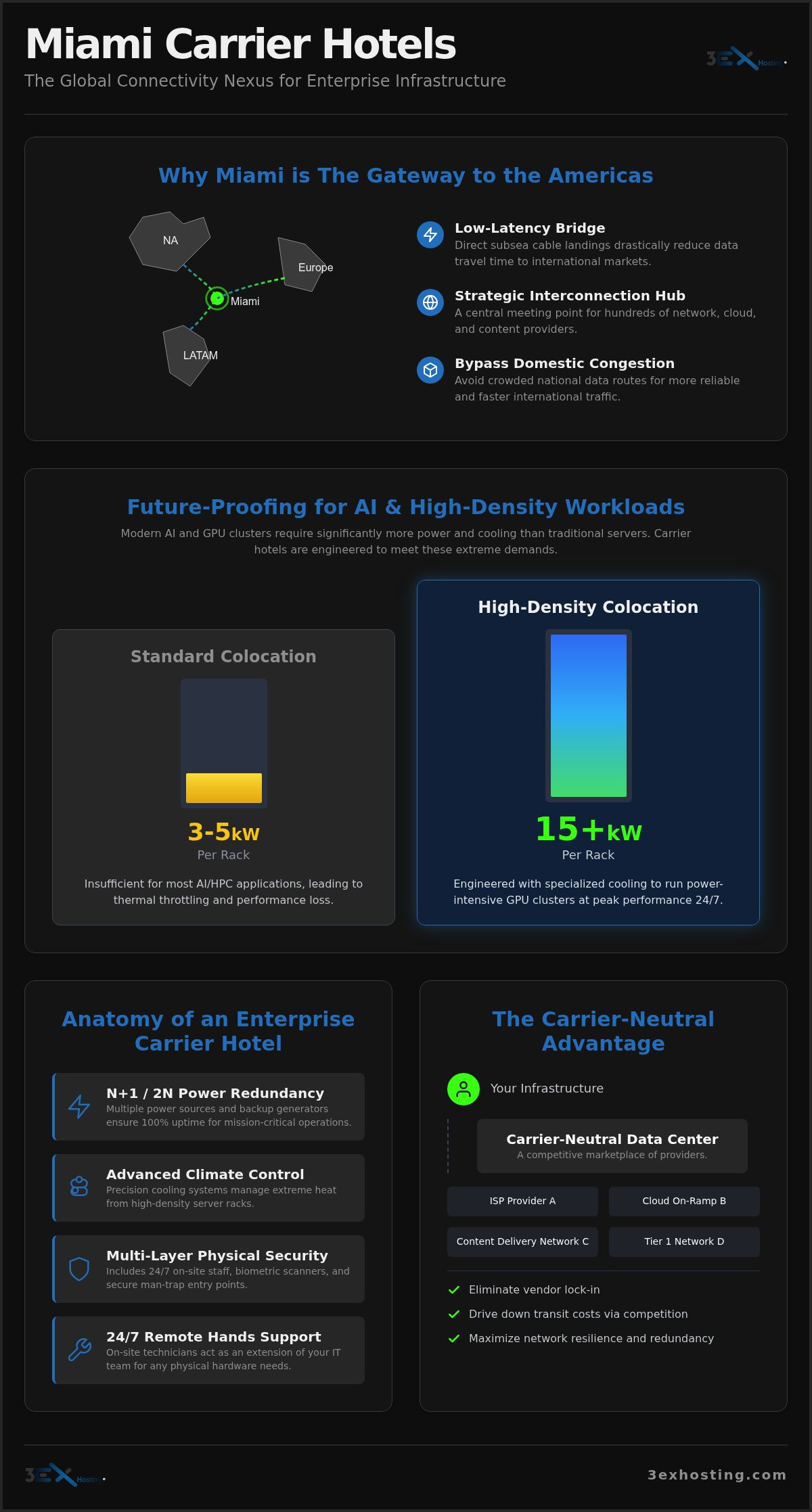
Miami serves as the “Gateway of the Americas” due to its geographic proximity to international markets. A carrier hotel Miami acts as the central meeting point for subsea fiber optic cables that link the United States to Latin America, the Caribbean, and Europe. National enterprises use this hub to bypass congested domestic routes. This ensures their data reaches international end-users with the lowest possible hop count. The transition from traditional telecom hubs to modern enterprise colocation has turned Miami into a vital node for national data flow.
The Evolution of Interconnection in Major Markets
Interconnection originally happened in “central offices” controlled by single telecom incumbents. This often led to vendor lock-in and restricted network growth. Modern carrier hotels have moved toward high-density environments where carrier-neutrality is the industry standard for enterprise resilience. This allows businesses to choose from dozens of providers within a single rack, ensuring they aren’t dependent on one network’s uptime. A carrier hotel is a physical location where diverse networks interconnect to maximize speed and minimize costs.
Miami as a Strategic Nexus for National Enterprises
National companies frequently use Miami as a primary hub for international expansion or as a critical secondary failover location. The density of subsea cable landings provides redundancy that inland markets cannot match. However, the Florida environment demands specific infrastructure standards. Tier III or Tier IV ratings are non-negotiable to protect against regional weather events. Facilities like the NAP of the Americas are built 32 feet above sea level and engineered to survive Category 5 hurricanes. For enterprises, utilizing full cabinet colocation in these hardened environments provides the peace of mind that their systems will remain online. Recent regulatory shifts, such as Florida Senate Bill 484, also emphasize the importance of large-scale facilities bearing their own service costs. This makes established data center Miami locations a more predictable long-term investment for high-capacity users.
Anatomy of an Enterprise Carrier Hotel: Power, Cooling, and Security
A carrier hotel Miami distinguishes itself from standard data centers through its specialized internal architecture. These facilities aren’t just shells for servers; they’re engineered ecosystems designed for 100% uptime. For mission-critical continuity, enterprises require N+1 or 2N power redundancy. This ensures that if a primary power source fails, secondary systems engage instantly without interrupting active workloads. This level of Power, Cooling, and Security is regulated by federal standards to ensure energy efficiency and reliability across national infrastructure.
Physical security follows a multi-layer protocol to prevent unauthorized access. This includes 24/7 on-site surveillance, biometric scanners, and secure man-traps at all entry points. Beyond the physical walls, the most critical service for out-of-state enterprises is 24/7 Remote Hands Support. This service allows your team to manage hardware deployments and troubleshooting through local experts without ever needing to travel to Florida.
Power Density: Beyond the Standard Rack
Modern enterprise cabinets now require significantly more than the standard 3kW to 5kW of power. As AI and high-performance computing (HPC) become standard, cooling systems must manage between 10kW and 15kW of heat per rack. Standard colocation often fails to meet these thermal demands. You should look for facilities that offer metered power. This model ensures transparent cost management because you only pay for the electricity your hardware actually consumes. You can learn more about Full Cabinet Colocation specs to see how high-density power translates to better hardware performance.
The Meet-Me Room (MMR): Where Connectivity Happens
The Meet-Me Room is the heart of any carrier hotel. It’s a secure, dedicated space where different carriers and customers physically interconnect their networks. By utilizing diverse fiber entry points, the facility eliminates single points of failure. If one fiber path is compromised by external construction or a natural event, the network remains stable through alternative routes. These low-latency cross-connects are vital for financial trading and real-time AI inference where every millisecond counts. Direct connections in the MMR bypass the public internet, providing a cleaner, faster signal for your global traffic.
The Carrier-Neutral Advantage: ROI and Network Resilience
Carrier neutrality is a strategic requirement for any enterprise that values operational flexibility. In a carrier-neutral environment, the facility owner doesn’t restrict you to their own network services. Instead, you have access to an open marketplace of ISPs, CDNs, and transport providers. This prevents vendor lock-in, which often leads to stagnating service quality and inflated pricing over time. By choosing a carrier hotel Miami, you position your infrastructure in a facility where providers must compete for your business. This competition directly lowers your monthly transit costs while increasing the overall quality of your network performance.
Resilience is built through diversity. When you utilize multiple carriers within the same facility, you can implement BGP (Border Gateway Protocol) optimization. This allows your network to automatically route traffic through the fastest or most stable path available at any given moment. If one provider experiences a fiber cut or a routing error, your traffic shifts to a secondary provider instantly. This level of redundancy is impossible in a single-carrier data center where you’re at the mercy of one provider’s uptime.
Reducing Latency and Transit Costs
Direct peering is the most efficient way to handle high volumes of data. When you connect directly to a partner network via a cross-connect in the Meet-Me Room, you bypass the public internet entirely. This reduction in hop counts significantly lowers latency, which is essential for real-time applications and financial transactions. While public internet transit is subject to congestion and unpredictable routing, a direct physical connection offers consistent performance. You can Explore our Data Center Infrastructure to see how these interconnections are physically managed for maximum throughput. The ROI of this approach becomes clear as your bandwidth needs grow; cross-connect fees are typically fixed, while high-volume public transit costs can fluctuate based on usage and market demand.
Disaster Recovery and Business Continuity
Enterprises across the United States use Miami as a primary disaster recovery (DR) site because of its unique connectivity to international markets. If your primary site in the Northeast or Midwest goes offline, a carrier hotel Miami ensures your services remain accessible to global users. Carrier diversity plays a vital role here. By maintaining active connections with multiple global carriers, you ensure “always-on” connectivity even during widespread regional outages. This strategy turns your colocation footprint into a hardened insurance policy for your data. For a deeper look at protecting your operations, read our sibling article on Strategic Disaster Recovery for Enterprise Continuity. This multi-carrier approach ensures that your business continuity plan isn’t dependent on a single provider’s infrastructure.
Future-Proofing for AI: High-Density GPU Colocation
AI training and inference workloads have fundamentally changed the requirements for modern data centers. Standard racks designed for general-purpose computing cannot handle the thermal output or power draw of high-performance GPU clusters. A carrier hotel Miami provides the necessary infrastructure to support these dense environments while maintaining global network performance. These facilities must handle the physical weight of liquid-cooled GPU servers and the massive electrical load required to keep them operational. Transitioning to AI-ready infrastructure isn’t just about space. It’s about finding a partner that can scale power density from 5kW to 15kW per rack without risking thermal throttling.
Infrastructure for AI and Machine Learning
Cooling is the primary challenge for AI infrastructure. Standard air cooling often reaches its limit at 10kW per rack. Advanced facilities now utilize specialized air containment or liquid cooling to manage the heat generated by GPU dedicated servers. Beyond cooling, the performance of AI clusters depends on high-speed interconnects. Low-latency cross-connects within the Meet-Me Room ensure that data flows between GPU nodes and storage arrays at wire speed. This prevents the network from becoming a bottleneck during large-scale model training. For a comprehensive look at these technical requirements, read our guide on High-Density GPU Colocation: The Enterprise Guide to AI Infrastructure in 2026.
Private Suites and Cage Solutions for AI Security
AI firms often deal with proprietary models and sensitive datasets that require enhanced physical security. Private colocation suites offer a dedicated environment where only authorized personnel have access to the hardware. This level of isolation is critical for data sovereignty and compliance. Custom cage configurations allow for specialized rack layouts that accommodate non-standard AI hardware dimensions. Enterprises scaling their models within a carrier hotel Miami benefit from these isolated environments because they combine physical security with the facility’s massive carrier density. You can Explore Private Data Center Suites to understand how dedicated space can be tailored to your specific AI cluster needs. If you’re ready to deploy your next GPU cluster, request a custom infrastructure quote today.
3EX Hosting: Your Enterprise Gateway in the Miami Carrier Hotel
3EX Hosting provides the technical foundation for enterprises looking to capitalize on the connectivity of a carrier hotel Miami. We specialize in full cabinet colocation and high-density infrastructure for AI workloads. Our facility offers the stability of N+1 power redundancy and advanced cooling systems capable of managing up to 15kW per rack. We don’t just provide space; we provide a managed gateway to the global network. This ensures your data moves with the speed and reliability your users expect.
Enterprise deployments require precision. Our white-glove move-in assistance handles the logistics of getting your hardware on-site and operational. We manage the physical installation, ensuring every component is racked and cabled to professional standards. This service, combined with our managed cloud and disaster recovery integrations, allows you to build a hybrid environment that is both scalable and resilient. We understand that your infrastructure is the backbone of your business, and we treat it with the technical respect it deserves.
Unrivaled Support and Managed Services
National enterprises often face the challenge of managing hardware across state lines. Our 24/7 Remote Hands Support Services solve this by acting as a local extension of your own IT team. We handle everything from simple power cycles to complex hardware swaps and cable management. This eliminates the need for your staff to travel for routine maintenance or emergency troubleshooting. Our experts understand the technical nuances of enterprise gear and provide the security of knowing your systems are in capable hands at all times. We also offer managed IT infrastructure support for complex deployments that require specialized configuration and monitoring.
Customizable Enterprise Solutions
Every network strategy has unique requirements. We offer a range of solutions including full cabinets, custom cages, and private suites. This flexibility allows you to scale from a single presence to a massive AI cluster within the same ecosystem. You gain direct access to a diverse marketplace of carriers and cloud on-ramps, ensuring your data moves with maximum efficiency. By positioning your hardware with 3EX Hosting, you leverage the full power of a carrier hotel Miami without the operational burden of managing it yourself. If you’re ready to secure your infrastructure in the Gateway of the Americas, you can get a custom quote for your Miami colocation needs and start your deployment today.
Securing Your Global Edge in the Gateway of the Americas
Securing your network’s future requires more than just square footage and electricity. It demands a strategic position within a carrier hotel Miami to bridge national innovation with global markets. By leveraging carrier-neutral interconnection and N+1 redundant power and cooling, your enterprise eliminates the risks of vendor lock-in and infrastructure failure. Whether you’re scaling high-density GPU clusters for AI or optimizing latency for international traffic, the right facility acts as a force multiplier for your IT team. You don’t have to manage these technical complexities alone.
3EX Hosting offers the technical stability and 24/7 on-site remote hands support needed to manage complex deployments without the overhead of local staff. We provide the specialized environment required for 2026’s high-performance hardware, ensuring your systems remain cool, powered, and connected. It’s time to transform your connectivity into a measurable competitive advantage. Request a Custom Colocation Quote for Your Enterprise and take the next step toward a resilient, high-performance network. We’re ready to help you build the foundation for your next decade of growth.
Frequently Asked Questions
What makes a data center a “carrier hotel”?
A carrier hotel is a specialized data center that serves as a centralized hub for dozens or hundreds of internet service providers, network carriers, and content delivery networks. Unlike standard data centers that might only have a few providers, these facilities house a massive density of diverse networks. This environment allows enterprises to establish direct physical cross-connects between different providers. It effectively creates an ecosystem for traffic exchange that maximizes speed and reliability while reducing dependence on any single network.
How does a carrier hotel in Miami benefit a national company not based in Florida?
For national enterprises, a carrier hotel Miami serves as a strategic gateway to international markets, specifically Latin America and Europe. Even if your headquarters is in the Midwest, placing infrastructure here reduces the number of network hops for your global traffic. It also functions as an ideal secondary disaster recovery site. The facility’s proximity to subsea cable landings ensures your services remain accessible to international users even if domestic routes experience congestion or regional outages.
What is the difference between carrier-neutral and carrier-specific colocation?
Carrier-neutral colocation allows you to choose from any network provider available within the facility, which fosters competition and lowers transit costs. In contrast, carrier-specific facilities restrict you to the data center owner’s own network services. This neutrality prevents vendor lock-in and gives your IT team the flexibility to switch providers or use multiple carriers for BGP optimization. It ensures your infrastructure remains resilient and cost-effective as your bandwidth requirements scale over time without needing physical hardware moves.
Can a Miami carrier hotel support high-density GPU hosting for AI?
Yes, specialized facilities in Miami are engineered to support the massive power and cooling demands of AI and machine learning workloads. High-density GPU hosting requires infrastructure that can manage between 10kW and 15kW of heat per rack. 3EX Hosting provides these high-performance environments, utilizing advanced cooling strategies to prevent thermal throttling. This ensures that your GPU dedicated servers operate at peak efficiency while benefiting from the massive connectivity options found within a major network hub.
What are “Remote Hands” and why are they necessary in a carrier hotel?
Remote Hands refers to professional on-site technical support provided by data center staff to perform physical tasks on your hardware. This service is necessary for national companies because it eliminates the need to fly internal IT staff to the facility for routine maintenance. Our team handles everything from server reboots and cable management to complex hardware swaps. Having 24/7 Remote Hands ensures that your infrastructure is managed by experts who are physically present in the building at all times.
How do cross-connect services improve network performance?
Cross-connect services involve a direct physical cable between two different networks within the data center’s Meet-Me Room. This bypasses the public internet entirely, which reduces latency and eliminates the unpredictability of standard routing. By using a direct connection, your data moves at wire speed with significantly lower jitter and packet loss. This is critical for enterprises managing real-time data processing, financial transactions, or large-scale AI inference where every millisecond of performance directly impacts the user experience.
What security standards should an enterprise carrier hotel meet?
An enterprise-grade facility must maintain multi-layer physical security protocols to protect mission-critical hardware. This includes 24/7 on-site security personnel, continuous video surveillance, and biometric access controls at every entry point. Secure man-traps are also standard to prevent unauthorized tailgating into sensitive areas. Additionally, the facility should adhere to Tier III standards for redundancy and environmental protection, ensuring that your infrastructure remains safe from both physical intruders and regional weather events common to the Florida coast.
Is there move-in assistance for shipping hardware to a Miami facility?
3EX Hosting provides comprehensive white-glove move-in assistance for all enterprise deployments. We manage the logistics of receiving your hardware, unboxing it, and professionally installing it into your designated cabinet or suite. Our team ensures that all equipment is racked according to your specifications and cabled for optimal airflow and connectivity. This service allows you to ship your servers directly to the data center, knowing that the physical deployment will be handled by experienced technicians without requiring your presence.