 SUPPORT


 3EX United States
 Blog
For decades, a key strategic location has served as the “Gateway to the Americas,” and in 2026, it has transformed into the high-density power engine driving Latin American AI. You already know that routing traffic through traditional, more distant hubs adds unacceptable lag to your users across Latin America. Finding a reliable data center optimally positioned for Latin America is no longer just about proximity; it’s about solving the bottleneck for modern GPU-heavy workloads that require specialized cooling and massive power draws. Managing these complex systems from abroad adds another layer of risk when you don’t have a local technical team on the ground.
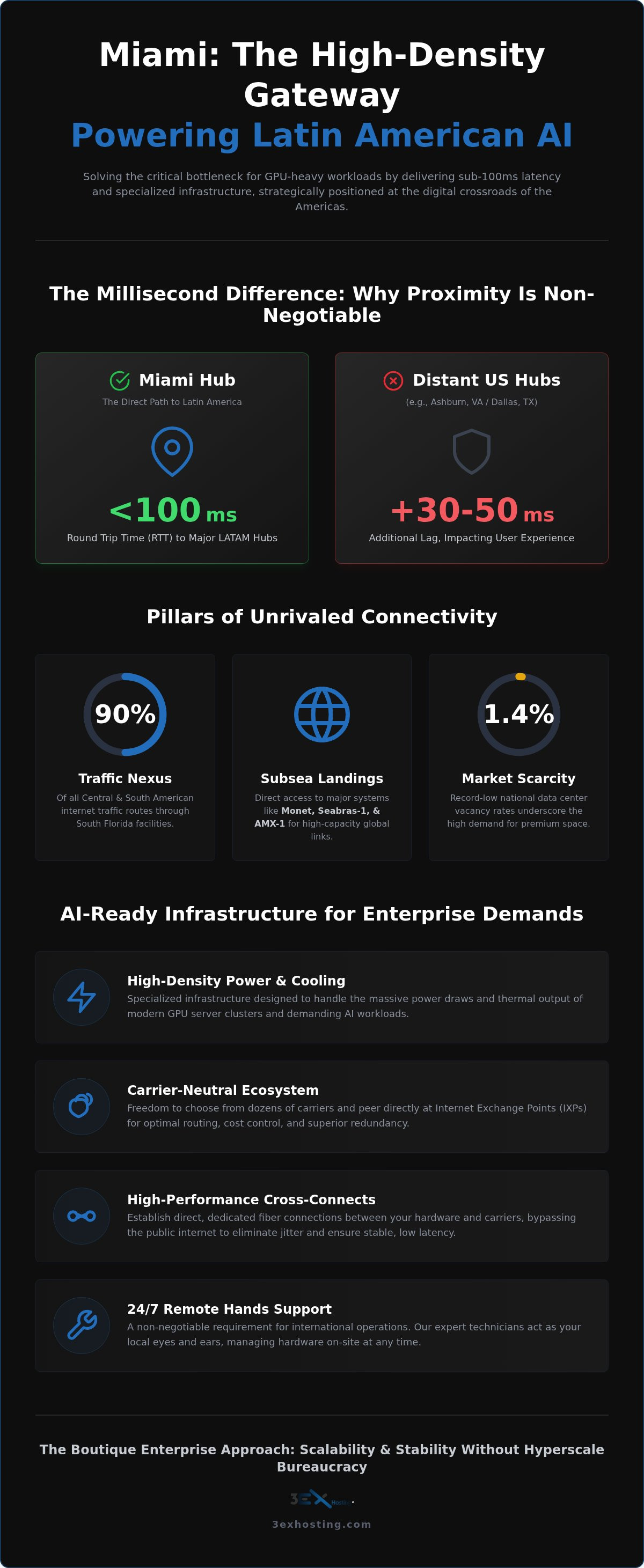
This guide reveals how to secure the sub-100ms latency your enterprise requires while utilizing 24/7 technical support from 3EX Hosting that acts as your local eyes and ears. We’ll examine the impact of 2026 regulatory shifts and how to secure scalable, high-density cabinet space in a market where national vacancy rates have hit record lows of 1.4%. Discover how to balance low-latency interconnection with the specialized infrastructure necessary for the AI-driven demands of the coming year.
Key Takeaways
- Understand why Miami serves as the primary Network Access Point (NAP) and how subsea cable landings ensure sub-100ms latency for major Latin American hubs.
- Learn how to leverage carrier-neutral networking and high-performance cross-connects to bypass the public internet for superior redundancy and cost control.
- Discover how to select a Miami data center for Latin America that provides the high-density power required for 2026 AI and GPU server clusters.
- Identify why 24/7 remote hands support is a non-negotiable requirement for managing hardware in Miami from international locations like Bogotá or Mexico City.
- Explore the benefits of a boutique enterprise approach that offers scalable cabinet space and technical stability without hyperscale bureaucracy.
The Strategic Role of Miami Data Centers for Latin America
Miami acts as the primary logical and physical gateway for the Western Hemisphere. It’s the central nervous system where North American backbones meet Latin American regional networks. Over 90% of all internet traffic originating from Central and South America routes through South Florida facilities. This massive concentration of data is anchored by the NAP of the Americas, which serves as a critical massive-scale exchange point. For any enterprise, selecting a Miami data center for Latin America isn’t just a geographic choice; it’s a strategic move to secure the most direct path to emerging markets.
The region has evolved from a simple transit point into a sophisticated edge computing hub. In previous decades, Miami merely passed traffic through to Virginia or New York. Today, it hosts the actual compute resources. This shift solves the “middle-mile” latency problem for countries like Brazil, Chile, and Colombia. When organizations deploy a Miami data center for Latin America, they’re positioning their infrastructure at the edge of the continental shelf, effectively shortening the digital distance to their end users.
The Gravity of Subsea Cable Landings
Physical fiber dictates the speed of the internet. Miami is the landing site for major subsea systems like Monet, Seabras-1, and AMX-1, which provide high-capacity links directly to São Paulo and Rio de Janeiro. These systems are the lifeblood of international connectivity. Direct proximity to these landings reduces hop counts and significantly lowers the risk of packet loss. 3EX Hosting operates as a carrier hotel, consolidating these international fiber paths into a single environment. This allows clients to use full cabinet colocation to connect directly to the subsea backbones, bypassing the congestion of the public internet.
Latency Benchmarks: Miami vs. Other US Hubs
The performance difference between Miami and other major US hubs is stark. A Round Trip Time (RTT) from Miami to Buenos Aires typically stays well within the sub-100ms range. In contrast, routing that same traffic through Ashburn, Virginia, or Dallas, Texas, can add 30 to 50 milliseconds of additional lag. For the financial and gaming sectors, this difference is the margin between a functional service and a failed user experience. High-frequency trading and real-time multiplayer environments demand the lowest possible response times. Because light can only travel so fast through fiber optics, physical distance remains the only absolute constraint on network speed that hardware alone cannot overcome.
Interconnection and Carrier-Neutral Networking
Carrier-neutrality defines the technical freedom of your infrastructure. In a neutral environment, you aren’t forced to use a single provider’s bandwidth. Instead, you can choose from dozens of carriers to find the best route to specific markets like Bogotá or Santiago. This competitive landscape keeps costs low while providing the redundancy necessary for enterprise-grade uptime. A high-quality Miami data center for Latin America acts as a neutral meeting ground where global backbones and local ISPs converge.
Building a multi-homed network requires more than just raw bandwidth. By utilizing Miami-based Internet Exchange Points (IXPs), you can peer directly with regional networks. This reduces the number of hops your data takes. In the 2026 landscape, we’re seeing a rapid shift toward software-defined interconnection. This allows engineers to provision virtual circuits to cloud providers or other data centers in minutes rather than weeks. Miami remains the Gateway to the Americas because it offers the highest density of peering opportunities in the southern United States.
Maximizing Performance with Cross-Connect Services
Standard IP transit often subjects your traffic to the unpredictability of the public internet. When you deploy a Miami data center for Latin America, you should prioritize direct physical links to achieve the stability required for financial or medical applications. Cross-Connect Services establish a dedicated fiber connection between your cabinet and a carrier’s equipment. This eliminates jitter and ensures your latency remains constant. Economically, cross-connects are often more cost-effective for high-volume traffic than traditional metered transit, as they provide a fixed-cost path for your most critical data flows.
The Carrier Hotel Ecosystem
Operating within a carrier hotel is vital for maintaining ISP diversity. You gain immediate access to Tier 1 and Tier 2 providers within a single physical campus. This proximity is the ultimate safeguard against outages. If a primary subsea cable like Seabras-1 experiences a fault, a well-architected network can failover to an alternative path, such as Monet, within milliseconds. This level of resilience is only possible when your provider offers a rich ecosystem of interconnectivity. If you’re ready to optimize your network path, you can request a custom connectivity map for your specific LatAm targets.
High-Density Colocation: Powering AI for the Americas
The 2026 digital landscape has fundamentally shifted the power requirements for enterprise infrastructure. Traditional data centers often struggle with 5kW or 10kW per rack limits. Modern AI and machine learning workloads, specifically those utilizing NVIDIA H100 or B200 clusters, require much more. These systems can draw 30kW to 40kW per cabinet. Without specialized infrastructure, these clusters will trigger thermal shutdowns or overload standard circuits. As the epicenter of commerce for Latin America, Miami must now provide the electrical and thermal headroom to support these “AI-ready” deployments.
Managing the thermal load of these clusters in a subtropical climate presents unique engineering challenges. High humidity and ambient temperatures in South Florida mean that cooling systems must be exceptionally efficient. A professional Miami data center for Latin America uses advanced containment strategies and high-efficiency chilled water systems to maintain stable operating temperatures. This ensures that your hardware performs at peak efficiency regardless of the external weather conditions. Maintaining this stability is critical for long-running training jobs that cannot afford unexpected downtime.
Infrastructure for AI Infrastructure and GPU Clusters
Modern GPU dedicated servers demand a level of power density that legacy facilities simply cannot provide. High density GPU colocation requires specialized electrical distribution that supports high-amperage feeds directly to the rack. Raw power availability and cooling capacity have surpassed floor space as the primary bottlenecks for scaling enterprise AI initiatives. To maintain mission-critical continuity, 3EX Hosting utilizes N+1 power redundancy. This architecture ensures that training runs or inference workloads continue uninterrupted even during utility maintenance or equipment failure.
Full Cabinet vs. Custom Cage Solutions
As your compute needs grow, your physical footprint must adapt. Many enterprises start with full cabinet colocation for initial testing or smaller inference clusters. However, as you scale to dozens of GPU nodes, transitioning to cage solutions or private suites becomes necessary. These configurations offer enhanced physical security for your AI assets and allow for customized power distribution units (PDUs). Custom PDUs enable precise monitoring of high-draw hardware, helping you manage energy costs while preventing circuit overloads. This level of customization is essential for any enterprise using a Miami data center for Latin America to drive regional innovation.
Operational Security and Remote Management
Managing physical hardware across international borders presents a significant logistical hurdle. If a server requires a hard drive swap or a manual power cycle, sending an engineer from Bogotá or Mexico City isn’t just expensive; it’s a threat to your uptime. A professional Miami data center for Latin America must provide more than just floor space. It must serve as a physical extension of your own IT team. This “local eyes and ears” approach ensures that technical issues are resolved in minutes rather than days.
Security isn’t just about software firewalls. Physical protocols must meet rigorous international standards to protect your investment. Facilities should maintain SSAE 18 compliance and utilize multi-factor authentication, including biometric access at all entry points. 24/7 surveillance and on-site security personnel ensure that your high-density AI assets remain protected from unauthorized physical access. When you’re thousands of miles away, knowing that your infrastructure is housed in a fortress provides the stability your enterprise requires.
24/7 Remote Hands: Your On-Site Engineering Team
Skilled technicians handle the manual labor that keeps your network running. Common tasks include precision cable management, drive swaps, and power cycling. This eliminates the need for international travel, providing a clear ROI for IT budgets. 3EX Hosting provides Remote Hands Support with strict Service Level Agreements (SLAs). Emergency response times are guaranteed. You’ll have the peace of mind that a qualified professional is always standing by to act on your behalf. If you need a local team to manage your Florida infrastructure, contact our engineering team for a support consultation.
Disaster Recovery and Business Continuity
Miami’s subtropical climate requires specific resilience strategies for 2026. Data centers must be located outside immediate flood zones to minimize risk during hurricane season. Robust disaster recovery solutions include N+1 power redundancy and on-site fuel reserves for backup generators. Regular load testing of these generators is a standard protocol to ensure continuity during utility failures. Additionally, enterprises using a Miami data center for Latin America must navigate data sovereignty. Understanding how US data protection laws interact with Latin American regulations is essential for maintaining legal compliance across different jurisdictions. Our facility is designed to meet these complex regulatory and environmental challenges head-on.
Choosing 3EX Hosting for Your Latin American Expansion
Selecting the right Miami data center for Latin America is the final step in securing your regional digital strategy. While hyperscale providers offer massive footprints, they often come with rigid bureaucracy and standardized support that fails to address the unique needs of international enterprises. 3EX Hosting provides a boutique enterprise alternative. We combine the technical capabilities of a Tier 1 carrier hotel with the agility of a dedicated engineering team. This balance is essential for companies that need custom configurations and rapid deployment without the delays of a global corporate hierarchy.
Our focus on technical stability means your infrastructure is managed by experts who understand the nuances of high-density AI clusters and cross-continental networking. We don’t just provide space; we provide a foundation for growth. For organizations expanding from South America, our specialized move-in assistance simplifies the logistical challenges of shipping and installing hardware in a foreign jurisdiction. We act as your local partner, ensuring your equipment is racked, stacked, and connected to the global backbone with precision.
The 3EX Hosting Advantage
The core of our service is a carrier-neutral ecosystem designed for ultra-low latency. By positioning your hardware with us, you gain direct access to the fiber paths discussed in previous sections, ensuring your users in Brazil or Chile experience seamless performance. We’ve optimized our facility for the 2026 power demands of AI and GPU workloads, offering scalable colocation in Miami that standard providers cannot match. Beyond raw power, our expert managed it infrastructure support provides the high-level oversight necessary to maintain complex systems. This combination of physical resilience and technical expertise makes us the premier choice for any Miami data center for Latin America.
Next Steps: From Quote to Deployment
Moving from planning to execution starts with a clear understanding of your requirements. We provide a technical consultation to assist with cage design and power distribution planning, ensuring your infrastructure is built for 2026 and beyond. You can request a custom colocation quote to see how our solutions align with your budget and performance goals. Once the design is finalized, our onboarding process is streamlined for speed. Contact 3EX Hosting today to bridge the gap to Latin America and secure your place in the most connected hub in the Western Hemisphere.
Securing Your Infrastructure for the Future of Latin American Connectivity
Miami’s role as the primary network access point for the Western Hemisphere is solidified by its subsea cable density and evolving high-density power capabilities. As AI workloads continue to dominate the 2026 landscape, your infrastructure must balance low-latency connectivity with the thermal and electrical headroom required for modern GPU clusters. Choosing a Miami data center for Latin America that operates as a strategic carrier hotel ensures you remain at the intersection of global backbones and regional local loops.
3EX Hosting provides the technical stability and on-site expertise necessary to bridge the gap between North and South America. With N+1 redundant power infrastructure and 24/7/365 on-site remote hands engineering, your systems are managed by professionals who act as your local eyes and ears. We’ve designed our facility to handle the most demanding enterprise requirements while maintaining a boutique focus on your specific deployment goals.
Ready to optimize your regional footprint? Get a Custom Miami Colocation Quote today and secure a reliable foundation for your Latin American expansion. We look forward to supporting your technical success in this dynamic market.
Frequently Asked Questions
Why is Miami considered the gateway to Latin America for data centers?
Miami is the primary landing point for the majority of subsea fiber optic cables connecting North and South America. This physical concentration of infrastructure allows traffic to bypass congested routes, making it the logical hub for regional connectivity. The city hosts the NAP of the Americas, where global backbones and local ISPs converge. This established ecosystem provides the technical stability required for large-scale enterprise expansion into the Southern Hemisphere.
What is the typical latency from a Miami data center to Brazil?
Typical Round Trip Time (RTT) from Miami to São Paulo is sub-100ms. This performance is achieved through direct subsea systems like Seabras-1 and Monet. Using a Miami data center for Latin America ensures your traffic follows the shortest physical path possible. This low latency is critical for real-time applications, financial services, and gaming sectors that demand immediate response times for a functional user experience.
How do Miami data centers handle hurricane season and power outages?
Professional facilities are built outside of immediate flood zones and feature N+1 or 2N power redundancy. They maintain on-site fuel reserves and backup generators that undergo regular load testing. These systems ensure mission-critical continuity even during extreme weather events. By utilizing high-efficiency cooling and robust structural designs, these data centers provide a stable environment for international deployments regardless of the subtropical climate challenges.
What are the benefits of a carrier-neutral data center for LatAm traffic?
Carrier-neutrality allows you to choose from multiple network providers within a single facility. This competition lowers costs and provides the redundancy needed to reroute traffic if a specific carrier experiences an outage. It prevents vendor lock-in and gives you the flexibility to optimize routes for specific countries. You can build a multi-homed network that leverages several subsea paths to ensure the highest possible availability for your regional users.
Can I manage my Miami servers remotely without sending staff from Latin America?
You can utilize 24/7 remote hands engineering to act as your on-site technical team. These experts handle physical tasks like hardware swaps, cable management, and power cycling on your behalf. This approach eliminates the need for expensive international travel from Bogotá or Mexico City. It ensures that your infrastructure is managed by qualified professionals who understand the specific technical requirements of your Miami-based hardware around the clock.
Does 3EX Hosting support high-density power for AI and GPU servers?
3EX Hosting specializes in high-density power configurations that support 30kW per rack and beyond. Our infrastructure is designed to handle the thermal and electrical demands of modern GPU clusters. We provide the specialized cooling and N+1 power redundancy required for continuous AI training and inference workloads. This ensures that your high-performance hardware operates at peak efficiency without the risk of thermal shutdowns or power overloads.
What compliance standards should I look for in a Miami colocation provider?
You should prioritize providers that maintain SSAE 18 (SOC 1 and SOC 2) compliance to ensure rigorous operational and security controls. Look for facilities with multi-factor biometric access and 24/7 surveillance. These standards guarantee that your data and physical hardware are protected according to international security protocols. Compliance ensures that your colocation environment meets the audit requirements necessary for financial, medical, or government-level data processing.
How fast can I deploy a full cabinet at 3EX Hosting?
Deployment timelines depend on your specific power and cage requirements, but our boutique approach allows for rapid onboarding. We offer specialized move-in assistance to streamline the installation of your hardware. Once the technical consultation and design phase are complete, we work quickly to get your Miami data center for Latin America operational. Our engineering team prioritizes efficiency to ensure your regional expansion stays on schedule without bureaucratic delays.