 SUPPORT


 3EX United States
 Blog
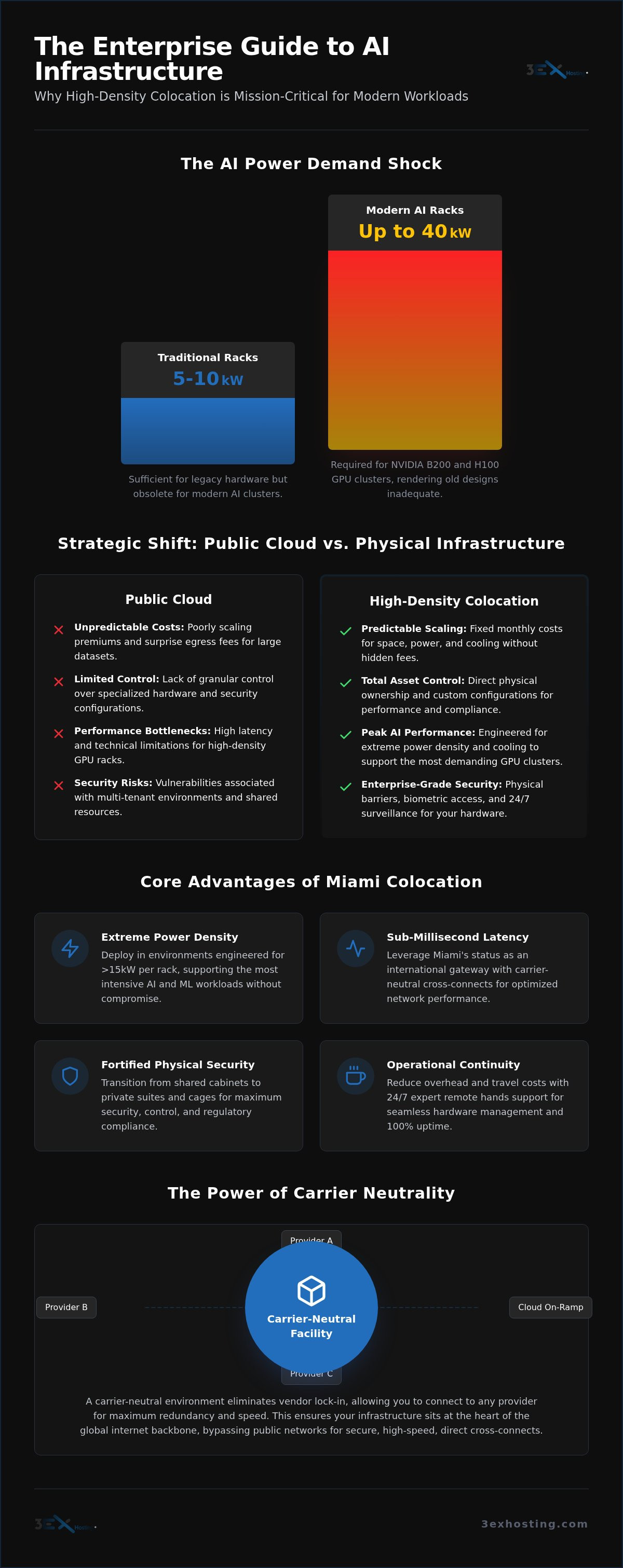
Modern AI clusters like the NVIDIA B200 now demand up to 40kW per cabinet, a requirement that renders traditional data center designs obsolete almost overnight. If you’re managing enterprise hardware, you’ve likely felt the pressure of high latency in standard cloud deployments or the anxiety of a rack that can’t pull enough power. Relying on outdated infrastructure isn’t just a bottleneck; it’s a risk to your uptime. Selecting the right Miami colocation services is no longer about finding floor space. It’s about securing the power density and interconnection speed required for the AI era.
We understand that your priority is technical stability and predictable scaling. This guide provides a roadmap to optimize your hardware deployment with high-density power, advanced security protocols, and national-scale connectivity. You’ll discover how to achieve seamless 100% uptime while reducing operational overhead through expert remote hands support. We’ll examine the 2026 infrastructure landscape, including the impact of Florida’s SB 484 regulations, to ensure your AI and ML workloads remain fast, secure, and fully scalable.
Key Takeaways
- Support intensive AI and machine learning workloads by deploying in environments engineered for high-density power requirements exceeding 15kW per rack.
- Evaluate the strategic shift from standard cabinets to private suites to ensure maximum physical security and regulatory compliance for enterprise-grade hardware.
- Optimize your network performance using Miami colocation services to achieve sub-millisecond latency through carrier-neutral cross-connects.
- Reduce operational overhead and travel costs by utilizing 24/7 remote hands support for seamless hardware management from any location.
- Master the transition from public cloud to physical infrastructure to regain control over technical performance and long-term scaling costs.
Strategic Advantages of Miami Colocation Services for Enterprise
For data-intensive enterprises, a colocation data center serves as a high-performance alternative to the public cloud. While cloud environments offer convenience, they often fail to provide the granular control required for specialized hardware. Modern Miami colocation services provide the physical foundation for companies to deploy their own server assets while benefiting from industrial-grade cooling, power redundancy, and high-speed network fabrics. This model ensures that mission-critical data remains under direct physical control; it reduces the risks associated with multi-tenant cloud vulnerabilities. Security isn’t just a software layer here. It involves biometric access, 24/7 surveillance, and physical barriers that ensure your hardware remains untouched by unauthorized personnel.
The Shift from Cloud to High-Density Colocation
In 2026, the cost-performance ratio has shifted back toward owned hardware. Public cloud instances for AI and ML workloads often carry a premium that scales poorly as datasets grow. By utilizing Miami colocation services, enterprises can deploy high-density GPU racks that are often technically unsupported in a standard cloud environment. Physical control over assets also addresses data sovereignty concerns. It allows for custom security configurations that meet strict compliance standards. This control is essential for industries handling sensitive intellectual property or regulated financial data. You aren’t just renting a rack. You’re securing a perimeter for your most valuable digital assets. Moving back to physical hardware allows for predictable monthly costs without the surprise egress fees associated with major cloud providers.
Carrier Neutrality: Why Interconnection Matters
A carrier-neutral facility acts as a central connectivity hub where multiple network providers converge. This environment eliminates vendor lock-in by allowing you to switch between or combine services from different telecommunications companies. Carrier neutrality is the ability to connect to any provider without restriction. This diversity ensures maximum redundancy. If one provider experiences an outage, your traffic can be rerouted through another instantly. Miami’s status as a major international gateway makes these interconnections vital for reducing national and international network latency. Accessing a carrier hotel through cage colocation or private data center suites ensures your infrastructure sits at the heart of the global internet backbone. This connectivity is a prerequisite for real-time data processing and global service delivery. It allows your team to establish direct cross-connects to partners and service providers, bypassing the public internet for better speed and security.
Engineering for AI: High-Density Power and GPU Hosting
Engineering for AI requires a departure from traditional data center architecture. As of August 2026, modern AI and machine learning workloads, particularly those utilizing NVIDIA H100 or B200 clusters, can require 30kW to 40kW per cabinet. This staggering power draw makes standard 5kW to 10kW racks obsolete for enterprise AI training. When selecting Miami colocation services, the primary technical hurdle is no longer floor space. It’s the facility’s ability to deliver and cool high-density power without compromising the N+1 redundancy model. This technical excellence supports Miami’s role as a gateway to Latin America, where high-growth tech firms increasingly rely on South Florida’s infrastructure to power regional AI operations.
Power Density Requirements for Modern GPU Clusters
Calculating the power draw for an AI-ready full cabinet is the first step in avoiding mid-deployment bottlenecks. Enterprise teams must account for both the peak draw of GPU clusters and the overhead of high-speed networking hardware. For a deep dive into hardware-specific power profiles, consult our technical guide on high density GPU colocation. Beyond raw capacity, look for metered power options. This ensures transparent enterprise billing, where you only pay for the energy your hardware actually consumes. It eliminates the guesswork of flat-rate pricing and allows for better budget forecasting as your AI inference clusters scale.
Thermal Management and Uptime Guarantees
Extreme thermal loads are the natural byproduct of high-density computing. Without sophisticated cooling strategies, high-end GPUs will throttle their performance or suffer permanent hardware failure. Modern facilities utilize advanced airflow management and N+1 cooling redundancy to maintain a stable environment even during peak processing cycles. This isn’t just about preventing crashes. It’s about protecting your investment. Consistent temperature and humidity control can extend the lifespan of server assets by years. Every enterprise deployment should be backed by an SLA that guarantees 100% uptime for both power and cooling. If you’re ready to secure a stable environment for your hardware, you can request a technical consultation to review your specific cooling needs.
Infrastructure Options: Full Cabinets vs. Private Suites
Choosing between a single cabinet and a private suite depends on your current power density needs and your three year growth forecast. For many enterprises, the transition point occurs when the need for physical isolation or complex internal networking outweighs the convenience of individual racks. High tier Miami colocation services provide a modular path from a single footprint to a fully enclosed environment. This ensures your infrastructure doesn’t outgrow its surroundings. Technical leaders must evaluate not just the space they need today, but the power and cooling headroom required for the next generation of hardware.
Full Cabinet Colocation: The Enterprise Standard
Standardizing your deployment starts with full cabinet colocation. This option provides a dedicated, lockable 42U or 48U rack, which serves as the baseline for mid sized enterprise loads. It’s the most efficient way to secure specialized hardware while maintaining immediate access to facility wide redundancies. These cabinets are designed for optimal airflow and power distribution, allowing for a “plug and play” experience for standard server configurations.
- Dedicated PDUs for precise power management.
- Immediate integration with cross connect services for sub millisecond latency.
- Lockable front and rear doors to ensure physical asset integrity.
This setup is ideal for companies that need technical stability without the operational overhead of a larger footprint. It allows your team to focus on software performance while the facility handles the foundational environment.
Private Suites and Custom Cage Solutions
When your hardware requires higher levels of physical isolation or strict compliance, private data center suites become necessary. Regulatory frameworks like HIPAA or PCI DSS often mandate that sensitive data assets be stored behind additional physical barriers. A cage colocation setup allows for custom internal networking and power distribution that isn’t possible in a shared row. You gain the ability to design your own rack layout, which is critical for complex internal cabling or non standard equipment sizes.
These solutions offer multi layered security protocols. You can implement your own biometric access controls and dedicated surveillance cameras within the cage. This ensures a verifiable chain of custody for every piece of equipment. Beyond security, cages provide the physical space to design for future expansion. You can pre provision floor space for upcoming GPU clusters. This ensures your Miami colocation services grow alongside your AI initiatives without the need for a full facility migration. Customizing your power distribution within a cage also allows for tailored N+1 or 2N configurations that match the specific resilience needs of your enterprise software stack.
Operational Continuity via Remote Hands and Connectivity
Operational efficiency for national enterprise teams depends on minimizing the need for physical travel. When your primary IT staff is based in a different state, the cost of flying a technician to Florida for a simple hardware reboot or cable swap is prohibitive. High quality Miami colocation services eliminate this overhead by providing on site technical expertise. This ensures that your infrastructure remains functional without requiring your team to be physically present. By leveraging localized support, you can maintain high availability while focusing internal resources on strategic development rather than hardware maintenance.
Remote Hands Support: Your On-Site Technical Team
The primary value of remote hands lies in immediate response times. Having a technician available 24/7/365 within the facility significantly reduces your Mean Time To Repair (MTTR). These specialists handle a wide range of critical tasks, including server reboots, structured cabling, and physical hardware audits. For a detailed look at how to integrate these services into your operational workflow, see our guide on remote hands support. This on site presence acts as an extension of your own department. It provides the peace of mind that a qualified professional is always within reach of your racks, ready to troubleshoot power issues or swap out failing components at a moment’s notice.
Maximizing Performance with Cross-Connects
Network performance in a data center environment is often limited by the reliance on public IP transit. While functional, public routes introduce unpredictable latency and security risks. Private cross connects provide a direct, physical link between your equipment and your partners, cloud on ramps, or financial exchanges. This dedicated infrastructure allows you to achieve sub millisecond latency, which is essential for high frequency trading or real time AI data processing. By bypassing the public internet, you also reduce network overhead and improve overall security. These direct links are a core component of Miami colocation services, enabling seamless hybrid cloud models where data moves between private hardware and managed cloud environments without bottlenecks. If your current network feels sluggish, you can optimize your connectivity by establishing direct interconnections today.
Beyond daily operations, these connectivity options form the backbone of a robust disaster recovery strategy. Utilizing a carrier neutral facility ensures that your business continuity plan isn’t dependent on a single network provider. If a primary link fails, your traffic can be rerouted through a different cross connect instantly. This level of redundancy is vital for enterprises that cannot afford even a few minutes of downtime. It allows for a seamless transition between your primary production environment and your recovery site, ensuring that mission critical data remains accessible regardless of external network conditions.
Implementing Your Infrastructure Strategy with 3EX Hosting
Successful infrastructure deployment requires more than just high density power and floor space. It demands a partnership with a provider that understands the technical nuances of enterprise hardware. 3EX Hosting serves as a stable foundation for companies requiring premium Miami colocation services. We prioritize technical stability, speed, and reliability. Our facility is engineered to handle the most demanding GPU clusters while providing the security protocols necessary for enterprise compliance. By choosing a partner focused on N+1 redundancy and carrier neutral connectivity, you ensure your systems remain performant and secure through every stage of your growth.
Seamless Hardware Migration and Onboarding
As your business expands its technical footprint into new global markets, staying informed about regional administrative costs is essential; for example, enterprisehub.sa provides a comprehensive guide on commercial registration fees for companies looking to establish a presence in Saudi Arabia.
The transition from a local server room or a public cloud environment to a dedicated data center can be complex. We simplify this process by offering technical move-in assistance to minimize deployment downtime. This service is designed to bridge the gap between hardware arrival and full operational status. Our team works with your IT department to execute pre deployment checklists. These lists cover everything from cabinet rail configurations to precise power draw verifications for high density racks. We ensure that your connectivity is live the moment your hardware is racked and stacked. This proactive approach eliminates the common “day one” bottlenecks that often plague enterprise migrations. Your hardware is handled by experienced specialists who understand the sensitivity of modern server components.
Future-Proofing with Scalable Managed Services
Infrastructure needs are rarely static. A strategy that works today must be flexible enough to accommodate the AI and ML breakthroughs of tomorrow. We offer a hybrid approach that blends physical colocation with managed cloud hosting for maximum flexibility. This allows you to keep your most data intensive workloads on dedicated hardware while utilizing the cloud for burstable tasks. Our 24/7 technical partnership means you have an invisible but magisterial support layer working in the background. We monitor the environment and power delivery so your team can focus on software development. This long term collaboration ensures that your Miami colocation services scale seamlessly as your compute requirements increase. Whether you’re expanding a single cabinet or building out a private suite, our facility provides the technical headroom you need. If you’re ready to optimize your deployment, you should Request a custom colocation quote today. Our specialists will help you design a configuration that matches your specific power, cooling, and security requirements.
Securing Your Enterprise Infrastructure for the AI Era
The shift toward high-density computing and specialized AI hardware has redefined the requirements for modern infrastructure. Success in 2026 depends on securing a facility that offers the power density, thermal management, and physical isolation necessary for GPU-heavy workloads. By leveraging Miami colocation services, your enterprise gains a strategic foothold in one of the world’s most connected cities without sacrificing hardware control or technical stability. Physical proximity to global network hubs ensures that your data moves with the speed your users expect.
Operational continuity is no longer a luxury; it’s a requirement. With N+1 power and cooling redundancy and carrier-neutral high-speed connectivity, your systems stay online and accessible during peak demand. Our 24/7 Enterprise Remote Hands ensure that technical expertise is always on-site, even when your team is working remotely. Ready to optimize your deployment? Scale Your Infrastructure with 3EX Hosting Colocation and build a foundation that grows with your technical ambitions. We’re here to ensure your transition is seamless and your systems remain secure.
Frequently Asked Questions
What are the primary benefits of Miami colocation services for national enterprises?
Miami colocation services provide a strategic geographic advantage by acting as the primary gateway to Latin America. National enterprises benefit from subsea cable access and low-latency connections to international markets. These facilities are built to withstand Category 5 hurricanes, ensuring technical stability in a region prone to seasonal weather events. You gain access to a carrier-neutral ecosystem where multiple network providers compete, driving down costs while increasing redundancy and speed for global data delivery.
How does high-density colocation support AI and GPU workloads?
High-density colocation provides the massive power and cooling infrastructure required for modern AI training and inference. Unlike standard data centers that peak at 10kW per rack, these specialized environments support 30kW to 40kW per cabinet. This capacity is essential for running NVIDIA H100 or B200 clusters without thermal throttling. N+1 cooling systems manage the extreme heat generated by these GPU workloads, protecting your hardware investment and ensuring consistent performance during peak processing cycles.
What is the difference between a full cabinet and a private colocation suite?
A full cabinet is a dedicated, lockable 42U or 48U rack within a shared row, whereas a private colocation suite is a fully enclosed cage solution. Cabinets are the standard for mid-sized enterprise deployments that need physical security without a massive footprint. Private suites offer an additional layer of isolation, which is often required for HIPAA or PCI compliance. These solutions also allow for custom rack layouts and dedicated surveillance, providing a higher degree of physical control over your assets.
How does remote hands support reduce operational costs for IT teams?
Remote hands support reduces operational overhead by providing on-site technicians to handle physical tasks like reboots, cabling, and hardware audits. This service eliminates the need to fly your internal IT staff to Florida for routine maintenance or emergency troubleshooting. By utilizing 24/7 technical support within the facility, you significantly reduce your Mean Time To Repair (MTTR). It’s a cost-effective way to manage your Miami colocation services while keeping your core team focused on higher-level software architecture.
What redundancy standards should I look for in an enterprise data center?
You should prioritize facilities that offer N+1 or 2N redundancy for both power and cooling systems. These standards ensure that your hardware remains operational even if a primary component fails. Look for diverse power feeds from different utility grids and robust backup generator configurations. Physical security is equally critical. Verify that the data center uses multi-factor authentication, biometric access controls, and 24/7 on-site security personnel to protect your mission-critical enterprise infrastructure from unauthorized access.
Can I integrate my colocation hardware with managed cloud services?
Yes, most enterprise facilities allow you to blend physical hardware with managed cloud hosting in a hybrid configuration. This setup allows you to keep sensitive or data-intensive workloads on your own servers while using the cloud for burstable compute tasks. By establishing direct cross-connects to major cloud providers, you can move data between environments with minimal latency. It’s a flexible strategy that combines the security of physical control with the scalability of modern cloud services.
How do cross-connect services improve network performance and security?
Cross-connect services establish direct, physical links between your hardware and other network providers or partners within the same facility. These private connections bypass the public internet, which drastically improves security and reduces network jitter. You can achieve sub-millisecond latency, making cross-connects indispensable for real-time data processing and financial transactions. This direct interconnection model also reduces your reliance on third-party IP transit, lowering your overall network costs while providing a more predictable and secure data path.