 SUPPORT


 3EX United States
 Blog
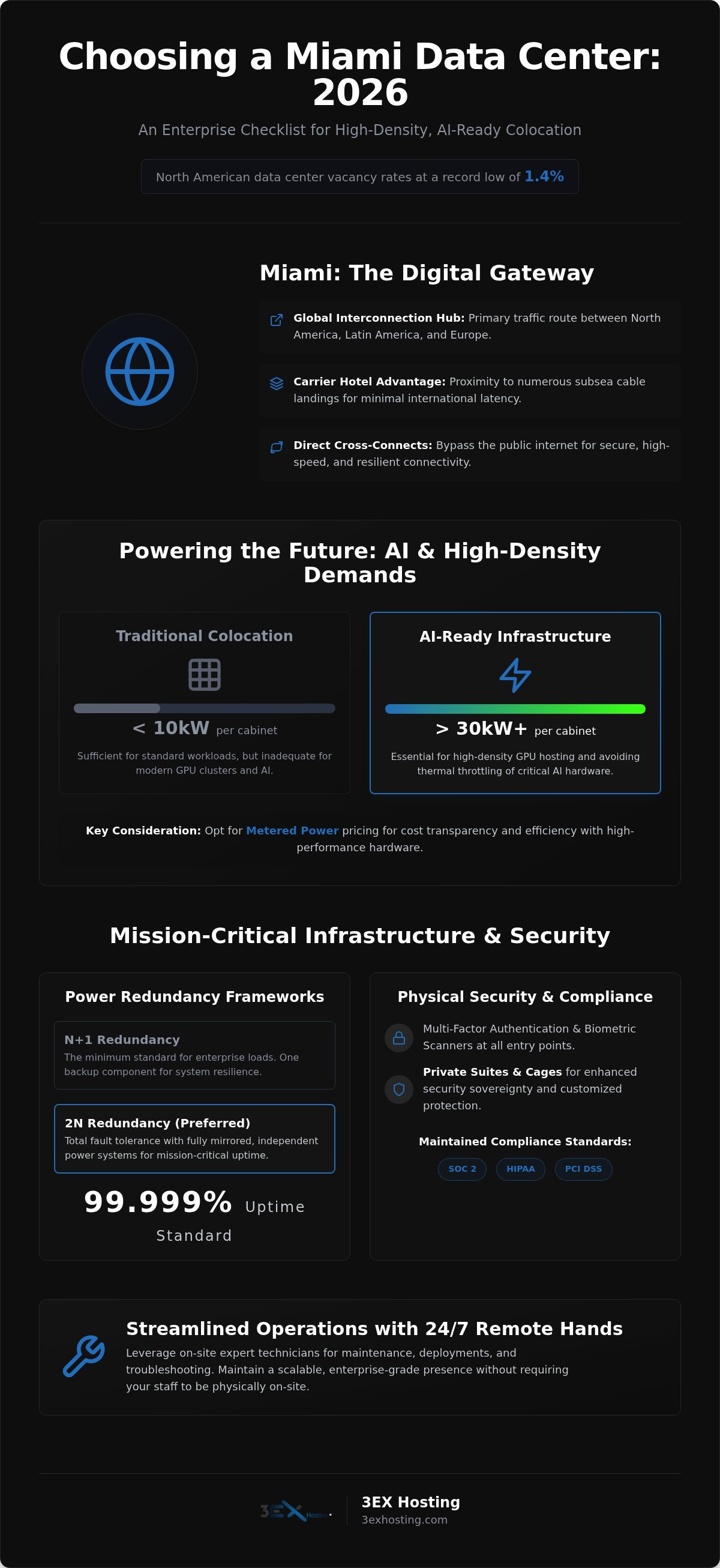
With North American data center vacancy rates hitting a record low of 1.4 percent, securing enterprise-grade infrastructure has become a race against time. For IT leaders, vetting Miami data center providers is no longer just about floor space. It’s about finding a strategic partner capable of supporting 30kW racks and AI-driven workloads while navigating Florida’s shifting tax landscape. You need a facility that offers more than just a roof; you need a high-density hub that acts as a gateway to the Americas.
You’ve likely noticed that traditional facilities are struggling to keep up with the cooling demands of modern GPU clusters. It’s a common pain point, especially when rising power costs and latency issues from restricted carrier access start to eat into your operational efficiency. This guide promises to help you navigate these complexities by identifying the benchmarks for 2026 colocation excellence. We’ll break down how to secure high-density power, leverage carrier-neutral connectivity, and utilize 24/7 remote hands to maintain your systems with total peace of mind. We’ll also examine how new regulatory requirements in Florida impact your long-term infrastructure investment.
Key Takeaways
- Understand why Miami serves as the primary digital gateway for international traffic and how this status influences your global connectivity strategy in 2026.
- Learn how to evaluate Miami data center providers based on mission-critical redundancy standards and physical security protocols like biometric access and custom cage solutions.
- Identify the specialized infrastructure needed for high-density AI workloads, including cooling solutions and power scaling requirements that exceed 10kW per cabinet.
- Discover how leveraging carrier hotels and direct cross-connect services can eliminate latency and reduce reliance on third-party network intermediaries.
- Explore the operational advantages of using 24/7 remote hands and full cabinet colocation to maintain a scalable, enterprise-grade presence without being on-site.
The Strategic Role of Miami Data Center Providers in 2026
Miami’s geographic position has always made it a natural hub for international trade. In 2026, this physical advantage has translated into a digital one. The city now serves as the primary “Digital Gateway” for data traffic moving between North America, Europe, and Latin America. Choosing among Miami data center providers is no longer a localized decision for regional businesses. Instead, it’s a strategic move for enterprises that require a global interconnection hub to manage high volume traffic with minimal delay. With vacancy rates across North American data centers reaching record lows, securing a position in this high-demand market is essential for long-term scalability.
Understanding the Miami Carrier Hotel Advantage
A carrier hotel is a specialized facility where multiple network service providers, internet exchange points, and subsea cable operators physically meet. For an enterprise colocation centre, being located within or directly adjacent to these hubs is critical. This physical proximity allows for direct data center connections that bypass the public internet, significantly reducing national and international latency. Miami’s unique position is bolstered by numerous subsea cable landings connecting the United States to the Southern Hemisphere. Carrier neutrality remains a mandatory requirement. It provides the flexibility to switch network providers without moving hardware, ensuring connectivity remains resilient and cost-effective.
The Evolution of Colocation in the AI Era
The rise of artificial intelligence has fundamentally changed what enterprises need from their colocation partners. We’ve moved beyond the days when floor space and basic power were sufficient. Today, the demand for AI cloud computing hosting requires specialized infrastructure designed for extreme thermal loads. High-density GPU hosting generates heat levels that can overwhelm standard cooling systems. Miami data center providers have had to adapt, offering power configurations that can scale well beyond 10kW per cabinet to support dense AI clusters. This evolution is about technical stability. Secure infrastructure ensures your hardware runs at peak capacity without the risk of thermal throttling. As AI workloads become central to business operations, the focus has shifted toward facilities that can guarantee high-density reliability and specialized 24/7 support.
Critical Selection Criteria for Enterprise-Grade Colocation
Evaluating Miami data center providers requires a technical audit of their power architecture and physical safeguards. For mission-critical enterprise loads, an N+1 redundancy model is the minimum standard, but 2N is preferred for total fault tolerance. This ensures that even during a primary system failure, your hardware remains powered and operational. In 2026, 99.999 percent uptime isn’t a luxury; it’s the baseline for any facility supporting global commerce. You need to know that your provider can handle the load without compromise. For those who also prioritize the physical presentation of their South Florida business facilities, you can visit Pro Turf Greens for premium artificial turf solutions.
As U.S. data center demand continues to surge, auditing power density becomes vital for future growth. You must determine if a provider uses metered power, where you pay for actual consumption, or flat-rate cabinet pricing. For high-performance hardware, metered power often provides better cost transparency and efficiency. Robust disaster recovery solutions should be integrated into the redundancy framework to maintain business continuity during regional power grid fluctuations. If you’re managing complex deployments, it’s often more efficient to consult with a technical specialist about your specific redundancy needs.
Physical security standards have evolved to include multi-factor authentication and biometric scanners at every entry point. Beyond the perimeter, your equipment needs localized protection that prevents unauthorized physical access while allowing your authorized staff to work efficiently.
Compliance and Security Sovereignty
Enterprises handling sensitive data must prioritize facilities that maintain SOC 2, HIPAA, and PCI DSS compliance. For many, a shared floor doesn’t offer enough isolation. This is where private suites provide a significant advantage by ensuring security sovereignty. You can customize cage solutions with dedicated security cameras and motion sensors to meet specific regulatory requirements. This level of control is essential for industries where data residency and physical access logs are strictly audited.
Maintaining a national operation means you can’t always be on-site to handle hardware issues. Having 24/7 remote hands support allows your team to focus on high-level strategy while on-site experts handle hardware swaps, cable management, and visual audits. It’s a critical component of operational reliability for any enterprise choosing Miami as their technical hub. This support ensures that your infrastructure is managed by professionals who understand the urgency of technical stability.
Specialized Infrastructure for AI and High-Density GPU Hosting
Artificial intelligence has fundamentally altered the physical requirements of the modern server room. Legacy facilities designed for standard web hosting often lack the power and cooling capacity to support the intense thermal output of modern GPU clusters. For enterprises, evaluating Miami data center providers now involves a deep dive into their ability to manage high-density workloads. While a standard rack might pull 5kW, AI training clusters frequently require 20kW to 30kW per cabinet. Managing this in Miami’s tropical climate requires advanced engineering to prevent thermal throttling and ensure hardware longevity.
Recent Miami data center development trends show a clear shift toward “GPU-ready” facilities. These sites utilize hot and cold aisle containment or liquid-to-chip cooling to maintain stable operating temperatures. For businesses, this means your high-performance computing (HPC) assets can run at peak clock speeds without risk. It’s about technical stability in an environment where even a minor cooling failure can lead to significant hardware damage.
Designing Racks for High-Performance AI Training
Deploying AI infrastructure requires more than just high-voltage power lines. You need a specialized approach to high density GPU colocation that accounts for weight distribution and airflow optimization. Heavy GPU servers can exceed standard floor load ratings, requiring reinforced structural support. Professional managed IT infrastructure teams play a vital role here. They ensure that power distribution units (PDUs) are balanced and that network cabling doesn’t obstruct the critical airflow needed to cool dense clusters. This level of planning prevents the “hot spots” that plague poorly designed high-density environments.
Scaling GPU Dedicated Servers
Just as IT professionals must optimize every square foot of a server room, homeowners in South Florida can achieve similar organizational excellence in their personal spaces with The Garage RX, a specialist in creating efficient residential storage solutions.
Many enterprises are finding that the public cloud is no longer cost-effective for sustained AI inference tasks. Transitioning to a colocation model with dedicated GPU servers allows for predictable monthly costs and better performance tuning. By placing your hardware with top-tier Miami data center providers, you gain the benefit of physical control over your environment. This is especially effective when combined with low-latency cross-connects. Direct connections to network providers ensure that your AI models can ingest data and deliver results with minimal delay. It’s a hybrid approach that provides the scalability of the cloud with the security and cost-efficiency of private infrastructure.
Network Performance: Leveraging Carrier Hotels and Cross-Connects
Network performance in 2026 is defined by physical proximity. Top-tier Miami data center providers leverage their presence in carrier hotels to offer sub-millisecond latency. A carrier hotel acts as a dense ecosystem where hundreds of networks meet. By utilizing cross-connect services, your enterprise can link directly to ISPs, cloud on-ramps, and partners. This physical cable connection eliminates the “middleman” of the public internet. It results in lower transit costs and significantly higher throughput for data-heavy applications.
Redundancy is another critical factor. Relying on a single network provider is a risk most enterprises can’t afford. A carrier-dense campus allows you to build a multi-homed network strategy. If one carrier experiences an outage, your traffic automatically reroutes through another. This level of resilience directly impacts managed cloud hosting availability. When your core infrastructure is directly connected to the backbone of the internet, your services remain accessible even during regional congestion.
Optimizing the Interconnection Lifecycle
Managing high-speed cross-connects requires a proactive approach to capacity planning. In a carrier-neutral facility, you have the freedom to choose the most cost-effective and highest-performing carriers for your specific needs. You aren’t locked into a single provider’s pricing or performance limitations. This neutrality allows you to peer directly with major ISPs. Direct peering reduces the number of hops your data takes. It’s a technical advantage that ensures your national and international traffic moves with maximum efficiency. Most enterprises find that the initial setup effort pays for itself through reduced monthly transit fees.
Connectivity for Disaster Recovery
Miami serves as a strategic secondary site for disaster recovery for many organizations based in the Northern United States. Its unique subsea cable connectivity provides a reliable path for data if primary terrestrial routes are compromised. A high-speed network failover strategy ensures that your business stays online during a crisis. Implementing these complex network changes often requires on-site expertise. You can leverage remote hands support to handle physical troubleshooting, cable patches, and hardware visual audits. This specialized support allows your IT team to manage the failover remotely while knowing the physical infrastructure is in expert hands. Ready to secure your network’s future? Request a custom connectivity quote today.
Future-Proofing with 3EX Hosting: Custom Colocation Solutions
3EX Hosting stands out among Miami data center providers because we bridge the gap between impersonal hyperscale facilities and basic regional hosts. We provide the technical stability needed for national enterprises while maintaining a high-touch support model. For scaling organizations, full cabinet colocation offers the physical sovereignty and power capacity to grow without the constraints of shared environments. You gain total control over your hardware footprint while benefiting from the infrastructure of a world-class carrier hotel.
Moving hardware across the country is a significant logistical challenge. We offer move-in assistance to ensure that national deployments are handled with precision from day one. Our team manages the rack-and-stack process and initial cabling according to your specifications. This service ensures your engineers don’t have to fly in for basic setup tasks. It’s a professional approach that prioritizes speed and accuracy during the critical transition phase.
Customizing Your Physical Infrastructure
Every enterprise has unique security and spatial requirements that standard data center models often ignore. You can choose from shared space for smaller footprints or specialized cage solutions for partitioned security within a larger room. For those requiring the highest level of data sovereignty, our private suites offer a dedicated, walled-off environment. These enterprise private suites provide the isolation needed for strict compliance and proprietary AI research. We also integrate managed cloud hosting and disaster recovery protocols directly into your physical deployment to create a unified hybrid infrastructure.
Operational Excellence with 24/7 Remote Hands
Efficiency in 2026 is measured by how quickly you can respond to hardware events without being physically present. Our remote hands support acts as an immediate extension of your internal IT team. Whether it’s a simple cable swap, a visual audit, or a complex hardware replacement, our on-site experts are available 24/7 to intervene. This high-touch service model reduces the need for expensive on-site travel and ensures your systems remain operational around the clock. By combining the connectivity of a carrier hotel with this level of technical expertise, we provide a foundation for total peace of mind. Get a custom quote for your Miami colocation needs to see how we can optimize your infrastructure for the year ahead.
Securing Your Infrastructure Advantage in the 2026 Landscape
Miami’s transformation into a global interconnection hub is complete. Selecting from the available Miami data center providers is now a strategic decision that defines your ability to scale AI workloads and maintain international connectivity. Technical stability rests on three essential pillars: high-density infrastructure, robust redundancy, and immediate on-site expertise. You don’t just need space; you need a facility that acts as a reliable gateway to the Americas.
Securing your hardware in a carrier-neutral facility ensures your network remains resilient and cost-effective. By prioritizing N+1 power redundancy and 24/7 remote hands support, you eliminate the risks associated with hardware failure and geographic distance. Your infrastructure should be a silent, powerful engine driving your growth, not a source of operational anxiety. The right partnership allows your team to focus on high-level strategy while professional technicians manage the physical layer with precision.
It’s time to move beyond standard floor space and invest in a solution designed for the future of enterprise computing. Scale your enterprise infrastructure with 3EX Hosting and gain the stability your technical roadmap requires. We’re ready to support your next phase of growth.
Frequently Asked Questions
What makes Miami a strategic location for enterprise data centers in 2026?
Miami serves as the primary digital gateway for data traffic between the Americas and Europe. Its strategic value comes from being a major hub for subsea cable landings and carrier-neutral interconnection points. In 2026, Miami data center providers offer a critical low-latency bridge for enterprises targeting Latin American markets. This geographic advantage, combined with high-density power availability, makes it a preferred national hub for AI infrastructure and global content delivery networks.
How do Miami data center providers handle high-density GPU cooling in a warm climate?
To manage the heat generated by GPU clusters in a tropical climate, Miami data center providers utilize advanced thermal engineering. This includes hot and cold aisle containment, reinforced airflow systems, and specialized liquid-to-chip cooling solutions. These systems prevent thermal throttling by maintaining stable intake temperatures even during peak external heat. Expert management ensures that high-density cabinets pulling 20kW or more remain within operational limits, protecting your hardware’s lifespan and performance.
What is the difference between a standard data center and a carrier hotel?
A standard data center provides space, power, and cooling, but a carrier hotel offers a much higher density of network service providers. Carrier hotels act as meeting points for subsea cables and global backbones. This allows for direct, low-latency cross-connects that bypass the public internet. While standard facilities are suitable for basic hosting, carrier hotels are essential for enterprises requiring massive throughput and diverse network redundancy options.
Can I customize my security with private suites or custom cages at 3EX Hosting?
Yes, 3EX Hosting specializes in tailored physical security environments for sensitive enterprise workloads. You can choose from cage solutions for partitioned security or fully enclosed private suites for maximum sovereignty. These suites offer dedicated walls, biometric access control, and independent security monitoring. This level of customization ensures that your infrastructure meets specific internal audit requirements and regulatory compliance standards while providing a completely isolated operational environment.
How does remote hands support benefit enterprises located outside of Florida?
Remote hands support acts as an immediate extension of your internal IT team, eliminating the need for expensive on-site travel. For national enterprises, having 24/7 access to on-site technicians means hardware swaps, cable management, and visual audits happen in real-time. This service is critical for maintaining technical stability from afar. It ensures that any physical issue is addressed by experts who understand your infrastructure’s specific requirements without delay.
What certifications should I look for in a Miami colocation provider?
At a minimum, you should verify that a provider maintains SOC 2 Type II, HIPAA, and PCI DSS certifications. These audits prove that the facility adheres to strict operational, security, and data handling protocols. For enterprises in 2026, these certifications are non-negotiable for ensuring compliance with national data privacy laws. You should also audit the provider’s power redundancy standards, looking for N+1 or 2N architectures to guarantee mission-critical uptime.
How do cross-connect services improve my managed cloud performance?
Cross-connect services provide a direct physical link between your hardware and your cloud service providers. By bypassing the public internet, you significantly reduce latency and eliminate the risk of network congestion. This direct path improves throughput and ensures consistent performance for hybrid cloud applications. It’s an essential technical component for enterprises that rely on high-speed data transfers between their colocation environment and managed cloud hosting platforms.
What disaster recovery solutions are available for national enterprises in Miami?
Miami is a strategic choice for disaster recovery due to its unique network path diversity. National enterprises use Miami as a secondary site to ensure business continuity if primary terrestrial routes in the Northern U.S. are compromised. Solutions include high-speed network failover, automated data replication, and dedicated recovery suites. These services leverage Miami’s subsea cable connectivity to provide a resilient backup path that remains operational even during large-scale regional network disruptions.