 SUPPORT


 3EX United States
 Blog
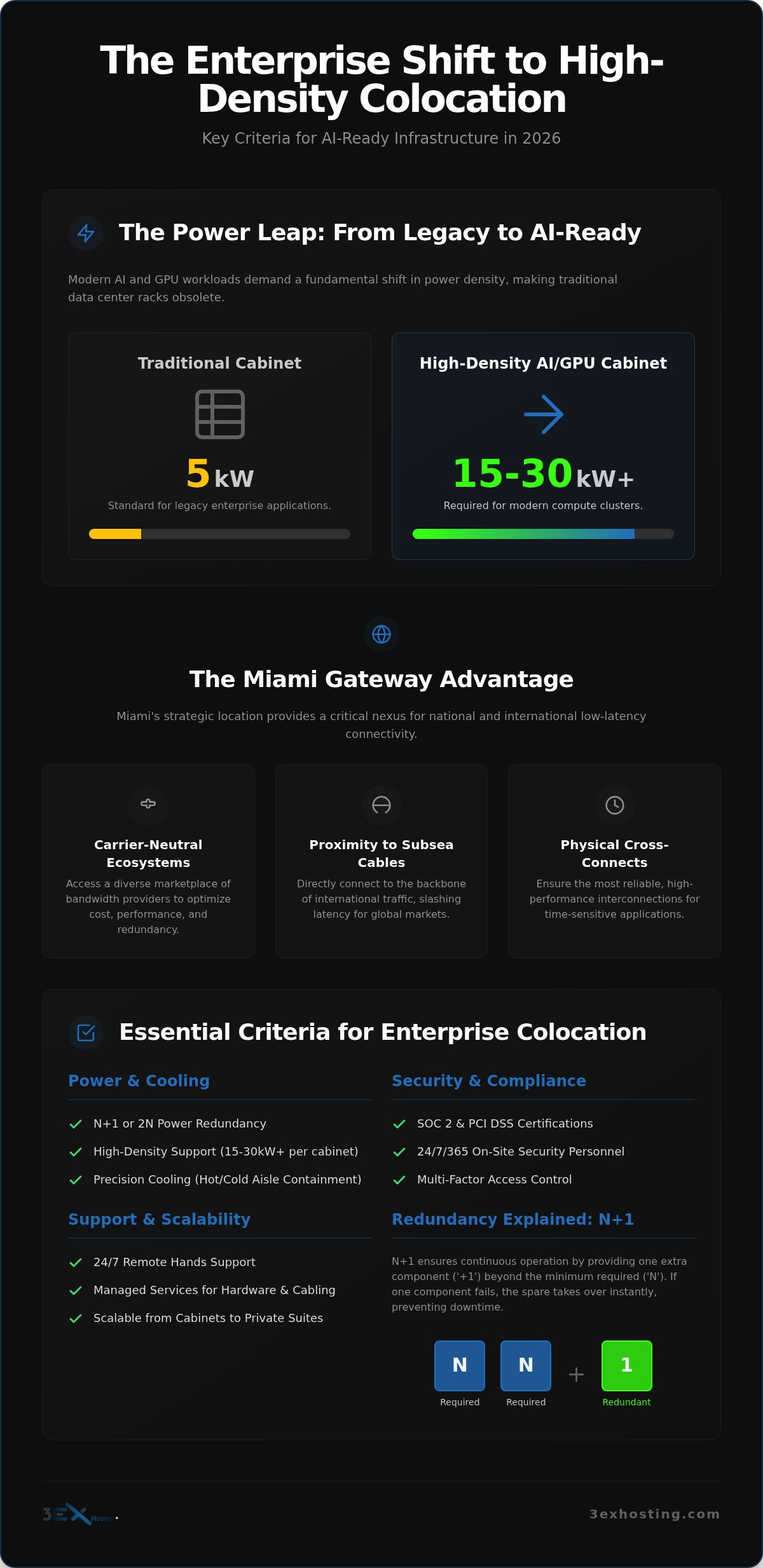
Your next infrastructure decision in 2026 isn’t about how much floor space you can lease, but how many kilowatts you can pull through a single rack. As AI workloads and GPU clusters become the enterprise standard, the traditional 5kW cabinet has become a relic of the past. Selecting from the top Miami data center providers now requires a focus on high-density power capabilities and robust cooling systems that can handle 15kW to 30kW per rack. You likely understand the frustration of hitting power ceilings or dealing with international latency that disrupts your global operations.
It’s a common challenge for remote teams who need more than just a cage; they need reliable, on-site support and a secure, N+1 redundant environment. This guide provides the technical criteria you need to evaluate the Miami gateway’s connectivity advantages. You’ll discover how to access a carrier-neutral ecosystem and choose scalable cabinet options that ensure your hardware remains stable. We’ll break down the infrastructure essentials that turn a simple colocation site into a high-performance engine for your business growth.
Key Takeaways
- Learn why enterprise demand is shifting toward high-density colocation to support evolving 2026 technical roadmaps.
- Identify the technical criteria for selecting Miami data center providers capable of hosting power-hungry AI and GPU clusters.
- Discover how carrier-neutral ecosystems and physical cross-connects significantly lower latency for national and international traffic.
- Understand how 24/7 remote hands support acts as a reliable extension of your team for hardware swaps and cabling.
- Evaluate the advantages of N+1 redundant environments and scalable suite options for long-term infrastructure stability.
Navigating the Market for Miami Data Center Providers
The strategic intersection of national and international network paths has evolved into a critical nexus for enterprise data exchange. For infrastructure leaders, evaluating Miami data center providers is no longer just about finding a place for servers. It’s about securing a position within a high-performance connectivity ecosystem. In 2026, the market has shifted away from simple retail hosting toward specialized high-density colocation that supports AI-ready hardware. This transition is driven by the need for massive compute power and the ability to process global traffic without bottlenecks.
A modern colocation centre must act as a carrier hotel to be viable for enterprise use. This distinction is vital. Retail facilities often lock you into a limited set of bandwidth providers. Enterprise-grade carrier hotels offer carrier neutrality. This allows you to design vendor-agnostic networks that scale with your national footprint. By choosing a facility with a dense ecosystem of providers, you gain the leverage to negotiate better transit rates and improve your network’s overall redundancy. It’s a technical advantage that ensures your data reaches its destination via the most efficient path possible.
Defining Your Infrastructure Requirements
Every deployment starts with a clear assessment of current rack needs versus three-year growth projections. National enterprises often find that standard power densities fail to meet the demands of modern GPU clusters. High-density environments are now the baseline. Beyond power, physical security and compliance standards like SOC 2 and PCI DSS are non-negotiable. These certifications ensure that your data remains protected under rigorous, audited protocols. You need to verify that your partner can scale from a single cabinet to private colocation suites as your compute requirements expand.
The Value of a Strategic Carrier Hotel
Proximity to subsea cable landing sites defines the modern network landscape. These cables are the backbone of international traffic. Being physically close to them slashes latency for global markets. For financial services and cloud-native applications, every millisecond counts. A strategic carrier hotel provides the low-latency interconnections required for high-frequency trading and real-time data processing. This connectivity is a core feature of an enterprise data center. Accessing these ecosystems ensures that your national network remains resilient and your international traffic stays on the fastest possible paths.
High-Density Infrastructure: Power and Cooling for AI-Ready Workloads
The legacy model of data center design relied on a standard 5kW rack capacity. In 2026, this approach is no longer sustainable for enterprises deploying AI and machine learning workloads. Modern GPU clusters require significantly more power and specialized thermal management. When you evaluate Miami data center providers, the most critical metric is now power density per cabinet. High-performance computing (HPC) environments demand a different architectural approach to power distribution and redundancy. You should look for facilities that offer N+1 or 2N power configurations. This ensures your systems remain operational even during equipment maintenance or utility failure. Reliability isn’t just about floor space; it’s about the technical stability of the power grid within the facility.
GPU Hosting and AI Infrastructure Needs
AI training clusters generate unique thermal profiles that standard cooling systems can’t handle. These servers pull massive amounts of current, creating intense heat pockets that can lead to hardware throttling or failure. Specialized high density GPU colocation provides the necessary power delivery and airflow to keep these systems stable. Leading Miami data center providers have adapted to these requirements by treating their facilities as strategic assets in the data center industry. These locations combine massive power capacity with the connectivity required for distributed AI training and real-time inference workloads.
Evaluating Cooling and Environmental Controls
Precision cooling is the backbone of high-wattage deployments. It isn’t enough to simply lower the ambient temperature of the room. You need focused environmental controls that address heat at the source. Hot and cold aisle containment systems are essential for maintaining hardware health by preventing the mixing of exhaust and intake air. This increases cooling efficiency and reduces the operational cost of running high-density clusters. Modern facilities also use real-time monitoring systems to track humidity and temperature at the rack level. This data allows for immediate adjustments to the cooling load, ensuring a stable environment for your most sensitive equipment.
If your current setup feels constrained by power or heat limits, exploring cage colocation options can provide the dedicated environment needed for custom cooling configurations. Every component in these systems works together to guarantee the longevity of your hardware and the speed of your operations. This technical precision is what separates a standard hosting site from a true enterprise partner.
Connectivity Ecosystems: Carrier Hotels and Cross-Connect Services
Connectivity is the lifeblood of any modern enterprise deployment. In this strategic network intersection, the density of network providers determines the ultimate value of your colocation investment. Unlike facilities owned by single ISPs, carrier-neutral environments allow you to build vendor-agnostic networks. This flexibility lets you optimize transit costs and negotiate directly with multiple global carriers. Top-tier Miami data center providers act as massive traffic exchanges where national and international networks meet, providing the agility required for 2026 technical roadmaps.
Direct cloud on-ramps are another essential feature for modern infrastructure. These private links bypass the public internet, providing secure and predictable performance for AWS, Azure, and Google Cloud workloads. By establishing a presence in a facility with multiple subsea cable landing points, your business gains a massive advantage in reaching international markets. This proximity slashes latency and ensures your global applications remain responsive. It’s a strategic move that turns a simple server room into a global communications hub where data moves without congestion.
Maximizing Network Performance
Network performance isn’t just about speed; it’s about path diversity. Enterprises require facilities with diverse fiber entry points to eliminate single points of failure. If one path is compromised by technical issues, your traffic automatically reroutes through another. Evaluating the density of service providers within a facility is a key step in this process. A higher concentration of carriers means more options for building a resilient, high-speed network edge that can handle peak traffic. You don’t want your data trapped behind a single bottleneck when national scalability is the goal.
Interconnection and Disaster Recovery
Secure data exchange requires more than just a standard internet connection. Leveraging cross-connect services allows you to establish direct, private links between your equipment and network providers or business partners. These physical connections reduce latency to microseconds and significantly lower your monthly transit fees. Carrier-neutral hubs play a vital role in national business continuity strategies. They provide the redundant infrastructure needed to maintain operations during localized outages. By placing your hardware at the network edge, you ensure that your most critical data remains accessible and secure regardless of external network conditions.
Operational Support: Scaling with Remote Hands and Managed Services
Managing distributed infrastructure shouldn’t require a massive travel budget. For national IT teams, the physical distance from their hardware is a significant operational risk. This is where the “eyes and ears” of a facility become indispensable. Remote Hands services allow you to outsource physical maintenance tasks to experts who are already on-site. When comparing Miami data center providers, the depth of their technical support often dictates the long-term success of your deployment. You need a partner that acts as a seamless extension of your own engineering team.
Outsourcing these tasks provides a clear ROI by eliminating the costs associated with dispatching internal staff for manual interventions. On-site technicians handle everything from basic reboots to complex hardware swaps and structured cabling. Response time is the most critical metric in these scenarios. Leading Miami data center providers offer 24/7/365 availability to ensure that someone is always ready to intervene. This level of support transforms your colocation from a passive storage space into an active, managed asset that remains stable regardless of your team’s location.
Remote Hands and On-Site Technical Expertise
Specialized on-site support is the first line of defense against hardware failure. Relying on remote hands support reduces the logistical burden of emergency repairs. Imagine a scenario where a mission-critical server goes offline due to a faulty component. Instead of waiting for a flight to land, a technician can perform a hardware replacement immediately. This rapid intervention keeps your services online and your data moving. It provides the peace of mind that your systems are in professional hands at all times.
Managed IT Infrastructure for National Growth
Scaling a national enterprise requires an infrastructure that can grow as fast as your business. Integrating managed IT infrastructure helps you bridge the gap between physical hardware and cloud agility. You can combine your full cabinet colocation with managed hosting services to create a flexible hybrid environment. This allows you to scale your operations without the need to constantly hire and train new internal staff. It streamlines your growth and keeps your internal resources focused on core business objectives.
To see how our technical team can support your national deployment, request a custom colocation quote today.
Choosing 3EX Hosting for National Enterprise Colocation
Selecting a partner from the available Miami data center providers requires a focus on long term technical stability and scalability. 3EX Hosting addresses the specific demands of the 2026 enterprise by providing a high density environment designed for AI and GPU workloads. We don’t just offer space; we provide the specialized infrastructure required for modern compute clusters. Our facility is engineered to handle the intense power and cooling needs that legacy providers often struggle to support. This technical edge ensures your hardware operates at peak performance without the risk of thermal throttling or power constraints.
Every enterprise deployment has unique requirements. We offer customizable solutions that scale with your growth, ranging from full cabinet colocation to expansive private suites. Transitioning your infrastructure to a new facility can be complex. To streamline this process, our move-in assistance program provides the logistical support needed for a seamless onboarding experience. We focus on the technical details so your team can remain productive during the migration.
Enterprise-Grade Reliability and Security
Reliability is built into every layer of our facility. We maintain N+1 power redundancy to guarantee that your systems stay online during maintenance or utility disruptions. For enterprises with strict security and compliance needs, our scalable cage solutions provide the physical isolation required for SOC 2 or PCI DSS standards. As one of the premier Miami data center providers, we operate a carrier-neutral environment. This allows you to leverage a diverse ecosystem of network providers to build a resilient national network with multiple points of failure protection.
Partnering for Future Growth
Your 2026 infrastructure roadmap requires a partner that understands the trajectory of high performance computing. 3EX Hosting provides the technical expertise to support your most ambitious projects, from large scale machine learning training to global data distribution. The 3EX advantage is defined by our high performance cross-connects and 24/7 on-site support. We act as a reliable extension of your internal team, ensuring your systems are secure and your network is optimized for speed. Our commitment to stability and professional service makes us the preferred choice for national enterprises seeking a robust colocation partner.
Don’t let power limits or latency bottlenecks hold back your growth. Contact our engineering team today to get a custom quote for your colocation needs and secure your place in our high density ecosystem.
Securing Your 2026 Infrastructure Roadmap
Selecting from the landscape of Miami data center providers in 2026 requires a focus on technical excellence and high-density capacity. As AI and GPU workloads redefine enterprise standards, your choice of colocation partner becomes a strategic foundation for national growth. You’ve seen how carrier-neutral ecosystems and advanced cooling are no longer optional features; they’re essential requirements for global connectivity and hardware stability.
3EX Hosting provides the technical stability your mission-critical systems demand. We combine N+1 Power Redundancy with a Carrier-Neutral Connectivity Hub to ensure your data moves at the speed of your business. Our 24/7 On-Site Remote Hands team acts as your local engineering force, managing physical maintenance so your internal staff can focus on high-level strategy. Secure your competitive edge by placing your hardware in an environment built for the future of compute.
Request a Personalized Colocation Quote from 3EX Hosting to begin optimizing your infrastructure today. We’re ready to help you scale with confidence.
Frequently Asked Questions
What should I look for when comparing Miami data center providers?
When you evaluate Miami data center providers, you must prioritize power density, connectivity ecosystems, and the availability of 24/7 technical support. Standard facilities often lack the infrastructure required for modern GPU clusters. You need a partner that offers N+1 power redundancy and carrier-neutral access. These features ensure your hardware remains stable and your network can scale. Security certifications like SOC 2 are also non-negotiable for enterprise-grade compliance and risk management.
What is the difference between a carrier hotel and a standard data center?
A carrier hotel acts as a central hub where multiple network service providers and global carriers interconnect. Standard data centers might only offer a few bandwidth options, which limits your redundancy and increases costs. Carrier hotels provide a vendor-agnostic environment that slashes latency for international traffic. This density of providers allows you to negotiate better transit rates and design a more resilient network edge for your national enterprise operations.
How much power density can I get per rack for GPU colocation?
High-density facilities in 2026 are designed to support 15kW to 30kW per rack or more. This is a significant jump from the traditional 5kW standard used in legacy data centers. GPU clusters used for AI training generate massive thermal loads and require specialized power distribution. You should verify that your provider can handle these wattage requirements without the risk of thermal throttling. Proper hot and cold aisle containment is essential for maintaining hardware health.
Why is carrier neutrality important for enterprise colocation?
Carrier neutrality gives you the freedom to choose from multiple network providers rather than being locked into a single ISP. This independence is vital for building vendor-agnostic networks that improve redundancy and lower transit costs. If one provider experiences an outage, you can easily reroute traffic through another carrier. This flexibility ensures your national infrastructure remains resilient and allows you to optimize performance for specific geographic regions or cloud on-ramps.
What are Remote Hands services, and why do I need them?
Remote Hands services provide you with on-site technical expertise to manage physical hardware tasks. These technicians act as your “eyes and ears” for cabling, reboots, and hardware swaps. This support is critical for national IT teams who aren’t physically present at the facility. Having 24/7/365 availability reduces the need for emergency travel and ensures that mission-critical issues are addressed immediately. It’s a cost-effective way to maintain hardware uptime without increasing internal headcount.
How does subsea cable connectivity impact my network’s latency?
Subsea cable landing points are the backbone of international data exchange. Proximity to these landing sites significantly reduces latency for traffic moving between the United States, Latin America, and Europe. By placing your hardware in a facility that connects directly to these cable systems, you ensure the fastest possible paths for your data. This is a strategic advantage for financial services and global cloud applications where every millisecond affects the user experience and application performance.
What redundancy levels are standard for enterprise data centers in 2026?
For enterprise-grade reliability in 2026, N+1 power redundancy is the minimum standard. This architecture ensures that if a single component like a generator or UPS fails, a backup system is already in place to handle the load. Some mission-critical environments even utilize 2N configurations for complete system duplication. These redundancy levels protect your hardware from utility failures and allow for scheduled maintenance without disrupting your operations. Always verify these certifications before finalizing your selection.
Can I scale from a single cabinet to a private suite within the same facility?
Yes, professional Miami data center providers offer the flexibility to scale your footprint as your compute needs expand. You can start with a full cabinet and transition into private colocation suites or custom cage solutions without moving your existing hardware. This scalability is essential for national enterprises that anticipate rapid growth in AI or data-heavy workloads. Choosing a facility with ample floor space and power capacity ensures you won’t outgrow your infrastructure partner within a few years.