 SUPPORT


 3EX United States
 Blog
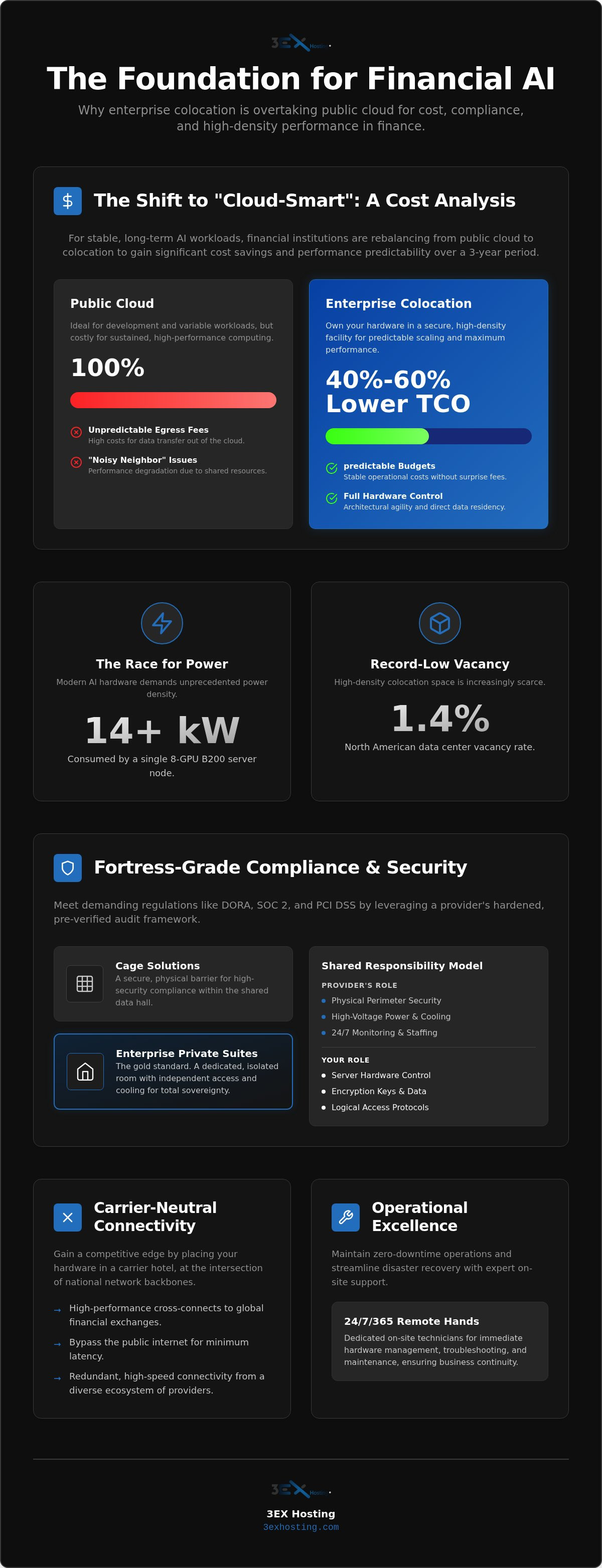
For stable, long-term AI workloads, the public cloud is no longer the most efficient path forward. Once you factor in hardware acquisition, colocation can be 40% to 60% less expensive than public cloud services over a three-year period. As North American vacancy rates hit a record low of 1.4%, securing colocation for financial services has become a race for power rather than just rack space. You’re likely feeling the squeeze of rising cloud bills and the mounting pressure of DORA, SOC 2, and PCI DSS compliance.
It’s a difficult balance to maintain when a single 8-GPU B200 server node consumes over 14 kW. You need an environment that acts as both a fortress and a high-performance engine. This article will show you how enterprise-grade colocation provides the security, compliance, and high-density performance your institution requires. We’ll look at building resilient, AI-ready environments that offer predictable scaling costs and zero-downtime disaster recovery through dedicated remote hands and private suites.
Key Takeaways
- Learn why financial institutions are shifting toward “cloud rebalancing” to optimize costs and performance for sustained AI workloads.
- Understand how enterprise colocation for financial services provides the physical security and high-density power required for DORA and SOC 2 compliance.
- Identify the infrastructure standards necessary for GPU hosting, specifically for racks requiring 15kW or more.
- Explore how 24/7 remote hands support and carrier-neutral connectivity enable zero-downtime disaster recovery.
The Evolution of Financial IT: Why Colocation is the Foundation for 2026
Financial infrastructure has entered an era of strategic maturity. The initial rush to the public cloud has evolved into a more nuanced approach known as “cloud rebalancing.” Institutions are discovering that the public cloud, while useful for development, often lacks the density and cost-efficiency required for sustained AI workloads. This shift has revitalized the demand for colocation for financial services, which provides the high-density power and physical security that modern fintech demands. A colocation data center acts as a secure, high-density physical environment where mission-critical hardware can operate without the overhead of building a proprietary facility.
Financial colocation is the provision of physical sovereignty and high-performance infrastructure that allows institutions to own their hardware while outsourcing the complexities of power, cooling, and security.
From Cloud-First to Cloud-Smart
Financial firms are increasingly repatriating predictable workloads from public clouds to stabilize their operational budgets. For stable AI training or risk modeling, the cost-benefit analysis favors full cabinet colocation over public cloud instances. Industry data suggests that for these sustained workloads, colocation can be 40% to 60% less expensive than cloud services over a three-year period when hardware acquisition is included. This transition allows you to avoid unpredictable egress fees and “noisy neighbor” performance issues. You maintain architectural agility while owning the underlying hardware, ensuring your data residency remains under your direct control.
The Role of the Carrier Hotel in Financial Connectivity
Connectivity is the lifeblood of high-frequency trading and automated wealth management. In a carrier-neutral environment, your infrastructure sits at the intersection of national network backbones. This positioning allows for high-performance cross-connects, which are direct, private links between your servers and global financial exchanges. These connections bypass the public internet, reducing latency to the absolute minimum and ensuring transaction processing happens at the speed of the market. By placing your hardware at these network intersections, you gain access to a diverse ecosystem of providers, ensuring that your connectivity is both redundant and exceptionally fast. This physical proximity to the network core is a competitive requirement that the public cloud simply cannot replicate.
Regulatory Compliance and Physical Security in Financial Data Centers
Compliance in the financial sector isn’t optional. It’s the baseline. As regulations like the Digital Operational Resilience Act (DORA) take effect, the burden of proof for operational stability has shifted significantly. Regulators now demand evidence of physical resilience and third-party risk management. Choosing colocation for financial services allows you to leverage a provider’s existing, hardened audit framework. Standards such as PCI DSS and SOC 2 Type II are pre-verified at the facility level, saving your team months of preparation. This setup creates a Shared Responsibility Model. The provider secures the perimeter, maintains high-voltage power, and manages industrial cooling. You maintain exclusive control over the servers, encryption keys, and logical access protocols.
Physical security must be multi-layered. It starts at the facility gate and extends directly to the rack. Most enterprise facilities utilize biometric scanners, 24/7 on-site security personnel, and continuous video monitoring with long-term footage retention. For firms requiring an extra layer of isolation, Cage Solutions for High-Security Compliance offer a physical barrier within the data center floor. This ensures that only your authorized staff can touch the hardware. It’s a critical requirement for many internal audits that demand strict separation of duties and hardware access.
Private Suites vs. Shared Space for Compliance
While cages provide excellent security, Enterprise Private Suites are the gold standard for institutional banking. A private suite offers total sovereignty. You aren’t just behind a fence; you’re in a dedicated room with independent access controls and often separate cooling zones. This isolation simplifies regulatory reporting. It removes the risk of accidental exposure to other tenants and provides a clean, auditable environment for sensitive financial data hardware. You control the environment completely, from the layout of the racks to the specific security cameras inside the room.
Auditing Your Data Center Provider
Auditing your provider for colocation for financial services requires a technical eye. When you tour a facility, look beyond the lobby. Ask about power redundancy configurations. For mission-critical financial apps, 2N redundancy is the benchmark. It ensures that every piece of equipment has two completely independent power paths. If one utility feed or UPS system fails, the other takes over instantly without a millisecond of lag. You should also request to see the physical access logs and the chain of custody for hardware deliveries. Reliable providers document every entry and exit with timestamped precision. These logs are vital for your annual compliance reviews and regulatory reporting. If you’re ready to see how these standards look in practice, you can request a detailed facility specification to compare against your internal compliance requirements.
Power Density and GPU Hosting: The Engine of Financial AI
AI is no longer a peripheral experiment in the financial sector. It’s the core engine behind real-time fraud detection and automated wealth management platforms. These applications require massive computational power that traditional server rooms cannot sustain. Modern colocation for financial services must provide the infrastructure to support high-density GPU clusters. For instance, an 8-GPU HGX H100 server node consumes approximately 10.2 kW, while the newer B200 nodes pull about 14.3 kW. When you stack these in a single rack, requirements quickly exceed 15 kW, pushing the limits of standard data center designs.
Managing this heat is as critical as providing the power. Traditional room air conditioning remains effective only up to densities of about 15 kW per rack. Beyond this point, you need specialized cooling strategies like rear-door heat exchangers or direct-to-chip liquid cooling to prevent thermal throttling. Maintaining these high-performance financial clusters requires a facility designed for extreme density from the ground up. Higher power density directly correlates with significantly shorter AI model training cycles by allowing for more compact, high-bandwidth communication between GPU nodes.
GPU Colocation vs. Cloud GPU Instances
While cloud providers offer GPU access, the total cost of ownership (TCO) for sustained workloads often favors owning the hardware. Renting high-end GPUs for 24/7 model training leads to massive monthly bills and unpredictable egress fees. By utilizing High-Density GPU Colocation, you capitalize on the 40% to 60% cost savings associated with hardware ownership over a three-year period. This approach provides the predictability your finance department needs while ensuring you have dedicated, non-shared hardware for sensitive financial modeling.
Maximizing Throughput with Cross-Connect Services
The speed of your AI is only as fast as the data feeding it. Direct cross-connects are essential for building a low-latency fabric between your private hardware and global financial exchanges. These private links eliminate the bottlenecks and security risks of the public internet. By Optimizing Performance with GPU Cloud Hosting through a carrier-neutral provider, you ensure your AI models receive market data with microsecond precision. This physical proximity to network intersections is the only way to maintain a competitive edge in high-frequency environments. If you’re planning a high-density deployment, you can request a power density assessment to ensure your hardware has the headroom it needs to scale.
Operational Excellence: Remote Hands and Disaster Recovery
Managing hardware shouldn’t be a logistical burden for your senior engineering team. In the high-stakes world of colocation for financial services, every minute of physical downtime translates to lost market opportunity. This is where 24/7 Remote Hands Support becomes critical. These on-site technicians act as a skilled extension of your internal staff, performing the physical tasks that don’t require your lead architects to be present. Whether it’s a simple power cycle or a complex hardware swap, having expert support on-site ensures your infrastructure remains operational without the need for expensive, time-consuming travel.
Operational excellence also relies on the strategic placement of your hardware within carrier hotels. These facilities provide the dense network fabric required for seamless failover and redundancy. If a primary circuit fails, a carrier-neutral environment allows for immediate rerouting through secondary providers. This level of network resilience is a prerequisite for any institution aiming for “Zero RPO/RTO” goals. By utilizing high-performance cross-connects, you build a redundant pathway that ensures your data reaches its destination even during regional network disruptions.
The ROI of Managed IT Infrastructure
Leveraging on-site technical expertise significantly improves your bottom line. Instead of dispatching staff for routine maintenance, you can utilize remote hands for cabling, inventory management, and rack audits. Most providers bill these services in precise 15 or 30-minute increments, allowing you to pay only for the support you actually use. This efficiency is detailed further in our Data Center Efficiency Guide. By outsourcing layer-one tasks, your team can focus on high-value projects like AI model optimization and regulatory reporting.
Business Continuity in Crisis Scenarios
When designing colocation for financial services, true resilience requires a hybrid approach to disaster recovery. Many financial institutions now implement managed cloud hosting as a secondary failover for their physical cabinets. This ensures that if a hardware-level crisis occurs, mission-critical apps can migrate to a virtual environment instantly. Maintaining N+1 power and cooling redundancy is the baseline, but regular testing is what guarantees uptime. You should schedule quarterly disaster recovery drills to verify that your failover protocols work as intended. If you’re looking to strengthen your resilience, you can explore our full cabinet colocation options to see how we integrate these failover standards into every deployment.
Choosing the Right Partner for Financial Colocation
Selecting a provider for colocation for financial services requires looking beyond square footage. You need a partner capable of supporting the high-density power requirements of modern AI while maintaining the stringent compliance standards your auditors demand. A provider’s expertise in high-density enterprise environments is the difference between a stable deployment and thermal throttling. 3EX Hosting serves as a national strategic partner, providing the technical foundation for institutions that have outgrown the unpredictable costs of the public cloud. By focusing on full cabinets and private suites, we ensure your hardware resides in a sovereign, high-performance environment.
Flexibility is equally important. A carrier-neutral philosophy ensures you aren’t locked into a single bandwidth provider. This independence allows you to build a redundant network fabric using multiple carriers, ensuring your transaction processing remains online even if one backbone experiences an outage. It also gives you the leverage to negotiate better rates as your data needs expand. Your infrastructure should be a dynamic asset, not a static cost center. As your AI initiatives move from development to production, your provider must offer a clear path for scalability, allowing you to transition from a single cabinet to a dedicated suite without complex renegotiations.
Full Cabinet Colocation: The Professional Starting Point
For most financial firms, shared rack space is a compliance non-starter. Full Cabinet Colocation Services provide the physical isolation and dedicated power circuits necessary for secure operations. You gain total control over the cabinet’s internal configuration. This allows you to optimize airflow for storage-heavy arrays or the 14 kW GPU nodes required for real-time risk modeling. Owning the cabinet means you control the physical access logs, which is a critical requirement for SOC 2 and PCI DSS audits. It’s the most efficient way to balance high-performance hardware with institutional security requirements.
Next Steps: Migration and Deployment
The transition from an on-premise data center or a cloud-only model can be complex. Utilizing professional move-in assistance is the best way to minimize migration downtime and ensure your hardware is racked according to best practices. 3EX Hosting supports this transition by acting as an extension of your IT team, helping you design a hybrid model that keeps your most sensitive workloads in a private, secure environment. If you’re ready to stabilize your infrastructure costs and prepare for the next generation of financial AI, you can Request a Custom Quote for Financial Colocation. Our team will help you size your power needs and design a deployment that meets your specific RTO and RPO goals.
Future-Proofing Your Financial Infrastructure
The transition toward high-density architecture is no longer a distant goal; it’s a current operational requirement. By prioritizing colocation for financial services, your institution gains the physical sovereignty and power density needed to sustain complex AI models while keeping regulatory compliance in check. You’ve seen how cloud rebalancing and carrier-neutral connectivity provide the technical edge necessary for microsecond precision in trading and automated wealth management.
3EX Hosting provides the national-scale foundation required for these mission-critical workloads. Our facilities are high-density GPU ready and supported by 24/7 on-site remote hands, acting as a seamless extension of your internal IT team. We ensure your systems remain resilient through carrier-neutral connectivity and redundant power architectures. Stabilizing your infrastructure costs and securing your data residency starts with a partner who understands the technical demands of modern finance. You can Get a Custom Quote for Financial Colocation today to begin designing your hybrid architecture. We’re ready to help you build a more secure and performant future.
Frequently Asked Questions
What is the difference between colocation and cloud for financial services?
Colocation offers physical sovereignty and hardware ownership, while cloud is a rented, shared resource. For financial institutions, colocation provides predictable costs for sustained AI workloads and direct control over data residency. Cloud is better for burstable, non-sensitive tasks. Using colocation for financial services ensures that your hardware isn’t affected by “noisy neighbors” or unpredictable egress fees common in public cloud environments.
How does colocation support PCI DSS and SOC 2 compliance?
Colocation providers handle the physical security layer of the compliance stack. They maintain hardened perimeters, biometric access, and 24/7 monitoring, which are pre-audited for SOC 2 and PCI DSS standards. This allows your team to focus on the logical security and encryption layers. By housing hardware in a certified facility, you inherit a robust physical audit trail required for regulatory reporting and DORA resilience.
Can colocation handle high-density GPU hosting for financial AI?
Yes, specialized facilities are designed to support the extreme power and cooling demands of AI hardware. While standard racks often cap at 5kW, high-density colocation can support 15kW to 30kW per rack or more. This infrastructure uses advanced cooling, such as rear-door heat exchangers, to manage the 14kW thermal output of modern GPU nodes. It’s the most stable environment for training large-scale financial models.
What are the latency benefits of using cross-connect services?
Cross-connects provide a direct, physical link between your server and a network provider or financial exchange. These private connections bypass the public internet, which significantly reduces jitter and latency. For high-frequency trading or real-time fraud detection, this microsecond advantage is critical. Because the traffic doesn’t leave the data center’s internal fabric, it’s also more secure and reliable than traditional VPN or internet-based routes.
How does Remote Hands support help financial IT teams?
Remote Hands acts as an on-site extension of your technical staff, performing physical hardware tasks 24/7. This includes cabling, server reboots, and part replacements. For financial IT teams, this service eliminates the need for emergency travel to the data center. It ensures that hardware-level issues are resolved immediately by expert technicians, maintaining uptime for mission-critical applications without pulling your senior architects away from strategic projects.
Why is a carrier hotel important for financial disaster recovery?
A carrier hotel houses a massive density of network providers, offering unmatched redundancy. In a disaster scenario, being in a carrier-neutral facility allows you to failover to a secondary network provider instantly if your primary link goes down. This architectural flexibility is essential for meeting zero-downtime goals. It ensures that your disaster recovery site remains connected to global markets through diverse, geographically redundant fiber paths.
Is private colocation suite more secure than a standard cage?
A private colocation suite offers the highest level of physical isolation. While a cage provides a physical barrier on a shared floor, a suite is a dedicated room with its own walls and access controls. This isolation prevents accidental contact with other tenants’ hardware and provides a cleaner environment for auditing. For large institutions, suites offer the sovereignty required to meet the most stringent internal security and privacy policies.
How much power density can a full cabinet support for AI workloads?
Modern full cabinets can be configured to support 15kW, 20kW, or even 30kW depending on the facility’s cooling capabilities. This is necessary for AI workloads where a single 8-GPU server can pull over 14kW. High-density cabinets utilize specialized power distribution units and containment systems to ensure that even at peak load, the hardware stays within safe operating temperatures. This allows for maximum computational density in a small physical footprint.