 SUPPORT


 3EX United States
 Blog
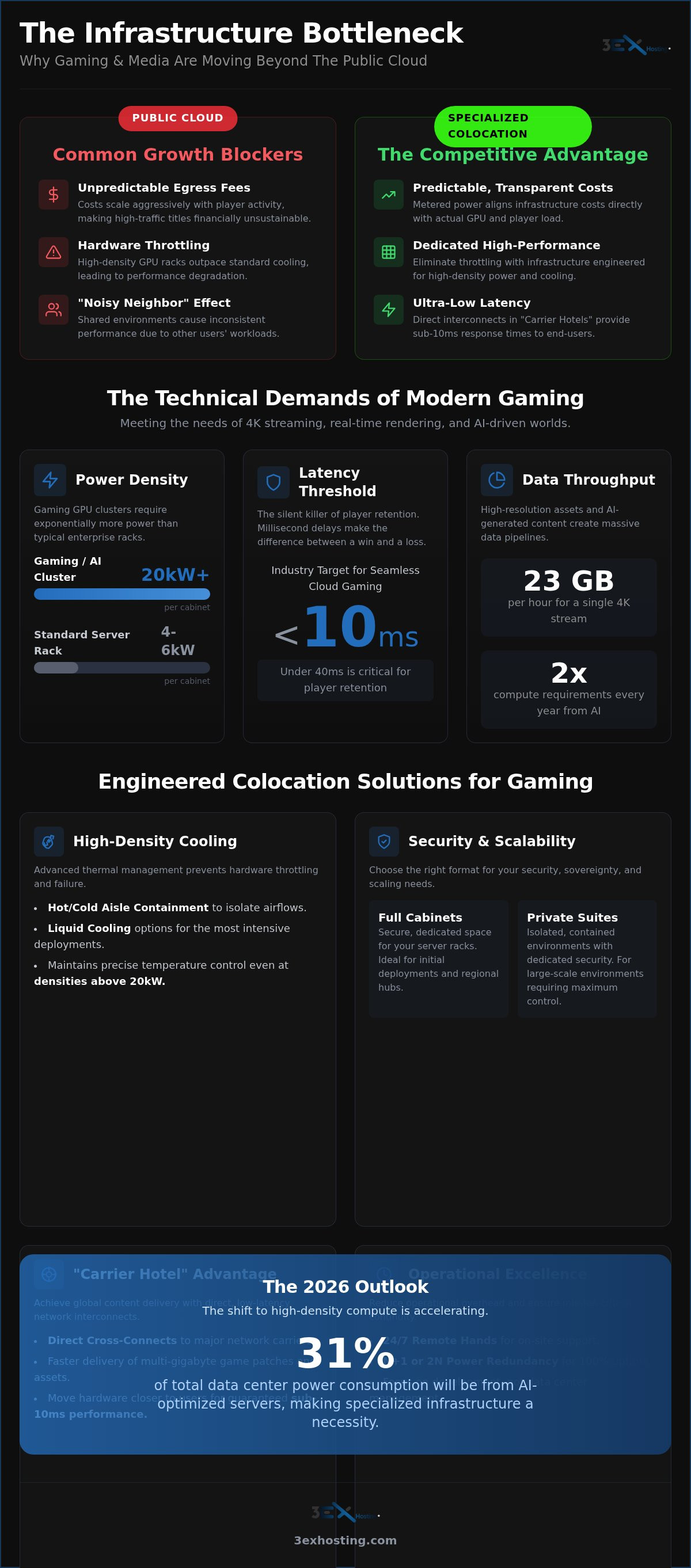
What if the public cloud is actually the biggest bottleneck for your studio’s 2026 growth? By 2026, AI-optimized servers are projected to account for 31% of total data center power consumption, making specialized colocation for gaming servers a necessity rather than an alternative. You’ve likely felt the sting of unpredictable egress costs and hardware throttling when your high-density GPU racks outpace standard cooling limits. It’s a common frustration for developers who need consistent performance without the “noisy neighbor” effect of shared environments.
You deserve an infrastructure that keeps pace with 4K streaming and real-time player interactions. This article explores the critical technical requirements for modern gaming and media delivery, from engineering high-density power for GPU rendering to establishing low-latency network interconnects. We’ll show you how to achieve predictable costs and sub-10ms latency for your end-users. You’ll gain a clear roadmap for scaling power to 20kW per cabinet and beyond, ensuring your hardware remains stable as player demands evolve.
Key Takeaways
- Understand how to eliminate unpredictable public cloud egress fees by transitioning to specialized colocation for gaming servers.
- Learn the technical infrastructure required to support 2026 GPU clusters, including high-density power configurations exceeding 20kW per cabinet.
- Discover the “Carrier Hotel” advantage for achieving sub-10ms latency and faster delivery of multi-gigabyte game patches via direct cross-connects.
- Evaluate the security and sovereignty benefits of private suites versus full cabinet colocation for scaling large-scale gaming environments.
- See how 24/7 remote hands support ensures mission-critical continuity and reduces operational overhead for national gaming distribution.
The Evolution of Gaming Workflows and Infrastructure Demand
Gaming infrastructure used to be about simple lobby management. It’s now a high-density compute problem. The shift from local server hosting to terabyte-scale cloud gaming and AI-driven environments has changed the rules of the game. Studios no longer just manage player counts; they manage massive data pipelines. Public cloud providers were once the default choice, but their egress fees have become the primary bottleneck for developers in 2026. These costs scale aggressively with player activity, often making high-traffic titles financially unsustainable in a public cloud environment.
Choosing a specialized colocation data center provides the predictability that cloud models lack. High-density facilities are now essential for accelerating real-time physics and rendering pipelines. Standard data centers often fail to meet the specific requirements of interactive media because they aren’t built for the extreme power draws of modern GPU clusters. High-performance colocation for gaming servers offers the dedicated power and cooling needed to maintain peak performance during heavy player loads.
The Data Explosion: From 4K to AI-Driven Worlds
High-resolution assets and constant live updates have pushed throughput requirements to the limit. 4K streaming can consume up to 23 GB of data per hour. This volume is only increasing as AI-powered procedural generation doubles compute requirements for game servers every year. Modern servers don’t just host games; they generate them in real-time. Gaming-optimized infrastructure is a high-density ecosystem that synchronizes multi-terabyte asset delivery with AI-driven procedural rendering at the edge.
Latency: The Silent Killer of Player Retention
Millisecond delays destroy the player experience. In competitive gaming, a 50ms spike is the difference between a win and a loss. Research shows that low latency, specifically under 40ms, is more critical for player retention than raw bandwidth. For seamless cloud gaming, the industry now targets a sub-10ms threshold. Achieving this requires moving hardware closer to the user. Direct proximity through full cabinet colocation ensures that interactive performance remains fluid, regardless of the game’s complexity or the number of concurrent users.
High-Density Power and Cooling for Gaming Server Clusters
Gaming rendering and VFX workloads demand a level of power density that standard enterprise IT rarely encounters. While a typical corporate server rack might draw 4kW to 6kW, a modern gaming cluster frequently exceeds 20kW per cabinet. This intensity is driven by the hardware requirements of real-time ray tracing and AI-enhanced physics engines. Without specialized colocation for gaming servers, hardware will throttle to protect itself from heat, leading to dropped frames and increased latency for your users.
Predictable costs are just as important as performance. Metered power solutions offer the transparency needed to manage variable rendering and player loads. Instead of paying for a flat capacity you might not always use, metered billing aligns your infrastructure costs with actual GPU consumption. This model is particularly effective for studios that experience massive traffic spikes during seasonal events or new title launches. You can request a custom quote to see how these power configurations fit your specific project needs.
Thermal Management for GPU-Heavy Gaming Racks
Efficient cooling is the silent partner of high-performance GPU hosting. Managing the thermal output of enterprise-grade GPU clusters requires more than just standard air conditioning. While air cooling remains viable for many setups, liquid cooling is becoming the standard for the most intensive 2026 deployments. Hot aisle and cold aisle containment is a non-negotiable requirement in these environments. By physically separating the cold supply air from the hot exhaust, data centers can maintain precise temperature control even at densities above 20kW. This prevents hotspots that lead to hardware failure and ensures your rendering pipelines run at maximum clock speeds.
Redundancy and Power Stability for 100% Uptime
Stability is the foundation of player trust. Mission-critical game server environments require N+1 or 2N power redundancy to guarantee 100% uptime. In high-density environments, even a minor power fluctuation can cause hardware damage or an unplanned reboot. Reliable power distribution units (PDUs) and uninterruptible power supplies (UPS) protect your investment from grid instability. If you’re planning a large-scale deployment, reviewing the requirements for high-density GPU colocation will help you understand the engineering needed for AI-driven gaming. These systems ensure that your hardware remains operational and safe, even during peak loads or maintenance windows.
Network Architecture: Cross-Connects and Global Content Delivery
The “Carrier Hotel” model is the gold standard for game content delivery networks (CDNs). It acts as a central hub where major ISPs, cloud providers, and content networks converge. For studios utilizing colocation for gaming servers, being inside a carrier-neutral facility means your data doesn’t have to travel across the public internet to reach a backbone provider. It’s already there. This proximity is the only way to guarantee the network throughput required for modern, interactive media in 2026.
Multi-gigabyte game patches and 4K assets require more than standard IP transit can provide. Cross-connect services offer a technical advantage by establishing a dedicated physical link within the data center. This setup bypasses the congestion of the open web. It ensures that when you push a 50GB update, your players aren’t throttled by external network traffic. Direct peering further optimizes this by reducing the number of “hops” between the game server and the end player. Fewer hops mean fewer points of failure and significantly lower jitter, which is vital for maintaining that sub-10ms latency mentioned earlier.
Direct Interconnection for Gaming Ecosystems
High-performance cross-connects bridge the gap between your hardware and the global gaming ecosystem. By choosing carrier-neutral facilities, studios gain access to multiple ISPs and cloud providers through a single point of entry. This diversity drives down pricing and prevents vendor lock-in. Cross-connects eliminate the ‘middleman’ in data transfer by creating a direct physical link between your server and your network provider. This architecture is essential for studios that rely on real-time collaboration between globally distributed development teams and need to move massive asset files without delay.
Building a Resilient Content Delivery Backbone
Resilience isn’t optional for viral game launches or massive live-streaming events. A multi-homed network strategy provides redundancy, ensuring that if one carrier fails, your traffic automatically reroutes to an active path. You should evaluate Cross-Connect Services to see how they integrate with managed cloud hosting for a true hybrid approach. This flexibility allows you to scale bandwidth dynamically during peak player hours or seasonal events. It ensures your infrastructure stays online when it’s under the most pressure, providing the stability your community expects. This network agility is what separates successful global launches from those plagued by connectivity issues.
Selecting Colocation Formats: Cabinets vs. Private Suites
Choosing the right physical format is as critical as the hardware inside the rack. As your studio scales, the decision between shared environments and dedicated space impacts both security and operational efficiency. Most growing projects start with Full Cabinet Colocation. This provides a dedicated, lockable 42U or 48U environment, which is the baseline for professional colocation for gaming servers. It allows for optimized cable management and custom hardware configurations that shared cages cannot always accommodate.
When handling pre-release builds or sensitive player databases, Cage Solutions provide an essential layer of physical isolation. These custom enclosures prevent unauthorized access in a multi-tenant facility, ensuring your assets remain secure. However, for large-scale enterprises with massive compute requirements, the transition to Private Data Center Suites becomes necessary. These suites offer complete content sovereignty and allow for deeper integration of custom cooling and power monitoring systems. Matching your infrastructure format to your 3-year growth projections ensures you don’t outgrow your space during a critical launch phase.
Full Cabinet Colocation for Growing Studios
Dedicated cabinets are the workhorses of game server clusters. A full 42U or 48U cabinet gives you the vertical space needed to stack high-density GPU servers while maintaining enough room for top-of-rack switches and power distribution. This format allows you to design your own airflow patterns and cable runs, which is vital for preventing thermal throttling. Scaling from a quarter cabinet to a full cabinet is a logical progression that balances immediate costs with the performance needs of a growing player base. It gives you the freedom to deploy specialized hardware without the constraints of shared rack space.
Private Suites for Enterprise Asset Sovereignty
Major gaming studios require Private Suites to meet strict physical security compliance and internal sovereignty standards. These private environments are physically walled off from the rest of the data center, providing a level of security that is mandatory for protecting high-value IP and pre-release content. Within a private suite, you can implement custom cooling solutions tailored specifically to your GPU-heavy racks and monitor power consumption at a granular level. For a deeper look at managing these environments, our Enterprise Private Suites Guide provides technical details on maintaining infrastructure sovereignty.
Ready to scale your infrastructure? Get a tailored quote for your gaming infrastructure today.
Operational Excellence: Remote Hands and Infrastructure Support
Maintaining 99.999% uptime for global gaming platforms requires constant vigilance. You can’t always have your internal team on-site, especially when managing national distribution across multiple facilities. This is where Remote Hands Support becomes a critical extension of your IT department. It eliminates the need for expensive travel for routine hardware upgrades or emergency troubleshooting. When a drive fails or a server needs a hard reboot, having a technician available 24/7 ensures that your community barely notices a hiccup.
Transitioning high-density hardware into a professional facility shouldn’t be a logistical nightmare. Professional Move-In Assistance streamlines the deployment process, from rack mounting to initial cabling. This support allows your engineers to focus on software optimization while the physical layer is handled by experts. For studios utilizing colocation for gaming servers, this operational support is the difference between a smooth launch and a week of unplanned downtime.
Maximizing ROI with Remote IT Support
Remote hands services provide more than just emergency fixes. They offer a way to maximize your infrastructure’s return on investment through proactive maintenance. Common tasks for gaming clients include:
- Performing physical cable audits to ensure optimal airflow.
- Swapping out components like RAM or NICs without shipping the entire server.
- Executing hard reboots during critical software freezes.
- Labeling and documenting complex high-density GPU clusters.
Rapid disaster recovery is essential for mission-critical game loads. Having on-site support means you don’t wait hours for a technician to arrive. For a deeper technical look at optimizing these workflows, our Remote Hands Support Guide details how to integrate these services into your 2026 operational strategy.
Planning Your Infrastructure Transition
Migrating high-value gaming servers requires a structured approach. You need to manage the logistics of high-density hardware deployment without necessarily having your own staff present. Ensure your checklist includes power density verification for each rack and a clear map for cross-connect termination. A managed transition reduces the risk of hardware damage and ensures that your network architecture is ready for immediate traffic. It’s about building a stable foundation that scales with your player base. If you’re ready to move your hardware into a high-performance environment, get a custom quote for your gaming infrastructure needs today.
Future-Proofing Your Gaming Infrastructure for 2026
The landscape of interactive media has shifted from simple hosting to a complex engineering challenge. Success in 2026 depends on your ability to deliver sub-10ms latency while managing the thermal demands of 20kW GPU clusters. Specialized colocation for gaming servers provides the physical security and power density that public clouds simply can’t match at scale. By leveraging carrier-neutral connectivity and high-speed cross-connects, you eliminate the network bottlenecks that drive away players.
Operational stability is the final piece of the puzzle. With 24/7 expert remote hands support and high-density cabinet options, your team can focus on development while the hardware remains in professional hands. Whether you need a single cabinet or private suites, the right infrastructure partner ensures your platform stays online during the most viral launches. Ready to scale your gaming infrastructure? Get a custom quote from 3EX Hosting today. Your players are waiting for a seamless experience, and the right technical foundation makes that possible.
Frequently Asked Questions
What is a data center for gaming and content delivery?
A data center for gaming is a specialized facility engineered to support the extreme compute and network demands of interactive media. Unlike standard enterprise sites, these facilities prioritize high-density power for GPUs and direct peering with major ISPs. They serve as hubs where game assets are stored and delivered with minimal delay. This infrastructure is essential for studios moving away from the high egress fees of public clouds.
How does colocation reduce costs for cloud gaming providers?
Colocation reduces costs by eliminating the unpredictable egress fees associated with public cloud providers. By owning or leasing hardware in a dedicated facility, studios pay for power and rack space rather than data transfer volume. This shift creates a predictable monthly expenditure, especially for high-traffic titles. Additionally, choosing colocation for gaming servers allows for custom hardware optimization, which extends the lifecycle of expensive GPU clusters.
What power density is required for high-end game rendering servers?
Modern high-end game rendering servers typically require power densities exceeding 20kW per cabinet. As AI-driven procedural generation and real-time ray tracing become standard in 2026, standard 4kW racks are no longer sufficient. Specialized facilities manage these loads using advanced thermal containment and liquid cooling. Planning for these high-density requirements ensures your hardware operates at peak clock speeds without thermal throttling during heavy player loads.
Can I manage my gaming servers remotely in a colocation facility?
Yes, you can manage your infrastructure through 24/7 remote hands support and managed IT services. These on-site experts handle physical tasks like hardware reboots, cable management, and component swaps. This capability allows your engineering team to focus on software performance from any location without traveling to the data center. It ensures mission-critical continuity by providing immediate physical intervention whenever a hardware failure or power fluctuation occurs.
What is the difference between IP transit and a cross-connect for game delivery?
IP transit sends data across multiple public networks to reach the end user, which often increases latency and jitter. In contrast, a cross-connect is a direct physical cable between your server and a network provider within the same facility. This direct link bypasses the congestion of the open web and reduces the number of network hops. For gaming, cross-connects are the superior choice for delivering multi-gigabyte patches and maintaining stable connections.
Why do gaming companies choose carrier-neutral data centers?
Gaming companies choose carrier-neutral data centers to avoid vendor lock-in and gain access to a diverse ecosystem of network providers. These facilities allow you to choose from multiple ISPs and cloud backbones within a single location. This competition leads to better pricing and improved network redundancy. If one carrier experiences an outage, you can quickly reroute traffic through another provider, ensuring your global gaming platform remains accessible to players.
Is colocation more secure than public cloud for pre-release game builds?
Colocation offers superior physical security and asset sovereignty for sensitive pre-release builds. While public clouds rely on virtual isolation, colocation allows for physical barriers like private suites and lockable cages. You have complete control over who accesses the hardware and when. This level of content sovereignty is often a requirement for compliance with strict security protocols. It prevents the risks associated with multi-tenant virtual environments and protects your intellectual property.
How does a data center support real-time physics and AI workloads?
A data center supports these workloads by providing the specialized high-density GPU hosting and low-latency interconnects they require. Real-time physics and AI-driven procedural generation demand massive compute power and rapid data exchange between server nodes. Specialized facilities offer the high-performance cross-connects and stable power redundancy needed to synchronize these complex calculations. This infrastructure ensures that AI-driven worlds remain fluid and responsive, providing the high-fidelity experience modern players expect.