 SUPPORT


 3EX United States
 Blog
Could your current data center infrastructure survive the thermal load of a 700W TDP chip? Most legacy facilities are hitting a hard wall at 15kW, yet the demand for 30kw rack hosting has become the baseline for modern AI training and high-density enterprise workloads. If you’re still spreading hardware across dozens of low-density cabinets, you’re not just wasting floor space; you’re inviting thermal throttling and escalating operational costs.
It’s frustrating to watch mission-critical hardware underperform because of power circuit limitations or inadequate airflow. You need a setup that ensures 100% uptime while maximizing every square inch of your footprint. This guide provides a technical roadmap for mastering 30kW deployments in 2026. We’ll break down the essential transition from advanced air cooling to liquid cooling systems, explore N+1 power architectures, and analyze the ROI of high-density consolidation. By the end, you’ll understand exactly how to stabilize your most demanding GPU clusters without the risk of rack sprawl. We’ll focus on technical stability and the precise infrastructure required to keep your hardware running at peak performance.
Key Takeaways
- Learn why 30kw rack hosting is now the enterprise standard for supporting H100 and B200 GPU clusters without the inefficiency of rack sprawl.
- Master the infrastructure requirements for high-density loads, including the transition to three-phase 415V power and N+1 redundancy models.
- Calculate the ROI of high-density colocation by evaluating footprint consolidation and the reduction of expensive networking components.
- Follow a technical deployment checklist to audit hardware PSU efficiency and choose the correct intelligent PDU configurations for your environment.
- Identify the strategic advantages of carrier-neutral connectivity and expert remote hands support for maintaining high-value AI infrastructure.
The Evolution of High-Density: Why 30kW Racks are the New Enterprise Standard
The landscape of the modern data center has fundamentally shifted. For decades, enterprise infrastructure relied on power densities between 5kW and 10kW per cabinet. These legacy limits are now obsolete. The rapid adoption of NVIDIA H100 and B200 GPU clusters has pushed power requirements into a new stratosphere. Standard air-cooled facilities often struggle to provide the necessary power and cooling for these high-performance systems. 30kw rack hosting has emerged as the new baseline for organizations running production-grade AI models. It represents a strategic threshold where efficiency meets physical reality.
The Tipping Point: From Traditional to High-Density Colocation
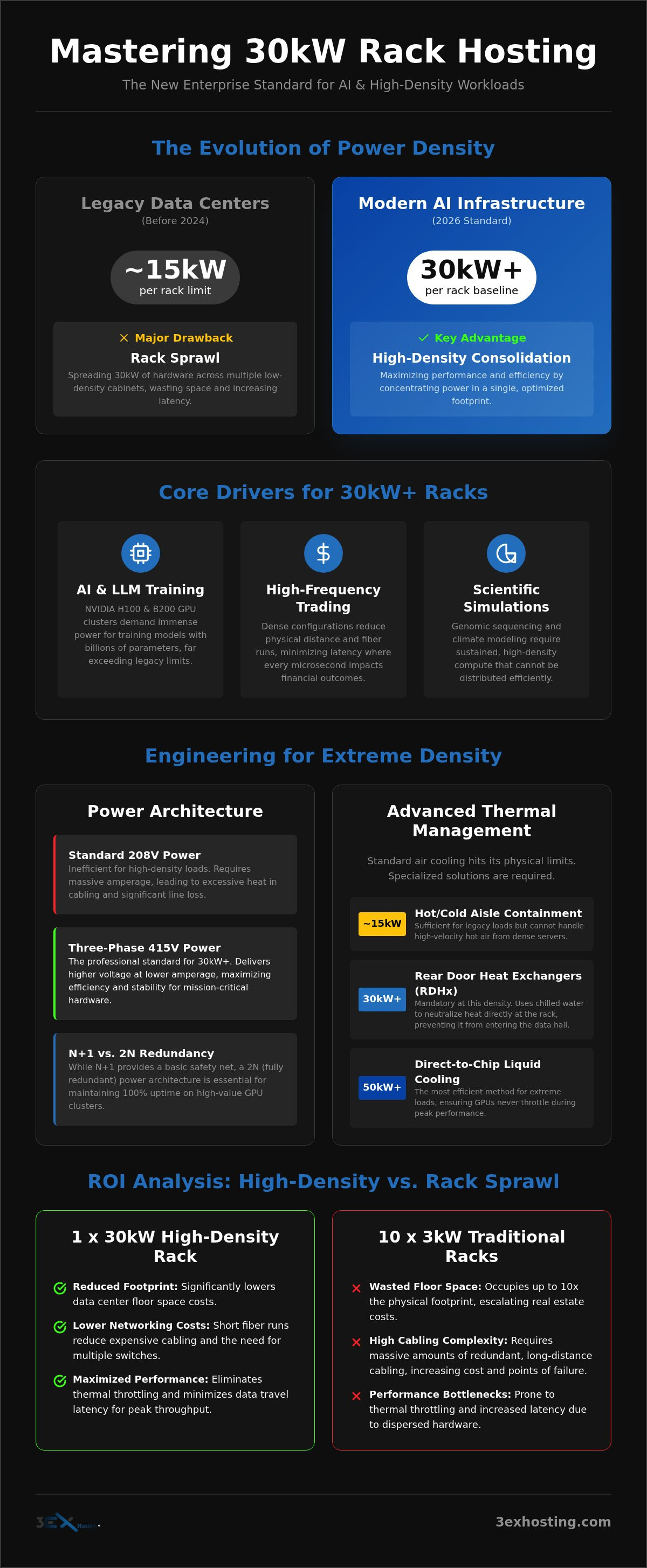
Consider the logistical nightmare of rack sprawl. Deploying 30kW of compute across ten 3kW racks requires ten times the floor space and massive amounts of redundant cabling. By consolidating into a single high-density cabinet, enterprises significantly reduce their physical footprint. This isn’t just about saving space; it’s about performance. High-speed fabrics like InfiniBand rely on short fiber runs to maintain ultra-low latency. 30kW rack hosting is the convergence of maximum power delivery and manageable thermal dissipation. It allows engineers to keep interconnected nodes physically close, minimizing the distance data travels and maximizing throughput.
Industry Use Cases for 30kW+ Power Envelopes
Several sectors have already moved beyond traditional density limits to remain competitive:
- Large Language Model (LLM) Training: Training and fine-tuning models with billions of parameters requires massive GPU clusters that consume power far beyond legacy limits.
- High-Frequency Trading (HFT): In financial modeling, every microsecond counts. Dense configurations reduce the physical distance between processing units and networking switches.
- Scientific Simulations: Genomic sequencing and complex climate modeling demand sustained, high-density compute power that can’t be efficiently distributed across a sparse floor plan.
Strategic alignment with modern power distribution units (PDUs) also favors this density. Utilizing three-phase 415V power allows for higher efficiency and lower line losses compared to traditional 208V systems. This technical stability is exactly what full cabinet colocation providers focus on to ensure mission-critical uptime. Moving to 30kW isn’t just a trend; it’s a structural requirement for the next generation of enterprise hardware. It’s the point where technical excellence and operational simplicity align.
Engineering the Infrastructure: Power and Cooling at 30kW Density
Engineering for 30kW density requires more than just “more air.” It demands a fundamental shift in how power is delivered and how heat is removed from the cabinet. At this level, traditional cooling methods reach their physical limits. Choosing a provider for 30kw rack hosting requires a deep dive into their power architecture and thermal management strategies. You aren’t just renting space; you’re securing an environment designed for extreme thermal loads.
Advanced Thermal Dissipation Strategies
30kW is the critical threshold where standard hot/cold aisle containment often proves insufficient. While containment prevents thermal recirculation, it doesn’t solve the problem of high-velocity hot air exhaust from dense GPU chassis. Rear Door Heat Exchangers (RDHx) become mandatory at this density. These passive or active units use chilled water to neutralize heat directly at the back of the cabinet. This prevents the heat from ever entering the data center’s ambient air. For clusters pushing toward the 50kW mark, direct-to-chip liquid cooling is the next logical step. It’s the most efficient way to keep modern GPU Thermal Design Power (TDP) within safe operating ranges, ensuring your hardware never throttles during intense training cycles.
Power Distribution and Circuit Engineering
Standard 120V or 208V circuits aren’t viable for 30kw rack hosting because they require massive amperage, which generates excessive heat in the cabling. Three-phase 415V power is the professional standard for 2026. It delivers higher voltage at lower amperage, which increases efficiency and significantly reduces line loss. Redundancy is equally vital for high-value workloads. While N+1 provides a basic safety net, 2N redundancy is the preferred choice for mission-critical AI training. It ensures that a single power strip or circuit failure doesn’t crash a multi-million dollar GPU training run.
You must also calculate “usable” power correctly. The National Electrical Code (NEC) typically requires a 20% safety margin for continuous loads. This means a 30kW provisioned circuit actually offers about 24kW of continuous usable load. Intelligent, metered PDUs are essential for monitoring these thresholds in real-time. They allow your team to track power consumption at the outlet level and reboot hung servers remotely. To ensure your infrastructure is engineered for these extreme loads, consider a specialized full cabinet colocation solution that supports these advanced power and cooling requirements. This level of technical stability keeps your systems running at peak performance without the risk of circuit trips or thermal shutdowns.
ROI Analysis: 30kW High-Density vs. Traditional Rack Sprawl
Deciding between high-density and traditional colocation often comes down to the bottom line. While the per-kW price for 30kw rack hosting might appear higher at first glance, the total operational costs tell a different story. Consolidating your hardware into a single 30kW cabinet instead of six 5kW racks creates immediate savings in floor space rental. You aren’t just paying for power; you’re paying for the real estate to house it. High-density environments allow you to maximize your compute power while minimizing your physical footprint.
Networking infrastructure represents another significant area for ROI. In a sprawled deployment, you need more top-of-rack (ToR) switches and a massive number of expensive optical transceivers to interconnect nodes across multiple cabinets. By concentrating your AI or enterprise workloads through 30kw rack hosting, you reduce the number of switch ports required. This simplifies the network topology and lowers the initial capital expenditure. Additionally, high-density facilities are often engineered with superior Energy Efficiency Ratios (EER). Modern cooling systems like liquid cooling or RDHx allow these centers to achieve a lower Power Usage Effectiveness (PUE), which can translate to lower pass-through energy costs over time.
The Hidden Costs of Low-Density Sprawl
Low-density deployments often suffer from what engineers call the “Cross-Connect Tax.” When your infrastructure is spread across a data center floor, you must pay for additional cabling to link your racks. These monthly recurring costs for cross-connects can quickly erode any perceived savings from cheaper, low-density space. Speed is also a factor. Physical distance between servers creates latency penalties that can degrade the performance of tightly coupled AI clusters. Utilizing full cabinet colocation ensures that your high-performance nodes remain physically adjacent, maintaining the ultra-low latency required for InfiniBand fabrics.
Scalability and Future-Proofing
30kW racks provide a level of agility that legacy setups can’t match. They allow for “in-place” hardware upgrades. When next-generation GPUs with higher TDP ratings arrive, you can swap components within your existing rack without negotiating for more floor space or moving to a different cage. This reduces the lifecycle costs associated with hardware refreshes and migration downtime. Industry data suggests that high-density colocation reduces Total Cost of Ownership (TCO) by 20-30% over three years compared to traditional sprawl models. It’s a strategic investment that prioritizes technical stability and long-term financial efficiency.
Deployment Checklist: Preparing for 30kW High-Density Colocation
Preparing for 30kw rack hosting requires a meticulous audit of your hardware before it arrives at the loading dock. It’s not enough to have a facility that supports high density; your own equipment must be engineered for these extreme environments. Start by verifying the efficiency of your power supply units (PSUs). High-density deployments in 2026 typically utilize three-phase 415V power. Your PSUs must be rated for these voltages and should ideally meet 80 Plus Titanium standards to minimize waste heat and maximize power delivery efficiency.
Thermal exhaust patterns are equally critical. In a 30kW cabinet, even a few mismatched fans can disrupt the airflow of the entire row. Ensure every server in the stack pulls air from the cold aisle and exhausts it toward the rear door heat exchanger. Physical weight is another factor often overlooked. A fully populated 42U or 48U rack filled with GPU-dense nodes can easily exceed 2,000 lbs. You must confirm that the data center’s floor loading capacity can handle this concentrated weight. Standard raised floors might require additional bracing or solid floor slabs to maintain structural integrity.
Hardware and Power Compatibility
Cable management is a primary concern at 30kW. Thick power cords and high-speed network cables can quickly obstruct exhaust paths if not managed properly. Use vertical (0U) PDUs to keep the back of the rack clear for maximum airflow. This setup allows for easier hardware swaps and reduces the risk of accidental cable snags. If your internal team isn’t on-site, utilizing remote hands support ensures that your cabling is professionally dressed and your airflow remains unobstructed from day one.
Network and Security Integration
Connectivity planning must happen in parallel with power engineering. Map your high-speed cross-connects to ensure low-latency data ingestion for your AI clusters. Every 30kW deployment should also include a dedicated out-of-band (OOB) management network. This allows your engineers to troubleshoot BIOS-level issues or power-cycle individual outlets without needing physical access. For high-value GPU assets, consider cage solutions to provide an extra layer of physical security and restricted access.
For a deeper look at specific hardware requirements for artificial intelligence, see our sibling guide on High-Density GPU Colocation. To secure a facility that can handle these rigorous technical standards, request a customized high-density colocation quote today to stabilize your compute footprint.
Choosing the Right Partner for 30kW Rack Hosting
Selecting a facility for 30kw rack hosting is a long-term strategic decision. While power density is the primary filter, it’s the operational ecosystem that determines your long-term success. You need a partner that treats high-density compute as a specialized requirement rather than an edge case. Carrier-neutrality is non-negotiable. High-performance AI clusters require diverse, high-speed cross-connects to multiple providers to ensure low-latency data flow and redundant connectivity. Being locked into a single carrier creates a single point of failure that can jeopardize your entire training model. Technical stability depends on having multiple paths for your data, just as you have multiple paths for your power.
Redundancy claims require careful scrutiny. Don’t get distracted by “Tier” ratings alone. A facility might be marketed as Tier III but have a poor actual uptime record. Ask for historical data on power and cooling stability. For 30kW loads, thermal management is a 24/7 concern. If a cooling pump fails and the failover isn’t instantaneous, your hardware will throttle within minutes. For organizations requiring the highest level of sovereignty and control, private colocation suites offer the ultimate solution. These suites allow for custom containment and specialized power distribution tailored specifically to 30kW+ clusters, providing a secure perimeter for your most valuable assets.
Operational Excellence and Support
High-density hardware is expensive and sensitive. You need specialized technical expertise on-site at all times. 24/7 remote hands support is essential for managing physical hardware incidents without sending your own team to the site. Continuous thermal monitoring is also vital. In a 30kW environment, even a small airflow obstruction can lead to a rapid temperature spike. Proactive monitoring prevents these thermal incidents before they impact performance. For more information on securing dedicated space, read our guide on Enterprise Private Suites. It covers the specific benefits of dedicated infrastructure for high-density environments.
Next Steps: Securing Your High-Density Infrastructure
Securing your high-density infrastructure begins with a technical site audit. This process verifies that the facility can meet your specific airflow and power redundancy requirements. Typically, provisioning a 30kW cabinet takes between four to eight weeks, depending on the complexity of the cooling upgrades required. Start your planning early to avoid deployment bottlenecks. If you’re ready to stabilize your AI training or enterprise compute footprint, get a custom quote for your 30kW high-density rack hosting today. Our team will help you engineer a solution that prioritizes technical stability and 100% uptime.
Future-Proofing Your High-Density Strategy
Transitioning to 30kw rack hosting represents a fundamental shift in enterprise efficiency. By consolidating hardware into high-density environments, you eliminate the overhead of rack sprawl and significantly reduce inter-node latency for AI training. Technical stability at this level requires more than just raw power; it demands the right infrastructure partner. Success in 2026 relies on mastering the transition to advanced cooling strategies and three-phase power distribution. Every decision you make now regarding power density directly impacts your long-term scalability and total cost of ownership.
We specialize in providing the technical foundation your mission-critical workloads require. Our facilities prioritize security and performance with N+1 power redundancy, carrier-neutral interconnections, and 24/7 remote hands support to manage your high-value hardware around the clock. Don’t let legacy infrastructure limits lead to thermal throttling or unexpected downtime. Take the next step toward a more efficient, consolidated compute footprint that supports the most demanding GPU clusters.
Request a High-Density Colocation Quote to secure your infrastructure today. We’re ready to help you deploy your next-generation systems with confidence and technical precision.
Frequently Asked Questions
What is considered high-density colocation in 2026?
High-density colocation is defined as any deployment where power requirements exceed 15kW per cabinet. In 2026, 30kw rack hosting has become the benchmark for enterprise AI training and GPU-intensive workloads. While legacy facilities often cap out at 5kW to 10kW, modern high-density environments are engineered to support 30kW to 100kW per rack. This shift allows organizations to consolidate compute power into a smaller physical footprint while maintaining technical stability.
Can air cooling support a 30kW rack?
Standard air cooling reaches its physical limit around 15kW to 20kW. Supporting a 30kW load with air alone requires advanced techniques like Rear Door Heat Exchangers (RDHx) or localized hot/cold aisle containment. These systems prevent hot air recirculation and manage the high-velocity exhaust from dense GPU chassis. While air can be used at 30kW, many operators are transitioning to direct-to-chip liquid cooling to ensure more efficient thermal dissipation and prevent hardware throttling.
Do I need special PDUs for 30kW rack hosting?
Yes, 30kW deployments require specialized three-phase 415V power distribution units. Standard 120V or 208V circuits generate too much amperage and heat at this density level. You should select intelligent PDUs that provide outlet-level monitoring and high-temperature ratings. These units are often 0U vertical configurations to avoid obstructing airflow at the rear of the cabinet. Using the correct power architecture is essential for maintaining N+1 or 2N redundancy for mission-critical clusters.
What is the difference between metered and managed power in high-density racks?
Metered PDUs provide real-time data on power consumption, allowing you to track load levels and avoid circuit overloads. Managed power, or switched PDUs, goes a step further by offering remote control over individual outlets. This functionality is vital for dense environments, as it enables your team to reboot hung servers or cycle power without a physical site visit. Both options provide the visibility needed to manage high-density environments effectively and ensure maximum uptime.
How does 30kW density affect my data center footprint costs?
Consolidating your infrastructure into 30kw rack hosting significantly lowers your footprint costs by reducing the total number of cabinets required. Instead of renting six 5kW racks, you utilize a single high-density cabinet. This reduction in floor space often leads to lower monthly recurring costs. It also simplifies your networking topology, as you’ll require fewer top-of-rack switches and cross-connects. High-density environments prioritize scalability by allowing you to grow compute power without expanding your physical cage.
Are there specific weight limits for high-density racks?
Yes, weight is a critical factor because a fully loaded 30kW rack can exceed 2,000 lbs. Standard raised floors in legacy data centers may not be rated for this concentrated load. You must verify that the facility has a high floor-loading capacity or utilizes solid slab flooring with specialized structural bracing. Ensuring structural integrity is a key part of the deployment checklist to prevent floor deformation or equipment damage in your high-density rows.
What happens if a 30kW rack exceeds its thermal threshold?
When a rack exceeds its thermal threshold, modern hardware automatically initiates thermal throttling to protect internal components. This results in a significant drop in processing speed and performance. If temperatures continue to rise, the system may trigger an emergency shutdown to prevent permanent damage. In 30kW environments, these temperature spikes can happen rapidly. This is why 24/7 monitoring and advanced cooling systems are mandatory to maintain technical stability and prevent costly downtime.
Why is carrier-neutrality important for high-density AI hosting?
Carrier-neutrality ensures that you aren’t locked into a single telecommunications provider for your data ingestion needs. High-density AI hosting requires massive bandwidth and low-latency paths to process large datasets. A carrier-neutral facility allows you to establish cross-connects with multiple high-performance providers. This creates a redundant networking environment where you can optimize for speed and cost. It provides the flexibility needed to scale your connectivity as your AI training requirements evolve over time.