 SUPPORT


 3EX United States
 Blog
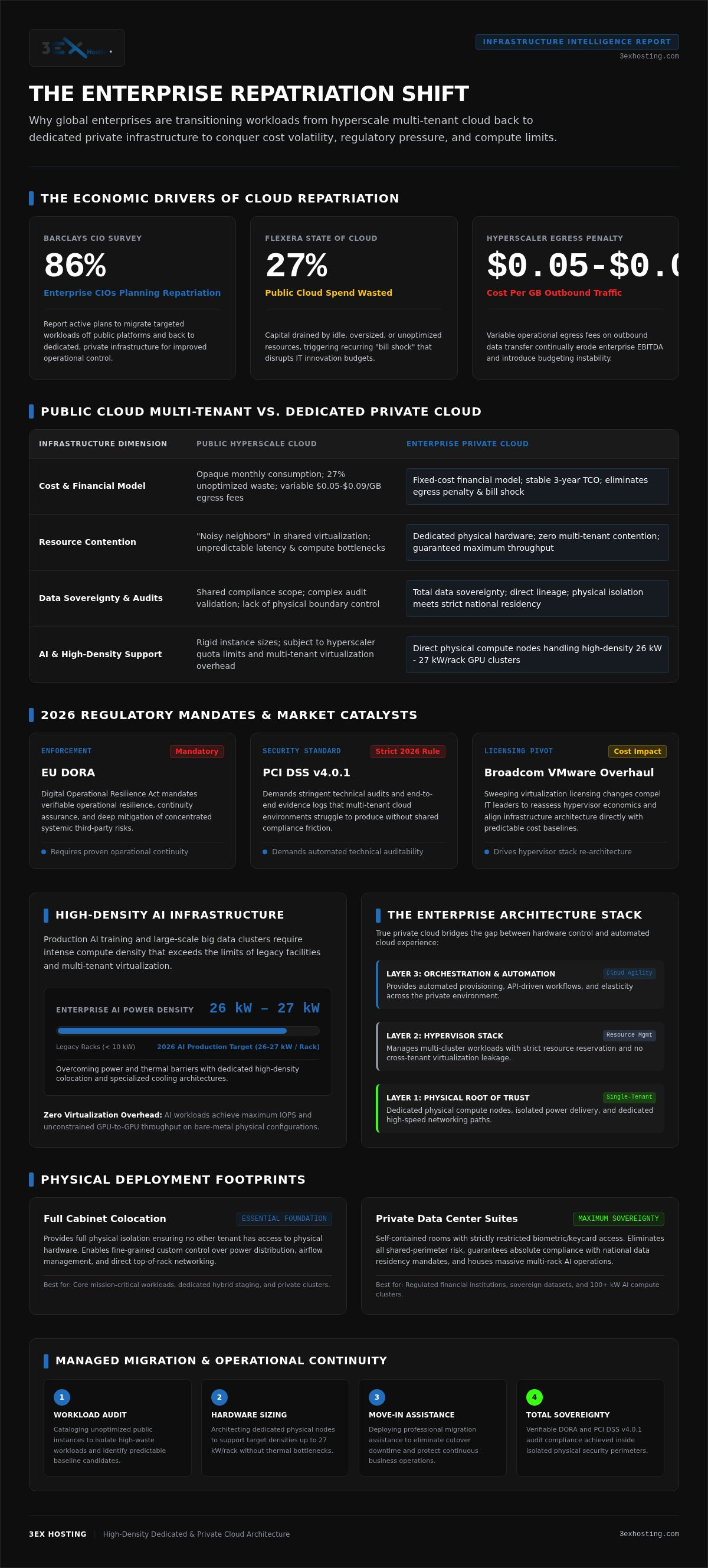
86% of enterprise CIOs now report plans to repatriate specific workloads from the public cloud back to private or dedicated infrastructure. This shift isn’t about moving backward; it’s a calculated response to the 27% of public cloud spending currently lost to idle or unoptimized resources. You’ve likely experienced the frustration of unpredictable monthly billing and the compliance hurdles inherent in multi-tenant environments. It’s difficult to maintain peak performance for mission-critical applications when you’re battling latency or “noisy neighbors” in a shared space.
This guide demonstrates how private cloud hosting for enterprises provides the agility of the cloud with the security and predictable costs of dedicated physical hardware. We’ll analyze the 2026 infrastructure landscape, covering the Broadcom VMware licensing overhaul and the strict enforcement of PCI DSS v4.0.1 and DORA. You’ll discover how to achieve total data sovereignty and deploy high-density hardware for AI and big data. By the end, you’ll have a clear roadmap to balance high-performance requirements with a stable, fixed-cost financial model.
Key Takeaways
- Learn why modern private cloud architecture requires a synergy between dedicated physical hardware and sophisticated orchestration to eliminate performance bottlenecks.
- Analyze the three-year total cost of ownership to see how private cloud hosting for enterprises delivers predictable financial modeling compared to variable hyperscaler consumption.
- Understand the technical requirements for high-density GPU hosting to support production-grade AI workloads without hitting thermal or power barriers.
- Identify the specific infrastructure controls needed to meet 2026 mandates like PCI DSS v4.0.1 and DORA through total data sovereignty.
- Discover a step-by-step framework for managed migration that utilizes professional move-in assistance to ensure operational continuity.
The Enterprise Shift: Why Private Cloud Hosting is Reclaiming the Data Center
Private cloud hosting for enterprises refers to a dedicated environment where hardware, networking, and storage are reserved exclusively for a single organization. In 2026, the industry is witnessing a significant pivot toward “smart-sizing” and selective repatriation. According to the Barclays CIO Survey, 86% of enterprise CIOs report plans to move workloads from public platforms back to private infrastructure. This isn’t a rejection of cloud agility; it’s a strategic move to regain control over performance and costs. Private Cloud is the ultimate tier of data sovereignty for mission-critical loads.
The economic reality of hyperscale environments has shifted. While major providers have eliminated one-time exit fees due to regulatory pressure, day-to-day operational egress costs remain a heavy burden. These fees typically range between $0.05 and $0.09 per GB for outbound traffic. For a global enterprise, these variable network costs directly erode EBITDA and complicate long-term financial planning. Moving to a dedicated environment provides the stability needed for reliable forecasting.
The Cost of Complexity in Public Environments
Hyperscale billing is notoriously opaque. Flexera’s State of the Cloud Report indicates that approximately 27% of public cloud spending is wasted on idle or unoptimized resources. This waste leads to the “bill shock” phenomenon, where unexpected spikes in data transfer or compute usage drain IT innovation budgets. Transitioning to a fixed-cost model allows leaders to forecast infrastructure spending with high accuracy. Dedicated hardware also eliminates the “noisy neighbor” effect. It ensures that mission-critical applications receive consistent, high-speed access to resources without the performance overhead of shared virtualization layers.
Data Sovereignty and the Regulatory Landscape
Modern compliance frameworks have made multi-tenant environments a potential liability for high-stakes industries. As of 2026, the EU Digital Operational Resilience Act (DORA) and PCI DSS v4.0.1 are strictly enforced. These regulations mandate verifiable resilience and automated technical audits that are often difficult to execute in a shared public cloud. Utilizing a private cloud computing infrastructure provides a clear audit trail and absolute physical isolation. Organizations can meet national data residency requirements by hosting sensitive datasets in private data center suites. This physical isolation is a cornerstone of modern cybersecurity, ensuring that data lineage and risk mitigation are handled within a controlled, single-tenant environment.
Decoding the Architecture: From Virtual Clusters to Private Data Center Suites
Understanding private cloud hosting for enterprises requires looking beyond the software layer. Many providers offer “private” environments that are merely logical partitions on shared hardware. True enterprise-grade solutions build from the ground up, establishing a physical root of trust. This architectural stack consists of three critical layers: the dedicated hardware, the hypervisor that manages resources, and the orchestration layer that provides the cloud experience through APIs and automation.
By 2026, power requirements for these environments have skyrocketed. Traditional facilities often struggle with the 26 kW to 27 kW per rack average now seen in modern enterprise deployments. High-density infrastructure is no longer optional. It is a requirement for organizations running AI training or massive big data clusters that demand consistent, high-speed access to physical compute nodes.
The Physical Foundation: Full Cabinet Colocation
For many, full cabinet colocation is the essential starting point for building a dedicated environment. It provides the physical isolation necessary to meet cloud security best practices by ensuring no other tenant has access to your hardware. This setup allows for precise control over power distribution and cooling, which is vital for high-performance compute clusters. Organizations with larger footprints often upgrade to private data center suites. These suites offer a dedicated room with restricted access, providing a significant security advantage over shared floor space where multiple vendors operate in the same row.
The Managed Layer: Orchestrating for Agility
The true value of private infrastructure is realized through orchestration. Managed cloud hosting bridges the gap between bare metal and the public cloud experience. It provides engineers with familiar APIs to spin up or tear down resources automatically. This automated provisioning is key to leveraging private cloud hosting for enterprises to maintain agility without the manual intervention typically associated with legacy hardware. It also simplifies the integration of legacy on-premise systems with new private cloud nodes. By creating a unified management plane, teams can treat their dedicated suites as a seamless extension of their local network. If you’re planning a complex transition, exploring professional move-in assistance can ensure your hardware is integrated correctly from day one.
Performance vs. Predictability: Evaluating Private Cloud ROI
Evaluating the total cost of ownership (TCO) for private cloud hosting for enterprises requires a long-term perspective, typically over a 3-year hardware lifecycle. While hyperscale public clouds offer low entry costs, the “scale tax” often becomes prohibitive as data volumes grow. Organizations frequently find that dedicated infrastructure provides a more favorable ROI when workloads reach a steady state. This is largely due to the elimination of hypervisor overhead. Running applications directly on dedicated bare metal ensures that 100% of the hardware resources are available to the primary workload, resulting in superior compute efficiency compared to virtualized instances.
Another critical factor is the elimination of the “Noisy Neighbor” effect. In a multi-tenant public environment, a spike in a nearby user’s traffic can cause unpredictable latency for your own mission-critical applications. Private infrastructure removes this variable entirely. Fixed-cost colocation provides a stable financial baseline, whereas variable cloud egress charges introduce unpredictable monthly volatility into the balance sheet. This predictability allows IT leaders to reinvest savings into development rather than reactive infrastructure management.
Network Performance and Low-Latency Cross-Connects
Interconnectivity is the lifeblood of modern enterprise architecture. Utilizing carrier-neutral data center connectivity allows organizations to choose from multiple providers, ensuring competitive pricing and redundant paths. Direct cross-connects within the facility significantly reduce application response times by bypassing the public internet. This architecture aligns with the CISA Cloud Security Technical Reference Architecture, which emphasizes secure, low-latency paths for sensitive data flows. These physical connections provide a deterministic performance level that software-defined networking in a public cloud cannot match.
Operational Efficiency: The Role of Remote Hands
Maintaining a national infrastructure footprint shouldn’t require constant regional travel for your internal engineering team. Leveraging 24/7 remote hands support acts as a force multiplier for lean IT departments. These on-site technicians handle everything from physical hardware installation to complex cable management and lifecycle swaps. This managed support model ensures that hardware issues are addressed in real-time without the delays of dispatching staff. Enterprises have successfully scaled their private clouds across multiple sites by treating remote hands as a seamless extension of their local team. This approach reduces operational overhead while maintaining the high availability standards required for enterprise-grade deployments.
Strategic Implementation: AI Infrastructure and Security Compliance
Designing private cloud hosting for enterprises in 2026 requires a radical departure from traditional rack layouts. The surge in production-grade AI inference and training means that infrastructure must now support extreme power densities. While standard enterprise racks historically operated between 5 kW and 10 kW, modern AI architectures like NVIDIA Blackwell GB200 NVL72 demand upwards of 120 kW per rack. This shift places immense pressure on cooling systems. Bridging the gap between standard colocation and specialized AI infrastructure requires facilities equipped for direct-to-chip liquid cooling and rear-door heat exchangers. You can explore more technical details in our guide on High-Density GPU Colocation: The Enterprise Guide to AI Infrastructure in 2026.
Private AI: Training Models on Sovereign Hardware
Protecting proprietary intellectual property is the primary driver for “Private AI.” Sending sensitive datasets to public LLM APIs introduces risks of data leakage and regulatory non-compliance. By hosting GPU clusters within a dedicated private cloud, organizations ensure that data never leaves their physical control. Specialized cage solutions provide an additional layer of security for these high-value assets. These physical barriers prevent unauthorized access and allow for custom security configurations tailored to specific model training requirements. High-density GPU hosting ensures that performance remains consistent regardless of the model’s complexity, providing the stable foundation needed for continuous batch inference.
Compliance Frameworks: HIPAA, PCI, and Beyond
Regulated industries face stricter oversight in 2026 with the full enforcement of PCI DSS v4.0.1 and the EU AI Act. Private suites simplify the auditing process by providing a clearly defined, single-tenant perimeter. This setup is a prerequisite for a robust Zero Trust architecture. It allows for granular physical access controls and automated logging of every interaction with the hardware. For a deeper look at how isolation supports regulatory needs, read our article on Enterprise Private Suites: The Comprehensive Guide to Colocation Sovereignty in 2026. These environments ensure that data lineage and risk mitigation are verifiable during third-party audits. Physical isolation remains the most effective way to satisfy data residency requirements while maintaining high-speed connectivity to global networks.
Ready to secure your AI infrastructure? Get a custom quote for your high-density requirements today.
The Roadmap to Deployment: Managed Migration and Continuity
Migrating to private cloud hosting for enterprises is a phased process that requires meticulous planning of both software and physical layers. The first step involves a comprehensive audit to separate steady-state applications from those requiring public cloud elasticity. Once identified, the architecture phase defines the hypervisor and networking requirements. Data transfer should be executed using secure, high-speed links to minimize the $0.05 to $0.09 per GB egress fees typically charged by hyperscalers. A successful cutover relies on final synchronization and a well-tested DNS update strategy to eliminate service interruptions.
For national deployments, professional move-in assistance is a critical success factor. This service handles the physical logistics of receiving, unboxing, and racking enterprise hardware. It ensures that the physical installation matches the logical design, preventing thermal issues or cabling errors that cause downtime. As your requirements grow, your infrastructure should scale from a single cabinet to dedicated cage solutions or full private suites. This modular approach allows for capital efficiency while maintaining a clear path for future expansion.
Disaster Recovery and Business Continuity
A resilient private cloud strategy must prioritize business continuity. Integrating disaster recovery solutions directly into the primary architecture ensures that failover is seamless. This requires N+1 power redundancy standards as a non-negotiable baseline. In this configuration, if one power component fails, the system remains operational without interruption. High-speed network failover further protects uptime by automatically rerouting traffic if a primary carrier link goes dark. These physical safeguards provide a level of reliability that software-defined networking in public environments cannot match.
Managed IT Infrastructure: The Final Piece of the Puzzle
Operating a private environment doesn’t mean your internal team must handle every mundane task. Managed infrastructure services allow you to outsource hardware monitoring, OS patching, and routine maintenance. This shift enables your engineers to focus on core business logic and application development rather than replacing failed drives or managing firmware updates. By combining dedicated physical control with professional management, you achieve the perfect balance of security and operational speed. Professional support teams act as a seamless extension of your department, ensuring that your private cloud hosting for enterprises remains stable and performant.
Get a custom quote for your enterprise private cloud infrastructure today to start your migration journey.
Securing Your Infrastructure Foundation for 2026 and Beyond
The transition toward private cloud hosting for enterprises represents a strategic realignment with the realities of modern data sovereignty and fiscal predictability. By moving mission-critical workloads away from the variable costs of hyperscalers, organizations gain the stability needed to scale production-grade AI and big data projects. Success in this landscape requires more than just dedicated hardware; it demands a facility built for the power densities of the future.
Our infrastructure is engineered to meet these rigorous standards through high-density cabinet configurations and N+1 power and cooling redundancy. This ensures your operations remain uninterrupted while meeting the strict compliance mandates of PCI DSS v4.0.1 and DORA. With 24/7 technical remote hands support acting as an extension of your own team, you can manage complex migrations and day-to-day operations without the need for constant on-site presence.
Scale your enterprise with a dedicated Private Cloud solution from 3EX Hosting and reclaim control over your technical environment. Building on a stable, high-performance foundation is the most reliable way to drive long-term innovation.
Frequently Asked Questions
What is the difference between a virtual private cloud and a hosted private cloud?
A virtual private cloud (VPC) is a logically isolated section of a shared public cloud environment. In contrast, a hosted private cloud provides dedicated physical servers, storage, and networking reserved for a single organization. This physical isolation eliminates the “noisy neighbor” effect and ensures consistent performance. While VPCs offer software-level separation, hosted environments provide a higher degree of hardware-level control and data sovereignty for mission-critical applications.
How does private cloud hosting improve enterprise data security?
Private infrastructure significantly enhances security by removing the risks associated with multi-tenancy. Since the hardware isn’t shared with other organizations, the attack surface is reduced, and physical access is strictly controlled. This architecture allows for custom security configurations and dedicated firewalls that align with specific internal policies. It also simplifies forensic audits and incident response by providing a clear, isolated environment where data lineage is easily verifiable and protected.
Can we integrate our existing public cloud workloads with a private cloud environment?
Integration is achieved through a hybrid cloud strategy, utilizing high-performance cross-connects to link private nodes with public hyperscalers. This setup allows you to leverage private cloud hosting for enterprises to maintain sensitive databases on dedicated hardware while using the public cloud for burstable workloads. By establishing a unified management plane, IT teams can move data seamlessly between environments. This approach balances specialized security with broad scalability.
What are the power requirements for high-density GPU hosting in a private cloud?
High-density GPU hosting typically requires power configurations far beyond traditional data center standards. While average enterprise racks now operate between 26 kW and 27 kW, specialized AI clusters can demand upwards of 120 kW per rack. These environments require N+1 power redundancy and advanced cooling solutions, such as direct-to-chip liquid cooling or rear-door heat exchangers. Facilities must be engineered to handle these extreme thermal loads to prevent hardware throttling.
Is private cloud hosting more cost-effective than AWS or Azure for large enterprises?
For large enterprises with steady-state workloads, private infrastructure often provides a lower total cost of ownership over a three-year cycle. Public clouds are cost-effective for variable usage, but the “scale tax” and unpredictable egress fees can erode budgets at high volumes. Dedicated colocation offers a fixed-cost model, making financial forecasting more accurate. By eliminating outbound traffic charges, organizations can manage massive datasets without the financial volatility inherent in hyperscale consumption billing.
How do remote hands services assist with private cloud management?
Remote hands services provide on-site technical support to handle physical hardware tasks on your behalf. These technicians perform routine maintenance, hardware lifecycle replacements, and complex cable management within your private suite. This support model is essential for national deployments, as it allows your internal engineering team to manage the infrastructure remotely without traveling for physical interventions. From unboxing new servers to executing hard resets, these experts ensure your hardware remains operational.
What compliance standards can be met using private colocation suites?
Private colocation suites are designed to meet the most stringent regulatory requirements, including HIPAA, PCI DSS v4.0.1, and the EU Digital Operational Resilience Act (DORA). The physical isolation of a dedicated suite provides the verifiable access controls and audit trails required by these frameworks. Because the environment is single-tenant, organizations can implement custom physical security measures, such as biometric access and dedicated surveillance, ensuring that high-compliance workloads remain fully sovereign and audit-ready.
How long does it typically take to deploy a full cabinet private cloud environment?
Deployment timelines vary based on hardware availability and the complexity of the network design. Once the equipment arrives at the facility, a full cabinet can typically be racked, cabled, and powered within a few business days. Utilizing professional move-in assistance can accelerate this process by handling the physical logistics and initial configuration. This ensures that the environment is ready for software orchestration quickly, allowing your team to focus on application migration.