 SUPPORT


 3EX United States
 Blog
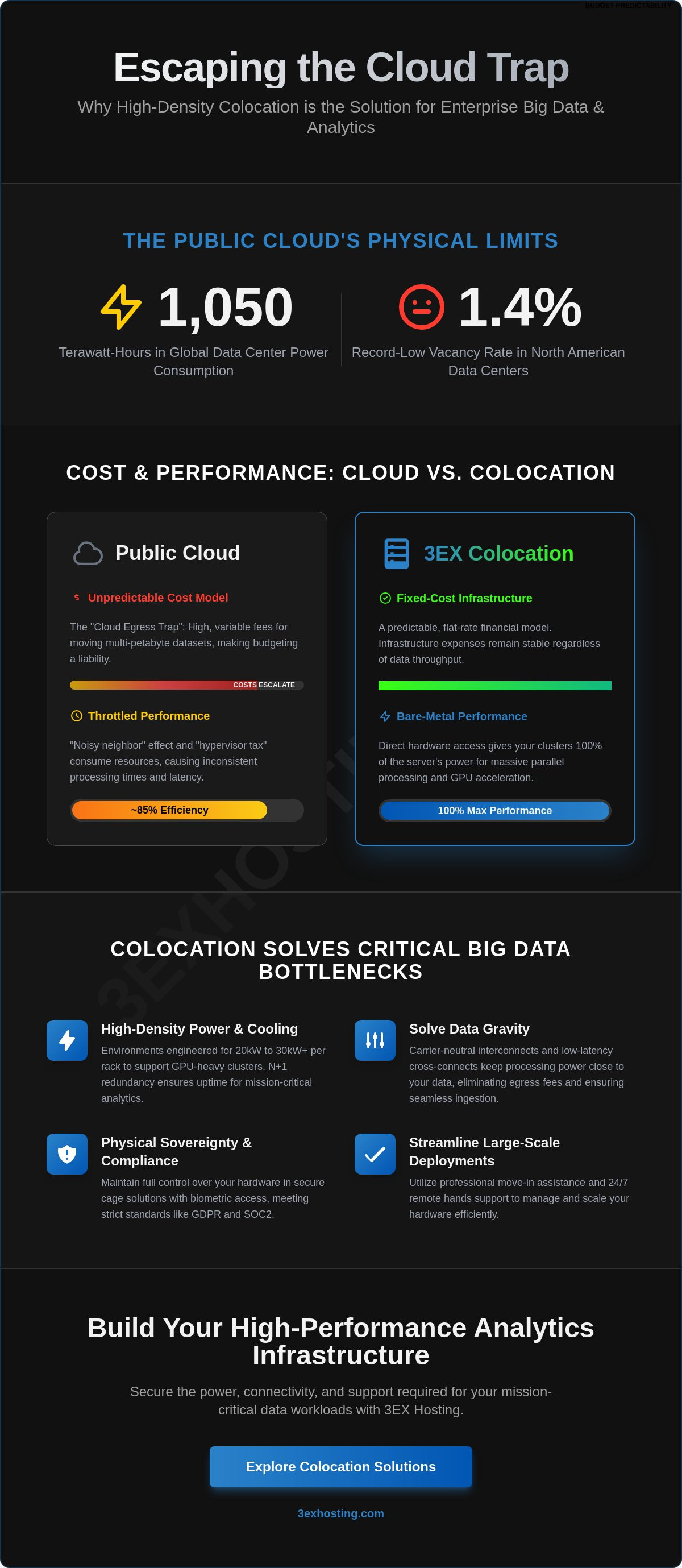
With global data center power consumption reaching 1,050 terawatt-hours this year and North American vacancy rates hitting a record low of 1.4 percent, the physical limits of the public cloud have finally hit a breaking point for enterprise analytics. You’ve likely felt the impact in your monthly billing as unpredictable egress fees and latency bottlenecks turn a promising data lake into a costly liability. Many organizations are now finding that colocation for big data and analytics workloads provides the only viable path to escape these performance traps while maintaining strict control over infrastructure costs.
This guide demonstrates how high-density colocation solves the specific bottlenecks that public clouds can’t manage effectively. You’ll learn how to secure the specialized power and cooling required for GPU-accelerated processing and achieve the sub-millisecond latency necessary for real-time insights. We’ll look at the technical requirements for building a scalable, high-performance environment that remains stable and predictable as your data grows.
Key Takeaways
- Avoid the “cloud egress trap” by transitioning multi-petabyte datasets to a fixed-cost infrastructure model for better budget predictability.
- Master the technical requirements for high-density power and N+1 redundancy when deploying colocation for big data and analytics workloads.
- Solve data gravity issues using carrier-neutral interconnects and low-latency cross-connects to ensure seamless data ingestion.
- Maintain physical sovereignty and meet strict compliance standards like GDPR and SOC2 through secure cage solutions and biometric access.
- Streamline large-scale hardware deployments by utilizing professional move-in assistance and 24/7 remote hands support.
The Economic Shift: Why Big Data is Moving from Cloud to Colocation
Many enterprises originally chose the public cloud for its perceived agility. However, as datasets grow into the multi-petabyte range, the financial model shifts dramatically. The “Cloud Egress Trap” occurs when organizations try to move large volumes of data between cloud regions or back to on-premises systems for specialized processing. These fees can quickly exceed the cost of the compute resources themselves. Choosing a specialized colocation data center allows for a fixed-cost model. Your infrastructure expenses remain predictable regardless of data throughput or transfer volume.
The Hidden Costs of Cloud Data Analytics
Beyond egress fees, the “noisy neighbor” effect in multi-tenant cloud environments often throttles analytics performance. When your ETL jobs compete with other users for CPU cycles or I/O bandwidth, processing times become inconsistent. This variability forces companies to over-provision, leading to wasted spend. For 24/7 analytics workloads, owning hardware in a full cabinet colocation environment offers a significantly higher ROI. You aren’t paying a premium for the flexibility of the cloud when your baseline processing needs are constant and heavy. This transition provides the technical stability necessary for long-term strategic planning.
Bare Metal Performance for ETL and Data Processing
High-frequency data processing requires direct access to physical hardware. In a public cloud, the “hypervisor tax” consumes a portion of system resources just to manage the virtualization layer. Using colocation for big data and analytics workloads removes this overhead. It gives your clusters 100 percent of the bare-metal power for massive parallel processing. This is particularly critical for GPU-accelerated workloads. Every millisecond of latency impacts the real-time nature of the insights you generate. Direct hardware access ensures that your servers perform at their theoretical maximum without interference.
Data Gravity is the principle that as datasets increase in size, they become physically and financially difficult to move, forcing processing power and applications to migrate toward the data’s physical storage location. This reality is driving the adoption of hybrid-cloud architectures. Enterprises keep their massive, static data lakes in high-density colocation for cost efficiency. They then use the public cloud only for burstable, short-term compute needs or specific edge services. This strategy balances technical stability with the flexibility required for modern business intelligence. It’s a pragmatic approach to infrastructure that prioritizes performance and budget control.
Engineering for Density: Power and Cooling for Analytics Clusters
Modern analytics hardware has transformed the data center from a room of racks into a high-precision thermal environment. When deploying colocation for big data and analytics workloads, the primary constraint is no longer square footage. It’s the ability of the facility to deliver and cool intense power densities. Standard 5kW racks can’t support the GPU-heavy clusters required for modern AI training or real-time stream processing. You need an environment engineered for 20kW to 30kW per rack to avoid spreading your infrastructure across multiple cabinets and increasing your cabling costs. This concentration of power requires a sophisticated approach to electrical and mechanical engineering.
Meeting the Power Demands of Modern Analytics
Accurate calculations must account for the difference between kVA and kW to ensure your power distribution units (PDUs) aren’t overloaded. While kVA represents the total power delivered to the rack, kW is the actual power your hardware consumes. In high-density environments, metered power is essential. It provides granular visibility into consumption patterns, allowing you to track the specific energy cost of individual analytics jobs. When planning for future growth in a full cabinet colocation environment, ensure your provider offers N+1 redundancy. This configuration guarantees that even if a power component fails, your data remains available and your processing continues without interruption. These standards often align with the federal colocation readiness checklist, which emphasizes the necessity of redundant power paths for mission-critical workloads.
Cooling the High-Performance Computing (HPC) Environment
Managing the heat from a rack drawing over 20kW requires more than just high-capacity air conditioning. It requires strict hot-aisle or cold-aisle containment to prevent the mixing of air. This separation ensures that cold air is forced directly through the servers where it’s needed most. Efficient airflow management directly lowers your Power Usage Effectiveness (PUE) rating, reducing total operational costs over time. High-density cooling is critical for NVMe storage longevity because sustained thermal stress on flash controllers significantly accelerates drive degradation and increases the risk of silent data corruption. Beyond just cooling, optimizing rack airflow involves using blanking panels and organized cabling to prevent hotspots in dense compute nodes. If you’re unsure if your current setup can handle these thermal loads, you can request a custom infrastructure assessment to verify your requirements and ensure long-term hardware stability.
Solving Data Gravity with Carrier-Neutral Interconnectivity
Data gravity dictates that as your datasets grow, the cost and complexity of moving them increases exponentially. This physical reality makes carrier-neutral data centers a requirement for multi-cloud analytics strategies. Instead of being locked into a single provider’s network, you gain access to an ecosystem of hundreds of carriers. This flexibility allows you to route data through the most efficient paths, minimizing the distance between your storage clusters and your compute resources. When you optimize colocation for big data and analytics workloads, you aren’t just buying space; you’re buying proximity to the global network backbone.
Technical stability depends on a redundant network fabric. A single point of failure in your data ingestion pipeline can lead to processing blackouts, resulting in stale insights and lost revenue. By leveraging peering exchanges within a carrier-neutral facility, you can exchange traffic directly with partners and service providers. This bypasses the congested public internet, providing a cleaner, more stable signal for your distributed analytics clusters. It’s about building a resilient infrastructure that maintains performance even during peak traffic periods or regional network outages.
The Role of Cross-Connect Services in Data Analytics
A physical cross-connect is the most effective way to eliminate network bottlenecks. These direct, point-to-point cables link your hardware to Tier-1 network providers without the latency of multiple router hops. Utilizing cross-connect services enables sub-millisecond response times, which is the baseline requirement for real-time data ingestion and hybrid cloud integration. You can maintain your primary data lake in a private environment while still pushing processed results to cloud-based visualization tools with zero perceptible delay. This direct link ensures your data ingestion remains fast and predictable.
Connectivity vs. Bandwidth: What Matters for Big Data?
Massive bandwidth is often a vanity metric if it’s paired with high-latency routing. For distributed analytics clusters, jitter and packet loss are far more destructive than a slightly narrower pipe. Inconsistent packet arrival times cause synchronization issues between nodes, often forcing the entire cluster to wait for the slowest data packet. This is especially true for High-Density GPU Colocation where parallel processing demands perfect timing. Prioritizing low-latency routing over raw throughput ensures that your ETL pipelines remain fluid and your hardware resources are never idling while waiting for data to arrive. Reliable connectivity is the foundation of any high-performance analytics strategy.
Compliance and Security in Private Colocation Environments
Big data analytics often involves sensitive customer information or proprietary intellectual property. Managing this in a public cloud environment introduces a shared responsibility model where you lack direct control over the physical hardware. For organizations optimizing colocation for big data and analytics workloads, security begins at the perimeter. Physical sovereignty ensures that only authorized personnel can touch the servers processing your most valuable assets. This level of control is essential for meeting the strict requirements of GDPR, HIPAA, and SOC2.
Effective security requires multiple layers. Beyond standard data center access controls, cage solutions provide a dedicated physical barrier within a shared data hall. This prevents unauthorized visual or physical access to your hardware. While many talk about “air-gapping,” true physical network isolation is the real-world standard for high-security analytics. This means your data processing network is physically separate from the public internet, reducing the attack surface to the smallest possible footprint. You should regularly audit your provider for these protocols to ensure they meet enterprise-grade standards.
Private Suites and Custom Cages for Data Sovereignty
Shared environments are suitable for many, but certain financial or healthcare workloads require higher levels of isolation. Transitioning to private colocation suites provides a self-contained room with dedicated cooling and power distribution. This setup allows for completely customized security protocols, such as individual biometric scanners and dedicated surveillance systems. To understand the full scope of these environments, explore our guide on Enterprise Private Suites and how they support data sovereignty.
Disaster Recovery for Mission-Critical Data Lakes
A robust data strategy requires more than just a single secure location. Designing for disaster recovery involves geographic redundancy to ensure your analytics stay online during regional outages. This fits into a 3-2-1 backup strategy: three copies of data, on two different media types, with one copy offsite. Data backup refers to the process of creating a copy of your data for recovery after a loss, while data continuity is the strategy of maintaining uninterrupted business operations during and after a disruptive event. Using colocation allows you to place DR nodes in different power grids without the performance lag of the public internet. If your current security posture needs an upgrade, contact us for a custom security and compliance quote today.
Scaling Big Data Operations with 3EX Hosting Infrastructure
Building a physical foundation for data analytics requires a partner that understands the operational friction of large-scale hardware. When you choose 3EX Hosting for colocation for big data and analytics workloads, you gain more than just a power circuit and a floor tile. You’re integrating your clusters into an environment specifically engineered for the high-density demands of modern GPU and CPU processing. We combine the technical stability of N+1 power redundancy with a carrier-neutral ecosystem to ensure your data pipelines never experience a bottleneck. This infrastructure allows your team to focus on extracting insights rather than managing the complexities of data center facilities.
The transition from a cloud-only model to a physical environment often presents logistical challenges. Our move-in assistance streamlines this deployment phase. We handle the physical logistics, from receiving your hardware to professional rack-and-stack services. This service ensures that your equipment is installed according to thermal best practices, maximizing the efficiency of your cooling and power distribution from day one. It’s a pragmatic approach to scaling that minimizes downtime and eliminates the risks of improper installation.
Operational Excellence with Remote Hands
Scaling a data lake shouldn’t require your senior engineers to travel for routine maintenance. Our 24/7 remote hands support acts as an extension of your on-site IT staff. We perform technical tasks such as drive swaps, cable management, and hardware troubleshooting around the clock. This level of support is critical for maintaining 24/7 data availability in large-scale analytics clusters. For a deeper look at how to optimize your operational workflow, consult our Remote Hands Support Guide. Hardware fails. Having a skilled technician available to swap a failed component in minutes ensures your processing jobs continue without delay.
Future-Proofing Your Analytics Infrastructure
Data grows. Your infrastructure must be able to keep pace without requiring a complete migration every two years. 3EX Hosting provides modular growth options that allow you to add cabinets as your data lake expands. You can start with a single rack and scale into private colocation suites as your sovereignty and power needs increase. This flexibility also supports hybrid architectures. You can keep your primary datasets on bare metal while integrating managed cloud hosting for burstable compute requirements. This balanced strategy ensures you always have the right resource for the job. If you’re ready to stabilize your infrastructure costs and improve performance, get a custom quote for your big data workload today.
Building a Resilient Foundation for Data-Driven Insights
Successfully managing colocation for big data and analytics workloads requires a partner capable of supporting extreme power draws and complex networking needs. Our facilities provide the N+1 power redundancy and carrier-neutral interconnectivity essential for 24/7 data availability. With 24/7/365 remote hands support, your team can maintain operational excellence and hardware health without being physically present at the data center. It’s time to move beyond the limitations of the public cloud and secure a stable, high-performance home for your data lake.
Request a High-Density Colocation Quote for Your Big Data Workload
Your data is your most valuable asset. Give it the technical excellence and expert support it deserves to drive your business forward. For organizations looking to translate their technical efficiency into a stronger market presence, Exclusive Business Marketing offers specialized digital strategies to help scale your brand.
Frequently Asked Questions
How much power density is required for big data analytics racks?
Modern analytics clusters typically require power densities between 20kW and 30kW per rack. Standard data centers often cap at 5kW or 10kW, which forces you to spread hardware across more cabinets and increases cabling costs. High-density facilities are specifically engineered with the cooling and electrical infrastructure to support the intense thermal loads of GPU-heavy processing nodes.
Can colocation reduce my data egress costs from AWS or Azure?
Colocation significantly reduces egress costs by eliminating the per-gigabyte transfer fees charged by public cloud providers. When you host your primary data lake in a private environment, you move from a variable usage model to a fixed monthly port fee. This shift provides budget predictability and allows you to move petabytes of data without financial penalties.
What is the difference between a cage and a private suite for analytics?
A cage provides physical separation using mesh walls within a shared data hall, while a private suite is a fully enclosed room with dedicated cooling and power distribution. Analytics workloads with extreme security requirements or those needing more than 10 racks often prefer private suites for total environmental control and enhanced data sovereignty.
How do cross-connects improve the performance of real-time data processing?
Cross-connects provide a direct, point-to-point physical cable between your hardware and a network provider. This bypasses the public internet and eliminates multiple router hops, ensuring the sub-millisecond response times required for real-time stream processing. Direct connectivity ensures that your ingestion pipelines remain fluid and predictable regardless of external network congestion.
Is colocation compliant with HIPAA and SOC2 for healthcare analytics?
Yes, colocation for big data and analytics workloads is fully compatible with HIPAA and SOC2 standards. The data center provider manages the physical security layers, including biometric access, surveillance, and audit trails. You maintain control over the logical security and encryption of the data, creating a secure environment that meets strict regulatory sovereignty requirements.
What happens if my hardware fails and my team is not on-site?
24/7 Remote Hands technicians are available to perform physical tasks like drive swaps, cable resets, and hardware troubleshooting on your behalf. This service acts as an extension of your IT staff, ensuring that critical component failures are addressed in minutes rather than hours. You don’t need to deploy personnel to the data center for routine maintenance or emergency repairs.
How does carrier neutrality impact my analytics connectivity options?
Carrier neutrality allows you to choose from an ecosystem of multiple network providers rather than being locked into a single carrier. This competition lowers your bandwidth costs and provides diverse routing options. You can select the specific carriers that offer the best latency and performance for your regional data ingestion points.
Can I use colocation for a hybrid-cloud big data architecture?
Colocation serves as the ideal foundation for hybrid-cloud big data strategies. You keep your massive, static datasets on cost-effective bare-metal hardware while using high-speed cross-connects to reach public clouds. This allows you to leverage specialized cloud-based AI tools or burstable compute resources while maintaining a predictable and secure primary data lake.