 SUPPORT


 3EX United States
 Blog
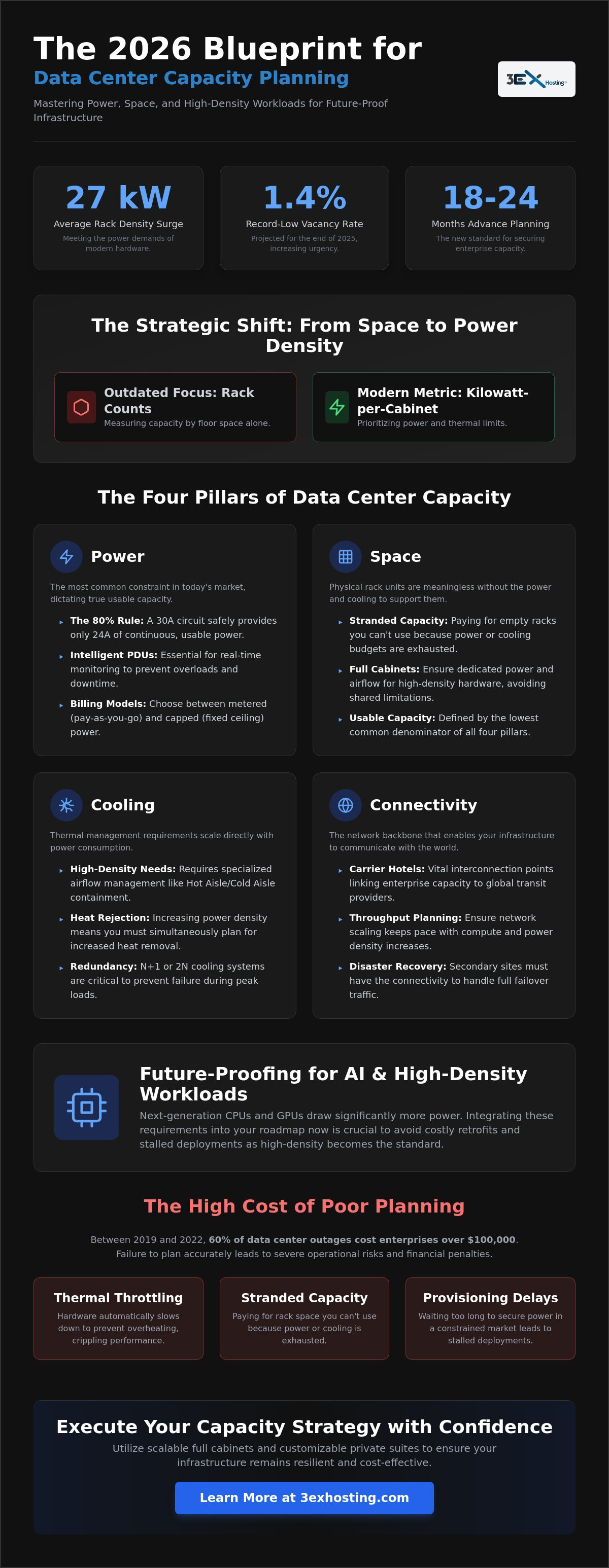
With the average rack density surging to 27 kW and data center vacancy rates hitting a record-low 1.4% at the end of 2025, the margin for error in infrastructure scaling has effectively disappeared. You’ve likely felt the frustration of over-provisioning costs eating into your budget, or perhaps you’re facing the daunting task of predicting GPU requirements for 2026. Effective capacity planning for colocation is no longer just about securing floor space. It’s a high-density power and cooling optimization challenge that requires a proactive, engineering-first approach.
We understand that the complexity of AI workloads and shifting energy regulations makes long-term strategy feel like a moving target. This guide will help you master the technical and financial variables of data center scaling to ensure your infrastructure remains resilient and cost-effective. You’ll gain a clear framework for calculating rack density, a roadmap for future-proofing your AI and GPU growth, and proven methods to minimize operational risk during hardware refreshes. Let’s look at how to secure your technical future in a market where power availability is the primary constraint.
Key Takeaways
- Shift your focus from simple rack counts to kilowatt-per-cabinet metrics to meet the power demands of 2026 hardware.
- Master the four pillars of capacity—power, space, cooling, and connectivity—to unlock the true usable potential of your infrastructure.
- Integrate AI and GPU hosting requirements into your roadmap now to avoid costly retrofits as high-density workloads become the standard.
- Implement a data-driven strategy for capacity planning for colocation to eliminate the high costs of over-provisioning and idle resources.
- Streamline your enterprise deployment by utilizing scalable options like full cabinets and customizable private suites for maximum flexibility.
What is Capacity Planning for Colocation?
Capacity planning for colocation is the strategic alignment of your IT hardware requirements with the physical and technical resources of a data center. It’s a specialized branch of capacity management that focuses on ensuring power, cooling, and space are available exactly when your workloads need them. In the 2026 market, this discipline has shifted away from simple rack counts. It now centers on kilowatts per cabinet. For national network strategies, the role of carrier hotels is vital. These facilities act as the primary interconnection points where enterprise capacity meets global transit providers, ensuring that your scaling efforts don’t outpace your connectivity limits.
Failing to plan accurately leads to severe operational risks. Industry data shows that between 2019 and 2022, 60% of data center outages cost enterprises over $100,000. Beyond total downtime, poor planning results in three specific failures:
- Thermal Throttling: Hardware automatically slows down to prevent overheating in under-cooled environments.
- Stranded Capacity: You pay for physical rack space you can’t use because the facility’s power or cooling budget is exhausted.
- Provisioning Delays: Waiting too late to secure power in a market where availability is the primary constraint leads to stalled deployments.
A meticulous approach to capacity planning for colocation is the only way to maintain a cost-effective footprint in an era of record-low vacancy rates.
The Shift from Space to Power Density
Modern data centers aren’t limited by square footage. They’re limited by the grid. Stranded capacity occurs when a facility reaches its power limit while floor space remains empty. For enterprise-grade power delivery, many organizations now prioritize full cabinet colocation. This approach ensures that high-density hardware receives the dedicated power feeds and airflow management necessary to operate at peak performance. It eliminates the risk of being “boxed in” by the power limitations of a shared environment where you might run out of juice long before you run out of rack units.
Why 2026 Demands Proactive Planning
The surge in edge computing and regional data center loads has changed the timeline for infrastructure scaling. Enterprises now secure capacity 18 to 24 months in advance. This proactive stance is essential because next-generation CPUs and GPUs draw significantly more power than their predecessors. If you wait until hardware is ordered to secure your power, you’ll likely find the facility at its limit. Additionally, your capacity strategy directly impacts disaster recovery readiness. If your secondary site can’t handle the burst load of a failover event, your resilience plan is effectively void.
The Four Pillars of Data Center Capacity
Every successful deployment rests on four technical foundations. If you treat space, power, cooling, and connectivity as isolated silos, you’ll inevitably hit a bottleneck that stalls your growth. Usable capacity is the lowest common denominator of these four pillars. For example, you might have forty rack units of physical space, but if your cooling system can only handle 5 kW per cabinet, your usable space is effectively cut in half. High-tier data center providers solve this by maintaining N+1 or 2N redundancy across every pillar. This ensures that a single component failure doesn’t compromise your mission-critical hardware during peak loads.
Effective capacity planning for colocation requires a deep understanding of how these variables interact. When you increase power density, you must simultaneously account for increased heat rejection and network throughput. Balancing these factors is the only way to maintain a resilient and scalable environment.
Power: Beyond the Volts and Amps
Power is the most common constraint in the 2026 market. You must choose between metered billing, where you pay for actual consumption, and capped billing, which provides a fixed power ceiling. A critical technical detail often overlooked is the 80% rule. National electrical codes generally require that circuit breakers only carry 80% of their rated load for continuous use. This means a 30A circuit only provides 24A of usable power. Intelligent PDUs are now essential; they provide the real-time telemetry needed to monitor capacity and prevent circuit overloads before they occur.
Cooling and Thermal Management
Cooling requirements scale directly with your power draw. High-density environments require specialized airflow management, such as Hot Aisle/Cold Aisle containment, to prevent the mixing of air streams. As average rack densities push toward 27 kW, calculating BTU requirements per kilowatt becomes a precise engineering task. Without proper containment and airflow discipline, you risk thermal hotspots. These spots trigger hardware throttling, which reduces performance and shortens the lifespan of your enterprise equipment.
Connectivity and Cross-Connects
Network port capacity is just as vital as physical rack units. Your connectivity strategy should account for the number of available fiber pairs and the physical path diversity of your links. Utilizing cross-connect services allows for direct, low-latency links to carriers and cloud on-ramps. These services are the backbone of hybrid cloud integrations. They provide the throughput necessary for massive data transfers without the latency or security risks associated with the public internet. If you’re preparing for a high-density deployment, it’s wise to request a technical consultation to audit your specific power and connectivity requirements.
- Verify the derated (80%) amperage of all assigned power drops.
- Confirm the facility’s maximum cooling capacity per cabinet for high-density hardware.
- Inventory all required network handoffs for both internal and external traffic.
- Audit N+1 redundancy for all UPS systems and cooling loops.
Future-Proofing for AI and High-Density Workloads
Many enterprises still believe high-density infrastructure is a niche requirement for the future. This is a strategic error in 2026. With the industry average rack density surging to 27 kW, and AI training clusters frequently pushing toward 100 kW per rack, the baseline for enterprise hardware has shifted. Even if your current load is modest, next-generation hardware refreshes will likely demand 15 kW or more per cabinet. Proactive capacity planning for colocation must account for these exponential jumps in power draw to avoid mid-cycle migrations or costly infrastructure retrofits. For those specifically deploying machine learning clusters, our guide on High-Density GPU Colocation provides a deeper dive into these specialized requirements.
The surge in GPU-accelerated computing means that power density and thermal management are now the primary drivers of your data center strategy. Planning for 15 kW per rack is no longer “future-proofing”; it’s the current enterprise standard. If your facility can’t support these densities today, your ability to scale AI workloads tomorrow will be severely compromised.
Preparing for GPU Server Deployment
GPU clusters introduce unique physical and electrical challenges. Beyond the massive power draw, these racks are significantly heavier than standard compute nodes. You must verify that the facility’s floor load capacity can support fully populated high-density racks, which can weigh several thousand pounds. Electrical delivery also requires precision. Most GPU deployments require 3-phase power and specialized PDUs to maintain stable voltages. Partnering with experienced AI infrastructure hosting providers ensures that these physical and electrical variables are managed by experts who understand high-performance computing.
Scalability vs. Sovereignty
As your footprint grows, the choice between shared space and private suites becomes critical. While shared cabinets offer speed, private suites provide the sovereignty needed for custom cooling and power configurations. This is especially important for enterprises using liquid cooling or non-standard rack dimensions. For organizations that need a middle ground, cage solutions offer physical security and dedicated space within a shared hall. This allows you to scale your footprint while maintaining strict access controls and organized cable management. Choosing the right environment today determines how easily you can adapt to the hardware demands of 2027 and beyond.
The Over-Provisioning Trap: Balancing Risk and ROI
The fear of running out of power or space often leads enterprise IT leaders into the over-provisioning trap. In a market where wholesale colocation pricing for large deployments has risen by up to 19% year-over-year, committing to unused capacity is a significant financial risk. Paying for “empty racks” or “dark fiber” that sits idle for months creates an immediate drain on your bottom line. Effective capacity planning for colocation requires a shift toward a Just-in-Time (JIT) expansion model. This framework allows you to secure the right amount of infrastructure for today’s needs while maintaining a contractual roadmap for future growth.
Balancing risk and return on investment means treating your data center footprint as a dynamic asset. Managed services and flexible contract structures can mitigate the risks of lean capacity. By aligning your hardware refresh cycles with your colocation commitment, you ensure that you aren’t paying for power density that your current equipment can’t even utilize. If you’re ready to optimize your footprint, request a custom quote to see how a tailored strategy can reduce your operational overhead.
Identifying Stranded and Underutilized Resources
Maximizing ROI starts with an audit of your existing footprint. Many legacy environments suffer from stranded resources where power is available but space is disorganized, or vice versa. Consolidation is the primary tool for efficiency. By replacing aging, power-hungry servers with modern high-density hardware, you can often free up multiple rack units while reducing your total power draw. Virtualization plays a massive role here. It allows you to increase the utilization rates of your physical hardware, ensuring that every kilowatt you pay for is actively supporting a workload.
Operational Support: The Remote Hands Advantage
Maintaining a lean capacity model requires high-speed operational support. Utilizing remote hands support allows your team to manage complex hardware refreshes and scaling tasks without the cost of travel or dedicated on-site staff. These professionals act as your eyes and ears on the data center floor, performing everything from cable audits to server reboots. For larger expansions, professional move-in assistance provides a high ROI by ensuring that new hardware is racked, stacked, and cabled correctly the first time. This minimizes the risk of deployment delays that could lead to service outages. To learn more about optimizing your on-site operations, read our comprehensive guide on Remote Hands Support.
- Calculate the delta between your contracted power and your actual peak usage.
- Identify hardware older than five years that could be consolidated via virtualization.
- Review your cabling infrastructure to ensure airflow isn’t being blocked by “cable dams.”
- Audit your cross-connect inventory to eliminate unused or redundant network ports.
Executing Your Capacity Strategy with 3EX Hosting
Executing your capacity planning for colocation requires more than a simple lease agreement; it requires a strategic partner that understands the high-density demands of the 2026 market. 3EX Hosting provides the technical stability and expert support necessary to turn complex infrastructure goals into a resilient operational reality. We understand the technical anxieties surrounding power density and scaling. Our role is to provide a stable foundation where your processes are in expert hands. Whether you’re consolidating legacy hardware or deploying a massive AI training cluster, our team ensures that your power, cooling, and connectivity requirements are met with precision. We prioritize speed and reliability, allowing your IT team to focus on innovation while we manage the physical layer with professional care.
A successful deployment is the result of aligning technical variables with long-term business goals. At 3EX Hosting, we don’t just provide space. We provide a roadmap for growth that avoids the common pitfalls of over-provisioning and stranded capacity. Our experts are available to guide you through the complexities of circuit derating, thermal management, and network path diversity. This collaborative approach ensures that your infrastructure remains cost-effective as you scale.
Enterprise-Grade Reliability and Redundancy
Infrastructure resilience is built on a foundation of N+1 power and cooling architecture. This level of redundancy ensures that your mission-critical operations remain online even during component maintenance or unexpected equipment failures. As a carrier-neutral facility provider, 3EX Hosting offers direct access to a diverse ecosystem of global transit providers and cloud on-ramps. This neutrality is a core component of a national connectivity strategy. It reduces latency and provides the throughput required for modern enterprise applications. Our focus remains entirely on business continuity, ensuring that your hardware remains protected in a secure, high-availability environment.
Customized Solutions for Every Scale
We recognize that every enterprise has a unique growth trajectory. Our solutions range from full cabinet colocation for focused deployments to expansive private suites for large-scale operations. These private environments are ideal for projects requiring custom power configurations or specialized cooling for AI and high-density hardware. With 24/7 technical expertise available through our remote hands team, you can scale your footprint rapidly without increasing your on-site headcount. Our experts are ready to assist with everything from initial infrastructure design to final hardware integration. It’s time to secure a partner that moves as fast as your business.
Ready to future-proof your infrastructure and eliminate scaling risks? Get a customized colocation quote today and discover how our tailored solutions can support your 2026 growth strategy.
Securing Your Infrastructure Roadmap for 2026
The landscape of data center scaling is undergoing a fundamental shift where power availability, not floor space, dictates success. Mastering capacity planning for colocation requires a precise balance between current hardware needs and the high-density requirements of tomorrow’s AI workloads. By focusing on the four pillars of capacity and avoiding the financial drain of over-provisioning, you ensure your enterprise remains both resilient and cost-effective. You’ve seen that 2026 demands a proactive, engineering-first approach to navigate record-low vacancy rates and rising energy costs effectively.
3EX Hosting provides the stable foundation needed for this transition. We offer enterprise N+1 power redundancy and carrier-neutral connectivity options to keep your mission-critical systems online and fully integrated. With our 24/7 expert remote hands support, your team can manage complex scaling tasks with total peace of mind. It’s time to build a strategy that matches the speed of your growth and the technical excellence of your brand. We don’t just provide space; we provide the reliability your modern infrastructure requires.
Request a Specialized Colocation Capacity Consultation to start designing your custom infrastructure today. Your technical future is in expert hands, and we’re ready to help you navigate these complexities with ease.
Frequently Asked Questions
What is the most common mistake in colocation capacity planning?
The most common mistake is treating the process as a procurement exercise rather than an engineering one. Many organizations focus on rack counts while ignoring the power density and cooling limits of the facility. This often leads to stranded capacity, where you pay for physical space you can’t use because the data center’s power or thermal budget is already exhausted for your assigned area.
How much power density do I need for AI and GPU hosting in 2026?
For AI and GPU workloads in 2026, you should plan for a minimum of 15 kW to 30 kW per rack as a standard enterprise baseline. High-performance training clusters frequently push these limits toward 100 kW per rack. Accurate capacity planning for colocation must account for these surges to ensure your cooling and power delivery systems can handle the intense thermal load of next-generation hardware.
What is the difference between metered and flat-rate power in colocation?
Metered power billing charges you based on your actual kilowatt-hour consumption, which provides better ROI for variable workloads. Flat-rate power provides a fixed power ceiling for a set monthly fee, regardless of your actual usage. While flat-rate models simplify budgeting, they often lead to overpaying for unused capacity if your hardware doesn’t consistently operate at its peak rated draw.
How do I calculate the cooling requirements for my server cabinet?
You calculate cooling requirements by converting your total IT kilowatt load into British Thermal Units (BTUs). One kilowatt of power generates approximately 3,412 BTUs of heat per hour. If your cabinet draws 10 kW, your cooling system must be able to reject at least 34,120 BTUs per hour to prevent hardware throttling and maintain the technical stability of your enterprise equipment.
Can I expand my colocation footprint without moving my existing hardware?
You can expand without moving by securing adjacent rack space or a “right of first refusal” on neighboring cabinets during your initial contract. Another effective strategy is to refresh legacy servers with higher-density hardware. This allows you to increase your total compute power within your existing rack units, effectively expanding your capacity without needing to physically increase your data center square footage.
What role do cross-connects play in network capacity planning?
Cross-connects provide direct, physical fiber or copper links between your equipment and carriers or cloud providers within the facility. They’re essential for network capacity planning because they bypass the public internet, which significantly reduces latency and increases throughput. This ensures your network bandwidth can scale alongside your physical hardware without becoming a performance bottleneck during massive data transfers.
Is it better to over-provision space or power for future growth?
It’s almost always better to prioritize power availability over physical space. Power is the primary constraint in the 2026 market; finding a facility with available high-density circuits is much harder than finding extra floor tiles. Securing a robust power commitment ensures you can deploy modern, high-density hardware even if your physical footprint remains compact, maximizing your overall infrastructure efficiency.