 SUPPORT


 3EX United States
 Blog
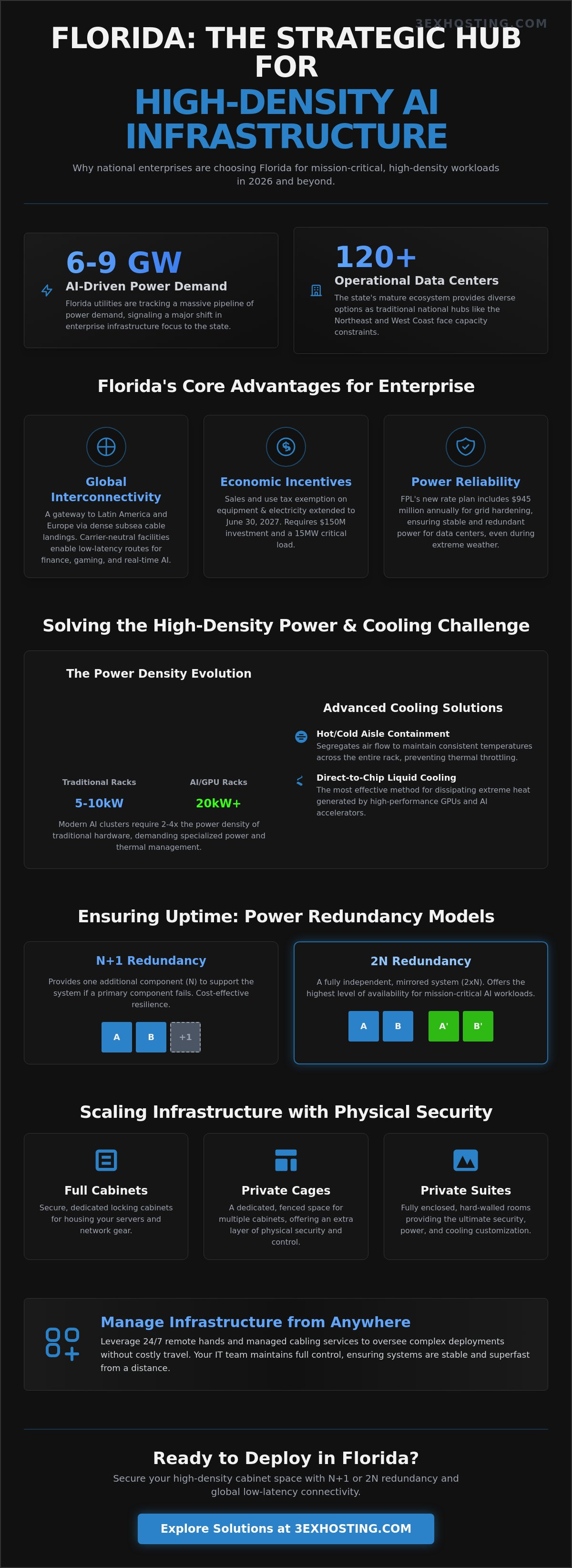
Florida’s utilities are currently tracking a massive 6 to 9 GW of estimated AI-driven power demand in their development pipeline. As traditional national hubs reach capacity, enterprises are rapidly moving high-density workloads to the Sunshine State to stay competitive. You’ve likely noticed that finding a reliable data center florida has become the top priority for firms needing low-latency connectivity to international markets without the skyrocketing power costs found in other regions. It’s a challenge to balance grid stability with the need for massive, redundant power for AI infrastructure.
This guide explains why Florida has evolved into a strategic hub for high-density colocation and global enterprise traffic in 2026. We’ll explore the extended sales tax exemptions available through June 30, 2027, and how new regulations like HB 1517 impact your infrastructure planning. You’ll learn how to secure high-density cabinet space with 24/7 remote hands support to eliminate travel and ensure your systems remain superfast and stable. We’ll also preview the specific FPL rate structures and inland development trends that provide the security and reliability your enterprise demands.
Key Takeaways
- Identify why Florida’s subsea cable landings and carrier-neutral hotels are critical for enterprises requiring low-latency international connectivity.
- Learn the technical specifications of N+1 and 2N redundancy models necessary to support high-density AI and GPU-intensive workloads.
- Discover how to scale your infrastructure from full cabinets to private suites in a premier data center florida to enhance physical security and operational performance.
- See how 24/7 remote hands support and managed cabling services allow your IT team to oversee complex deployments from a distance without the cost of travel.
What Makes a Florida Data Center Strategic for National Enterprises?
Florida has transitioned from a regional market into a powerhouse hub with over 120 operational facilities. For national enterprises, choosing a data center florida location is no longer just about serving local users; it’s about global positioning. The state’s unique geography places it at the intersection of North American fiber backbones and the subsea cables connecting to Latin America and Europe. This physical connectivity allows for massive data throughput with minimal delay. As traditional hubs in the Northeast and West Coast face power constraints, Florida offers the space and utility capacity required for modern, high-density deployments.
A critical component of this strategy is the carrier hotel model. These facilities serve as central nervous systems where hundreds of providers meet. Carrier neutrality is non-negotiable for enterprise resilience. It prevents vendor lock-in and allows your IT team to switch providers or blend multiple carriers to ensure 100% uptime. We’re seeing a fundamental shift toward high-density AI and GPU-ready infrastructure. Florida’s utilities currently manage a pipeline of 6 to 9 GW in estimated AI-driven power demand. This shift requires specialized cooling and power redundancy that traditional data center environments simply can’t provide.
The Gateway to Global Interconnectivity
Florida’s subsea cable density is a primary driver for high-performance networking. By utilizing cross-connect services within a carrier-neutral facility, companies link directly to global providers and bypass the congested public internet. Proximity to subsea landings reduces global hop counts by placing compute resources at the immediate edge of the continental fiber. This results in ultra-low latency for financial services, gaming, and real-time AI applications that require immediate feedback loops across international borders.
Business Incentives and Economic Reliability
The economic landscape in 2026 heavily favors large-scale infrastructure investments. Governor DeSantis extended the sales and use tax exemption for data center equipment and electricity through June 30, 2027. To qualify for these significant savings, companies must make a $150 million cumulative investment and maintain a critical load of at least 15MW. These incentives have solidified Florida’s role in the national “High Tech Corridor,” with total market investment projected to exceed $2 billion this year, attracting a diverse array of local service providers like preatigewoodblinds.com. Power reliability remains a top priority; Florida Power & Light (FPL) implemented a new rate plan on January 1, 2026, which includes $945 million in annual revenue dedicated to grid hardening. This investment ensures that even during extreme weather events, the power infrastructure supporting your data center florida deployment remains stable and redundant.
Solving the High-Density Power and Cooling Challenge
High-density computing is redefining what a data center florida must provide for enterprise clients. Traditional racks designed for 5kW to 10kW can’t sustain the 20kW+ per cabinet required by modern AI clusters and GPU arrays. This surge in power density forces a move toward precise thermal management and transparent power usage. Enterprises now prioritize facilities that offer metered power and real-time PUE (Power Usage Effectiveness) reporting to meet their internal ESG goals while maintaining peak performance. This transparency ensures you aren’t paying for cooling inefficiencies or shared overhead from lower-density tenants.
Infrastructure for AI and GPU Clusters
AI training and GPU-intensive workloads generate heat that standard air conditioning can’t dissipate. Effective designs now utilize hot and cold aisle containment or direct-to-chip liquid cooling to manage these thermal loads. If your hardware requires massive compute power, reviewing a High-Density GPU Colocation guide is essential for planning your rack layout. These environments ensure that hardware stays within safe operating temperatures even at maximum utilization. By segregating the airflow, facilities can maintain a consistent temperature across the entire height of the rack, preventing the thermal throttling that plagues older data center designs.
Power Redundancy and Grid Resilience
Reliability in a data center florida depends on the underlying redundancy architecture. N+1 redundancy provides a single extra component for every group of active units to cover a failure, while 2N redundancy offers two completely independent power paths for total fault tolerance. Industrial-grade UPS systems and on-site fuel reserves for backup generators are standard for achieving 99.999% uptime. These systems are governed by Florida state data center regulations which mandate strict operational standards for disaster recovery and security management.
Modern cooling architectures have also evolved to mitigate water consumption concerns. While some hyperscale centers historically used 50,000 gallons of water daily, newer facilities employ closed-loop systems that recycle water or use air-side economizers. This approach protects local resources while ensuring your mission-critical systems stay online during extreme weather. Facilities now build their shells to withstand Category 5 hurricane winds, with floor elevations set well above flood levels to ensure physical safety. To see how these technologies work in practice, you can request a technical spec sheet for your specific deployment needs.
Comparing Colocation Models: Cabinets, Cages, and Suites
Choosing the right footprint in a data center florida depends on your current rack density and your five-year growth forecast. Enterprises often start with Full Cabinet Colocation because it offers a secure, lockable environment with immediate deployment capabilities. This model is perfect for businesses that need to scale one rack at a time without the overhead of a dedicated room. As your infrastructure expands, Cage Solutions provide a customizable middle ground. These partitioned areas allow you to manage multiple racks within a shared hall while maintaining a physical barrier from other tenants.
Recent data center colocation market trends show a 14.5% annual growth rate in high-density deployments, largely driven by enterprises moving away from shared environments toward dedicated spaces. When your power requirements exceed 100kW or you manage highly sensitive datasets, it’s time to graduate to Private Colocation Suites. These suites offer floor-to-ceiling walls and dedicated access, providing the highest level of isolation available in a multi-tenant facility.
Full Cabinet vs. Private Suites
The decision between a cabinet and a suite usually comes down to compliance and customization depth. While cabinets are superfast to deploy, private suites allow for bespoke cooling configurations and dedicated power distribution units (PDUs). For financial institutions and healthcare providers, the sovereignty factor is often the deciding point. Private suites ensure that your hardware isn’t just logically isolated, but physically separated from any other entity’s equipment. This model allows you to maintain total control over the environment while leveraging the facility’s redundant power and cooling backbone.
Compliance and Physical Security Standards
Operational stability requires more than just redundant power; it demands rigorous physical security. Any enterprise-grade data center florida must meet SOC 2, HIPAA, and PCI-DSS requirements to ensure data integrity. These facilities utilize multi-factor access control, including biometric scanners and high-definition CCTV with 90-day footage retention. Physical sovereignty is the top priority for 2026 enterprise buyers because it guarantees that only authorized personnel can ever touch the physical server hardware. Every entry and cabinet opening creates a permanent audit trail, giving your compliance officers the peace of mind that your infrastructure is secure 24/7.
Operational Excellence: Managing Infrastructure from a Distance
Managing a data center florida footprint from a national headquarters requires a shift in operational strategy. You can’t fly a senior engineer across the country every time a server needs a hard reboot or a fiber patch cable fails. This is where professional managed IT infrastructure services become the backbone of your deployment. From the initial hardware migration to daily troubleshooting, having a team on the ground ensures that your systems remain stable and superfast without the overhead of constant travel. It’s about maintaining total control while your physical assets are thousands of miles away.
The move-in phase is often the most complex part of a national migration. Utilizing specialized move-in assistance allows your team to ship equipment directly to the facility. On-site engineers handle the unboxing, racking, and professional cabling according to your exact diagrams. This level of operational excellence ensures that your infrastructure is production-ready the moment the power is switched on, preventing the delays common with unmanaged setups.
24/7 Remote Hands: Your On-Site Engineering Team
A robust Service Level Agreement (SLA) for Remote Hands Support is the best way to reduce the “travel tax” on your IT budget. Standard tasks include visual inspections, power cycling, and hot-swapping failed components like NVMe drives or power supplies. In emergency scenarios, response times are measured in minutes, not hours. For a deeper look at optimizing these workflows, consult our Remote Hands Support Guide. By delegating physical layer tasks to certified on-site technicians, your internal team can focus on high-level architecture and software optimization.
Interconnection and Ecosystem Access
Carrier-neutral facilities in Florida provide more than just power and cooling; they offer an ecosystem of connectivity. Within this environment, you can access global cloud on-ramps and regional peering exchanges through low-latency fiber. Cross-connects function as the nervous system of a data center, facilitating direct, private links between your racks and your chosen carriers or cloud providers. This direct interconnection bypasses the public internet, significantly reducing latency and increasing security for hybrid cloud strategies. Whether you’re balancing traffic between multiple carriers or linking to an AI GPU cluster, these physical connections are essential for modern enterprise performance.
If you’re ready to streamline your Florida operations, learn how our Remote Hands team can support your national deployment.
Selecting Your Florida Data Center Partner
Selecting a data center florida provider in 2026 requires a balance between technical capacity and operational support. You need more than just a floor and a power feed. A strategic partner must bridge the gap between physical hardware colocation and managed cloud performance. As we’ve discussed, the surge in AI-driven power demand makes high-density readiness a primary filter. With Florida’s utilities managing up to 9 GW of AI-driven demand in their pipeline, your partner must have the engineering depth to handle massive thermal loads without compromising stability.
The 2026 Infrastructure Checklist
Before signing a contract, verify that the facility supports your long-term roadmap. Ensure they offer at least 20kW per rack for GPU clusters and maintain a PUE efficiency that aligns with your ESG goals. Check for a diverse array of carriers to avoid vendor lock-in; carrier neutrality is essential for network resilience. You should also audit their disaster recovery readiness, specifically looking for Category 5 hurricane wind ratings and floor elevations set above 100-year flood levels. Review the 3EX Data Center overview to see how these specifications look in a production-ready environment. A history of 100% uptime through extreme weather events is the best indicator of future reliability.
Future-Proofing with 3EX Hosting
3EX Hosting provides the stability national enterprises require for mission-critical deployments. We specialize in high-density, carrier-neutral infrastructure designed for the demands of 2026 and beyond. Our team understands that hardware is only half the battle; the other half is the human support behind it. With our professional Move-In Assistance, we take the stress out of hardware migrations by handling the physical logistics on your behalf. This service allows your IT staff to stay focused on core business applications while our engineers manage the racking and cabling. We don’t just provide space; we provide a partnership that eliminates the need for constant travel.
Whether you need a single rack or a dedicated room, our solutions are built for speed and security. We offer a unique combination of hardware expertise and managed cloud hosting knowledge, ensuring your hybrid strategies are seamless. The next step in your infrastructure journey is a technical assessment to align our resources with your specific power and connectivity needs. You can start this process by Getting a Quote or consulting with our engineers to design your Florida infrastructure today. We’re ready to provide the stable, superfast foundation your enterprise deserves.
Scale Your Enterprise Infrastructure with Confidence
Florida’s role as a strategic connectivity bridge is now a permanent fixture in the national IT landscape. For enterprises, the move toward high-density AI infrastructure requires a facility that offers more than just square footage. You need a data center florida partner that provides the technical depth to handle 20kW+ rack loads while maintaining carrier-neutral flexibility. By leveraging 24/7 enterprise remote hands, your team can manage complex global deployments from a distance with total confidence. This operational model eliminates the travel tax and ensures your hardware stays stable and superfast.
Stability and performance are the non-negotiable foundations of success in the 2026 market. Whether you’re graduating to a private suite or deploying a new GPU cluster, your infrastructure must be resilient enough to withstand extreme weather and efficient enough to meet strict ESG goals. Our engineers are ready to help you address these technical requirements with precision. We combine AI-ready power with the human support needed to keep your systems online 24/7. It’s time to secure a footprint that supports your international growth without the overhead of local staffing.
Design your high-density Florida infrastructure with a 3EX Hosting expert today. Let’s build a secure foundation for your enterprise future.
Frequently Asked Questions
What are the primary benefits of choosing a data center in Florida for national operations?
Florida serves as a strategic gateway to Latin America and Europe through its dense network of subsea cable landings. National enterprises benefit from ultra-low latency and a business-friendly environment, including sales tax exemptions for equipment extended until June 30, 2027. This makes a data center florida location ideal for companies that need to balance international connectivity with domestic backbone performance.
How do Florida data centers handle extreme weather and power grid stability?
Facilities utilize Category 5 hurricane-rated shells and elevated floor designs to protect against high winds and flooding. On January 1, 2026, a new FPL rate plan took effect, dedicating $945 million in annual revenue to grid hardening and infrastructure resilience. These investments, combined with on-site fuel reserves and 2N power redundancy, ensure that mission-critical operations remain stable during severe weather events.
What is high-density colocation and why is it necessary for AI workloads?
High-density colocation provides the specialized power and cooling required for racks that exceed 20kW of critical load. Standard data center florida designs often struggle with the thermal output of AI training and GPU clusters. High-density environments use advanced cooling, such as hot-aisle containment or direct-to-chip liquid cooling, to prevent hardware throttling and ensure the stability of intensive compute tasks.
Can I manage my Florida-based servers without being physically present?
You can manage your entire infrastructure through 24/7 Remote Hands Support. Certified on-site engineers handle physical layer tasks like hardware swaps, cabling, and visual audits based on your specific instructions. This service eliminates the “travel tax” by allowing your internal IT team to focus on software and architecture while our experts manage the physical hardware in Florida.
What is the difference between a carrier-neutral data center and a carrier hotel?
A carrier hotel is a physical building where many different fiber providers meet to exchange traffic. Carrier-neutrality is a service model that allows you to connect to any of these providers without being forced to use a specific vendor. This neutrality is essential for enterprise resilience, as it lets you blend multiple carriers to ensure 100% network uptime and avoid vendor lock-in.
Are there tax incentives for placing IT infrastructure in Florida?
Florida provides a sales and use tax exemption for data center equipment, infrastructure, and electricity through June 30, 2027. To qualify, a company must make a cumulative investment of $150 million and maintain a critical load of at least 15MW. These incentives are designed to attract large-scale enterprise deployments by significantly reducing the long-term cost of high-density hardware operations.
How do cross-connect services improve network performance for enterprise clients?
Cross-connects are direct, private fiber links between your equipment and a service provider within the same facility. By bypassing the public internet, these connections dramatically reduce latency and increase data security. They are the most efficient way to access cloud on-ramps, peering exchanges, and international subsea cables, making them the nervous system of any high-performance network strategy.
What security certifications should I look for in a Florida colocation provider?
Enterprises should prioritize providers that maintain SOC 2 Type II, HIPAA, and PCI-DSS certifications. These standards verify that the facility follows rigorous protocols for physical security, environmental controls, and data privacy. Ensure the provider uses multi-factor biometric access and high-definition CCTV monitoring with at least 90 days of archived footage to maintain a complete audit trail for compliance.