 SUPPORT


 3EX United States
 Blog
Your public internet connection has become the hidden tax on your enterprise scalability. As we move through 2026, relying on standard bandwidth for high-density AI workloads isn’t just slow; it’s a structural risk to your operations. You’re likely already feeling the friction of latency in multi-cloud environments and the unpredictable costs of public data transfer. This is why many organizations are moving toward strategically located low latency colocation to regain control over their network performance.
We understand that managing hardware across multiple sites is complex enough without the added headache of network bottlenecks. This guide shows you how to eliminate those hurdles by leveraging data center interconnection (DCI) to power modern scalability and security. You’ll discover how a carrier-neutral hub provides the technical stability and speed needed for mission-critical applications. We’ll examine the physical layer of high-performance networking, from cross-connect services to GPU-ready infrastructure. By the end of this article, you’ll have a clear roadmap for building a secure, predictable, and high-speed network that supports your most demanding workloads.
Key Takeaways
- Understand how private traffic exchange points eliminate the security risks and performance volatility inherent in public internet routing.
- Explore the technical architecture of Meet-Me-Rooms and software-defined networking to optimize both physical and virtual connectivity.
- Learn why low latency colocation Miami is essential for maintaining predictable throughput and minimizing data hops for mission-critical apps.
- Discover the specialized interconnection requirements for AI workloads, including the high-density bandwidth needed for GPU server hosting.
- Identify how a carrier-neutral hub strategy provides the flexibility to scale infrastructure and reach national networks without hardware bottlenecks.
What is Data Center Interconnection (DCI)?
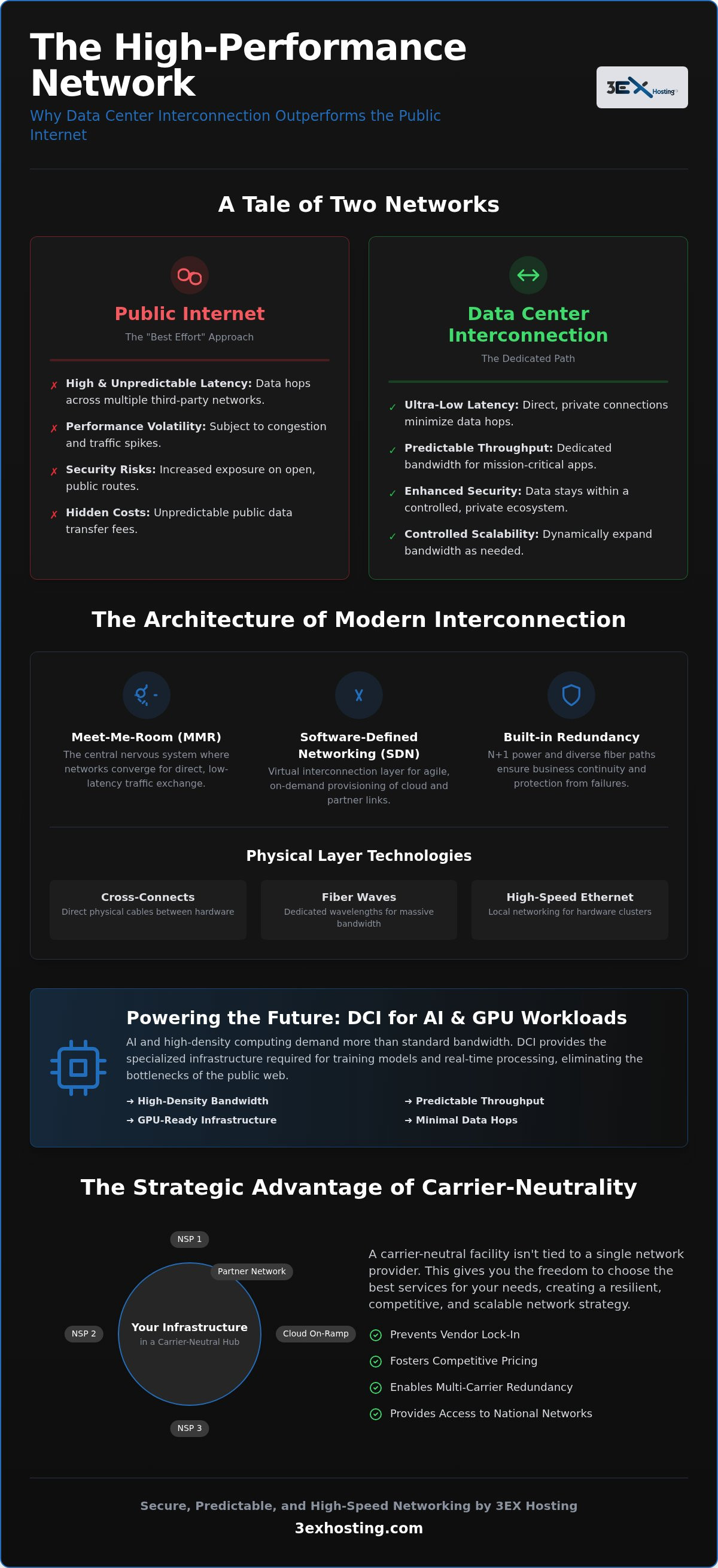
Data Center Interconnection (DCI) is the deployment of IT traffic exchange points that integrate direct, private connections between various infrastructure components. It’s the physical nervous system of modern enterprise architecture. While the public internet serves general needs, it’s often insufficient for mission-critical operations. DCI creates a controlled, private environment for data movement that bypasses the congestion and security risks of open networks. For enterprises in 2026, this isn’t just an upgrade; it’s a foundational requirement for high-density AI and multi-cloud strategies.
The public internet functions as a “best effort” service. Your data hops across multiple third-party networks, which introduces latency and performance volatility. In contrast, Data Center Interconnect (DCI) offers a dedicated path. This approach provides the security, performance, and predictability that businesses need to protect their bottom line. By moving data closer to the user through low latency colocation Miami, organizations can ensure their applications remain responsive and their data stays secure within a private ecosystem.
The physical layer is where the real work happens. DCI relies on hardware-level solutions to move massive amounts of data at light speed. Common technologies include:
- Cross-connects: Direct cable runs between two different customers or providers within the same facility.
- Fiber waves: Dedicated wavelengths of light on a fiber optic cable that provide massive, isolated bandwidth.
- Ethernet: High-speed local area networking used to bridge gaps between hardware clusters.
These tools allow low latency colocation Miami providers to support the heavy data demands of AI training and real-time processing without the overhead of the public web.
The Core Objectives of Interconnection
Modern interconnection aims to solve three primary challenges. First, it achieves ultra-low latency for real-time applications and financial transactions where every millisecond counts. Second, it ensures business continuity. By creating redundant data paths across multiple sites, you protect your operations from localized failures. Finally, DCI allows you to scale bandwidth dynamically. As your digital ecosystem grows, your network can expand to meet those demands without a total hardware overhaul.
Carrier-Neutrality: The Foundation of Choice
Carrier-neutrality is the foundation of a resilient network. It means the facility isn’t tied to a single network provider. You gain the freedom to access multiple Network Service Providers (NSPs), which prevents vendor lock-in and fosters competitive pricing. This diversity is crucial for building a redundant system that can withstand outages from any single carrier. Selecting high-performance colocation services provides the physical base required to establish these vital, diverse connections.
The Architecture of Modern Interconnection
A resilient network architecture relies on a blend of physical proximity and logical agility. This structure begins in the Meet-Me-Room (MMR). The MMR serves as the central nervous system of the facility; it is a secure, controlled space where different network providers and enterprises terminate their fiber lines. By housing all these connections in one room, the data center facilitates direct traffic exchange with minimal physical distance. This setup is the primary driver for achieving low latency colocation Miami, as it removes the geographic hurdles that typically slow down data transfer across the state or country.
The hierarchy of connectivity extends from these local cross-connects to regional and global exchange points. While physical cables provide the foundation, Software-Defined Networking (SDN) adds a layer of virtual interconnection. SDN allows administrators to manage network traffic through software rather than manual hardware adjustments. This flexibility enables businesses to provision cloud on-ramps or partner links in minutes rather than days. It bridges the gap between hardware stability and the dynamic speed required by modern digital ecosystems.
Reliability is built into this architecture through rigorous redundancy protocols. High-performance facilities utilize N+1 power configurations and diverse fiber pathing. Diverse pathing means that network cables enter the building through different physical locations. If a construction crew accidentally cuts a line on one side of the street, your data automatically reroutes through the other entry point. This level of protection is vital for businesses that require low latency colocation Miami to maintain 100% uptime for their mission-critical applications and AI workloads.
Cross-Connect Services: The Direct Link
Point-to-point fiber connections are the most effective way to eliminate the middleman of the public web. By using a direct cable between two racks, you remove the latency introduced by external routers and third-party hops. Research into Low-Latency Data Center Networks highlights that minimizing these hops is critical for high-frequency operations and real-time processing. Utilizing cross-connect services within a carrier-neutral facility ensures your data travels the shortest possible distance at the highest possible speed.
Cloud On-Ramps and Multi-Cloud Integration
Cloud on-ramps act as a private highway between your physical servers and providers like AWS, Azure, or Google Cloud. This direct integration bypasses the public internet, which significantly reduces egress fees and improves data security. For organizations handling massive datasets or complex AI training, Private Data Center Suites offer the dedicated space needed to manage these high-speed integrations. If you’re looking to refine your multi-cloud strategy, consider how a tailored interconnection plan can lower your operational costs while increasing performance.
Interconnection vs. Public Internet: A Performance Analysis
The public internet operates on a best-effort delivery model. This means your data packets compete for bandwidth with every other user on the web. For a home user, a minor delay is unnoticeable. For an enterprise running real-time financial models or AI inference, these fluctuations are unacceptable. Choosing low latency colocation Miami provides a dedicated, private path that bypasses this congestion. You gain a predictable environment where throughput remains constant regardless of external traffic spikes.
Reliability is another critical differentiator. The public internet relies on a complex web of peering agreements and third-party infrastructure. An outage three states away can reroute your traffic and cause unexpected downtime. Private interconnection avoids these vulnerabilities. By establishing direct links within a carrier-neutral facility, you remove the reliance on the open web. This architecture ensures that your mission-critical applications stay online even when public networks face regional failures.
Cost management becomes significantly more straightforward with interconnection. Public internet bandwidth often comes with variable pricing based on usage or peak demand. This makes budgeting difficult for data-intensive organizations. Flat-rate cross-connects provide a fixed cost for virtually unlimited data transfer between local points. You don’t have to worry about the “success tax” of rising egress fees as your traffic grows. It’s a more stable financial model for long-term infrastructure planning.
Latency and Jitter: The Silent Performance Killers
Every router and switch your data passes through on the public internet adds a “hop.” Each hop introduces a few milliseconds of delay. While the total latency might seem low on average, it’s rarely stable. Jitter is the variation in time delay between data packets as they travel across the network. High jitter causes synchronization issues in clustered computing and disrupts real-time data streams. Private interconnection minimizes hops to the absolute physical limit, ensuring a smooth and consistent data flow that the public grid cannot match.
Security and Data Sovereignty
Traversing the public internet exposes your data to sniffing and unauthorized interception. Even with strong encryption, the metadata and traffic patterns remain visible to third parties. Keeping sensitive data off the public grid is often the only way to meet strict compliance standards. Utilizing Cage Solutions provides the physical layer of this security strategy. It ensures your hardware is isolated while your data moves through private, encrypted channels. For organizations requiring the highest level of control, Private Data Center Suites offer a completely sovereign environment for your most sensitive operations. This approach ensures that low latency colocation Miami remains both fast and compliant with 2026 data regulations.
Strategic Implementation for AI and High-Density Workloads
AI training and inference demand a level of bandwidth that traditional networking simply cannot sustain. Large language models (LLMs) and computer vision systems require constant, high-speed data flow between compute nodes and storage clusters. In a high-density GPU hosting environment, specialized interconnection is the only way to handle the movement of terabytes of data without creating a bottleneck. This requirement makes low latency colocation Miami a strategic necessity for businesses deploying AI infrastructure at the edge of the network. For a deeper look at hardware requirements, read our guide on High-Density GPU Colocation: The Enterprise Guide to AI Infrastructure in 2026.
Real-time AI inference at the network edge relies on the shortest possible path between the data source and the processing unit. Every millisecond saved in the networking layer translates directly to faster AI responses. Interconnection architecture allows you to place your compute resources in a carrier-neutral hub where they can ingest data from multiple sources via private cross-connects. This proximity ensures that your AI models perform with the speed and reliability required for autonomous systems or real-time financial analysis.
Scaling AI Infrastructure Nationally
DCI allows enterprises to distribute AI workloads across high-performance hubs without sacrificing performance. Scaling these clusters requires more than just space; it requires high-density power, often exceeding 20kW or 30kW per cabinet. Managing these complex, interconnected clusters is a significant operational challenge. Utilizing Remote Hands support ensures that your physical layer is managed by experts, allowing your internal team to focus on model optimization and data science. This approach combines the physical stability of high-density colocation with the flexibility of a global network fabric.
Future-Proofing for 2026 and Beyond
The transition to 400G and 800G network standards is already underway in the enterprise data center. Digital-native businesses are moving toward an interconnection-first architecture where the network is designed before the hardware is even deployed. By 2026, industry projections suggest that AI-driven traffic will dominate DCI bandwidth, making high-capacity private links the standard for any data-intensive organization. Preparing for this shift now ensures that your infrastructure won’t be obsolete when these higher speeds become the baseline for competitive operations.
If your enterprise is ready to deploy high-density AI clusters, request a custom infrastructure quote to see how our interconnection fabric supports your goals.
Operational Excellence: The 3EX Hosting Approach
Technical stability is the result of aligning high-density hardware with a carrier-neutral networking strategy. 3EX Hosting operates as a strategic hub for national and international connectivity. This placement is vital for organizations seeking low latency colocation Miami. By acting as a carrier hotel, we provide direct access to a dense ecosystem of network service providers. This reduces the physical and logical distance your data must travel. It ensures your infrastructure remains responsive under the heaviest AI or GPU workloads.
Managing a high-performance network shouldn’t require your team to be physically present at the data center. Our 24/7/365 Remote Hands service provides a persistent layer of physical management. Whether it’s a critical cable swap or a complex hardware audit, our technicians act as an extension of your staff. This allows you to maintain peak performance without the overhead of onsite personnel. We offer flexible configurations to match your specific needs, from individual cabinets to fully customized private suites tailored for high-speed interconnection.
Our facility is designed to support the power and cooling requirements of the most demanding modern hardware. We provide the N+1 redundancy and technical expertise necessary to protect your mission-critical applications. This combination of physical security and network agility makes us the preferred choice for enterprises that cannot afford performance volatility. Choosing low latency colocation Miami at a carrier-neutral facility ensures you have the vendor diversity needed to avoid provider lock-in and optimize your operational costs.
Seamless Onboarding and Migration
Transitioning to a new facility often reveals hidden network inefficiencies. Our Move-In Assistance program goes beyond simple hardware transport. We help audit your existing network topologies to identify optimization opportunities during the deployment phase. This proactive approach ensures your network is configured for maximum speed from day one. For large-scale requirements, our Full Cabinet Colocation solutions provide the isolated environment needed for complex, interconnected enterprise deployments.
Expert Support and Reliability
Designing low-latency network paths requires deep technical expertise and a focus on redundant infrastructure. We prioritize 100% uptime through managed services and a robust facility design. Our team understands the specific pathing requirements of real-time data streams and AI inference. You can learn more about how we optimize these processes in our detailed guide on Remote Hands Support: The Enterprise Guide to Data Center Efficiency in 2026. If you are ready to secure your infrastructure, request a quote for a solution tailored to your performance goals.
Future-Proof Your Network Architecture
Transitioning to a high-performance network is no longer a luxury for enterprises handling AI and massive datasets. You’ve seen how private interconnection bypasses the congestion and security risks of the public web. By utilizing direct cross-connects and carrier-neutral hubs, you can achieve the technical stability required for 2026’s digital landscape. Choosing low latency colocation Miami ensures your data travels the shortest possible path while maintaining 100% uptime through redundant infrastructure.
Our facility operates as a strategic carrier hotel hub, providing the high-density GPU colocation capabilities needed for intensive AI training and inference. With 24/7 Remote Hands support, your physical layer remains in expert hands even when your team is offsite. This combination of speed, security, and expert support allows your business to scale without hardware bottlenecks. It’s time to move beyond the limitations of the public internet and build a foundation for long-term growth.
Design your interconnected infrastructure with 3EX Hosting and take control of your network performance today. We’re ready to help you build a faster, more secure future for your enterprise.
Frequently Asked Questions
What is the difference between data center interconnection and a cross-connect?
Data center interconnection is the broad strategic framework of linking disparate IT environments, while a cross-connect is a specific physical cable within a single facility. You use a cross-connect to link two racks in the same building at light speed. DCI can involve longer distances between cities or regions using fiber waves or Ethernet. It’s the difference between a local direct link and a wider networking architecture.
How does DCI improve multi-cloud performance for national enterprises?
DCI improves multi-cloud performance by establishing private, dedicated on-ramps to providers like AWS and Azure. This bypasses the unpredictable routing of the public internet; it reduces latency and stabilizes throughput. National enterprises benefit from a consistent user experience across different cloud regions. You gain a unified network fabric that treats cloud resources as if they were local hardware in your own rack.
Is data center interconnection more secure than a standard VPN?
DCI is inherently more secure than a standard VPN because your data never traverses the public internet. A VPN encrypts data but still sends it across open, third-party networks where traffic patterns are visible. Interconnection uses private, physical paths that are isolated from the global grid. This architecture eliminates the risk of DDoS attacks or packet sniffing at the public network level.
What are the main costs associated with implementing DCI in 2026?
Implementation costs in 2026 typically involve port fees, monthly cross-connect charges, and potential circuit costs for inter-site links. Unlike public bandwidth, these are usually flat-rate fees rather than usage-based billing. You’ll also need to consider the cost of network hardware capable of supporting 400G or 800G standards. This predictable pricing model helps enterprises avoid the volatility of variable internet transit costs while scaling their infrastructure.
Why should I choose a carrier-neutral data center for interconnection?
Choosing a carrier-neutral facility is critical for low latency colocation Miami because it gives you access to a diverse ecosystem of network providers. You aren’t locked into a single carrier’s pricing or performance limitations. This vendor diversity allows you to choose the best path for specific geographic regions or cloud services. It also provides a higher level of redundancy since you can easily switch paths if one carrier experiences an outage.
Can DCI help reduce my cloud egress fees when using AWS or Azure?
DCI can significantly reduce your cloud egress fees when using AWS or Azure. Cloud providers typically charge lower data transfer rates for traffic moving through private connections like Direct Connect or ExpressRoute compared to the public internet. By utilizing a private on-ramp within your colocation environment, you bypass the expensive public transit tax. This makes high-volume data synchronization between your local servers and the cloud much more cost-effective.
What role does Remote Hands play in physical data center interconnection?
Remote Hands technicians manage the physical layer tasks required to establish and maintain interconnection. They handle the installation of cross-connects, cable patching, and hardware troubleshooting within the Meet-Me-Room. This support is vital for national enterprises that don’t have local staff in Miami. It ensures that your physical connections are managed professionally and quickly, maintaining the high-performance standards required for low latency colocation Miami.
How does interconnection support high-density AI and GPU workloads?
Interconnection supports high-density AI workloads by providing the massive, dedicated bandwidth required for data-heavy compute clusters. GPU servers need to ingest terabytes of data from storage at light speed to avoid idle time. Private links ensure that your compute resources aren’t waiting for data packets to arrive over a congested network. This architecture is the only way to sustain the throughput needed for large-scale AI training and real-time inference in 2026.