 SUPPORT


 3EX United States
 Blog
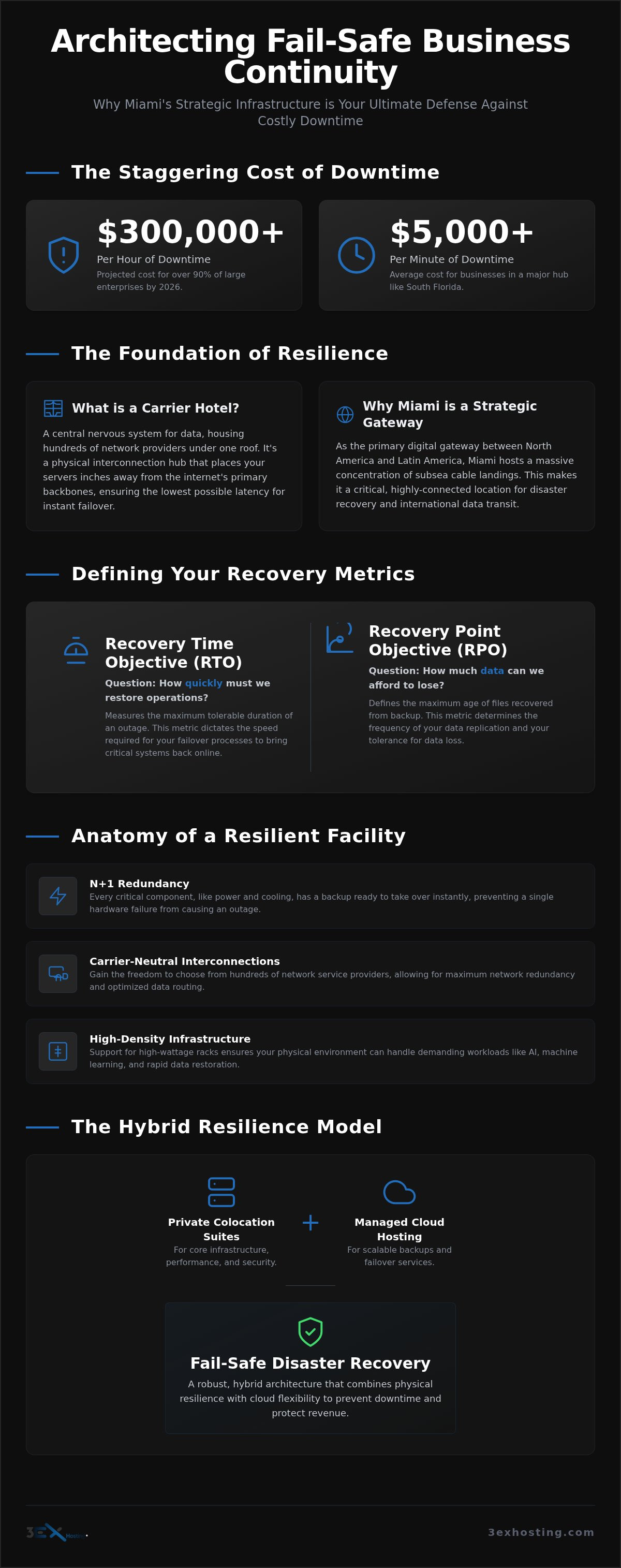
For over 90% of mid-size and large enterprises in 2026, a single hour of downtime now costs more than $300,000. In a fast-paced business hub like South Florida, the average cost of IT downtime can exceed $5,000 per minute. You already know that simple cloud backups aren’t enough to protect your operations against regional disasters or hardware failures. Relying on inconsistent remote support or complex failover processes makes finding robust disaster recovery solutions Miami can support a top priority for any resilient organization.
This guide explains how to architect a fail-safe business continuity strategy using high-density Miami infrastructure and managed recovery protocols. You’ll discover how sub-millisecond latency interconnections and guaranteed power redundancy ensure your data stays accessible even during extreme events. We’ll also examine how rapid recovery through expert remote hands provides the technical stability you need to stay online when it matters most. By the end of this article, you’ll understand how to leverage carrier hotel connectivity to build a recovery plan that’s both fast and reliable.
Key Takeaways
- Understand why carrier hotel status is essential for low-latency connectivity and how Miami serves as a strategic digital gateway for international data traffic.
- Learn how to define critical RTO and RPO metrics to align your recovery strategy with your organization’s core revenue drivers.
- Architect a hybrid resilience model that combines private colocation suites with managed cloud hosting to create fail-safe disaster recovery solutions Miami businesses need to prevent downtime.
- Discover the essential steps for conducting a Business Impact Analysis and designing redundant network architectures using carrier-neutral interconnections.
- See how 24/7 remote hands support and high-density infrastructure provide the physical anchor required for rapid, reliable disaster recovery.
The Strategic Importance of Carrier Hotels for Disaster Recovery Solutions
Reliable disaster recovery starts with the physical location of your hardware. While cloud-based backups offer a layer of protection, true enterprise resilience depends on where your data actually lives. Carrier hotels act as central nervous systems for global data, housing hundreds of network providers under one roof. For organizations seeking IT disaster recovery frameworks that actually work, these facilities offer the lowest possible latency by placing your servers inches away from the internet’s primary backbones. 3EX Hosting operates within this high-connectivity environment, ensuring your infrastructure isn’t just stored, but strategically positioned for instant failover.
Miami’s role in this ecosystem is unique. It’s the primary digital gateway between North America and Latin America, hosting a massive concentration of subsea cable landings. This makes it a critical location for disaster recovery solutions Miami enterprises use to maintain national and international data transit. When a primary site in another state fails, a Miami-based hub provides the high-speed pathways needed to restore services without the delays common in shared, public internet routes.
Infrastructure Resilience in Tier 1 Facilities
Uptime isn’t a suggestion; it’s a requirement. Tier 1 facilities prioritize N+1 redundancy, meaning every critical component like power and cooling has a backup ready to take over immediately. This architecture prevents a single hardware failure from cascading into a full system outage. High-performance cross-connect services enhance this by allowing direct, private connections between your equipment and your service providers. A carrier hotel is a physical interconnection hub where multiple network service providers converge to provide redundant, high-speed data transit for business continuity. 3EX Hosting’s facility leverages its carrier-neutral status, giving you the freedom to choose multiple providers for maximum network redundancy.
Geographic Advantages of the Miami Hub
National enterprises often require a secondary site that’s geographically distant from their primary headquarters but still highly connected. Miami fits this requirement perfectly. Its strategic positioning offers low-latency connectivity to global networks, making it an ideal anchor for your resilience plan. You can Explore our Miami Data Center infrastructure to see how these geographic benefits translate into technical advantages for your business. By utilizing a facility in this region, you ensure your disaster recovery solutions Miami strategy benefits from a hub that’s built for high-density workloads and extreme connectivity.
Calculating Critical DR Metrics: Defining RTO and RPO
Effective disaster recovery solutions Miami enterprises deploy rely on two fundamental metrics: Recovery Time Objective (RTO) and Recovery Point Objective (RPO). RTO measures how quickly you must restore operations after a failure. RPO defines the maximum age of files that must be recovered from backup storage for normal operations to resume. Aligning these targets with your revenue drivers is critical. For many large organizations, downtime costs now exceed $1 million per hour. In Miami specifically, even small interruptions average $5,000 per minute in lost productivity and revenue.
The NIST Contingency Planning Guide provides a structured framework for these calculations. Modern workloads, particularly those involving AI or large-scale databases, require high-density infrastructure to meet aggressive RTOs. If your hardware can’t handle the power draw of rapid data re-indexing, your recovery will stall regardless of your software’s capabilities. High-density colocation ensures your physical environment supports the high-wattage racks often needed for rapid restoration in GPU-heavy environments.
Establishing Your Recovery Time Objective (RTO)
Your RTO determines the maximum tolerable duration of an outage. While cloud services are convenient, physical hardware colocation often facilitates faster restoration for data-heavy enterprises. Moving petabytes of data over the public internet during a crisis is rarely feasible. Having your core infrastructure in a strategic Miami hub allows for local, high-speed restoration. You should prioritize applications based on their mission-critical status. Systems that drive immediate customer transactions require an RTO measured in minutes; internal reporting might tolerate several hours.
Setting Your Recovery Point Objective (RPO)
RPO focuses on your data loss tolerance. If your business processes thousands of transactions per minute, a 24-hour backup cycle is insufficient. You need continuous data replication to ensure your RPO is as close to zero as possible. This requires a robust network with sub-millisecond latency. To maintain these systems, you need more than just software. You need operational support. Review our Remote Hands Support guide to see how expert technicians help maintain the physical layer of your RPO strategy. If you’re ready to secure your infrastructure, you can request a custom resilience quote to see how our facility fits your specific metrics.
Hybrid Resilience: Combining Colocation with Managed Cloud DR
Enterprises often find that a 100% cloud strategy lacks the data sovereignty and predictable performance required for high-density workloads. True resilience comes from a hybrid approach. By keeping your core, mission-critical data on physical hardware while using the cloud for burst capacity, you create a tiered architecture that balances control with elasticity. This “best of both worlds” model is a cornerstone of the advanced disaster recovery solutions Miami providers offer to organizations that can’t afford a single point of failure in their virtual stack.
Physical control over your hardware ensures compliance with strict industry regulations. In a hybrid setup, your primary recovery datasets reside in a secure, physical environment where you manage the security protocols. When a disaster occurs, cross-connect services within the data center bridge the gap between your physical servers and cloud environments. These direct, private connections bypass the public internet, ensuring that your data moves between environments with sub-millisecond latency. This connectivity is vital for maintaining the RTO and RPO metrics discussed earlier in this guide.
When to Choose Private Colocation Suites
For large-scale deployments, private suites offer the highest level of physical security and operational sovereignty. Unlike shared environments, these dedicated spaces allow you to implement custom cage solutions and specialized cooling for high-density AI or GPU hardware. This isolation is particularly important for compliance-heavy industries that require audited access controls. You can Learn about Private Data Center Suites to see how dedicated infrastructure provides a more secure anchor for your recovery plan than shared cloud platforms alone.
Leveraging Managed Cloud for Scalability
Managed cloud hosting provides the necessary scalability to handle sudden spikes in compute demand during a recovery event. You don’t need to pay for idle physical servers to cover every possible peak. Instead, you maintain your baseline operations in a physical cabinet and scale into virtual environments only when a failover is triggered. This tiered storage and recovery model optimizes your monthly spend while ensuring that burst capacity is always available. Integrating managed cloud with your disaster recovery solutions Miami strategy allows for rapid environment replication without the lead times associated with ordering and racking new physical hardware during a crisis.
Step-by-Step: Implementing an Enterprise Failover Strategy
Implementation turns a theoretical plan into a functional defense. A comprehensive Business Impact Analysis (BIA) is the first mandatory step for any organization. This process involves mapping every technical dependency to a specific business function. You must identify which workflows sustain your revenue and which can wait during a restoration period. Without a BIA, your disaster recovery solutions Miami strategy will lack the prioritization needed to manage resources effectively during a high-stress outage. Mapping these dependencies allows you to allocate high-performance infrastructure only where it’s truly mission-critical.
Automating the failover process is equally vital for minimizing human error. During a crisis, manual intervention often leads to delays or configuration mistakes that extend downtime. Modern orchestration tools can trigger failover protocols the moment a primary system heartbeat is lost. This ensures that your transition to secondary infrastructure is predictable and fast. By removing the need for manual decision-making in the first minutes of an event, you protect your RTO and maintain service continuity for your end users.
The Network Failover Architecture
Designing a redundant network architecture requires carrier-neutral interconnections. In a carrier hotel environment, you can utilize high-speed cross-connects for seamless traffic redirection. Redundant BGP routing strategies allow your network to automatically reroute traffic through secondary paths if a primary carrier fails. This level of network agility is especially important for data-heavy workloads. For organizations managing advanced compute requirements, our guide on High-Density GPU Colocation for AI Infrastructure provides deeper insights into building resilient paths for resource-intensive applications. Using these carrier-neutral paths ensures you aren’t locked into a single provider’s failure point.
Testing and Validation Protocols
A disaster recovery plan is only as good as its last successful test. You should conduct scheduled “live” failover tests at least twice a year to ensure RTO and RPO compliance. This “Fire Drill” approach exposes hidden weaknesses in your playbook, such as outdated IP configurations or unauthorized software changes, before a real disaster strikes. Your DR playbook must be a living document that your team updates every time you modify your hardware or software stack. Verification of off-site backups is also essential. Automated testing should confirm that your data is not just present on the secondary site, but is also uncorrupted and ready for immediate mount. If you’re ready to secure your infrastructure with these advanced protocols, contact us for a custom resilience consultation to start building your failover strategy.
Securing Continuity with 3EX Hosting’s Infrastructure
3EX Hosting’s Miami facility provides the physical anchor required for high-availability disaster recovery solutions Miami. Operating as a strategic national hub, the site offers the N+1 redundancy and high-density power capacity necessary to support modern enterprise workloads. Choosing a facility with carrier hotel status ensures your recovery site isn’t isolated. It stays connected to the global network backbones that keep your business visible to the world. We focus on technical stability so you can focus on your core operations.
Moving your infrastructure into a new facility during a crisis shouldn’t be a bottleneck. We streamline the deployment process to ensure your DR environment is active as quickly as possible. Whether you’re transitioning from a shared space to a private suite or establishing a secondary site from scratch, our infrastructure supports rapid scaling without compromising on security or power availability. Our facility is designed to handle the most demanding hardware configurations, ensuring your failover site performs exactly like your primary production environment.
The Remote Hands Advantage
Regional disasters often make travel impossible for your internal IT staff. When roads are closed or flights are grounded, you need a trusted team already on the ground. Our Remote Hands Support provides 24/7 access to expert technicians who act as your physical presence in the data center. They handle hardware resets, complex cabling, and inventory management on your behalf. This service ensures that physical hardware issues don’t stall your recovery efforts. By delegating these tasks to our on-site experts, you maintain operational efficiency without the cost or risk of deploying your own team during an emergency.
Custom Infrastructure for Mission-Critical Loads
Every resilience strategy has unique hardware requirements. We offer scalability options that range from full cabinet colocation to private colocation suites and custom cage solutions. This flexibility is essential for hosting the high-density clusters required for AI and GPU-intensive recovery tasks. If your organization handles sensitive financial or healthcare data, our private suites provide the physical sovereignty and audited access controls needed for strict compliance. You can request a custom quote for DR solutions to see how our Miami infrastructure can be tailored to your specific mission-critical loads. Our goal is to provide a stable, high-performance environment that makes your disaster recovery solutions Miami deployment as simple and effective as possible.
Building a Future-Proof Resilience Strategy
Building your business resilience requires more than just digital backups. It demands a physical anchor in a high-connectivity environment that can handle modern, high-density workloads. By prioritizing metric-driven RTO and RPO targets and leveraging hybrid models, you ensure your data remains sovereign and accessible. A strategic carrier-neutral Miami hub provides the low-latency pathways necessary for rapid restoration when every minute counts.
Implementing effective disaster recovery solutions Miami relies on starts with choosing the right infrastructure partner. 3EX Hosting offers the N+1 power redundancy and 24/7 remote hands support needed to maintain uptime during regional outages. Our facility serves as a national gateway, giving you the technical stability to scale from single cabinets to private suites seamlessly. Don’t wait for a crisis to test your limits. Take the next step toward a fail-safe architecture today.
Secure your enterprise continuity with a custom DR quote from 3EX Hosting and gain the peace of mind that your systems are in expert hands. Your infrastructure is ready for the challenges of tomorrow.
Frequently Asked Questions
What are the primary benefits of disaster recovery solutions in Miami?
The primary benefits include access to a strategic digital gateway with high-density power and sub-millisecond latency. This region serves as a critical hub for international data transit, making it an ideal secondary site for national enterprises. Using disaster recovery solutions Miami provides allows organizations to bypass public internet congestion through direct cross-connects. This physical infrastructure ensures that mission-critical applications remain online even when primary regional sites experience total failure.
How does a carrier hotel improve disaster recovery performance?
Carrier hotels house hundreds of network providers in a single physical space. This allows for direct, private cross-connects that bypass the public internet entirely. By reducing the number of hops between your infrastructure and the network backbone, you achieve the lowest possible latency. This high-performance environment is vital for synchronous data replication and meeting aggressive recovery time objectives during a failover event, ensuring your systems stay responsive.
What is the difference between backup and disaster recovery?
Backup is the act of copying data to a secondary location for long-term storage and file retention. Disaster recovery is the comprehensive plan and infrastructure used to restore full operational functionality after a system failure. While backups protect your data, disaster recovery solutions Miami enterprises rely on ensure that applications and services are actually usable. DR focuses on business continuity and uptime rather than just maintaining a historical archive of files.
How often should an enterprise test its disaster recovery plan?
Most enterprises should conduct full-scale failover tests at least twice a year. Regular testing, often called a fire drill, uncovers configuration errors or outdated documentation that could stall a real recovery effort. You should also update your plan every time you make a significant change to your hardware or software stack. Automated testing of off-site backups should occur daily to ensure your data remains uncorrupted and ready for immediate mount.
Can colocation be used as a primary disaster recovery site?
Yes, colocation is an ideal anchor for a primary disaster recovery site. It provides physical control over your hardware and predictable power costs that cloud environments often lack. Using private suites or cages allows you to maintain data sovereignty while benefiting from enterprise-grade cooling and N+1 redundancy. This physical layer is often more reliable for data-heavy workloads than pure cloud environments that depend entirely on virtualized resources and shared infrastructure.
What role does remote hands support play in disaster recovery?
Remote hands support provides on-site technical expertise when your own team can’t travel to the facility. These technicians act as your boots on the ground for physical tasks like hardware resets, cabling, or drive replacements. During a regional disaster, having 24/7 access to expert support ensures that physical layer issues don’t extend your downtime. It’s a critical component of a resilient recovery strategy that keeps your hardware operational without requiring travel.
Is managed cloud hosting secure enough for disaster recovery?
Managed cloud hosting is highly secure when integrated with private infrastructure. Modern cloud environments use advanced encryption and isolated virtual networks to protect sensitive data. For high-compliance industries, a hybrid approach works best. You can keep sensitive core data in a private colocation suite while using managed cloud for burst capacity. This combination provides both the security of physical hardware and the scalability of the cloud to handle sudden recovery loads.
How do I calculate the ROI of an enterprise disaster recovery solution?
Calculating ROI involves measuring the cost of the solution against the financial impact of downtime. For most mid-size enterprises, downtime costs exceed $300,000 per hour. You should factor in lost revenue, employee productivity, and potential SLA penalties. When you compare these risks to the monthly cost of a resilient colocation suite, the value becomes clear. A proactive recovery strategy protects your bottom line by preventing catastrophic financial losses during an unexpected outage.