 SUPPORT


 3EX United States
 Blog
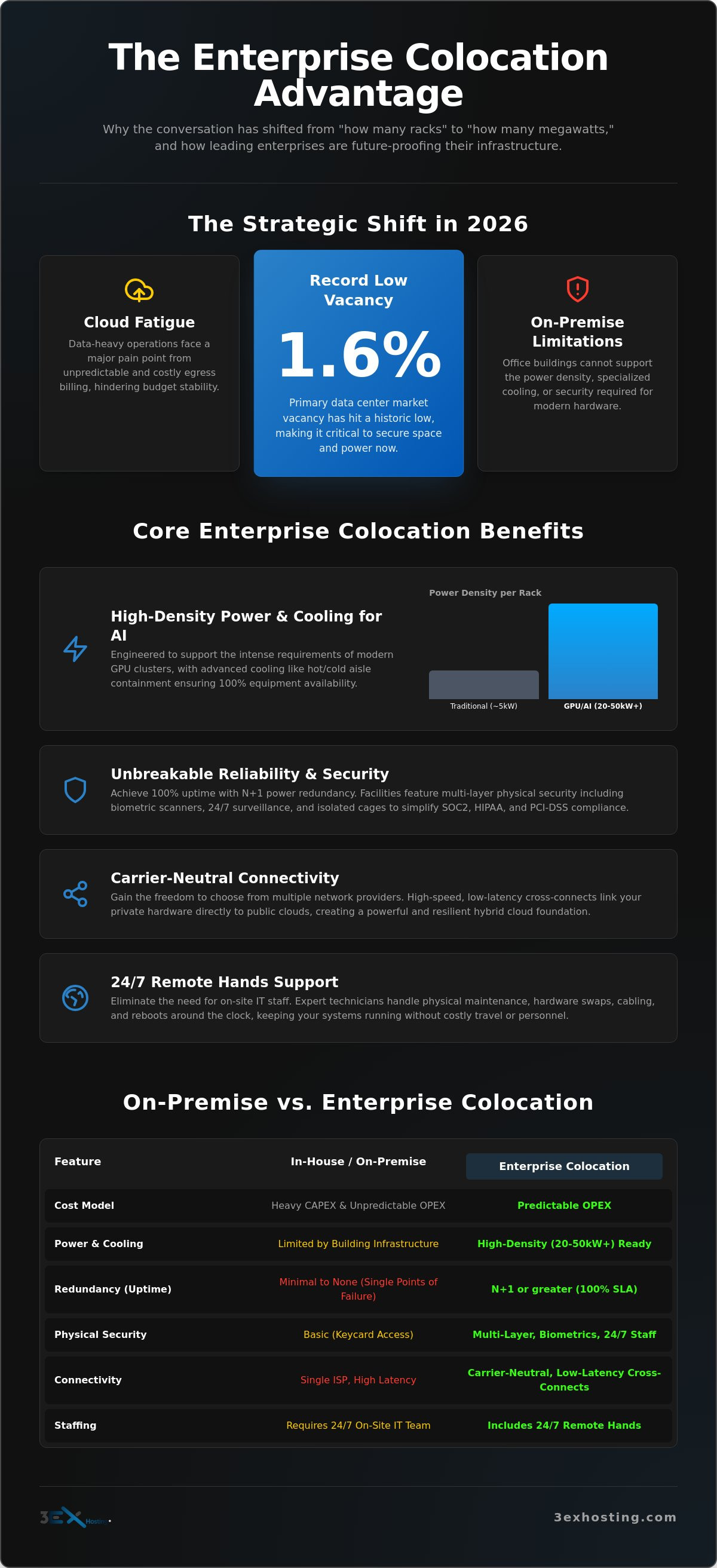
By the middle of 2026, the primary conversation around data centers has shifted from “how many racks do we need” to “how many megawatts can you provide.” With primary market vacancy rates hitting a record low of 1.6% recently, securing the right environment for your hardware has become a high-stakes strategic move. You’re likely tired of seeing unpredictable cloud egress fees eat into your budget or realizing your current facility simply can’t handle the power density required for new GPU clusters. It’s a common frustration for technical teams trying to scale AI and mission-critical workloads without the luxury of 24/7 on-site staff.
This article breaks down the essential enterprise colocation benefits that solve these infrastructure headaches. You’ll discover how high-density power, carrier-neutral connectivity, and professional operational security create a foundation for 100% uptime. We’ll look at why a national network of high-speed interconnections is the key to maximizing performance while keeping your operational costs predictable and your systems in expert hands. By the end, you’ll understand how to bridge the gap between your current hardware limitations and the scalability required for the next generation of computing.
Key Takeaways
- Understand how shifting to an OPEX-optimized model helps you avoid the “cloud fatigue” caused by unpredictable egress billing.
- Explore the core enterprise colocation benefits like N+1 power redundancy and biometric security protocols that ensure 100% uptime.
- Learn why specialized cooling and high-density power are essential for supporting the 20kW to 50kW requirements of modern GPU clusters.
- Discover how carrier-neutral connectivity and high-speed cross-connects reduce latency and give you the freedom to switch network providers.
- See how 24/7 remote hands support eliminates the need for on-site IT staff by offloading physical maintenance and hardware management.
The Strategic Shift: Why Enterprises are Choosing Colocation in 2026
The landscape of enterprise infrastructure has reached a tipping point in 2026. For years, the debate centered on “cloud versus on-premise.” Today, that conversation has matured into a more nuanced reality. Building and maintaining a private data center is no longer viable for most organizations. With global construction costs for data centers hitting $11.3 million per MW this year, the shift from heavy CAPEX spending to an OPEX-optimized model is a financial necessity. Enterprises are finding that a professional colocation centre provides the stability they need without the massive upfront investment in real estate and power infrastructure.
This movement is largely driven by “cloud fatigue.” While the public cloud offers agility, the reality of unpredictable egress billing has become a major pain point for data-heavy operations. Teams are realizing that one of the primary enterprise colocation benefits is cost predictability. By placing mission-critical hardware in a colocation facility, you gain the performance of bare metal with the flexibility of a service-based model. It’s the physical foundation required for a true hybrid cloud strategy, allowing you to keep sensitive data on private hardware while using the cloud for burstable workloads.
On-Premise vs. Colocation: The Hidden Costs
Maintaining a server room in a standard office building has become nearly impossible in 2026. Modern AI and GPU hardware require power densities that older electrical systems simply can’t support. Beyond the power draw, you have to account for 24/7 cooling, physical security, and specialized fire suppression. Most office leases don’t allow for the structural modifications needed to handle these loads. Upgrading an existing building’s grid connection is often cost-prohibitive, especially as new regulations like the Illinois POWER Act shift infrastructure costs onto the operator. Moving to full cabinet colocation offloads these burdens to experts who manage high-density environments daily.
Colocation as a Hybrid Cloud Catalyst
Colocation isn’t just about finding a place for servers; it’s about connectivity. In 2026, the speed of data movement defines your competitive edge. Leading facilities offer low-latency interconnections that let your private hardware “talk” to public cloud providers as if they were in the same room. This setup is perfect for scaling national infrastructure without the need for regional real estate. You can deploy private cage solutions to secure your most sensitive assets while maintaining high-speed links to the rest of your stack. This hybrid approach ensures you don’t have to choose between the security of on-premise and the reach of the cloud.
Core Reliability and Security Benefits for Mission-Critical Data
Uptime isn’t a luxury for modern businesses; it’s the baseline for survival. One of the most critical enterprise colocation benefits is the shift from “best effort” reliability to guaranteed system availability. While an in-house server room might rely on a single UPS or a backup generator that hasn’t been tested in months, enterprise facilities are built around tiered redundancy. This architecture ensures that power, cooling, and connectivity remain active even during utility failures or scheduled maintenance. You can stop worrying about local grid instability and focus on your core applications.
Security protocols in these facilities go far beyond a locked door. You’ll find multi-layer authentication including biometric scanners and 24/7 on-site surveillance. For organizations with strict compliance needs, cage solutions provide a physical barrier that isolates your hardware from other tenants. This setup simplifies audits for SOC2, HIPAA, and PCI-DSS because the facility’s physical controls already meet these rigorous standards. It’s a level of protection that’s often too expensive to replicate in a private office environment.
Precision cooling is another pillar of availability. Modern servers generate intense heat that can lead to hardware throttling or premature failure. Enterprise facilities use advanced environmental controls, such as hot and cold aisle containment, to maintain optimal temperatures. This results in 100% equipment availability and extends the lifespan of your expensive hardware investments.
Redundancy Beyond the Power Grid
True reliability requires a holistic data center strategy that addresses every potential point of failure. Enterprise facilities utilize 2N power configurations, meaning two completely independent power systems feed every rack. N+1 redundancy ensures that for every critical system component (N), there is at least one independent backup (+1) available to take over immediately if a failure occurs, maintaining 100% uptime for 2026-era hardware. Beyond electricity, carrier-neutrality ensures that if one ISP experiences a regional outage, your traffic can instantly reroute through a different provider.
Physical Sovereignty with Private Suites
For the highest level of isolation, private colocation suites offer a dedicated room within the data center. This allows you to customize security layers and environmental settings to match your specific hardware requirements. It’s an ideal environment for integrating disaster recovery solutions directly into the physical layer. You don’t have to worry about shared space or unauthorized access to your equipment. If you’re ready to secure your hardware, you can request a custom quote to see how these protections fit your specific needs.
Unlocking Performance: High-Density Power and AI Infrastructure
By mid-2026, the primary constraint in the data center market has shifted from physical floor space to power availability. Standard server environments often struggle to provide more than 10kW per rack, which is insufficient for modern high-performance computing. One of the most significant enterprise colocation benefits is the ability to access high-density power configurations that support the 20kW to 50kW requirements of modern AI clusters. Without this specialized infrastructure, your GPU-heavy workloads will face thermal throttling or frequent power trips, directly impacting your project timelines.
Maximizing performance requires more than just raw wattage; it demands advanced thermal management. Enterprise facilities utilize hot and cold aisle containment to prevent the mixing of air streams, ensuring that even the most demanding servers receive a steady flow of chilled air. Many facilities are now liquid-cooling ready, providing the infrastructure for rear-door heat exchangers or direct-to-chip cooling. This density doesn’t just improve performance. It also reduces your total cost of ownership by packing more compute power into a smaller physical footprint, which minimizes cabling complexity and rack rental costs.
GPU Hosting and AI Training Requirements
Modern AI hardware generates immense thermal output that standard ventilation systems can’t dissipate. Managing this heat requires a sophisticated approach to airflow and the use of specialized power distribution units (PDUs) capable of handling high-amperage loads. If you’re building out a machine learning stack, you should consult a High-Density GPU Colocation: The Enterprise Guide to AI Infrastructure in 2026 to understand the specific rack requirements for your hardware. Utilizing full cabinet colocation ensures your team has the dedicated power and cooling needed to run training models at 100% utilization without interruption.
Future-Proofing for Next-Gen Hardware
Technology cycles move fast, and the hardware you deploy today will likely be replaced within three years. Enterprise colocation provides a modular foundation that lets you scale as your power requirements increase. Instead of being locked into a static environment, you can design cages and suites that accommodate future liquid cooling loops or additional power circuits. This flexibility is a core part of the enterprise colocation benefits that allow you to deploy new server clusters in weeks rather than months.
| Feature | Standard Retail Colo | Enterprise High-Density Colo |
|---|---|---|
| Power per Rack | 5kW – 10kW | 20kW – 50kW+ |
| Cooling Method | Basic Air Cooling | Containment & Liquid Cooling |
| Support Level | General IT Support | GPU-Specialized Remote Hands |
Connectivity Advantages: Carrier Neutrality and Cross-Connects
A data center is only as powerful as the networks that feed it. While the previous sections focused on the physical requirements of high-density hardware, the digital flow of information is what determines your operational speed. One of the primary enterprise colocation benefits is the access to a carrier-neutral environment. In a standard office or a single-provider facility, you’re locked into one ISP’s pricing and performance. In a carrier-neutral facility, you have the freedom to choose from dozens of global and regional providers, ensuring your traffic always takes the most efficient path.
Carrier hotels function as the central nervous system for national and international data traffic. By placing your infrastructure in these hubs, you’re physically located at the intersection of the internet. This proximity allows for direct connections to major cloud on-ramps, which is essential for superior hybrid cloud performance. Instead of sending data over the unpredictable public internet, you use private links to move workloads between your colocation suite and public cloud providers like AWS or Azure. This setup eliminates the latency spikes that can cripple real-time applications.
The ROI of Carrier Neutrality
Vendor lock-in is a significant risk for growing enterprises. If your only provider raises rates or experiences a regional outage, your business has no recourse. Carrier neutrality solves this by fostering a competitive environment where multiple ISPs and telcos compete for your business. This competition naturally drives down bandwidth pricing and allows you to negotiate better terms. Resilience is also improved through diverse fiber entry points. If a construction crew cuts a line on one side of the building, your traffic automatically reroutes through a provider using a different path, ensuring your services stay online.
Low-Latency Interconnections
The technical secret to high-performance networking is the cross-connect. This is a physical fiber or copper cable established within the data center that links your equipment directly to a carrier, a cloud provider, or even another tenant. These connections bypass the public internet entirely, resulting in significantly lower latency and increased security. Physical proximity to network hubs is critical for financial services and real-time data processing where every millisecond counts. By optimizing your network performance for managed cloud hosting environments, you ensure that your users experience no lag, regardless of where they’re located. If you’re ready to optimize your network path, you can request a connectivity audit to see which carriers best serve your target markets.
Operational Excellence: Remote Hands and Managed Support
The final layer of a successful infrastructure strategy isn’t hardware or fiber; it’s the expertise available on the data center floor. Managing physical hardware at scale across multiple locations is a logistical nightmare for most IT departments. One of the most practical enterprise colocation benefits is the access to professional remote hands support. This service effectively places an expert extension of your team inside the facility 24/7. It eliminates the need for your senior engineers to travel for routine tasks like server reboots, cable management, or hardware swaps.
Expert on-site technicians drastically improve your Mean Time to Repair (MTTR). When a critical issue occurs at 3:00 AM, you don’t have to wait for a staff member to drive to the site. Instead, a technician who is already on the floor can perform a visual inspection or replace a failed component immediately. This rapid response is vital for maintaining the 100% uptime discussed throughout this guide. To make the transition even smoother, utilizing professional move-in assistance ensures that your initial deployment is rack-ready and optimized from day one. It removes the friction of physical migration so you can go live faster.
Extending Your IT Team with On-Site Expertise
Hiring dedicated data center technicians for every regional hub is rarely cost-effective. A better strategy involves leveraging the facility’s existing staff for physical labor while your internal team focuses on high-level architecture. Remote hands cover everything from inventory management and labeling to complex hardware installations. For a deeper dive into how this works, read Remote Hands Support: The Enterprise Guide to Data Center Efficiency in 2026. These technicians act as your eyes and ears on the ground, ensuring that every enterprise colocation benefits your organization through operational consistency and reduced travel costs.
Streamlining Infrastructure Management
Offloading physical tasks allows your internal resources to focus on software innovation and business strategy. Managed infrastructure isn’t just about convenience; it’s a risk mitigation tool. With 24/7 monitoring and response frameworks in place, you protect your bottom line from the costs of extended outages. You gain the peace of mind that comes from knowing your mission-critical systems are in expert hands. You don’t need to worry about the physical health of your servers because the facility’s team handles the environment for you. If you’re ready to scale your operations without adding to your physical workload, get a custom quote for your enterprise cabinet or suite today.
Securing Your Infrastructure for the Next Wave of Computing
The move toward specialized infrastructure isn’t just a trend; it’s a necessity for businesses scaling AI or mission-critical applications in 2026. As power availability becomes the primary constraint for modern data centers, the enterprise colocation benefits we’ve explored provide the stability you need to grow without the risks of on-premise limitations. This reliability is equally vital for high-end digital media, where professional video podcast production services depend on robust infrastructure to deliver seamless content. You’ve seen how high-density power and carrier-neutrality create a resilient foundation for hybrid cloud performance while keeping your operational costs predictable.
It’s about more than just floor space. It’s about having an expert team and a robust grid behind your hardware. Transitioning to a professional facility ensures your systems are protected by N+1 power redundancy and monitored by specialists who understand your technical requirements. This approach lets your team focus on strategy while the physical layer remains secure and optimized. Much like how scaling ecommerce businesses visit Boost3PL to manage their physical fulfillment, choosing a colocation partner allows you to offload technical complexities and focus on your core business goals.
Scale your infrastructure with 3EX Hosting’s enterprise-grade colocation solutions today. Our facilities offer high-density GPU-ready racks and 24/7 remote hands support to keep your operations running at peak performance. Take the next step toward a more reliable and scalable future.
Frequently Asked Questions
What are the primary cost benefits of enterprise colocation over on-premise data centers?
Enterprise colocation replaces massive upfront capital investments with a predictable monthly operating model. You avoid the high costs of building a private data center, such as electrical grid upgrades and specialized fire suppression systems. This shift allows you to allocate capital toward core business growth while the facility manages the complex infrastructure.
How does carrier neutrality impact an enterprise’s network reliability and costs?
Carrier neutrality gives you the freedom to negotiate bandwidth pricing among multiple providers within the same facility. It prevents vendor lock-in and ensures your network remains reliable. If one carrier experiences a regional fiber cut, your traffic can instantly reroute through a different provider’s path to maintain connectivity.
What is the difference between a standard rack and high-density colocation?
The difference lies in the power and cooling capacity provided to each rack. A standard rack typically supports 5kW to 10kW; high-density colocation is engineered for 20kW to 50kW or more. This specialized environment is a core part of enterprise colocation benefits for teams running AI training or high-performance GPU clusters.
Can colocation facilities help my business meet HIPAA or SOC2 compliance requirements?
Yes, enterprise-grade facilities provide the physical security layer required for these audits. They implement biometric access, 24/7 surveillance, and strict visitor logging. These controls simplify your compliance process for HIPAA or SOC2 because the facility’s physical environment already meets the necessary standards.
How does Remote Hands support work for enterprises with national operations?
Remote Hands support provides on-site technicians who perform physical tasks on your behalf. They act as a local extension of your IT team, handling hardware swaps, cable management, and power cycles. This service is essential for companies with national operations that don’t want to fly staff to regional sites for routine maintenance.
What happens to my hardware during a regional power outage or disaster?
Your hardware stays online through multiple layers of redundancy. If the local utility grid fails, N+1 or 2N power systems immediately switch to UPS battery backups and then to on-site diesel generators. These systems are tested regularly to ensure mission-critical applications don’t experience even a second of downtime during a disaster.
How do cross-connect services improve hybrid cloud performance?
Cross-connect services establish a direct physical link between your servers and a cloud provider or carrier. This connection bypasses the public internet entirely, which reduces latency and increases security. It’s the most effective way to optimize performance for hybrid cloud architectures that require frequent data movement.
Is it possible to scale from a single cabinet to a private suite within the same facility?
Scaling from a single cabinet to a private suite is a standard part of the growth path in modular facilities. Most providers design their floor plans to accommodate expansion into adjacent cabinets or private cages. This flexibility allows you to start small and scale your footprint as your hardware requirements increase.