 SUPPORT


 3EX United States
 Blog
Legacy server racks typically drew 5 to 10 kW, but in 2026, infrastructure specialists are designing environments for up to 2.2 MW per rack. This shift reflects the intense demands of AI and GPU-driven workloads that traditional facilities simply can’t handle. If you’re struggling with inadequate power density or high egress fees, moving to enterprise server colocation provides the physical control and specialized cooling your high-performance hardware requires.
While many organizations establish their initial digital presence using the hosting and domain services from eDomaiNames, standard leased hosting typically offers a “one size fits all” approach. This creates bottlenecks for specialized AI applications or massive data processing tasks that require custom-built rigs. Custom enterprise hardware allows for specific optimizations, such as specialized cooling loops or unique storage arrays, that leased hardware can’t match. By using a carrier-neutral facility, organizations also eliminate vendor lock-in. You gain the freedom to switch between multiple fiber providers or cloud on-ramps based on real-time performance and cost metrics.
You’ve likely realized that the public cloud isn’t always the most cost-effective home for steady-state, high-volume workloads. You need predictable monthly infrastructure costs and the ability to specify every component of your stack. This guide will show you how to master the technical and strategic requirements of high-density colocation to maximize your hardware performance and operational reliability. We’ll examine the shift from renting space to securing power envelopes, carrier-neutral connectivity, and the latest cooling standards necessary for 2026 operations.
Key Takeaways
- Identify why leading firms are shifting from leased hardware to owned infrastructure to secure lower total cost of ownership and total hardware control.
- Learn to navigate the critical power density requirements of 2026, ensuring your environment can support high-density AI and GPU-ready server racks.
- Evaluate the performance benefits of different physical deployment tiers, from individual full cabinets to high-security private suites and cages.
- Master the use of Remote Hands and carrier-neutral cross-connects to maintain operational agility without needing local on-site staff.
- Discover how to streamline your migration to enterprise server colocation using specialized move-in assistance for complex hardware environments.
Understanding Dedicated Server Colocation in the Modern Enterprise Era
Enterprise server colocation has evolved far beyond the simple rental of floor space and power. In 2026, it represents a strategic infrastructure partnership where the facility provides the high-density environment while the enterprise maintains absolute sovereignty over its hardware. A colocation centre serves as the backbone for this model, offering the specialized cooling and power redundancy that standard office buildings or generic cloud providers often lack.
The shift toward hardware ownership is accelerating among mid-to-large scale organizations. While leased dedicated servers offer convenience, they often come with hardware limitations and performance caps that hinder specialized growth. Enterprises are choosing to own their rigs to ensure every component meets their exact workload requirements. From an economic standpoint, the combination of capital expenditure for hardware and operational expenditure for enterprise server colocation often yields a higher ROI for steady-state workloads. It eliminates the variable, often opaque pricing associated with public cloud models and high egress fees.
Physical sovereignty over hardware also addresses modern data residency and compliance requirements. When you own the server, you have total control over the data lifecycle. You don’t have to worry about who else is on the same physical machine or how the underlying hypervisor is managed. This level of transparency is essential for industries where data security isn’t just a preference, but a legal mandate.
The Evolution of Colocation vs. Dedicated Hosting
Standard leased hosting typically offers a “one size fits all” approach. This creates bottlenecks for specialized AI applications or massive data processing tasks that require custom-built rigs. Custom enterprise hardware allows for specific optimizations, such as specialized cooling loops or unique storage arrays, that leased hardware can’t match. By using a carrier-neutral facility, organizations also eliminate vendor lock-in. You gain the freedom to switch between multiple fiber providers or cloud on-ramps based on real-time performance and cost metrics.
Who Benefits Most from Colocation in 2026?
Transparency and scalability are the primary drivers for organizations moving into private data center space. Certain sectors find this model particularly advantageous:
- Enterprise Firms: Organizations requiring strict audit trails and physical hardware sovereignty for regulatory compliance.
- SaaS Providers: Companies scaling rapidly that need to stabilize infrastructure costs and avoid the “cloud tax” on high-bandwidth applications.
- Research Institutions: Entities running high-performance computing (HPC) clusters that demand extreme power density and low-latency interconnectivity.
Transitioning from a leased model to owned hardware is a complex logistical task. Utilizing professional move-in assistance ensures that this transition doesn’t disrupt ongoing operations. It allows your team to focus on software and strategy while experts handle the physical integration into the data center environment.
Engineering for High-Density: Power, Cooling, and GPU-Ready Infrastructure
Modern hardware demands have shattered traditional power benchmarks. While legacy data centers were built for 4 to 5kW per rack, 2026 enterprise server colocation environments must support 20kW and beyond. This shift is driven by the density of modern compute clusters. Scaling without sufficient power headroom leads to thermal throttling and hardware underperformance. You need an environment that treats power as a scalable resource rather than a fixed limitation.
Reliability depends on the underlying power architecture. N+1 redundancy provides a single backup unit for every set of active components. For mission-critical infrastructure, 2N redundancy is the preferred standard. It offers two completely independent power paths from the utility to the server. This ensures that even a total failure of one power system doesn’t cause downtime. Understanding these colocation data center benefits helps teams choose facilities that align with their specific uptime requirements.
Efficiency is measured by Power Usage Effectiveness (PUE). A lower PUE indicates that more power is going directly to your servers rather than being wasted on overhead like lighting or inefficient cooling. In 2026, high-efficiency data centers use this metric to lower your total cost of ownership while supporting corporate sustainability goals. It’s a direct reflection of the facility’s engineering quality.
Powering AI and GPU Infrastructure
The rapid adoption of machine learning has changed the technical requirements for high density GPU colocation. High-performance chips generate extreme loads that standard circuits can’t sustain. A standard 42U rack supporting AI training typically requires multiple 30A or 60A 3-phase power circuits to maintain operational stability. Organizations must choose between metered power, where you pay for actual consumption, and fixed circuits. Metered billing offers transparency and cost savings for variable workloads, while fixed circuits provide budget predictability for constant-load training tasks.
Thermal Management at Scale
Removing heat is as critical as delivering power. High-density blade servers create concentrated thermal zones that overwhelm traditional room-based cooling. Efficient facilities use hot-aisle containment to isolate exhaust air and prevent it from mixing with the cold supply. This approach improves the facility’s PUE and directly lowers your operational costs. As you plan for the next generation of high-wattage CPUs, ensure your provider is ready for liquid cooling integration. Many enterprises now look for full cabinet solutions that offer SLA-backed temperature and humidity ranges to protect their hardware investment.
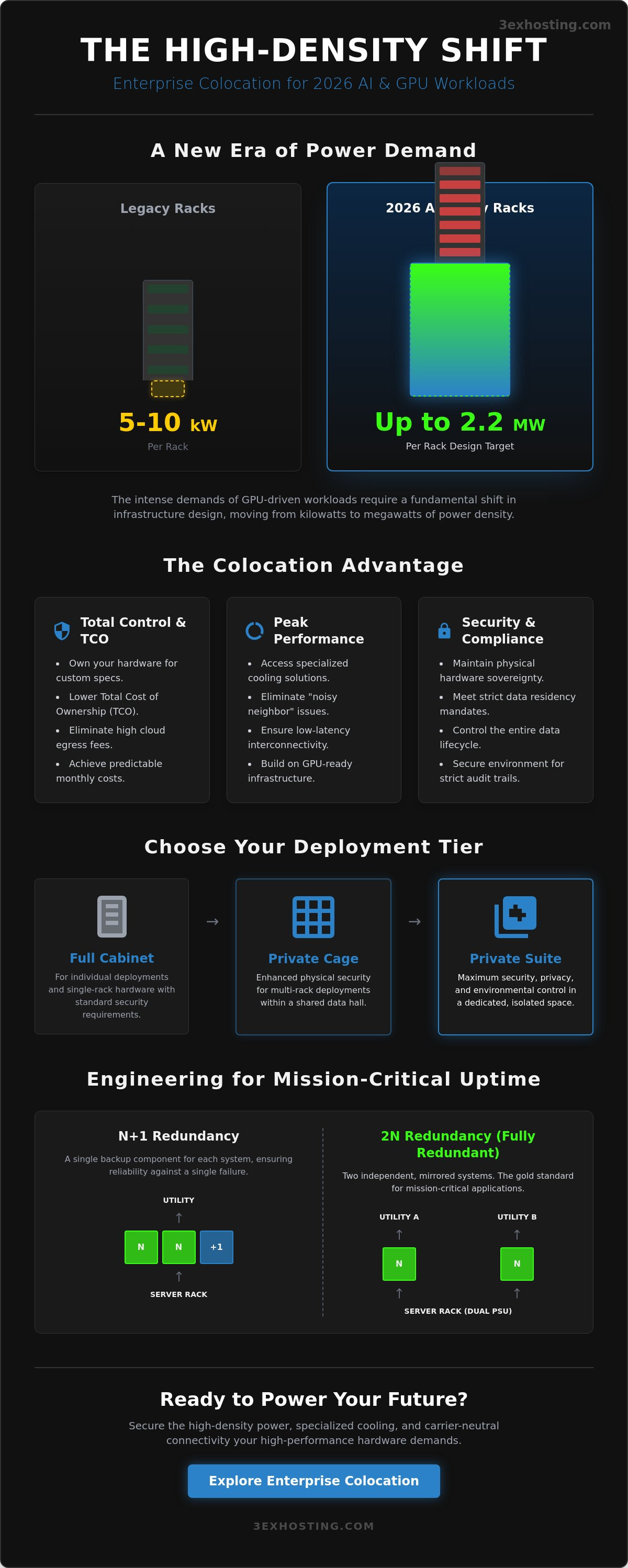
Comparing Colocation Tiers: Full Cabinets, Cages, and Private Suites
Choosing the right physical footprint is a critical step in enterprise server colocation planning. It’s not just about floor space. It involves defining physical security boundaries and administrative control over your assets. Data center colocation provides several tiers of isolation to match your specific risk profile and equipment volume. Each tier offers unique advantages for power distribution and cooling efficiency.
Scaling within the data hall can happen vertically or horizontally. Vertical scaling maximizes the density within your existing racks by utilizing every available U. Horizontal scaling involves adding adjacent cabinets or expanding into a cage. Planning for horizontal growth from the start prevents the logistical nightmare of stranding hardware in disconnected parts of the facility. It’s better to secure adjacent space early than to face a complex migration later.
When to Move to a Full Cabinet
Organizations often start with partial racks, but there is a clear economic tipping point. When your deployment grows to 10 or 15 units, full cabinet colocation becomes the logical choice. A dedicated cabinet eliminates the risks of shared rack space. It provides 42U to 52U of vertical space, which allows for “dark space” planning. This extra capacity is vital for mid-cycle hardware refreshes, so you don’t have to scramble for space during a hardware upgrade. A dedicated, locking cabinet is also your first line of defense for physical security in a shared environment.
High-Security Cage and Suite Configurations
For multi-rack deployments, cage solutions offer a balance of cost and isolation. Cages let you customize internal airflow and cabling within a fenced perimeter. This is especially useful for optimizing the containment strategies required for high-density clusters. It ensures that your cooling remains efficient even as you add more power-hungry hardware.
Regulated industries, like healthcare or finance, often need even more sovereignty. Private suites provide a completely enclosed, floor-to-ceiling room. This setup is essential for meeting SOC2 or HIPAA physical security requirements. It allows for dedicated biometric access and private environmental monitoring. Integrating these barriers with managed it infrastructure services creates a robust environment where the facility provides the shell and you maintain total control. This level of physical isolation is what defines a mature enterprise server colocation strategy.
Operational Continuity: Remote Hands and Network Interconnectivity
Operational continuity in enterprise server colocation depends on more than just high-density power. It requires a robust support ecosystem and flexible network access. Managing hardware from a distance can be a logistical challenge. Professional data centers solve this through specialized onsite services and carrier-neutral connectivity that keeps your systems reachable and responsive. You’ve likely found that physical access is the biggest hurdle for remote teams, making the facility’s support staff an extension of your own department.
Carrier neutrality is a critical risk-mitigation strategy. It allows you to switch between multiple fiber providers without physically moving your servers. If one ISP experiences a major outage or pricing shift, you can reroute traffic through a different carrier via a simple cross-connect. This flexibility is essential for building a resilient disaster recovery path that bridges your colocation environment and the public cloud. It ensures your infrastructure isn’t vulnerable to a single point of failure at the network level.
Maximizing Efficiency with Remote Hands Support
You don’t need to fly your engineering team across the country for routine maintenance. Professional remote hands support handles the physical tasks that require an onsite presence. This includes power cycles, structured cabling, and even complex hardware swaps like replacing a failed drive or adding more RAM. When evaluating an enterprise-grade SLA, look for guaranteed emergency response times. Having onsite experts available reduces travel costs and significantly cuts down your Mean Time to Repair (MTTR). It’s a faster, more cost-effective way to maintain high availability without maintaining a local staff footprint.
The Power of Cross-Connect Services
Cross-connects are direct physical fiber links between your rack and a network provider or partner within the same facility. These connections eliminate local loop costs and bypass the public internet entirely. For financial or gaming applications, this low-latency peering is non-negotiable. Proximity to the carrier hotel core ensures your data travels the shortest possible distance. You can also use cross-connects to build a private, high-speed link to hybrid cloud environments like AWS or Azure. This provides the speed of on-premise hardware with the scalability of cloud resources. If you’re ready to build a more resilient network architecture, you can get a custom connectivity quote to see how these direct links can optimize your infrastructure performance.
Strategic Deployment: Maximizing ROI with 3EX Hosting Infrastructure
Maximizing the return on your hardware investment requires an environment that treats high-density power as a baseline requirement. Many facilities struggle to adapt to the 20kW per rack standard that modern AI and GPU clusters demand. At 3EX Hosting, we design our infrastructure specifically for these high-performance workloads. This approach ensures your hardware operates at peak efficiency without the risk of thermal throttling or power-related bottlenecks. Choosing the right enterprise server colocation partner is about more than just finding a rack; it’s about securing a long-term home for your most critical assets.
The transition to a new facility is often the most vulnerable period for your hardware. Moving complex server rigs involves significant physical and operational risks. We mitigate these risks by providing specialized move-in assistance for complex hardware migrations. Our team handles the logistical heavy lifting, which allows your engineers to focus on software configuration and deployment strategy. This streamlined onboarding process reduces downtime and ensures your systems are online and productive as quickly as possible.
Future-proofing your enterprise means preparing for the infrastructure demands of 2026 and beyond. As compute requirements continue to scale, your data center must be able to support liquid cooling and higher amperage circuits without a total redesign. We provide the AI-ready foundations necessary to scale your footprint as your data needs grow. Every watt counts. A misconfigured power envelope can lead to costly hardware failure, so we prioritize precision in every deployment.
Enterprise-Grade Reliability
Our data center facility is built to exceed standard uptime expectations. We offer extensive customization options for power distribution, cooling paths, and network configurations to match your specific hardware profile. This flexibility allows you to build a environment that reflects your internal security and performance standards. 24/7 technical oversight ensures that mission-critical loads remain stable and secure without requiring your team’s constant physical presence.
Getting Started with Your Deployment
The first step toward a successful migration is a thorough audit of your current hardware specifications. During our consultation process, we match your server requirements to the appropriate power and cooling envelope. We believe in transparent pricing models that provide clear allocations for space, power, and bandwidth. This eliminates the hidden fees and variable costs often found in legacy data centers. If you’re ready to secure a stable and scalable home for your hardware, you can request a customized quote for your enterprise colocation needs. Our specialists will help you define the exact configuration required to support your operational goals.
Securing Your Infrastructure for the Next Decade
Transitioning to enterprise server colocation isn’t just about finding floor space; it’s about securing a power envelope that supports the next generation of compute. By owning your hardware, you gain the physical sovereignty and cost predictability that the public cloud often lacks. High-density cooling and carrier-neutral connectivity ensure your systems stay performant as your data demands scale. Reliability is no longer optional. You’ve seen how specialized environments are now a requirement for AI and GPU-driven workloads.
You need a partner that understands these technical demands. 3EX Hosting offers high-density AI and GPU ready infrastructure backed by 24/7/365 on-site remote hands support. Our carrier-neutral interconnectivity gives you the flexibility to optimize your network without vendor lock-in. It’s time to move beyond standard hosting and take full control of your hardware performance. Your systems deserve a stable, high-performance home.
Build your scalable enterprise infrastructure with 3EX Hosting Full Cabinet Colocation. Take the next step toward a more reliable future for your hardware.
Frequently Asked Questions
Is colocation cheaper than a dedicated server lease?
Colocation is typically more cost-effective for enterprises with steady-state workloads and high-performance requirements. While a leased dedicated server includes hardware costs in the monthly fee, owning your hardware and paying only for data center space and power reduces the total cost of ownership over a three to five-year lifecycle. You avoid the hardware premium charged by providers and gain full control over your equipment specifications.
What is the difference between managed colocation and unmanaged colocation?
Managed colocation includes technical support for your software stack, operating system, and security patching, whereas unmanaged colocation provides only the physical environment. In an unmanaged setup, you’re responsible for all logical configurations. Most enterprise server colocation agreements lean toward unmanaged or partially managed models, where the facility ensures power and cooling while your internal team handles the software layer.
How much power can I get per rack in a 3EX Hosting facility?
Our facility is engineered to support high-density power requirements, typically ranging from standard 5kW deployments up to 20kW or more per rack for AI and GPU clusters. We provide 120V, 208V, and 3-phase power options to match your specific hardware needs. This high-density capability ensures your infrastructure can scale vertically without the need for additional floor space.
What happens if my hardware fails and I am not on-site?
If a hardware failure occurs, our on-site technical team can intervene immediately through our Remote Hands Support services. We can perform physical tasks such as hard drive swaps, RAM upgrades, or cable replacements based on your instructions. This 24/7/365 availability ensures that your mission-critical systems are restored quickly without requiring your staff to travel to the data center.
Can I connect my colocated servers directly to the public cloud?
Yes, you can establish direct, private connections to major public cloud providers like AWS, Azure, and Google Cloud through our cross-connect services. These direct links bypass the public internet, offering lower latency and higher security for hybrid cloud architectures. This setup allows your colocated hardware to function as a seamless extension of your cloud-based resources.
What physical security measures are in place for dedicated cabinets?
Dedicated cabinets are secured with individual front and rear locks, ensuring that only authorized personnel can access your specific hardware. The facility itself is protected by multi-layer security protocols, including 24/7 video surveillance, biometric scanners, and secure access man-traps. These measures ensure that your enterprise server colocation environment meets the most stringent physical security and compliance standards.
How long does it take to deploy a full cabinet?
Standard full cabinet deployments can typically be completed within a few business days once the hardware arrives at the facility. More complex configurations involving custom cage builds or private suites may require additional lead time for engineering and installation. Our team works closely with your staff to ensure a streamlined move-in process that minimizes operational disruptions.
Do I need to provide my own rack, or is it included?
In most cases, the physical rack is included as part of your full cabinet colocation agreement. We provide standard 42U to 52U locking cabinets that are optimized for airflow and cable management. However, if you have specialized requirements or pre-configured racks, we can accommodate those within a cage or private suite environment to ensure your hardware fits perfectly.