 SUPPORT


 3EX United States
 Blog
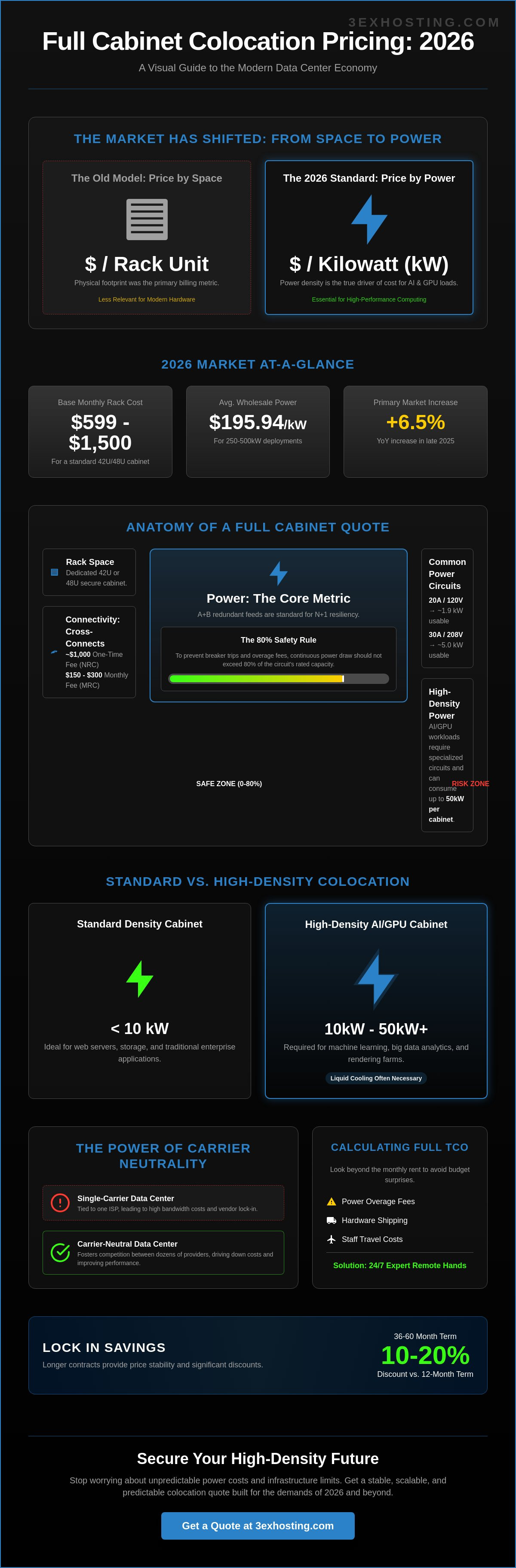
In 2026, the value of your data center footprint is no longer defined by physical rack units, but by power density and carrier neutrality. You’ve likely noticed the 6.5% price increase in primary markets during the second half of 2025 and felt the sting of unpredictable power overages or high cross-connect fees. Understanding full cabinet colocation pricing 2026 requires looking past the base monthly rate of $599 to $1,500 per rack. It’s about calculating the total cost of ownership for superfast, high-density infrastructure that supports GPU-heavy AI training without breaking your budget.
We agree that enterprise infrastructure should be stable and predictable, not a source of financial surprises. This guide promises to help you master the complexities of modern colocation costs so you can secure N+1 redundancy and scalable power for mission-critical apps. We’ll preview the current market rates, from the $195.94 per kW wholesale average to the specific costs of liquid-cooled racks. You’ll learn how to leverage 36-month contracts for 20% discounts and avoid the hidden fees that often derail enterprise scaling projects.
Key Takeaways
- Learn why the 2026 market has shifted from simple rack space to power-density pricing models to support modern hardware.
- Master the breakdown of full cabinet colocation pricing 2026 by accounting for A+B redundant feeds and circuit installation.
- Understand the density surcharges associated with high-heat AI and GPU clusters requiring up to 50kW per cabinet.
- Identify the hidden costs of hardware shipping and staff travel that can be eliminated with expert remote hands support.
- Discover why carrier-neutral hotels provide the most stable foundation for national scaling and 24/7 technical operations.
The 2026 Landscape of Full Cabinet Colocation Costs
Full cabinet colocation refers to a dedicated 42U or 48U rack reserved exclusively for your enterprise hardware. While space was once the primary billing metric, the market has shifted. In 2026, power density is the true driver of cost. Modern facilities now prioritize your kilowatt (kW) requirement over the number of rack units you occupy. This change reflects the reality of high-performance computing and AI workloads that demand more cooling and electrical capacity than traditional web servers. A colocation centre provides the physical shell, but the value lies in the infrastructure’s ability to support these intensive power loads.
Primary cost drivers include the physical footprint, power allocation, high-speed connectivity, and specialized remote hands support. Many enterprises are moving away from the public cloud and returning to colocation to regain control over their budgets. While cloud costs often fluctuate based on usage and egress, colocation offers a level of financial predictability that’s hard to match. By early 2026, the average wholesale asking price for 250-500 kW deployments reached $195.94 per kW, following a 6.5% year-over-year increase in primary markets during late 2025. Evaluating full cabinet colocation pricing 2026 means looking at these numbers to build a stable, long-term infrastructure strategy.
Fixed vs. Variable Pricing Models
You’ll generally choose between “all-in” fixed monthly rates and metered power models. Fixed rates bundle space and a set power limit into one bill. It’s simple, but you might pay for capacity you don’t use. Metered power is the 2026 standard for enterprise transparency. You pay a base fee for the rack and then only for the actual electricity your servers consume. Contract length plays a massive role here. Committing to a 36-month or 60-month term typically secures a 10% to 20% discount on your monthly recurring charges compared to a standard 12-month agreement. It’s a direct way to lower your TCO while maintaining technical excellence.
The Role of Carrier Neutrality in Pricing
Carrier-neutral data centers don’t tie you to a single internet service provider. This environment fosters competition, which drives down your bandwidth costs. You can choose from dozens of providers to find the best latency and price for your specific needs. This prevents vendor lock-in and significantly reduces long-term egress costs. Utilizing cross-connect services within these hubs allows for direct, low-latency links between your cabinet and various network providers. It ensures your infrastructure remains superfast and reliable without being held hostage by a single carrier’s pricing whims.
Anatomy of a Full Cabinet Quote: Breaking Down the Line Items
You won’t find the true cost of enterprise infrastructure in consumer-level “per-U” guides. For full cabinet colocation pricing 2026, the quote focuses on the holistic environment of a 42U or 48U rack. This includes the physical space with secure locking doors and the critical A+B redundant power feeds. Redundancy ensures your mission-critical apps stay online even if one power grid fails. High-density deployments often require 2N power configurations, which significantly impacts the monthly recurring charge. The future of these entities depends on their ability to manage these complex power and cooling demands efficiently.
Connectivity involves both non-recurring charges (NRC) for the physical fiber pull and monthly recurring charges (MRC) for the port. A single fiber cross-connect in major hubs can range from $150 to $300 monthly. Setup fees are another factor. You should expect a one-time installation cost, typically around $1,000, covering rack-and-stack services and initial cabling. This ensures your equipment is installed according to professional standards from day one.
Standard Power Allocations and Overage Risks
Power is the most complex line item. A standard 20A/120V drop provides about 1.9kW of usable power, while a 30A/208V circuit offers roughly 5kW. You must remember the 80% rule. For safety and breaker stability, you shouldn’t exceed 80% of the circuit’s rated capacity for continuous loads. If you’re allocated 5kW but draw 5.5kW, you’ll face steep overage charges. Always distinguish between your “Power Allocation” (what you pay for) and your actual “Power Draw.” This distinction is vital for maintaining a predictable monthly spend.
Bandwidth and IP Allocation
Your quote will specify whether you’re using blended bandwidth or a cross-connect to your own carrier. Blended bandwidth is simpler, combining several ISPs into one reliable stream. However, bringing your own carrier offers better long-term cost control. IPv4 addresses are becoming a premium expense in 2026 as the industry shifts toward IPv6-first environments. Reviewing the cabinet colocation specs helps you see which IP blocks are included by default. If you need a more precise estimate for your specific hardware stack, it’s best to request a custom quote tailored to your power needs.
High-Density Colocation: Pricing for AI and GPU Workloads
AI clusters featuring NVIDIA H100 or B200 units have fundamentally redefined full cabinet colocation pricing 2026. These deployments are no longer about simple rack units; they’re about managing extreme power density. A single cabinet housing AI nodes now requires between 20kW and 50kW. Standard air cooling often fails at these levels, leading facilities to apply a “Density Surcharge.” This premium covers the specialized infrastructure needed to prevent thermal throttling. You’ll likely see quotes that include Rear-door heat exchangers (RDHx) or liquid-to-chip cooling ready racks. These technologies are essential to maintain the stability and speed your high-value hardware requires.
If you’re architecting a large scale cluster, it’s helpful to review our detailed guide on High-Density GPU Colocation. That resource explores the specific hardware configurations that drive these infrastructure demands. In 2026, the goal is to find a partner that offers “liquid cooling ready” floor space without forcing you into expensive, proprietary cooling contracts. This flexibility allows you to scale your AI training capacity while keeping your monthly spend predictable and manageable.
Cooling Efficiency (PUE) and Its Impact on Your Bill
Power Usage Effectiveness (PUE) is a critical metric for any enterprise using metered power. It measures how much energy the facility uses for cooling and lighting compared to the power delivered to your servers. A lower PUE means the data center is more efficient, and those savings should be passed directly to you. In 2026, a data center with a PUE above 1.5 is a financial liability for high-density enterprise users. Modern, superfast facilities aim for a PUE closer to 1.2. When your cabinet draws 40kW, even a small difference in PUE can save you thousands of dollars in monthly utility pass-through costs.
Weight Loading and Floor Reinforcement
High-density racks bring a hidden physical cost: weight. A fully loaded rack of GPU servers can exceed 2,500 lbs, which surpasses the weight limits of many standard raised floors. You might encounter a “floor load” premium if your cabinet requires reinforced structural support or specialized heavy-duty tiles. It’s also vital to plan for high-performance cross-connects between your AI nodes. These links ensure low-latency communication across your entire cluster. Addressing these physical and network requirements during the quoting phase prevents unexpected installation delays or structural surcharges later.
Calculating TCO: Beyond the Monthly Rack Rent
The base monthly rent is only the starting point for your budget. When analyzing full cabinet colocation pricing 2026, you must account for “invisible” operational expenses that often surprise enterprise teams. Sending a senior engineer to a facility for a simple drive swap or power cycle isn’t just a scheduling headache; it’s a significant financial drain. Travel costs, shipping fees for replacement hardware, and lost productivity add up quickly. Managed services offer a clear ROI by providing on-site expertise that handles these tasks without requiring your team to leave the office. It’s a more efficient way to manage high-density environments while keeping your staff focused on core development.
Hardware lifecycle management is another critical TCO factor often overlooked during the quoting phase. At the end of a three or five-year hardware cycle, you’ll face costs for un-racking equipment and secure data destruction. Choosing a provider that handles these server-side processes simply and efficiently ensures a smooth transition to newer gear. It’s about building a stable foundation where the technical details are handled by experts in the background. If you want to see how these operational costs fit into your specific deployment, request a detailed TCO breakdown from our specialists.
The ROI of Remote Hands in 2026
Using remote hands support is a strategic move to lower your total cost of ownership. Instead of paying for an on-call technician’s emergency travel, you can utilize a monthly subscription or a per-incident fee for 24/7 on-site support. These experts handle essential tasks like cable management, physical drive swaps, and power cycling. For a deeper look at how this impacts your bottom line, check our Remote Hands Support Guide. It’s a much more efficient way to maintain technical stability without the overhead of local staffing or emergency travel expenses.
Compliance and Security Audit Costs
Enterprise-grade colocation provides built-in savings through physical security and compliance certifications. Utilizing a facility that’s already SOC2 or HIPAA compliant significantly reduces your own internal audit expenses. Features like biometric access, man-traps, and constant surveillance are standard inclusions that would be prohibitively expensive to build in-house. For organizations with ultra-high security requirements, private data center suites offer an additional layer of isolation. This ensures your infrastructure stays secure while providing the peace of mind that your mission-critical data is in safe, professional hands.
Selecting a Colocation Partner for National Scalability
Selecting a partner for national scalability requires looking beyond the immediate full cabinet colocation pricing 2026. You need to ensure your provider operates within carrier hotels. These facilities are the gold standard for enterprise interconnection because they house the highest density of network providers. This environment allows you to switch carriers or add redundant links with minimal latency. It provides a stable, superfast foundation that supports national operations without the risk of vendor lock-in. When your infrastructure is distributed across multiple regions, having a consistent, carrier-rich environment is the only way to maintain technical excellence.
Reliability depends on more than just hardware; it’s about the people on-site. A provider must offer 24/7/365 technical expertise to handle emergencies the moment they arise. You can’t wait for a technician to commute when a mission-critical system goes offline. Evaluating a provider’s financial stability and longevity is just as important. You’re planning a long-term roadmap. You need a partner that will still be there in 2030, providing the same high-quality service and technical stability you expect today. This long-term perspective prevents the massive costs and risks associated with forced migrations if a provider’s facility is decommissioned or sold.
The Onboarding Process: Move-in Assistance
Transitioning to a new data center is a complex logistical challenge that requires precision. Professional move-in assistance simplifies this by coordinating shipping, receiving, and the initial rack-and-stack of your gear. Your checklist for a successful deployment should include verifying power circuit labels, testing A+B redundancy, and documenting all cable runs. This structured approach ensures your transition is fast and error-free. It lets you focus on your software while our team handles the physical environment in the background with magisterial calm.
Customizing Your Infrastructure
Your needs will evolve as your business grows. While a single rack is a great start, you might eventually need the added security and physical isolation of cage solutions. Future-proofing means ensuring your current cabinet can scale its power density to meet the demands of 2027 and beyond. Don’t get stuck in a facility that can’t support the next generation of high-density hardware or liquid cooling requirements. When you’re ready to secure a predictable monthly spend for your enterprise, it’s time to get a customized full cabinet colocation quote tailored to your specific scaling requirements.
Secure Your Enterprise Infrastructure for 2026
Success in 2026 depends on shifting your focus from physical rack units to power density and carrier neutrality. You’ve seen how A+B redundancy and metered power models provide the transparency needed for a predictable monthly spend. By leveraging high-density readiness and expert remote hands, you eliminate the “invisible” travel and maintenance costs that typically derail enterprise budgets. Understanding full cabinet colocation pricing 2026 is about more than just comparing base rents; it’s about securing a foundation that supports up to 50kW per rack for your most demanding AI workloads.
3ex Hosting offers the technical stability and speed your national operations require. We provide carrier-neutral connectivity with hundreds of providers and 24/7/365 on-site remote hands expert support to keep your systems running at peak performance. It’s time to move from complex calculations to a concrete deployment plan. Request a Transparent Full Cabinet Quote today and ensure your hardware is in safe, professional hands. Building a scalable, superfast infrastructure has never been more straightforward.
Frequently Asked Questions
How much does a full cabinet colocation typically cost in 2026?
A standard 42U rack typically costs between $599 and $1,500 per month, though full cabinet colocation pricing 2026 is heavily influenced by geography. For example, New York averages $39.40 per U while Montreal offers a more budget friendly $18.12 per U. You must also factor in power, which adds roughly $300 to $1,000 monthly for a 3-5kW load. These rates reflect the rising demand and tight supply in primary technology hubs.
What is the difference between metered and capped power billing?
Metered billing charges you for the actual electricity your hardware consumes, while capped power provides a fixed power limit for a set monthly price. Metered power is the 2026 enterprise standard because it offers total transparency for high-density users. Capped models are simpler for monthly budgeting but often lead to expensive overage charges if your servers exceed the 80% breaker safety limit during peak processing times.
Are cross-connect fees recurring or one-time charges?
Cross-connects almost always involve both a one-time setup fee and a monthly recurring charge. In primary markets, a single fiber cross-connect typically costs between £150 and £300 per month. These recurring fees cover the maintenance of the physical path and the value of the low-latency interconnection within the facility. It’s a critical line item for any enterprise requiring direct links to multiple carriers or cloud providers.
Do I need to pay for remote hands if I have my own IT team?
Yes, remote hands are a vital investment even for companies with internal IT teams located elsewhere. It’s much more efficient to pay a per-incident fee of £50 to £150 than to cover the travel costs and lost time of your own staff. On-site experts handle physical tasks like drive swaps and power cycles immediately. This ensures your technical stability is maintained 24/7 without requiring your senior engineers to be on-site.
What is included in a standard 42U full cabinet setup?
A standard setup includes the physical 42U locking cabinet, perforated doors for optimal airflow, and A+B redundant power feeds. You’ll also receive basic PDU mounting and initial rack-and-stack assistance to ensure your gear is installed correctly. This provides the secure, professional environment necessary for mission-critical applications. Most providers also include basic physical security features like biometric access and 24/7 surveillance as part of the base package.
How does high-density GPU hosting affect my monthly colocation bill?
High-density GPU hosting significantly increases costs because AI workloads drawing 30kW to 50kW require specialized cooling infrastructure. A 50kW liquid-cooled rack is priced from £4,000 to £6,500 per month to account for this extra complexity. These environments often carry a “density surcharge” to cover the installation of rear-door heat exchangers or liquid-to-chip systems. It’s a necessary premium to ensure your high-value hardware doesn’t suffer from thermal throttling.
What is a setup fee (NRC) and can it be waived?
A setup fee, or Non-Recurring Charge, is a one-time cost of approximately $1,000 that covers the labor and materials for your initial installation. This includes running power circuits and configuring your network drops. While this is a standard industry cost, providers often waive it as a negotiation incentive. You can typically secure a waiver by committing to a long-term contract of 36 months or more, which also lowers your monthly recurring rate.
Is carrier-neutral colocation more expensive than single-provider facilities?
Carrier-neutral facilities may have slightly higher base rack rents, but they offer significantly lower long-term connectivity costs through provider competition. Access to hundreds of carriers prevents vendor lock-in and allows you to negotiate better bandwidth rates. This competition can reduce your monthly networking spend by 15% to 30% compared to single-provider data centers. It’s the most stable and cost-effective choice for enterprises planning for national scalability and high-speed performance.