 SUPPORT


 3EX United States
 Blog
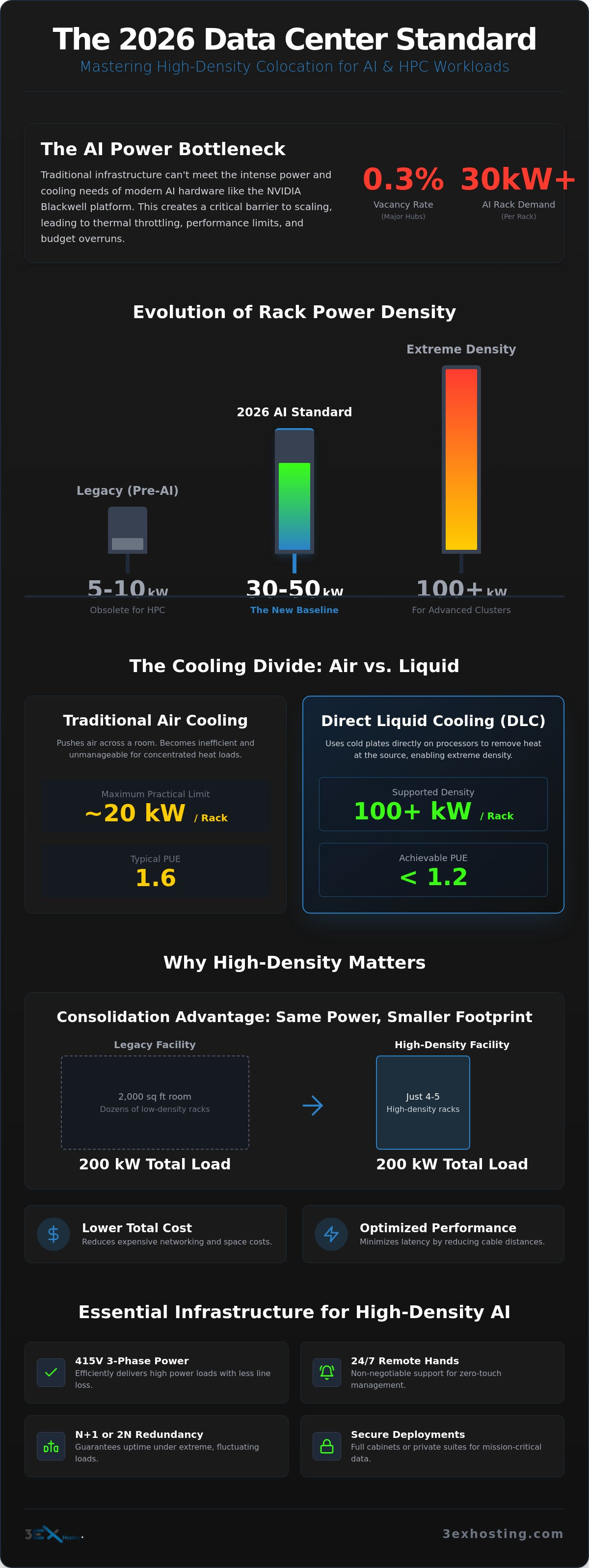
With vacancy rates in major data center hubs like Northern Virginia hitting a record low of 0.3% this year, the search for rack space has evolved into a high-stakes race for raw power. Most enterprises find that traditional infrastructure simply can’t keep up with the 30kW demands of modern AI clusters. If you’ve faced thermal throttling or realized your current provider can’t support high density colocation within your existing footprint, you’re facing the primary bottleneck of the AI era. It’s a common hurdle when trying to deploy hardware like the NVIDIA Blackwell Ultra B300 without blowing your operational budget.
This guide helps you master the technical and operational requirements to scale your AI and HPC workloads with maximum efficiency. You’ll learn how to achieve predictable scaling while reducing PUE and operational overhead. We’ll examine the shift toward liquid cooling standards, strategies for zero-touch management, and the specific infrastructure requirements needed to turn your AI roadmap into a reality. By the end, you’ll have a clear path to managing complex hardware across sites without the typical overhead or performance risks.
Key Takeaways
- Understand the 2026 power standards where scaling from 10kW to over 100kW per rack is the new benchmark for enterprise AI workloads.
- Master the technical requirements of high density colocation by integrating Direct Liquid Cooling (DLC) to eliminate thermal throttling and improve PUE.
- Learn how concentrated infrastructure reduces expensive fiber runs and optimizes performance for next-gen GPU clusters like the NVIDIA Blackwell platform.
- Discover why 24/7 Remote Hands support is non-negotiable for the zero-touch management of complex, liquid-cooled hardware.
- Determine whether full cabinets or private suites provide the necessary balance of security and footprint scalability for your specific mission-critical data.
Defining High-Density Colocation in the 2026 Data Landscape
The modern data center has undergone a radical transformation. Only a few years ago, a 10kW rack was considered high-spec. Today, that’s the bare minimum for basic enterprise operations. In 2026, high density colocation is defined by racks pulling 30kW, 50kW, or even 100kW+. This shift isn’t just about packing more servers into a cage. It’s about the fundamental ability of the facility to deliver and cool that concentrated energy without failure or thermal throttling.
The catalyst for this density is the explosion of AI and ML hardware. Systems like the NVIDIA Blackwell Ultra B300 or the Vera Rubin platform demand power levels that would melt a standard air-cooled rack. When you deploy these clusters, you can’t afford to spread nodes across dozens of low-power racks. Doing so introduces latency and skyrockets cabling costs. Concentrating that power into a smaller physical footprint is the only way to maintain the performance these systems demand.
The Evolution of Power Density
Traditional 5kW racks are now obsolete for high-performance enterprise workloads. Generative AI has pushed average rack requirements toward 30kW as standard. High-density colocation is the concentration of power and cooling to support advanced compute nodes. By consolidating hardware, you reduce your total cost of ownership through lower networking expenses and more efficient space utilization.
There’s a critical distinction between square footage and kilowatt consumption. Legacy facilities often have plenty of floor space but lack the power density to support modern hardware. You might have a 2,000-square-foot room that can only support 200kW of total load. In a 2026-ready facility, that same 200kW can be delivered to just four or five racks. This consolidation is a massive TCO advantage. It minimizes the distance data travels, simplifies physical security, and reduces the number of expensive fiber cross-connects required to link your cluster.
Infrastructure Efficiency and PUE
High-density environments naturally drive lower Power Usage Effectiveness (PUE) scores. It’s far more efficient to cool a concentrated area of heat than to push air across a vast, sparsely populated room. This efficiency directly correlates with carbon footprint reduction. Modern designs, like those found in Full Cabinet Colocation or Private Colocation Suites, use targeted cooling to ensure energy isn’t wasted on empty space. Energy-efficient infrastructure in 2026 can achieve PUE ratings below 1.2, a significant leap from the 1.6 average of legacy designs.
The Physics of Performance: Advanced Cooling and Power Distribution
Traditional air cooling hits a physical limit at approximately 20kW per rack. Beyond this point, the volume of air required to dissipate heat becomes unmanageable. Fans must spin at speeds that create excessive noise and turbulence, often failing to reach the hottest components. To maintain stability, facilities must adopt Advanced Cooling and Power Distribution techniques that handle heat at the source. In a high density colocation environment, the focus shifts from cooling the room to cooling the individual chip.
Modern power distribution has also evolved to support these loads. Moving to 415V 3-phase power reduces line loss and heat generated by the cables themselves. This setup allows for more efficient power delivery to the rack, supporting the massive draws required by 2026-era GPU clusters. Maintaining N+1 or 2N configurations at this scale requires specialized switchgear and high-capacity UPS systems that can handle sudden load spikes without compromising the entire row. If you’re planning a deployment of this scale, exploring Full Cabinet Colocation options can help you align your power needs with specialized infrastructure.
Liquid Cooling Technologies for 2026
Direct-to-chip liquid cooling (DLC) has become the primary standard for AI workloads. It uses cold plates directly on the processors to remove up to 80% of the heat. For legacy hardware that isn’t liquid-ready, Air-Assisted Liquid Cooling (AALC) provides a bridge by using liquid-to-air heat exchangers within the rack. The heart of these systems is the Cooling Distribution Unit (CDU). This unit manages the fluid flow and temperature, ensuring that the facility water remains isolated from the sensitive IT equipment. Immersion cooling is also gaining traction for extreme densities, where entire servers are submerged in dielectric fluid to achieve a PUE as low as 1.03.
Power Delivery and Redundancy
Stability is the priority when managing 50kW+ racks. Localized power surges in high-density zones can trigger cascading failures if the infrastructure isn’t designed for granular control. Using metered PDUs is essential for tracking consumption at the outlet level, allowing for precise capacity planning. N+1 power redundancy prevents downtime in mission-critical AI environments by ensuring a backup path is always active. This redundancy must be matched by high-density busways that can deliver hundreds of amps to a single cabinet without overheating. In a high density colocation facility, these power and cooling systems work in a closed loop to ensure that performance never wavers, regardless of the computational load.
GPU Hosting and AI: Why Density is the New Standard
AI workloads aren’t just a software trend. They represent a fundamental shift in hardware requirements. Systems built on NVIDIA H100 or Blackwell B200 GPUs demand power and cooling levels that legacy facilities can’t provide. In these environments, high density colocation is the only viable path forward. Spreading high-performance compute nodes across multiple low-density racks creates technical debt. It increases the distance between GPUs, which introduces latency and forces the use of expensive, long-distance fiber runs that degrade signal integrity.
Concentrating your infrastructure into fewer racks simplifies the network topology. Short-reach copper or optical cables are cheaper and more reliable for the high-speed InfiniBand or Ethernet fabrics required for model training. This consolidation also streamlines physical management. When your entire cluster sits within a compact footprint, troubleshooting and hardware swaps become significantly faster. For a deeper look at specialized setups, see our guide on High-Density GPU Colocation.
Designing AI Clusters for Scale
Physical weight is a frequently overlooked constraint. A fully loaded rack of B200 nodes can easily exceed 3,000 pounds. You need a facility with reinforced floor loading capacities specifically designed for AI infrastructure hosting. Beyond weight, rack layouts must be optimized for airflow and liquid manifold access. Proper planning ensures that you can scale your compute power without needing to re-engineer your entire cooling strategy every time you add a new node.
Connectivity and Cross-Connect Services
Latency is the enemy of distributed AI training. High-density GPU colocation works best when paired with high-performance Cross-Connect Services. In a carrier-neutral facility, you have the flexibility to choose the lowest-latency paths to your storage arrays and end-users. Being situated in a carrier hotel environment allows for direct, private connections to major network backbones. This setup ensures that your data moves at the speed of your processors, preventing networking bottlenecks from stalling your most expensive hardware assets.
Operational Resilience: Managing High-Density Racks Remotely
Deploying high density colocation infrastructure is only half the battle. The real challenge begins with day-to-day operations. When a liquid-cooled GPU cluster requires a physical reset or a manifold check at 3:00 AM, your internal IT team shouldn’t be boarding a flight. High-density environments demand a “hands-off” approach where the facility staff becomes an extension of your own department. This operational model ensures that the complexity of your hardware doesn’t become a liability during a service interruption.
Liquid-cooled systems introduce new maintenance variables. You have to monitor for leaks, manage coolant levels, and ensure that Cooling Distribution Units (CDUs) are functioning within tight parameters. Traditional data center management doesn’t cover these specialized tasks. Choosing a partner with specialized Remote Hands Support is critical. It allows you to maintain high availability without keeping a specialized cooling engineer on your own payroll.
The ROI of Remote Hands Support
The financial argument for remote management is clear. On-site experts provide 24/7 technical assistance for everything from hardware reboots to complex cable management. This drastically reduces your Mean Time to Repair (MTTR). Instead of waiting hours for a technician to arrive, local staff can address physical layer issues in minutes. Utilizing Remote Hands eliminates the need for enterprise travel, saving significant costs and reducing your team’s operational fatigue. If you want to see how these services integrate with your specific deployment, you can request a customized management plan to optimize your uptime.
Beyond infrastructure stability, maintaining the human element is equally vital in high-pressure tech roles. For those looking to balance the intensity of data center management with physical wellness, Iceology Cold Plunge offers professional-grade recovery solutions; learn more about their advanced cooling systems for personal health.
Disaster Recovery and Business Continuity
Resilience in high density colocation also means planning for the unthinkable. GPU workloads are often mission-critical, meaning even a few minutes of downtime can cost millions in lost training progress. Integrating these clusters into a national disaster recovery (DR) strategy is essential. Many enterprises use managed cloud hosting as a temporary failover for their physical high-density hardware. This hybrid approach ensures that if a site goes offline, your datasets and compute processes remain accessible. Data redundancy protocols must be strictly enforced, especially for massive AI datasets that can’t be easily moved over standard network connections during a crisis. Continuity isn’t just about power; it’s about having a documented, tested path to recovery that accounts for the unique weight and power requirements of your 2026-era infrastructure.
Selecting Your High-Density Strategy: Cabinets vs. Private Suites
The decision between a single rack and a dedicated room isn’t just about floor space. It’s about the degree of control your high density colocation strategy requires. For many AI-driven organizations, the choice comes down to the speed of deployment versus the need for total physical sovereignty. Both models offer the 30kW+ power profiles discussed earlier, but they differ in how they handle physical access and specialized cooling infrastructure. Choosing correctly prevents over-provisioning while ensuring your hardware has the room to scale as compute demands increase.
Cage solutions provide a middle ground for enterprises that need physical isolation without the footprint of a full suite. These cages allow you to balance scalability with security, using steel mesh partitions to separate your GPU clusters from the rest of the facility. This setup is particularly effective for teams that need to customize their rack layouts or implement proprietary cabling standards. Whether you need a single cabinet or a custom cage, the infrastructure must support the same rigorous power and cooling standards required for modern HPC hardware.
Full Cabinet Colocation for Rapid Deployment
Focused workloads often don’t need a custom room. Full Cabinet Colocation provides a standardized, high-density environment that’s ready for immediate use. This is the ideal path for fast-moving AI startups or departments testing new GPU clusters. You get pre-configured power and cooling, which removes the months of planning usually associated with custom builds. To streamline the transition, our comprehensive move-in assistance ensures your hardware is racked and connected without the typical logistical friction.
Private Suites and Custom Cages
When data sovereignty is the primary concern, Private Colocation Suites offer the highest level of physical security. These suites provide a walled environment where your hardware is isolated from other clients. This isolation is often a requirement for sensitive datasets or highly regulated industries. Beyond security, a private suite allows you to design custom cooling and power layouts. You can implement specialized manifolds for direct liquid cooling or set up proprietary metered power tracking that aligns with your internal reporting. Selecting the right model ensures that your high density colocation strategy scales with your business, not just your hardware.
Building Your AI Infrastructure for 2026 and Beyond
Transitioning to a high-density model is no longer optional for enterprises scaling modern AI workloads. It’s a strategic necessity. Throughout this guide, we’ve explored how high density colocation solves the thermal wall through advanced liquid cooling and how the right power distribution ensures your GPU clusters perform at peak capacity. Whether you deploy in standardized cabinets or private suites, the goal remains the same: maximum efficiency with zero operational friction.
Success in this technical landscape requires a partner that understands the stakes of AI infrastructure. You need N+1 power redundancy to guarantee continuity and carrier-neutral interconnectivity to eliminate networking bottlenecks. By leveraging 24/7 on-site Remote Hands, your team can focus on model development while experts handle the physical complexities of your liquid-cooled hardware. It’s time to move past the limitations of legacy data centers and embrace a foundation built for the next generation of compute.
Ready to secure your scalable infrastructure? Get a Custom Quote for High-Density Colocation today and ensure your hardware has the power and cooling it needs to thrive. Your roadmap to 2026 starts with a stable, high-performance environment.
Frequently Asked Questions
What is the standard power density for high-density colocation in 2026?
High-density standards in 2026 typically range from 30kW to 50kW per rack, with extreme deployments exceeding 100kW. This represents a significant shift from the 10kW thresholds common just a few years ago. Facilities must now be engineered to handle these concentrated thermal loads to support modern AI and HPC clusters effectively.
Does high-density colocation require liquid cooling?
Liquid cooling is practically mandatory for deployments exceeding 30kW per rack. While advanced air cooling with rear-door heat exchangers can bridge the gap for some workloads, Direct Liquid Cooling (DLC) is the only way to prevent thermal throttling in extreme environments. Most next-gen GPUs are designed specifically for liquid-ready infrastructure to maintain performance stability.
How does high-density colocation reduce overall infrastructure costs?
High density colocation reduces costs by consolidating your hardware footprint and minimizing networking expenses. By packing more compute power into fewer racks, you spend less on expensive high-speed fiber cross-connects and cabinet rental fees. This consolidation also improves energy efficiency, which leads to lower Power Usage Effectiveness (PUE) and reduced operational overhead.
Can I use my existing server hardware in a high-density cabinet?
You can use existing hardware in a high-density cabinet if the rail kits and dimensions follow standard 19-inch or 21-inch configurations. However, you must ensure the power supplies and airflow patterns are compatible with the specific cooling manifolds used in the facility. Mixing legacy hardware with high-density nodes requires careful planning to avoid creating hot spots.
What are the security implications of high-density shared space vs. private suites?
Shared spaces use cage solutions to provide physical isolation, while private suites offer a completely walled environment for maximum data sovereignty. Private suites are ideal for enterprises with strict compliance requirements or those deploying proprietary cooling systems. Shared cabinets are more cost-effective for smaller clusters but still benefit from high-level biometric access controls and surveillance.
How do Remote Hands services work with high-density GPU hosting?
Remote Hands services provide 24/7 technical support for physical tasks like hardware reboots, cable management, and component swaps. For GPU hosting, these technicians are trained to handle complex liquid-cooled systems and high-value hardware nodes. This allows your team to manage the software layer remotely while on-site experts ensure the physical infrastructure remains operational and stable.
What is the typical PUE for a high-density data center facility?
Modern high-density facilities typically achieve a PUE between 1.1 and 1.3. Liquid immersion cooling systems can push this even lower, often reaching 1.03 to 1.08. These ratings are significantly better than traditional data centers, which often hover around 1.6. Lower PUE means more of your energy budget goes directly to compute power rather than being wasted on inefficient cooling.
Is N+1 power redundancy available for high-density racks?
Yes, N+1 power redundancy is a standard requirement for mission-critical high density colocation environments. This ensures that even if a power source or UPS fails, your hardware remains online through a secondary path. These facilities use 3-phase circuits and specialized busways designed to handle the massive electrical draws of AI clusters without compromising stability.