 SUPPORT


 3EX United States
 Blog
With the cost to build an AI-ready data center now exceeding $20 million per megawatt, the financial logic for keeping servers in-house has officially collapsed. You likely feel the pressure of shrinking hardware budgets while facing a 5% year-over-year increase in commercial electricity rates. It’s frustrating to manage technical debt when your finance department views IT as a cost center rather than a strategic asset. Learning how to convince your CFO to move to colocation starts with shifting the narrative from rack space to risk mitigation and operational agility.
You already know that on-site hardware is a liability for surprise utility bills and catastrophic failure. We promise to show you how to translate technical infrastructure needs into the financial language of ROI and predictable spend that secures executive approval. This guide provides a clear roadmap to win over your leadership by addressing energy volatility, PCI DSS 4.0.1 compliance, and the massive capital savings of the colocation model. We will break down the 2026 strategic business case so you can stop puting out fires and start scaling with confidence.
Key Takeaways
- Identify the “hidden iceberg” of on-premise expenses, including specialized HVAC maintenance and physical security payroll that often escape standard IT budget lines.
- Discover why colocation provides the predictable monthly spend CFOs prefer, avoiding the “bill shock” often associated with unmanaged public cloud scaling.
- Learn how to convince your CFO to move to colocation by quantifying the risk of office grid failure under the high-density power demands of 2026 AI and GPU workloads.
- Quantify the financial impact of downtime and use facility certifications like SOC2 to negotiate lower cybersecurity insurance premiums.
- Follow a structured execution framework to audit current costs and project a future-state model that maps infrastructure efficiency directly to business growth.
Table of Contents
The 2026 Financial Shift: Moving Beyond CapEx vs. OpEx
The traditional argument for data center migration used to center entirely on shifting capital expenditure to operating expenses. In 2026, this is a narrow view. CFOs today care more about technical stability and financial predictability than simple tax buckets. If you want to know how to convince your CFO to move to colocation, you have to speak the language of risk and opportunity cost. It’s about moving from a rigid, high-maintenance internal model to a dynamic, scalable foundation.
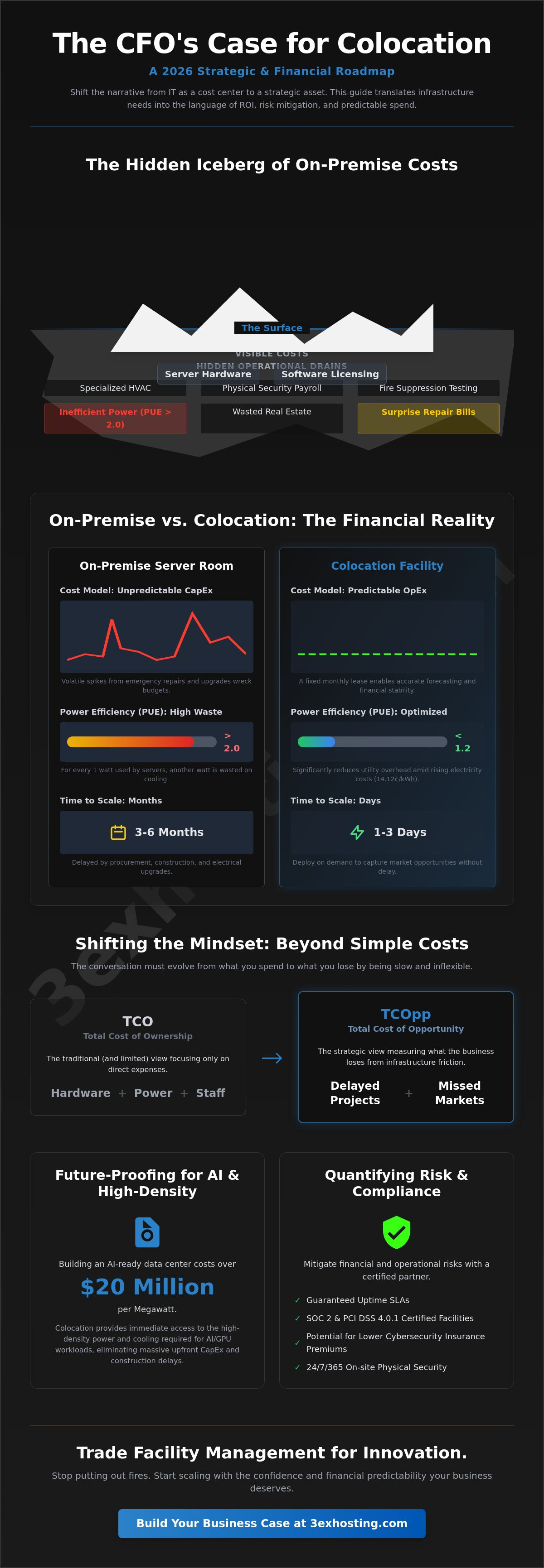
Many organizations fall victim to the "Sunk Cost Fallacy." They believe that because they spent millions building a server room five years ago, they must continue to use it. This logic ignores the "Hidden Iceberg" of on-premise costs. Beyond the hardware, your CFO is likely paying for specialized HVAC maintenance, physical security payroll, and complex fire suppression testing. These are operational weights that slow down the entire business. Understanding What is a Colocation Center? involves recognizing it as a specialized facility designed for efficiency that a standard office building cannot replicate. Professional facilities provide a level of technical excellence that protects the bottom line from hardware failure and unexpected outages.
We need to shift the conversation from Total Cost of Ownership (TCO) to Total Cost of Opportunity (TCOpp). While TCO measures what you spend, TCOpp measures what you lose by being slow. An inflexible on-premise environment prevents you from reacting to market shifts. By moving to a professional facility, you trade the burden of facility management for the freedom to innovate.
The True Cost of On-Premise Facilities
Office-based server rooms are notoriously inefficient. Most internal setups operate with a poor Power Usage Effectiveness (PUE) ratio, often exceeding 2.0. This means for every watt of power your servers use, you’re paying for another full watt just to cool them. With commercial electricity rates rising to 14.12¢ per kWh as of May 2026, that waste becomes a massive financial drain. Professional colocation facilities achieve much lower PUE ratings, significantly reducing utility overhead. Additionally, consider the real estate. That 500-square-foot server room could be repurposed as revenue-generating office space or a collaborative hub. You’re paying premium rent for a room that provides no direct business value.
Opportunity Cost: The Price of Inflexibility
Speed is a line-item asset. If your team needs to scale infrastructure to support a new AI project, an on-premise build-out can take months of procurement and electrical upgrades. In contrast, securing a full cabinet colocation solution allows you to deploy in days. This agility prevents delayed product launches, which are often the largest hidden costs in an enterprise budget. CFOs value the ability to scale up or down without the risk of construction delays or power constraints. A colocation partner provides the high-density infrastructure required for modern workloads, ensuring your business stays ahead of the competition without the massive upfront investment of a private build.
Predicting the Unpredictable: Financial Stability in Colocation
Financial leadership hates surprises. While the public cloud promised infinite scalability, many organizations in 2026 are reeling from "bill shock" caused by fluctuating egress fees and unmanaged compute spikes. Colocation serves as the strategic middle ground that CFOs prefer. It offers the performance of dedicated hardware with the cost predictability of a fixed monthly lease. When you’re looking at how to convince your CFO to move to colocation, the most powerful argument is the transition from volatile emergency spending to a steady, predictable OpEx model.
On-premise environments require an "emergency repair" budget line that sits idle until something breaks. When a specialized HVAC unit fails or a UPS battery bank leaks, the resulting capital spike can wreck a quarterly budget. In a professional facility, these risks are internalized by the provider. You pay a set fee, and the provider guarantees uptime through rigorous Service Level Agreements (SLAs). This shift allows your finance team to leverage The Financial Advantages of Colocation, such as economies of scale that a single company simply cannot achieve alone. It turns infrastructure from a source of financial anxiety into a stable utility.
Operational efficiency also extends to labor. Using remote hands support eliminates the need for expensive travel and emergency overtime pay. Instead of dispatching a senior engineer to swap a drive or reboot a server at midnight, you utilize on-site experts who are already at the facility. This reduces the "Total Cost of Ownership" by stripping away the secondary costs of hardware management. If you want to see how this works in practice, you can request a custom quote to compare these fixed costs against your current variable spending.
Eliminating Capital Spikes
The 5-year hardware refresh cycle is a trap for corporate cash flow. Buying massive UPS batteries or CRAC units is a poor investment because these assets depreciate quickly and offer zero competitive advantage for your core business. By moving to colocation, you shift the burden of facility upgrades to the provider. This ensures your infrastructure stays modern without requiring a multi-million dollar check every few years. Colocation preserves your liquid capital, allowing you to reinvest those funds into core business R&D where they can actually generate revenue.
Labor Cost Optimization
Maintaining a "Smart Hands" team on-staff 24/7 is financially unsustainable for most mid-sized enterprises. It also creates a dangerous key-person dependency; if your lead infrastructure tech leaves, your server room’s reliability goes with them. Professional data centers provide 24/7/365 support as a standard feature, ensuring expert eyes are always on your gear. For a deeper look at maximizing these efficiencies, consult Remote Hands Support: The Enterprise Guide. This approach professionalizes your uptime while significantly lowering your specialized headcount costs.
Future-Proofing for AI: The High-Density Cost Advantage
GPU clusters are not just faster servers; they are power intensive assets that outpace standard office infrastructure. In 2026, AI is no longer a pilot project. It’s a strategic mandate. CFOs must understand that supporting these workloads requires a fundamental shift in facility design. Building a private, AI-ready data center now costs over $20 million per megawatt. This is nearly double the cost of a standard enterprise build. If you’re looking at how to convince your CFO to move to colocation, you must highlight the "Cooling Tax." High-density racks generate heat that standard office HVAC systems cannot manage. Trying to cool GPU clusters with inefficient systems results in exponential utility costs and hardware throttling. Professional facilities use advanced liquid cooling and specialized airflow to keep these assets running at peak efficiency.
Density is the new metric for efficiency. By consolidating hardware into fewer, high-density racks, you reduce your physical footprint and lower your overall lease costs. This is why High-Density GPU Colocation is a financial hedge against rising energy prices. It allows you to extract maximum compute power from every square foot of space. A colocation partner provides the specialized power and cooling necessary to support these loads without the multi-million dollar capital investment of a private retrofit.
Scalability Without Construction
Retrofitting an office building to support 20kW or 50kW per rack is a logistical nightmare. It involves structural reinforcements, electrical grid upgrades, and complex permit processes. These projects often face long lead times for critical equipment like transformers. Moving to a carrier hotel or professional facility provides immediate access to this power. You gain the ability to scale your AI infrastructure in days rather than years. This speed to market is a major competitive advantage that preserves cash flow for core business operations.
Connectivity and Egress Fees
Standard business fiber is insufficient for modern data demands. Relying on it often leads to high latency and restricted bandwidth. In a professional data center, you gain access to cross-connect services that link you directly to carriers, cloud providers, and partners. This eliminates the financial trap of public cloud egress fees, which can spiral out of control as your data sets grow. Being in a carrier hotel reduces your long-term network spend by providing a flat-rate, high-performance connectivity model that public clouds cannot match. This predictability is exactly what financial leadership needs to see in a long-term infrastructure plan.
The CFO’s Compliance Checklist: Quantifying Risk
Risk management is often the deciding factor in infrastructure strategy. For a financial leader, compliance isn’t just a technical requirement; it’s a direct influence on insurance premiums and balance sheet protection. If you’re wondering how to convince your CFO to move to colocation, you must quantify the cost of non-compliance. With the average cost of a data breach reaching $6.08 million in 2026, the financial stakes of staying on-premise are higher than ever. Professional facilities provide a robust compliance posture that is nearly impossible to replicate in an office server room without massive capital investment.
Cybersecurity insurance carriers have become increasingly strict about physical and logical security controls. Most carriers now require SOC2 or SSAE18 certifications to even qualify for competitive rates. By moving your hardware to a certified facility, you can often negotiate lower premiums because the provider has already mitigated the most common physical risks. This creates a tangible, recurring saving that offsets the cost of the lease. To see how our certified infrastructure can simplify your next audit, you can explore our Miami data center facilities and their specific security protocols.
Regulatory pressure is also intensifying. The PCI DSS v4.0.1 standard became mandatory on March 31, 2025, and non-compliance fines can now reach $100,000 per month. Additionally, the SECURE Data Act introduced in April 2026 signals a move toward a national data privacy standard. Managing these shifting requirements in-house is a full-time job for a compliance officer. Colocation providers internalize this complexity, providing the documented physical controls you need to stay on the right side of federal law.
Audit Readiness and Cost Reduction
Internal audits are expensive and time-consuming. When your infrastructure is on-premise, your team must document every access log, camera angle, and visitor record for external auditors. Colocation providers "gift" you their existing certifications. You simply provide the provider’s SOC2 report to your auditors, which can reduce billable audit hours by 30% or more. This efficiency allows your IT team to focus on revenue-generating projects instead of chasing paperwork for weeks every year.
Physical Security and Asset Protection
An office closet can’t compete with the security of a professional facility. Biometric access, man-traps, and 24/7 on-site surveillance are standard features in a data center. The cost of securing a private colocation suite is significantly lower than the cost of installing and maintaining those same security layers in your own building. N+1 redundancy provides a financial safety net by ensuring that if a critical component fails, a backup is already running to prevent costly revenue loss. This level of asset protection ensures that your hardware investment remains secure and operational regardless of local building issues.
Executing the Transition: A Framework for CFO Approval
Moving from a theoretical discussion to a signed contract requires a tactical execution plan. Learning how to convince your CFO to move to colocation involves more than sharing technical specs. You must present a structured business case that addresses the five pillars of financial approval. This framework ensures that your proposal is viewed as a strategic investment rather than a simple expense request.
Step 1: The Current State Audit. Gather real on-premise costs, including utility bills, specialized HVAC maintenance, and physical security payroll. Don’t forget the 5% year-over-year increase in commercial electricity rates.
Step 2: The Future State Projection. Map your company’s growth, especially AI and GPU needs, to colocation efficiency. Show how density reduces the cost per unit of compute.
Step 3: The Risk Matrix. Quantify the cost of "doing nothing." Use the $6.08 million average data breach cost or the revenue lost during a single hour of downtime to illustrate the risk.
Step 4: The Pilot. Suggest starting with a cage solution or a single cabinet. This lowers the initial barrier to entry and proves the model.
Step 5: Partner Selection. Choose a provider like 3EX Hosting that aligns with enterprise financial goals. Our team addresses the specialized labor gap by providing on-site support, which eliminates the need for expensive in-house headcount.
Building the Presentation
Your presentation should lead with the metrics that matter most to the finance office. Place Uptime, Total Cost of Ownership (TCO), and Compliance on the very first slide. Frame the migration cost as a strategic one-time investment that unlocks long-term operational savings. You can significantly reduce transition friction by utilizing move-in assistance. This service ensures that the migration doesn’t disrupt daily operations or create unexpected labor spikes during the move. By professionalizing the transition, you demonstrate that the project is under expert control.
The Final Pitch: Agility as an Asset
Close your argument by framing colocation as the foundation for the company’s AI future. Remind your CFO that securing power for future workloads is a competitive necessity. With the cost of AI-ready data centers exceeding $20 million per megawatt, colocation is the only way to scale without massive capital drain. Most organizations see a clear ROI within a 12-month timeline as utility waste and maintenance costs vanish. This transition professionalizes your infrastructure while protecting your liquid capital for core business R&D. To start building your specific business case, get a custom quote today.
Securing Your Infrastructure’s Financial Future
The transition to colocation is no longer just a technical preference; it’s a financial necessity for navigating the high-density demands of 2026. By moving beyond the sunk cost fallacy of on-premise server rooms, you unlock immediate operational agility. Professional facilities mitigate the risks of energy volatility and provide the N+1 power and cooling redundancy that standard office buildings simply cannot match. Understanding how to convince your CFO to move to colocation requires focusing on these tangible outcomes: predictable monthly spend, lower insurance premiums, and the elimination of emergency repair spikes.
A carrier-neutral environment with high-speed cross-connects ensures your network remains fast and cost-effective as your data volumes grow. With 24/7 Remote Hands Support, your team is finally freed from the burden of routine hardware maintenance and travel costs. This professional foundation allows your organization to scale AI workloads without the massive capital investment of a private build. Your systems are in expert hands, allowing you to focus on growth instead of facility management.
Build your CFO-ready business case with a custom 3EX Hosting quote and take the first step toward a more stable, scalable infrastructure. You can build a more resilient company today.
Frequently Asked Questions
Is colocation really cheaper than the public cloud for CFOs?
Colocation is often more cost-effective for steady-state workloads because it eliminates the volatile egress fees and unmanaged compute spikes of the public cloud. While the cloud offers agility for transient projects, colocation provides the hardware control and price stability that financial leadership demands for long-term planning. It allows your organization to maintain high performance without the "bill shock" that often accompanies unmanaged cloud scaling.
How does colocation help with my company’s ESG and sustainability reporting?
Professional data centers operate with much higher efficiency than standard office buildings, significantly lowering your Power Usage Effectiveness (PUE) ratio. By sharing advanced cooling and power distribution systems, your organization reduces its overall carbon footprint and energy waste. These efficiency gains provide concrete data for your annual ESG reporting, showing a measurable commitment to sustainable infrastructure management through shared resource optimization.
What are the most common hidden costs in on-premise data centers?
Beyond the primary electricity bill, on-premise facilities hide expenses in specialized HVAC maintenance, fire suppression testing, and physical security staffing. You’re also paying for the real estate that could otherwise be used for revenue-generating office space or collaborative hubs. These "hidden iceberg" costs represent a significant portion of the IT budget that is rarely audited properly in a standard office environment.
Can moving to colocation actually lower our business insurance premiums?
Yes, moving to a certified facility can directly lower your cybersecurity and business liability insurance premiums. Carriers reward organizations that use SOC2 or SSAE18 certified facilities because these providers have already mitigated physical risks like unauthorized access and environmental failure. Showing these certifications to your insurance provider is a key part of how to convince your CFO to move to colocation during annual budget reviews.
How do I justify the one-time migration cost to my finance department?
Frame the one-time migration cost as a strategic investment that unlocks recurring annual savings. Most organizations see a full return on this investment within 12 months as maintenance fees and utility waste vanish from the balance sheet. Using professional move-in assistance minimizes operational risks, ensuring the transition doesn’t impact short-term revenue or productivity during the hardware relocation process.
What happens to our existing server hardware when we move to colocation?
Your current server hardware moves with you, allowing you to maximize the lifespan of your existing capital investments. Colocation centers provide the racks, power, and cooling, but you retain full ownership and logical control of your machines. This approach avoids the massive hardware disposal and replacement costs often required when shifting entirely to a managed cloud-only model.
How does colocation impact our internal IT staff’s productivity?
Colocation shifts your IT team’s focus from "keeping the lights on" to high-value strategic projects that drive business growth. By utilizing 24/7 remote hands support for routine tasks like reboots or drive swaps, your senior engineers can stop managing facility issues. This professional support structure eliminates key-person dependency and ensures your infrastructure is managed by on-site experts around the clock.
Is colocation a viable strategy for companies with high-density AI workloads?
Colocation is the most viable path for AI workloads because standard office grids cannot support the power density required for modern GPU clusters. Professional facilities offer 20kW+ per rack and specialized cooling solutions that prevent hardware throttling and premature failure. This infrastructure allows you to deploy AI projects in days without the multi-year timeline and massive capital drain of a private data center build.