 SUPPORT


 3EX United States
 Blog
Miami’s role in the global network has shifted from a regional hub to the primary engine room for international AI inference. If your enterprise handles high-frequency data or massive GPU workloads, you can’t afford the unpredictable jitter that plagues standard data centers. Securing low latency colocation Miami isn’t just a matter of floor space anymore; it’s about proximity to the subsea cables that power the LATAM gateway. You need a facility that handles the heat of 100kW racks while keeping your packets moving at light speed.
We understand the pressure of managing remote deployments where every millisecond counts and reliable on-site support is non-negotiable. This guide provides a clear roadmap for navigating Miami’s 2026 infrastructure landscape, including the impact of Florida’s SB 484 on power costs and the arrival of new AI-ready facilities. You’ll discover how to achieve sub-millisecond latency to key peering points and scale your hardware with high-density cabinet solutions. We’ll also cover why 24/7 expert remote hands are the backbone of a truly resilient global network, ensuring your operations remain stable regardless of your physical location.
Key Takeaways
- Understand why Miami’s status as a carrier-neutral gateway is essential for minimizing network jitter across North America and LATAM.
- Learn how to optimize your infrastructure for low latency colocation Miami by leveraging direct physical cross-connects and high-speed fiber interconnections.
- Discover the engineering requirements for cooling and powering high-density GPU clusters ranging from 20kW to 50kW per cabinet.
- Evaluate the strategic ROI of 24/7 remote hands support to maintain hardware uptime without the need for expensive on-site deployments.
- Stay informed on the latest Florida data center regulations and how they impact your long-term scalability and operational costs.
The Strategic Role of Miami in Global Network Architecture
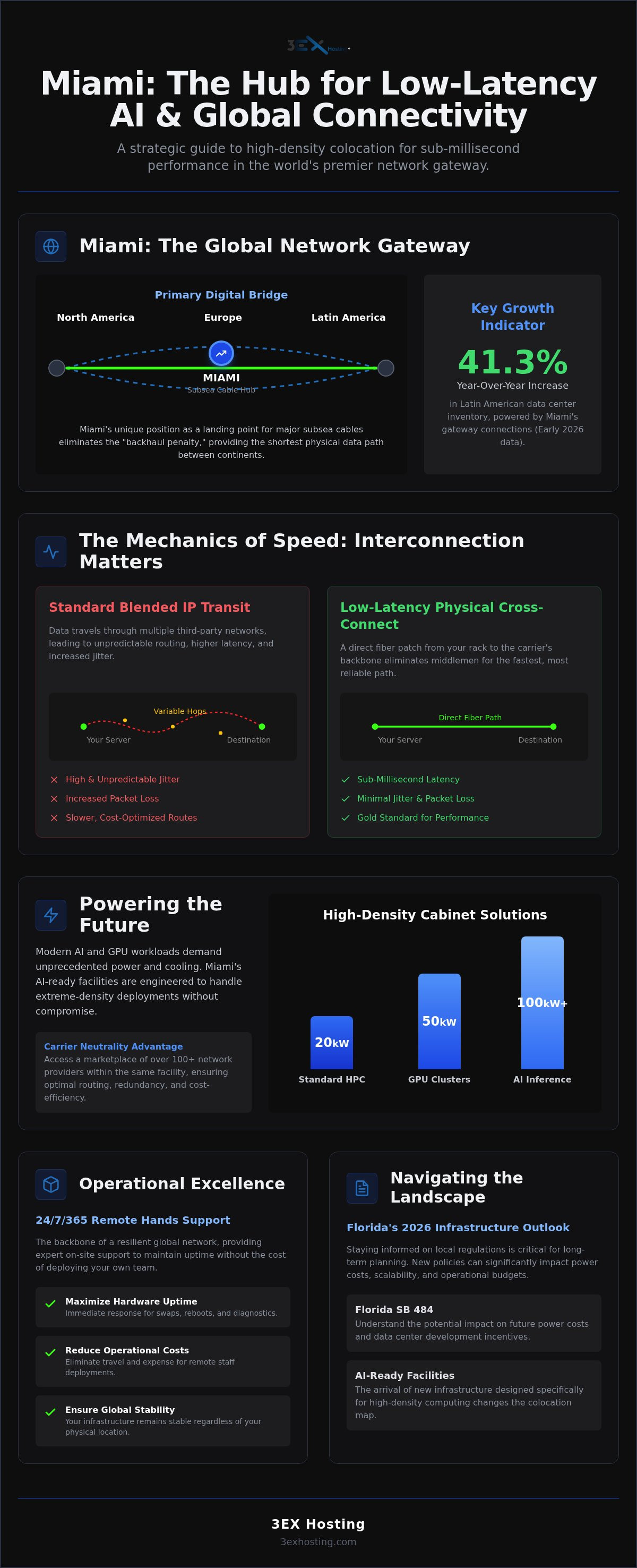
Miami functions as the primary digital bridge between North America, Latin America, and Europe. It’s the only location in the United States where massive subsea fiber optic cables from the South and East converge with major domestic backbones. For enterprises, this means Miami is the most efficient point to terminate traffic destined for international markets. By placing hardware in a data center Miami, organizations eliminate the “backhaul penalty” associated with routing traffic through northern hubs. This strategic positioning ensures that data reaches its destination via the shortest physical path possible.
Miami as a Subsea Cable Gateway
The Florida coast serves as the landing point for multiple high-capacity subsea cable systems. These routes provide direct, high-speed paths to the Caribbean and South America, which saw a 41.3% year-over-year increase in data center inventory in early 2026. These physical connections drastically reduce regional latency benchmarks by removing the need for terrestrial detours. Enterprises benefit from proximity to Internet Exchange Points (IXPs) where network peering arrangements happen in microseconds. This density reduces transit hops, which are the primary cause of packet loss and jitter in global deployments.
Defining Low-Latency for Modern Enterprise Needs
Modern workloads have outgrown standard connectivity. Fintech platforms, real-time gaming, and AI inference models require sub-10ms response times to remain competitive. Achieving this requires a distinction between distance latency and network congestion latency. While the speed of light is a constant, congestion is a variable you can control. 3EX Hosting operates within a Miami carrier hotel, providing direct access to the highest concentration of network providers in the region. This physical proximity to the core of the internet allows for low latency colocation Miami solutions that bypass the public internet’s unpredictable routing.
The Carrier Hotel advantage is about more than just having many providers in one building. It’s about the ability to establish physical cross-connects that link your cabinet directly to a carrier’s backbone. At 3EX Hosting, we leverage this density to provide redundant paths for mission-critical data. This architecture ensures that even if one route experiences an outage, your traffic fails over instantly to another high-speed path. It’s a level of reliability and speed that standalone facilities simply can’t match. Low-latency colocation is defined by the immediate physical proximity of server hardware to a high density of carrier interconnection points.
Engineering for Speed: The Mechanics of Low-Latency Interconnections
Speed in a data center environment is often misunderstood as simple bandwidth capacity. In reality, the physical layer of connectivity determines the floor of your network performance. Achieving low latency colocation Miami requires moving beyond the public internet’s best-effort routing. When you rely on public transit, your packets are subject to the BGP routing decisions of multiple third-party networks. These paths often prioritize cost over the fastest route, leading to unpredictable spikes in latency. High-performance enterprises require a more controlled environment where the physical distance between the server and the carrier backbone is minimized to the length of a fiber optic cable.
Cross-Connects vs. Blended IP Transit
Physical cross-connects are the gold standard for enterprise speed. Unlike blended IP transit, a cross-connect is a direct fiber patch between your rack and a carrier’s point of presence. This setup eliminates several layers of switching and routing equipment. It effectively removes the “middleman” from your data transfer. The result is a drastic reduction in jitter and packet loss, which are critical for high-frequency trading or real-time AI inference. You can learn more about our data center connectivity to see how these direct paths are engineered for maximum stability. While managed transit is convenient, the ROI of managing your own network via direct fiber becomes clear when you calculate the cost of a single millisecond of downtime in a competitive market.
The Role of Carrier Neutrality in Latency Optimization
A carrier-neutral facility acts as a high-density marketplace for connectivity. It gives you the freedom to choose from over 100 different providers without moving your hardware. This environment prevents vendor lock-in and allows you to optimize your network for specific geographic regions. For example, you might select one carrier specifically for its low-latency route to Brazil and another for its superior domestic backbone.
A neutral ecosystem also simplifies multi-homed network redundancy. In a carrier hotel, you can link your infrastructure to multiple ISPs and Content Delivery Networks (CDNs) simultaneously. If one provider experiences routing instability, your traffic shifts to a secondary path with minimal latency impact. This level of flexibility is only possible when your provider doesn’t force you into a proprietary network. If you are building a global network, you should request a custom connectivity map to see which carriers best serve your specific target markets.
Powering the Future: High-Density Colocation for AI and GPU Clusters
The rise of generative AI has fundamentally altered the power profile of the modern data center. While a standard rack once drew 5kW, today’s NVIDIA H100 and Blackwell B200 clusters demand between 20kW and 50kW per cabinet. Legacy facilities often lack the electrical backbone or the cooling capacity to support these “hot” racks. For enterprises, finding low latency colocation Miami that also offers high-density power is now a critical requirement for AI scalability. You can’t run modern GPU clusters on infrastructure built for the previous decade’s web traffic.
Infrastructure Requirements for AI Training and Inference
Standard data centers struggle with thermal management for GPU clusters. High-density deployments generate concentrated heat that traditional perimeter cooling can’t dissipate. Effective AI hosting requires specialized heat containment and high-volume airflow to prevent thermal throttling. At 3EX Hosting, we integrate these requirements into our full cabinet colocation environments, ensuring your compute-heavy hardware operates at peak efficiency. You’ll find deeper technical specs in our sibling article, The Enterprise Guide to AI Infrastructure in 2026.
Continuous AI training cycles are sensitive to even minor power fluctuations. We utilize N+1 power redundancy as a baseline, with 2N configurations available for mission-critical GPU workloads. This ensures maintenance or utility interruptions don’t derail weeks of expensive training progress. As of 2026, Florida’s utilities are tracking up to 9 GW of estimated AI-driven power demand. Choosing a provider with grid-hardened infrastructure is the only way to protect your hardware investment from local grid strain.
Scalability: From Single Cabinets to Private Suites
As your AI projects grow from pilot programs to global production, your footprint must expand without introducing latency. Moving from a single rack to private colocation suites allows for custom cage solutions tailored to high-performance compute (HPC) clusters. This transition focuses on managing the power-to-cooling ratio effectively. In the Miami market, we see a trend toward these mid-sized, high-density environments. Since Florida’s SB 484 took effect on July 1, 2026, large-scale data centers must cover their full energy costs transparently. This shift makes efficient, high-density low latency colocation Miami providers more attractive to enterprises needing predictable operational costs while scaling AI workloads. We help you manage this growth by providing the physical space and technical expertise to deploy custom cooling solutions that standard providers won’t touch.
Operational Excellence: Bridging the Distance with Remote Hands
Deploying hardware in a gateway city often means your primary IT team is hundreds or thousands of miles away. While the network path provides low latency colocation Miami, the physical distance can create a bottleneck when hardware requires manual intervention. Professional remote hands services eliminate this gap by acting as a local extension of your technical staff. This arrangement ensures that your infrastructure receives immediate, expert attention without the logistical nightmare of “truck rolls” or emergency flights.
The return on investment for on-site support is measured in minutes of uptime. When a server hangs or a component fails, waiting for a technician to travel to the facility isn’t an option for mission-critical systems. By utilizing 24/7 remote hands, enterprises can offload routine maintenance and emergency troubleshooting to on-site specialists who are already familiar with the data center’s layout and protocols. It’s a shift from reactive travel to proactive, managed infrastructure care.
The Scope of Professional Remote Hands Services
Expert support goes beyond simple power cycles. Our team handles complex hardware installations, meticulous structured cabling, and regular visual audits to ensure thermal stability. In high-density environments where cable clutter can impede airflow, professional cable management is a technical necessity. We also provide component replacement and emergency troubleshooting to keep your services online. For a deeper look at these operational workflows, read our guide on Data Center Efficiency through Remote Hands.
Security and Compliance in Managed Colocation
Maintaining a secure environment for your low latency colocation Miami deployment is as important as maintaining a fast one. Our facility employs multi-layered physical security protocols, including biometrics, 24/7 surveillance, and detailed access logs. These measures are essential for enterprises that must adhere to SOC2 or HIPAA compliance standards. Whether you’re in a shared cage or a private suite, your data’s physical integrity is documented and defended. Integrating these security measures with our Disaster Recovery Solutions ensures your business continuity plan is robust and ready for any scenario. If you need to upgrade your on-site support capabilities, contact our remote hands team today to discuss your specific deployment needs.
Conclusion: Selecting Your Miami Colocation Partner
Selecting the right facility is a strategic decision that impacts your global network performance and AI scalability for years. To achieve true low latency colocation Miami, you must balance three critical pillars: geographic location, interconnection density, and power availability. A facility that offers space but lacks direct subsea cable access or high-density power for GPU clusters will eventually become a bottleneck for your enterprise. You need a partner that provides the physical infrastructure to match your digital ambitions.
Evaluation Checklist for Miami Providers
Before signing a contract, perform a technical audit of the provider’s ecosystem. Ask these specific questions to ensure their infrastructure aligns with 2026 requirements:
- What is the carrier density within the building, and are physical cross-connects available at fixed, transparent rates?
- Can the facility support 20kW to 50kW per rack for AI expansion without requiring custom cooling retrofits?
- What is the average response time for remote hands during off-peak hours?
- Does the provider offer N+1 or 2N power redundancy to protect high-value GPU hardware?
A provider’s inability to answer these specifics usually indicates a legacy facility that isn’t ready for modern, high-performance compute workloads. Don’t settle for vague promises when your uptime depends on technical precision.
The 3EX Hosting Advantage
3EX Hosting operates as a specialized carrier hotel, providing the maximum possible interconnection options in the Miami market. We’ve built our reputation on a 100% uptime track record and a focus on enterprise-grade reliability. We don’t just offer rack space; we provide a consultative approach to infrastructure design that ensures your network is optimized for the LATAM gateway. 3EX Hosting’s 24/7 expert remote hands support serves as the primary differentiator for enterprises requiring immediate physical intervention without the delay of travel.
Our position within a Miami carrier hotel facilitates global reach by placing your hardware directly at the intersection of the world’s most important fiber routes. Whether you’re deploying a single cabinet or a private suite, our infrastructure is engineered to scale with your AI and GPU requirements. Don’t leave your network performance to chance in a market as competitive as Florida. It’s time to secure a partner that understands the technical nuances of low latency colocation Miami. You can get a customized colocation quote today to begin optimizing your global infrastructure.
Future-Proofing Your Infrastructure in the Miami Gateway
Miami’s position as a global interconnection hub offers unparalleled advantages for enterprises targeting international growth. Success in 2026 depends on more than just floor space; it requires a carrier-neutral environment where physical cross-connects eliminate the latency of the public internet. High-density power is no longer optional for those scaling AI workloads. Securing low latency colocation Miami ensures your hardware remains at the center of the world’s fiber routes, backed by the redundancy needed for mission-critical GPU clusters.
3EX Hosting provides a carrier-neutral connectivity hub designed specifically for these modern demands. With 24/7 expert remote hands support and high-density GPU & AI ready infrastructure, we ensure your systems operate at peak efficiency from day one. Scale your infrastructure with 3EX Hosting’s Miami colocation solutions and gain the technical stability your global network requires. Your digital bridge to the future starts with a foundation built on speed and reliability.
Frequently Asked Questions
What is low latency colocation and why is Miami a top choice?
Low latency colocation is the practice of housing server hardware in a facility strategically positioned near major network exchange points to minimize data travel time. Miami is a premier choice because it serves as the landing point for multiple subsea fiber cables connecting North America to Latin America and Europe. This geographic advantage makes low latency colocation Miami essential for enterprises that require sub-millisecond response times for international users and high-frequency data processing.
How do cross-connect services improve network performance in Miami?
Cross-connect services provide a direct, physical fiber optic link between your equipment and a service provider or partner within the same facility. By bypassing the public internet, these connections eliminate multiple routing hops and the unpredictable congestion of the BGP path. This architecture significantly reduces jitter and packet loss. It’s the most reliable method for ensuring high-speed data transfer and consistent performance for mission-critical applications that can’t tolerate network variability.
Can your Miami data center support high-density GPU servers for AI?
Yes, 3EX Hosting is specifically engineered to support high-density GPU servers required for modern AI training and inference. While standard facilities often struggle with the thermal demands of high-performance compute, our infrastructure handles power draws ranging from 20kW to 50kW per cabinet. We provide the specialized cooling and power distribution necessary for NVIDIA H100 and B200 clusters, ensuring your AI hardware operates at peak capacity without thermal throttling or power instability.
What are remote hands services and what tasks can they perform?
Remote hands services provide you with 24/7 on-site technical support to manage your physical hardware without requiring your team to travel. Our specialists perform a wide range of tasks, including hardware installations, structured cabling, and emergency troubleshooting. We can handle power cycles, component replacements, and visual audits of your environment. This service acts as a seamless extension of your IT department, maintaining your uptime and resolving physical issues in real time.
What is the difference between a full cabinet and a private colocation suite?
A full cabinet provides a single, secure rack for your equipment, typically offering up to 48U of space with dedicated power and cooling. This is ideal for most enterprise deployments. A private colocation suite is a dedicated, walled-off room within the data center that houses multiple racks. Suites offer an extra layer of physical security and operational autonomy, making them the preferred choice for large-scale deployments or sensitive high-performance compute clusters.
How does being in a carrier hotel benefit my business connectivity?
A carrier hotel is a facility that houses a high density of network providers, ISPs, and content delivery networks. Being in this environment gives your business direct access to over 100 carriers, fostering a competitive marketplace for bandwidth and transit. This density allows for diverse routing options and immediate physical cross-connects to global backbones. It ensures your network remains redundant and capable of reaching international markets with the lowest possible latency.
What power redundancy levels (N+1, 2N) do you offer in Miami?
We offer N+1 power redundancy as a baseline, with 2N configurations available for high-availability enterprise needs. N+1 ensures that a backup power component is always ready if a primary unit fails or requires maintenance. 2N redundancy provides two completely independent power paths from the utility to your rack. These levels of protection are critical for preventing downtime during grid fluctuations or equipment servicing, particularly for power-intensive AI and GPU hosting workloads.
How do I migrate my existing hardware to a Miami colocation facility?
Migrating hardware starts with a comprehensive audit of your current power and connectivity requirements. 3EX Hosting provides move-in assistance to streamline the logistics of transporting and racking your equipment. Our remote hands team can assist with the initial installation, structured cabling, and network testing to ensure a smooth transition. We recommend a phased approach to migration to minimize service interruptions and verify that all low latency colocation Miami benchmarks are met.