 SUPPORT


 3EX United States
 Blog
Most enterprise leaders assume that moving to the cloud guarantees performance, but generic public environments often fail when faced with high-density GPU or AI workloads. Latency isn’t just a technical metric. It’s the physical distance between your infrastructure and your global market. If your current stack struggles with unpredictable lag or lacks the power density for modern machine learning, you’ve likely outgrown standard virtualized solutions. Managed cloud hosting Miami offers a different path by placing your mission-critical data directly within a strategic interconnection hub.
You need infrastructure that matches your ambition without compromising on compliance or support. It’s frustrating when generic support teams don’t understand the nuances of high-density hardware or the requirements of national scalability. This guide explores how high-density managed cloud hosting in Miami provides the N+1 redundancy and low-latency connectivity required for modern enterprise workloads. You’ll learn how specialized 24/7 remote hands support and carrier-neutral hubs turn infrastructure from a bottleneck into a competitive advantage for your organization.
Key Takeaways
- Learn why strategic interconnection hubs in Miami are essential for reducing latency and ensuring reliable national data distribution for enterprise workloads.
- Discover how managed cloud hosting Miami leverages carrier-neutral hotels to provide superior network redundancy and cost-effective connectivity options.
- Understand the infrastructure requirements for scaling AI and GPU workloads, specifically why high-density power is a critical factor for modern performance.
- Explore how integrated disaster recovery and N+1 redundancy protect mission-critical applications against regional outages and unforeseen events.
- See how 24/7 remote hands support provides the technical expertise needed to manage complex infrastructure without sacrificing operational agility.
Understanding the Strategic Role of Managed Cloud Hosting Miami Hubs
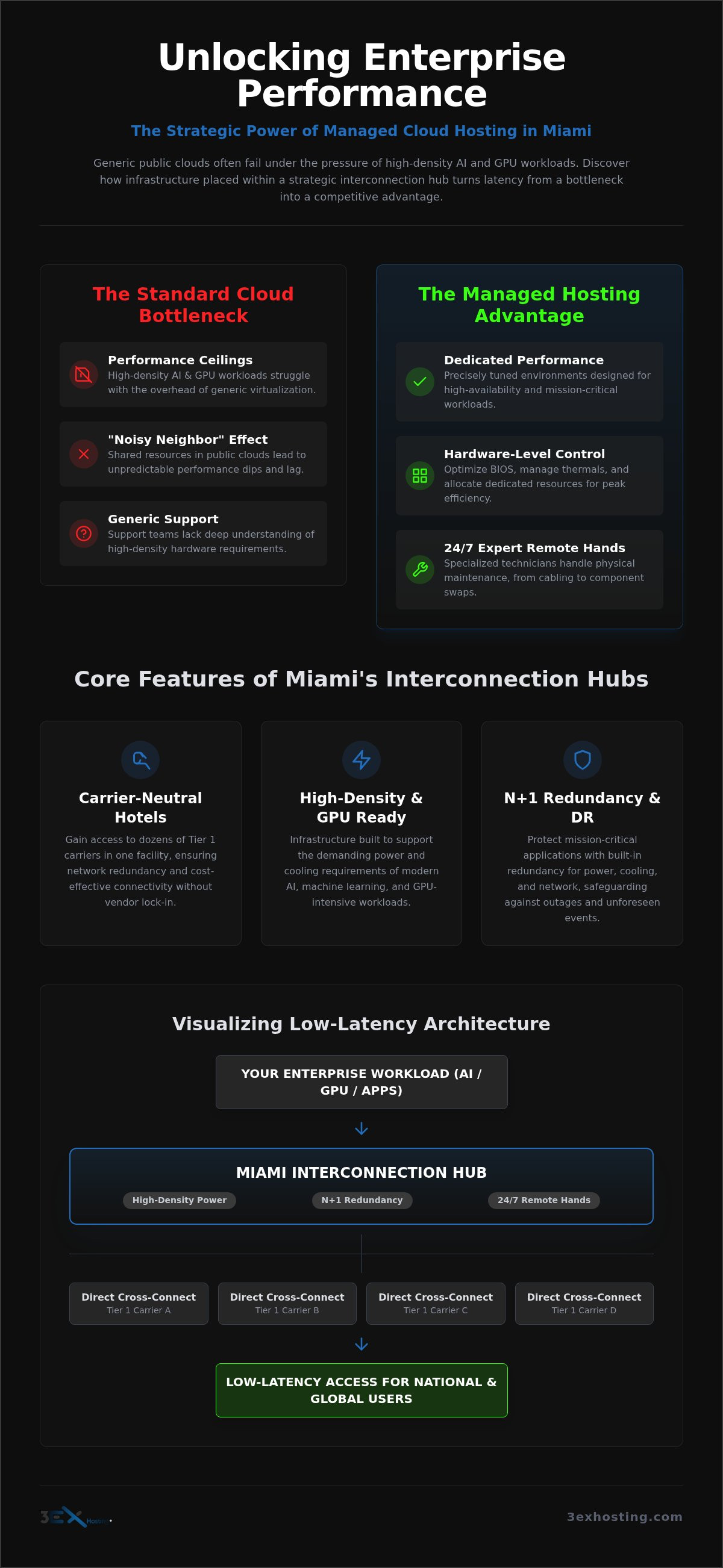
Managed cloud hosting Miami provides a specialized, enterprise-grade environment that bridges the gap between raw hardware and cloud scalability. Unlike generic public cloud platforms, this infrastructure is built on high-performance physical assets located within strategic interconnection points. These hubs are vital for national data distribution because they sit at the nexus of global fiber networks. By choosing a private, managed environment, enterprises gain predictable costs and escape the “egress fee” traps of major public providers. The foundation of this performance is the carrier-neutral facility. These carrier hotels allow for direct cross-connects to multiple providers, ensuring that your data takes the shortest, fastest path to its destination.
Reliability stems from the physical location. A facility in a major interconnection hub reduces the number of hops your data must take. This is critical for applications that require consistent, low-latency responses across the country. Managed cloud hosting Miami ensures that your stack isn’t just another virtual machine in a massive, anonymous warehouse. Instead, it’s a precisely tuned environment designed for high-availability workloads.
The Evolution of Enterprise Cloud Requirements in 2026
In 2026, standard cloud instances often hit a performance ceiling when handling high-density AI or GPU workloads. The overhead of virtualization in public clouds can introduce micro-latencies that degrade real-time processing. Performance now depends on physical proximity to major network backbones. A Miami data center location serves as a primary gateway for national traffic. Managed environments allow for deeper hardware-level optimization. You can tune the BIOS, manage thermal profiles, and allocate dedicated resources that public alternatives simply hide behind abstraction layers. This level of control is essential for industries that cannot afford the “noisy neighbor” effect common in shared public environments.
Defining the “Managed” in Managed Cloud Hosting
The “managed” aspect isn’t just about software updates. It involves proactive monitoring and expert-led infrastructure support that ensures business continuity. Transitioning from self-managed hardware to a provider like 3EX Hosting means offloading the burden of physical maintenance and power redundancy to specialists. This includes 24/7 remote hands support for immediate physical interventions. Expert teams handle everything from component replacements to cable management, allowing your internal developers to focus on code rather than cooling. This shift reduces operational risk and guarantees that your hardware remains in peak condition. Managed cloud hosting is the intersection of dedicated hardware and cloud-like flexibility.
Leveraging Carrier Hotels for High-Performance Cloud Connectivity
The performance of managed cloud hosting Miami is inseparable from the physical building where the servers reside. A carrier hotel is a specialized facility that houses a massive density of network service providers, fiber loops, and subsea cable landings. For an enterprise, this environment isn’t just a place to store data; it’s a strategic advantage. Carrier neutrality ensures you aren’t locked into a single provider’s pricing or performance limitations. Instead, your infrastructure sits in a room with dozens of Tier 1 carriers. This allows for direct, physical cross-connects that bypass the public internet entirely. These high-performance links reduce the number of “hops” your data takes, which is the primary factor in maintaining application speed and reliability.
Using a carrier-neutral hub means your network architecture is built for resilience. If one provider experiences an outage, your managed environment can instantly reroute traffic through another carrier within the same facility. This level of connectivity is a prerequisite for any organization aiming for national scalability. It transforms the cloud from a distant resource into a high-speed extension of your local network. If you’re planning a migration, you can explore how a Miami data center provides the physical foundation for these high-speed connections.
The Impact of Latency on National Enterprise Applications
Latency is the silent killer of enterprise productivity. In real-time data processing or high-frequency environments, even a 20-millisecond delay can result in significant operational costs. Miami serves as a low-latency gateway for the entire US East Coast and international markets. By placing your managed cloud hosting Miami resources in a central interconnection hub, you ensure that users in New York or Washington D.C. experience the same responsiveness as those in Florida. You can find detailed strategies for Maximizing Network Performance with Cross-Connects to understand how physical proximity to the backbone improves your bottom line.
Redundancy and Uptime in Carrier-Neutral Environments
Enterprise-grade reliability requires more than just software backups. It demands N+1 power and cooling redundancy at the hardware level. In a carrier hotel, every critical system has an independent backup, ensuring that your mission-critical workloads remain online during maintenance or regional power events. This physical hardening is essential for meeting strict Compliance and Disaster Recovery standards. When your infrastructure is backed by multiple Tier 1 carriers and redundant power grids, you eliminate single points of failure. This infrastructure-first approach is why the world’s largest organizations prioritize carrier hotel locations for their private cloud deployments.
Scaling Enterprise Workloads: High-Density and GPU Cloud Capabilities
The rapid adoption of AI and machine learning has fundamentally changed how enterprises view their digital infrastructure. High-density power is no longer a luxury; it’s the primary bottleneck for modern cloud scaling. While generic public cloud providers offer virtualized instances, they often struggle with the thermal and power demands of continuous GPU processing. Managed cloud hosting Miami addresses this by providing dedicated, high-density environments designed to support 30kW+ per rack. This specialized infrastructure ensures that your AI models train without thermal throttling or the unpredictable performance drops common in shared environments.
Managed GPU hosting provides hardware-level optimization that standard compute instances cannot match. By using dedicated hardware within a managed framework, you eliminate the overhead of complex hypervisors. This leads to faster processing times and lower operational costs for large-scale deployments. Our facility provides the cooling and power infrastructure necessary to sustain these workloads 24/7, backed by N+1 redundancy. You don’t have to worry about power caps or cooling failures during mission-critical training cycles.
Infrastructure for AI Training and GPU-Intensive Tasks
Modern AI clusters generate immense heat, requiring advanced cooling solutions that go beyond traditional air conditioning. Managed cloud providers must offer specialized hardware and environmental controls to maintain stability during intense machine learning cycles. If your organization is moving beyond small-scale testing into full production, you should consult the High-Density GPU Colocation: The Enterprise Guide to AI Infrastructure in 2026 for a technical breakdown of these requirements. Staying ahead of these power demands is the only way to ensure national scalability.
Transitioning from Colocation to Managed Infrastructure
Many enterprises find that a hybrid approach works best for their scaling needs. You can combine full cabinet colocation for your proprietary hardware with managed cloud services for burstable workloads. This strategy allows you to maintain physical control over your most sensitive data while leveraging the flexibility of the cloud. Managing such a complex deployment requires expert intervention. Our remote hands support teams act as an extension of your IT department, handling everything from hardware swaps to complex cabling. This ensures your high-density infrastructure remains operational even when your team isn’t on-site. Balancing physical control with cloud management layers is the most efficient way to achieve national scalability in 2026.
Compliance and Disaster Recovery in Mission-Critical Cloud Environments
Managed cloud hosting Miami provides the structural integrity required for national business continuity. For enterprises operating in regulated sectors, uptime isn’t a goal; it’s a legal and operational mandate. Integrated disaster recovery solutions go beyond simple data copies by creating a mirrored environment ready for immediate activation. This facilitates rapid restoration after unforeseen hardware failures or regional events. Data sovereignty remains a top priority, and enterprise-grade facilities ensure that your data resides on physically identifiable hardware within specific jurisdictions. This level of control allows you to maintain SOC, HIPAA, and PCI compliance without the ambiguity of generic public clouds.
Security protocols in these environments are designed to protect the entire stack, from the fiber entry points to the individual rack. By leveraging private infrastructure, you remove the “noisy neighbor” risks and security vulnerabilities inherent in shared virtualized platforms. Your compliance posture is only as strong as the physical layer it sits on. Choosing a provider that understands the nuances of enterprise-grade security ensures that your organization stays protected against both digital and physical threats.
Designing for Continuous Availability
Standard backups are a reactive measure, whereas true disaster recovery is a proactive strategy. True resilience requires a live failover mechanism where managed cloud resources can assume the workload of a primary site without manual intervention. In the context of managed cloud, the Recovery Time Objective (RTO) is defined as the maximum tolerable duration that an application can be offline after a failure occurs. By using secondary colocation sites and managed failovers, you ensure that your RTO remains measured in minutes rather than hours or days. This architecture is essential for maintaining a national presence where service interruptions are not an option.
Physical Security and Private Infrastructure
Physical isolation is the most effective way to guarantee data sovereignty. Enterprises often deploy their mission-critical hardware within private colocation suites or custom cages to prevent unauthorized physical access. Managed cloud providers secure this physical layer using biometric scanners, 24/7 on-site security personnel, and detailed access logging. For a deeper look at how these environments function, refer to our sibling article: Enterprise Private Suites: The Comprehensive Guide to Colocation Sovereignty in 2026. Securing the physical hardware is the only way to achieve total control over your infrastructure. To build a more resilient and compliant cloud environment, contact our engineering team for a quote on specialized infrastructure solutions.
Deploying National Infrastructure with 3EX Hosting Managed Services
3EX Hosting operates as a quiet professional in the background of your enterprise operations. We don’t just provide space; we provide a high-performance foundation for national scalability. Our managed cloud hosting Miami services are anchored in a premier carrier hotel, ensuring your data has the fastest possible route to its destination. This approach prioritizes technical stability over marketing hype. We understand that for an enterprise, every millisecond of latency and every minute of downtime has a direct fiscal impact. By removing the complexity of hardware management, we allow your team to operate with total confidence in the underlying stack.
Our methodology focuses on creating a bridge between physical hardware control and the agility of the cloud. This is particularly important for high-density workloads that generic providers cannot support. We don’t believe in one-size-fits-all solutions. Instead, we provide a stable, redundant environment where your mission-critical applications can thrive. Whether you’re scaling AI training clusters or distributing data across the US East Coast, our infrastructure is built to handle the load without compromise.
The 3EX Managed Cloud Advantage
Technical excellence is the baseline of our service. Moving mission-critical workloads is a high-stakes operation that requires precision and a deep understanding of network topology. Our move-in assistance ensures that your transition from legacy environments or generic public clouds to our managed environment is seamless and secure. Once deployed, our teams provide managed IT support that acts as a physical extension of your own staff. With 24/7 remote hands and carrier-neutral connectivity, we handle the physical layer complexities. This includes everything from component replacements to optimizing high-density power distribution for specialized tasks.
Next Steps for Infrastructure Optimization
Finding the right balance between physical control and cloud-like flexibility is unique to every organization. It starts with a comprehensive technical audit of your current hosting performance. We look for bottlenecks in power density, network latency, and redundancy gaps that might hinder your national reach. Whether you need full cabinet colocation or a fully managed private cloud, our experts provide a tailored roadmap for optimization. Scaling shouldn’t be a gamble. It should be a logical progression supported by redundant power and high-speed cross-connects. Our goal is to make the most complex infrastructure feel simple and reliable. Get a custom quote for your managed cloud infrastructure today to begin your audit and secure your national scalability.
Securing Your National Infrastructure Foundation
National scalability depends on more than just software. It requires the physical stability of a carrier-neutral hub and the power density to handle modern GPU workloads. Managed cloud hosting Miami provides this technical edge by combining high-performance connectivity with the reliability of N+1 redundant power and cooling. You don’t have to choose between hardware control and cloud flexibility when your infrastructure is managed by specialists who understand enterprise demands.
Our strategic carrier hotel location ensures your data reaches national markets with minimal latency. With 24/7 enterprise remote hands support, your team can focus on high-level growth while we maintain the physical integrity of your stack. It’s time to move beyond generic cloud environments and build a resilient foundation for your mission-critical applications. Every decision you make today about your infrastructure dictates your performance tomorrow.
Ready to optimize your stack? Request an Enterprise Managed Cloud Consultation today to audit your current performance and begin your scaling roadmap.
Frequently Asked Questions
What is the difference between managed cloud hosting and public cloud?
Managed cloud hosting provides dedicated hardware and expert support, whereas public cloud is a multi-tenant, self-service environment. In a managed setup, the provider handles hardware maintenance, BIOS tuning, and physical security. This reduces the “noisy neighbor” effect and offers predictable costs. Public clouds often hide abstraction layers that can impact performance for high-density enterprise applications. A managed environment bridges the gap between hardware control and cloud flexibility.
How does hosting in a Miami carrier hotel benefit national businesses?
Hosting in a carrier hotel provides direct access to a high density of network providers and subsea cable landings. This strategic location acts as a low-latency gateway for national and international data traffic. Businesses benefit from carrier neutrality, which prevents vendor lock-in and allows for instant network rerouting. It is the most reliable way to ensure a fast, consistent connection for users across the US East Coast and beyond.
Can managed cloud hosting Miami infrastructure handle AI and GPU workloads?
Yes, managed cloud hosting Miami infrastructure is specifically designed for high-density AI and GPU server hosting. These facilities support 30kW+ per rack and use advanced cooling systems to prevent thermal throttling. Unlike generic cloud instances, dedicated GPU environments provide the raw power required for continuous machine learning training. This ensures your AI models operate at peak efficiency without the performance variability found in virtualized environments.
What security certifications should I look for in a managed cloud provider?
Enterprises should prioritize providers with SOC 1, SOC 2, HIPAA, and PCI DSS certifications. These standards verify that the facility follows strict protocols for data security, environmental controls, and physical access. A compliant managed cloud environment ensures your infrastructure meets the legal requirements of your industry. It is also vital to look for ISO 27001 certification, which confirms an internationally recognized approach to information security management and data protection.
How does 24/7 remote hands support improve cloud uptime?
Remote hands support improves uptime by providing immediate on-site technical intervention for hardware-level issues. Whether it’s a component replacement or a complex cable adjustment, expert technicians are available to handle physical tasks without your team needing to travel. This proactive approach minimizes mean time to repair and ensures your mission-critical infrastructure remains online during unforeseen events. It effectively acts as a physical extension of your internal IT department.
What are the disaster recovery options for managed cloud environments?
Disaster recovery in a managed cloud environment typically involves N+1 redundant power, cooling, and live failover mechanisms. Providers offer mirrored environments in secondary locations that can assume the workload if the primary site fails. This architecture focuses on meeting strict Recovery Time Objectives and Recovery Point Objectives. By integrating these solutions directly into the cloud stack, businesses ensure continuity even during regional outages or severe natural disasters.
How do cross-connect services affect cloud application performance?
Cross-connects provide a direct, physical link between your servers and service providers within the same facility. This bypasses the public internet entirely, significantly reducing latency and improving application responsiveness. By lowering the hop count, cross-connects provide a more stable and secure path for data transfer. This is essential for real-time processing and high-frequency applications where even micro-latencies can impact operational efficiency and the final user experience.
Is managed cloud hosting suitable for HIPAA or PCI compliant industries?
Managed cloud hosting Miami environments are ideal for HIPAA and PCI compliant industries because they offer physical and logical isolation. Unlike public clouds, where data might reside on shared hardware, managed solutions provide identifiable physical resources. This control simplifies the auditing process and ensures data sovereignty is maintained. Providers implement strict encryption, access logging, and physical security measures that meet or exceed the requirements for handling sensitive financial or medical information.