 SUPPORT


 3EX United States
 Blog
With North American data center vacancy rates hitting a record low of 1.4%, is your enterprise infrastructure actually positioned for the AI-driven demands of 2026? You’ve likely noticed that selecting the right Miami data center providers isn’t just about floor space anymore. It’s about securing the power density required for GPU-intensive workloads while maintaining zero downtime. It’s a difficult balance to strike when international latency and surging energy costs are constantly threatening your bottom line.
We know your mission-critical applications can’t afford a single second of interruption. This guide shows you how to evaluate enterprise-grade infrastructure and leverage high-density colocation for national scalability. You’ll learn how to utilize carrier-neutral interconnections to slash latency and why specialized 24/7 technical expertise is the key to managing remote hardware without the need for an on-site team.
Key Takeaways
- Understand the strategic role of carrier hotels in Miami to optimize national network architecture and regional connectivity.
- Evaluate Miami data center providers based on carrier neutrality and cross-connect services to avoid vendor lock-in and minimize network latency.
- Prepare for 2026 infrastructure demands by securing high-density racks capable of supporting 20kW+ for AI and GPU workloads.
- Use a comprehensive audit checklist to verify facility power redundancy and critical compliance standards like SOC 2 and HIPAA.
- Discover how customizable colocation solutions, from single cabinets to private suites, provide the flexibility needed for national enterprise scalability.
Defining Excellence: What are Miami Data Center Providers?
To understand the local infrastructure market, we must first answer a fundamental question: What are Miami Data Center Providers? These organizations operate high-tier facilities designed for colocation, interconnection, and managed infrastructure. They serve as the backbone for national and international traffic, acting as a “Carrier Hotel” where hundreds of internet service providers and networks converge. In this environment, your hardware isn’t just sitting in a room; it’s part of a dense ecosystem of direct connections that bypass the public internet.
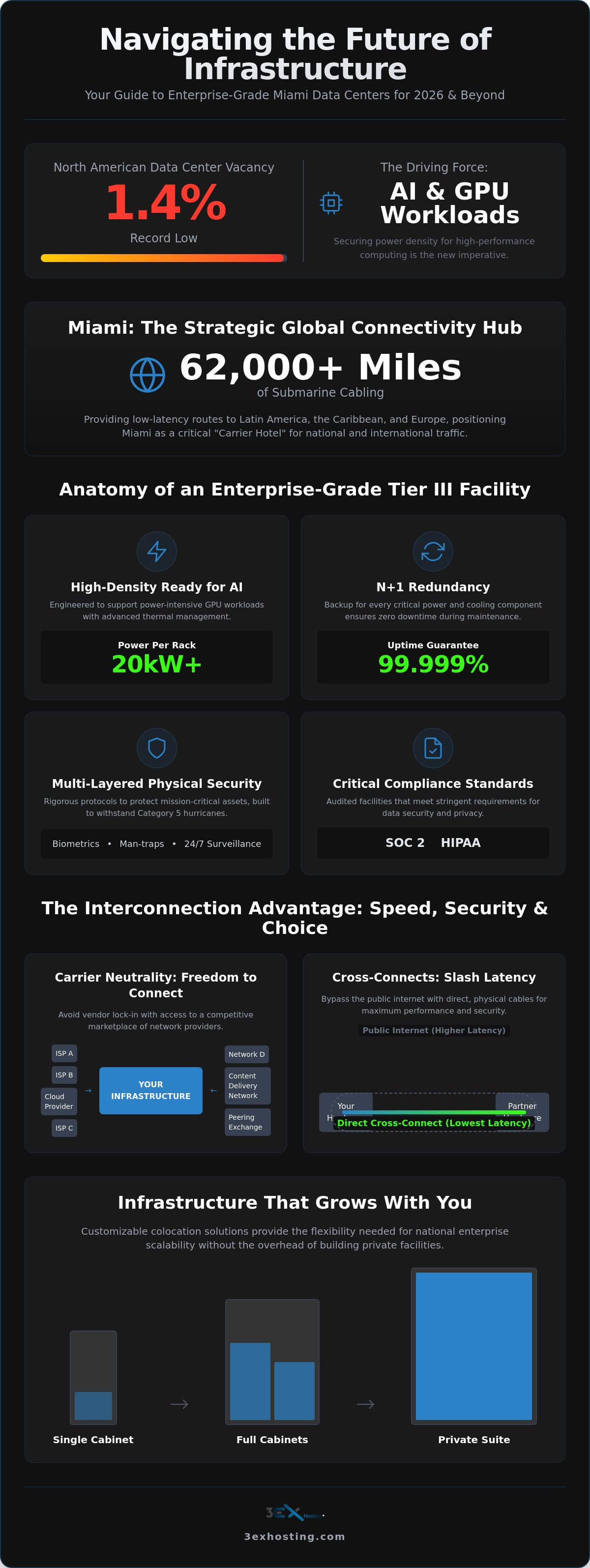
Miami’s strategic value lies in its access to over 62,000 miles of submarine cabling. This connectivity provides low-latency routes to Latin America, the Caribbean, and Europe. By 2026, the focus has shifted from simple server housing to high-density AI and GPU infrastructure. Modern enterprises now demand Miami data center providers capable of supporting power-intensive hardware that traditional centers simply weren’t built to handle. High-performance computing requires a level of engineering that prioritizes thermal management and massive power throughput above all else.
The Anatomy of a Tier III Data Center
Tier III status is the benchmark for enterprise reliability. It requires N+1 redundancy for both power and cooling systems. This means every critical component has a backup, ensuring that maintenance doesn’t interrupt operations. Most reputable providers offer a 99.999% uptime guarantee to support business continuity. Physical security is equally rigorous. You’ll find multi-stage protocols, including biometrics, man-traps, and 24/7 on-site surveillance to protect mission-critical assets. These facilities are built to withstand Category 5 hurricanes, providing a stable foundation in a volatile climate.
Why National Enterprises Choose Strategic Hubs
National enterprises choose Miami to centralize their infrastructure and serve multi-regional user bases efficiently. Leveraging a high-density connectivity hub reduces transit costs by allowing direct peering with multiple carriers. These sites also function as vital disaster recovery locations. If a primary corporate headquarters faces an outage, a Miami-based environment keeps applications running. For companies scaling quickly, full cabinet colocation in a strategic hub offers the quickest path to national scalability without the overhead of building private facilities. It’s about placing your data where the world connects.
The Interconnection Advantage: Carrier Neutrality & Cross-Connects
Strategic infrastructure in 2026 depends entirely on connectivity freedom. The most effective Miami data center providers operate under a carrier-neutral model. This design ensures you aren’t locked into a single internet service provider (ISP). You have the power to negotiate rates and performance levels across dozens of different vendors. If one provider’s route to a specific region degrades, you can shift traffic to another without moving your hardware. It’s a level of technical agility that protects both your operational uptime and your long-term budget.
Miami’s geography makes it a critical gateway for international data transfer. By selecting Miami data center providers with direct access to over 62,000 miles of subsea cabling, enterprises can achieve sub-millisecond latency to Latin America and the Caribbean. Many organizations now integrate managed cloud hosting with physical colocation to create robust hybrid environments. This approach keeps sensitive, mission-critical data on dedicated hardware while using the cloud for burstable workloads. It’s a balanced strategy that maximizes security without sacrificing the ability to scale rapidly.
Maximizing Network Performance with Cross-Connects
Network performance isn’t just about raw bandwidth; it’s about reducing the number of “hops” your data takes to reach its destination. Direct physical interconnections are the most efficient way to achieve this. A cross-connect is a dedicated physical cable between two network providers. By bypassing the public internet, you significantly lower latency and improve data security. This direct peering is also more economical than traditional IP transit for high-volume users. As global energy trends shift, optimizing every millisecond of data transfer becomes vital, especially when Powering AI: High-Density Colocation environments that consume massive resources.
The Role of the Carrier Hotel
High-traffic applications require a carrier-dense environment to function at scale. A carrier hotel is a specialized facility that houses hundreds of network service providers under one roof. This density creates a competitive marketplace for bandwidth, peering, and specialized transit services. It’s a non-negotiable requirement for national enterprises that handle real-time data processing or global financial transactions. Learn more about our data center connectivity and how a strategic location facilitates these vital links. If you need a more customized setup for your hardware, you might consider full cabinet colocation to maintain total control over your environment.
Powering AI: High-Density Colocation and GPU Hosting
By 2026, the artificial intelligence boom has fundamentally altered infrastructure requirements. Standard power configurations of 4kW to 6kW are no longer sufficient for modern enterprises. AI model training and inference workloads now routinely demand 20kW or more per rack. Leading Miami data center providers have responded by upgrading their facilities to support these intense power draws. This shift is driven by the need for high-performance computing (HPC) clusters that rely on dense GPU configurations. Success in this landscape requires a facility that can deliver massive power throughput without compromising on thermal stability.
Managing the thermal output of these clusters is a significant engineering challenge. Traditional air cooling often falls short when dealing with the concentrated heat of multiple H100 or B200 GPU nodes. Specialized containment and liquid cooling solutions are becoming the standard for high-density GPU hosting. When choosing between GPU dedicated servers and colocation, enterprises must weigh the benefits of owning specialized hardware against the speed of managed cloud hosting. Future-proofing your setup means ensuring the facility can scale its power and cooling delivery as next-generation chips arrive. High-density environments aren’t just about power; they’re about how that data moves. The Interconnection Advantage of being in a well-connected hub ensures that AI training data can be ingested from various sources with minimal latency.
Infrastructure Requirements for AI GPU Hosting
Modern GPU servers generate immense heat that can quickly overwhelm standard ventilation. Facilities must handle this thermal load through advanced hot-aisle or cold-aisle containment systems to prevent hardware throttling. Non-stop AI model training also requires absolute power redundancy. Even a brief fluctuation can corrupt weeks of computational work. For a deeper dive into these technical specs, read The Enterprise Guide to AI Infrastructure in 2026. This guide details how to align your hardware needs with facility capabilities.
Scaling with Full Cabinet Colocation
Dedicated cabinets provide the physical isolation necessary for high-security AI projects. They also allow for precise airflow management, which is critical when running high-density racks. For larger deployments, customizable cage solutions offer the space needed for massive GPU clusters. You can explore Full Cabinet Colocation options to see how dedicated space supports your specific hardware requirements. This level of control ensures your infrastructure remains stable as your AI initiatives grow in complexity and scale.
Selecting Miami Data Center Providers: An Audit Checklist
Selecting a partner requires more than a cursory site tour. You need a rigorous framework to vet Miami data center providers against your specific 2026 growth targets. Start by verifying power density. If a facility cannot support the 20kW+ requirements of modern GPU clusters today, it won’t handle your next hardware refresh. Ask for specific documentation on their power distribution units and cooling capacity per square foot. Confirm whether they utilize N+1 or N+2 redundancy for their power and cooling loops to ensure continuous operation during maintenance.
Site resilience is a non-negotiable factor in South Florida. Your audit must assess disaster recovery capabilities, including the elevation of critical equipment and the duration of on-site fuel reserves. A facility designed for Category 5 hurricane resistance provides the necessary peace of mind for national infrastructure. Analyze the Service Level Agreement (SLA) for precise language. It should cover not just network availability, but also power and cooling stability with clear financial penalties for any deviation. Don’t settle for vague uptime promises; demand granular performance guarantees.
Critical Compliance and Security Audits
SOC 2 Type II and ISO 27001 certifications are the baseline for enterprise trust. These audits prove the facility follows strict operational and security protocols over an extended period. You should also verify HIPAA or PCI compliance if your industry requires specialized data handling. Audit the physical layer too. Multi-layer security protocols, such as biometric scanners and man-traps, should protect every entry point and server aisle. Remote Hands support serves as a vital extension of your technical team, providing immediate physical intervention for national clients who cannot be on-site during a 3 AM emergency.
Operational Efficiency and PUE
Power Usage Effectiveness (PUE) remains a vital metric for operational efficiency in 2026. A lower PUE indicates that the facility uses energy more effectively to cool your hardware, which directly reduces your long-term operational costs. Modern cooling solutions, such as hot-aisle containment and liquid-to-chip systems, are essential for maintaining high-density environments without wasting electricity. Integrating 24/7 Remote Hands Support into your operational plan ensures that expert technicians are always available to monitor these systems. Before signing any agreement, get a quote to see how an efficient environment impacts your total cost of ownership.
The transition to a new facility shouldn’t be a source of friction for your IT team. We provide comprehensive move-in assistance to ensure your hardware is racked, stacked, and connected with zero technical debt. This hands-on approach is supported by our 24/7 Remote Hands team, who act as your on-site eyes and ears. Whether you’re deploying a single cabinet or a complex GPU cluster, our goal is to make the underlying infrastructure feel invisible so you can focus on your core business applications. Our role as one of the premier Miami data center providers is to ensure your hardware remains secure and operational around the clock.
Private Suites and Custom Cage Solutions
Enterprises with strict regulatory or security requirements often need more than just shared space. Private colocation suites offer the highest level of sovereignty, providing a fully enclosed, dedicated environment for your hardware. If a private suite exceeds your current needs, our custom cage solutions allow you to design a layout that optimizes airflow and security for your specific server configurations. You can learn more about these options in The Comprehensive Guide to Colocation Sovereignty. These solutions ensure your mission-critical assets are protected by physical barriers that meet the most rigorous compliance audits.
Your Partner in National Scalability
National scalability requires a partner that can handle more than just power and cooling. 3EX Hosting serves as a strategic disaster recovery site for companies headquartered in other regions, providing a resilient base in a Tier III facility. Our managed cloud hosting services also complement your physical hardware, allowing for a hybrid approach that combines the security of colocation with the burstability of the cloud. This dual-layered strategy ensures your applications remain available even during peak demand or regional outages. If you’re ready to secure your infrastructure, get a custom colocation quote today and see how our high-density solutions can support your growth.
Secure Your Infrastructure for a High-Density Future
Connectivity and power are the two essential pillars of a modern data strategy. The right facility does more than house servers; it provides a strategic gateway to international markets through carrier neutral connectivity and direct subsea cable access. By prioritizing high-density power configurations now, you ensure your hardware is fully prepared for the intense computational demands of 2026. It’s about placing your infrastructure in an environment designed for the next generation of performance.
Operational reliability is built on a foundation of technical excellence and immediate on-site expertise. When evaluating Miami data center providers, focus on facilities that offer verified N+1 power redundancy and 24/7 on-site Remote Hands support. These features provide the technical stability and peace of mind required for national scalability without the need for a local team. Your infrastructure is the foundation of your enterprise’s success. Let’s build a stable, high-performance environment that scales with your ambition.
Ready to optimize your environment? Request a custom quote for enterprise colocation at 3EX Hosting and secure your place in a world-class carrier hotel today.
Frequently Asked Questions
What should I look for when comparing Miami data center providers?
You should prioritize power density, carrier density, and geographic resilience. Effective Miami data center providers must support at least 20kW per rack to handle 2026 hardware requirements while offering protection against Category 5 hurricanes. Verify their Tier III status and ensure they have direct access to subsea cable landings for low-latency international traffic.
How does carrier neutrality affect my data center costs?
Carrier neutrality reduces your long-term costs by preventing vendor lock-in and encouraging competition among internet service providers. You aren’t forced to use a single provider’s expensive bandwidth. Instead, you can negotiate rates with dozens of carriers to find the best balance of performance and price for your specific network needs.
Can your facility support high-density GPU racks for AI training?
Yes, our infrastructure is specifically engineered to handle the 20kW+ power draws required for modern AI GPU hosting. We use advanced thermal management and containment systems to dissipate the intense heat generated by high-performance computing clusters. This stability ensures your AI model training continues without the risk of hardware throttling.
What is included in 24/7 Remote Hands support?
Remote Hands support covers essential physical tasks like server reboots, cable management, and hardware component replacements. Our on-site technicians are available 24/7 to act as your local team. This service is a vital component for national enterprises that need immediate technical intervention without the expense of sending staff to the facility.
Why is a carrier hotel better for national connectivity than a standard data center?
A carrier hotel acts as a central hub where hundreds of different networks converge, offering much higher interconnection density. This environment allows you to use direct cross-connects to bypass the public internet. It’s the most efficient way to reduce latency and transit costs when serving a multi-regional or international user base.
What redundancy levels are provided for power and cooling?
We provide N+1 redundancy for both power and cooling systems to maintain a 99.999% uptime guarantee. This means every critical piece of infrastructure has a dedicated backup ready to take over during maintenance or an unexpected component failure. It’s the benchmark for enterprise reliability and ensures your mission-critical applications stay online.
How do I migrate my existing servers to a new colocation provider?
Migration begins with a detailed audit of your current hardware and network dependencies. When moving to Miami data center providers, you should look for move-in assistance to handle the physical racking and cabling. Our team coordinates the logistics to ensure your transition is fast and minimizes any potential service interruptions.
Do you offer private colocation suites for enhanced security?
Yes, we offer private colocation suites and customizable cage solutions for organizations that require physical isolation. These spaces provide an extra layer of sovereignty and allow you to implement your own security protocols. They’re an ideal choice for enterprises that must meet strict SOC 2, HIPAA, or PCI compliance standards.