 SUPPORT


 3EX United States
 Blog
A single gap in your physical security perimeter can invalidate months of software-side PCI DSS 4.0.1 preparation. You’ve likely invested significant resources into hardening your applications, yet the fear of an audit failure due to third-party facility gaps remains a persistent threat. Securing a PCI compliant data center Miami offers is no longer just about a checkbox; it’s about offloading the massive operational overhead and high costs of maintaining in-house compliant rooms. With Florida’s SB 484 now impacting how large-scale facilities manage power and infrastructure, choosing a partner that already integrates these enterprise standards is essential for your stability.
We know that managing remote hardware security shouldn’t feel like a constant burden. You deserve a facility that simplifies the audit process rather than adding complexity. This guide explores how a specialized Miami carrier hotel environment provides the multi-layered physical fortress your mission-critical hardware requires. You’ll gain a clear framework for physical compliance that seamlessly integrates high-performance computing with the strict protocols necessary for financial data sovereignty. We’ll examine the specific 2026 standards for surveillance, access control, and redundancy that keep your enterprise ahead of regulatory shifts.
Key Takeaways
- Understand the transition to PCI DSS 4.0.1 and how the shared responsibility model defines the security boundaries between you and your provider.
- Learn how a PCI compliant data center Miami facility meets Requirement 9 through multi-factor biometric access and constant on-site security presence.
- Discover how 24/7 remote hands support creates a documented chain of custody for hardware changes, simplifying your next compliance audit.
- Identify the unique power distribution and cooling security protocols required to host high-density AI and GPU clusters within a compliant framework.
- Evaluate the advantages of full cabinet colocation for achieving total environmental control and global scalability in a carrier hotel setting.
Understanding PCI DSS 4.0 Requirements for Miami Colocation
As of 2026, the Payment Card Industry Data Security Standard (PCI DSS) v4.0.1 serves as the mandatory benchmark for any enterprise handling credit card transactions. This version isn’t just a minor update; it’s a fundamental shift toward continuous security monitoring rather than point-in-time audits. For companies utilizing a PCI compliant data center Miami facility, this means the physical infrastructure must be as dynamic and resilient as the software it hosts. Miami’s unique position as a primary exchange point for North American and Latin American financial traffic makes it a high-stakes environment where compliance isn’t optional.
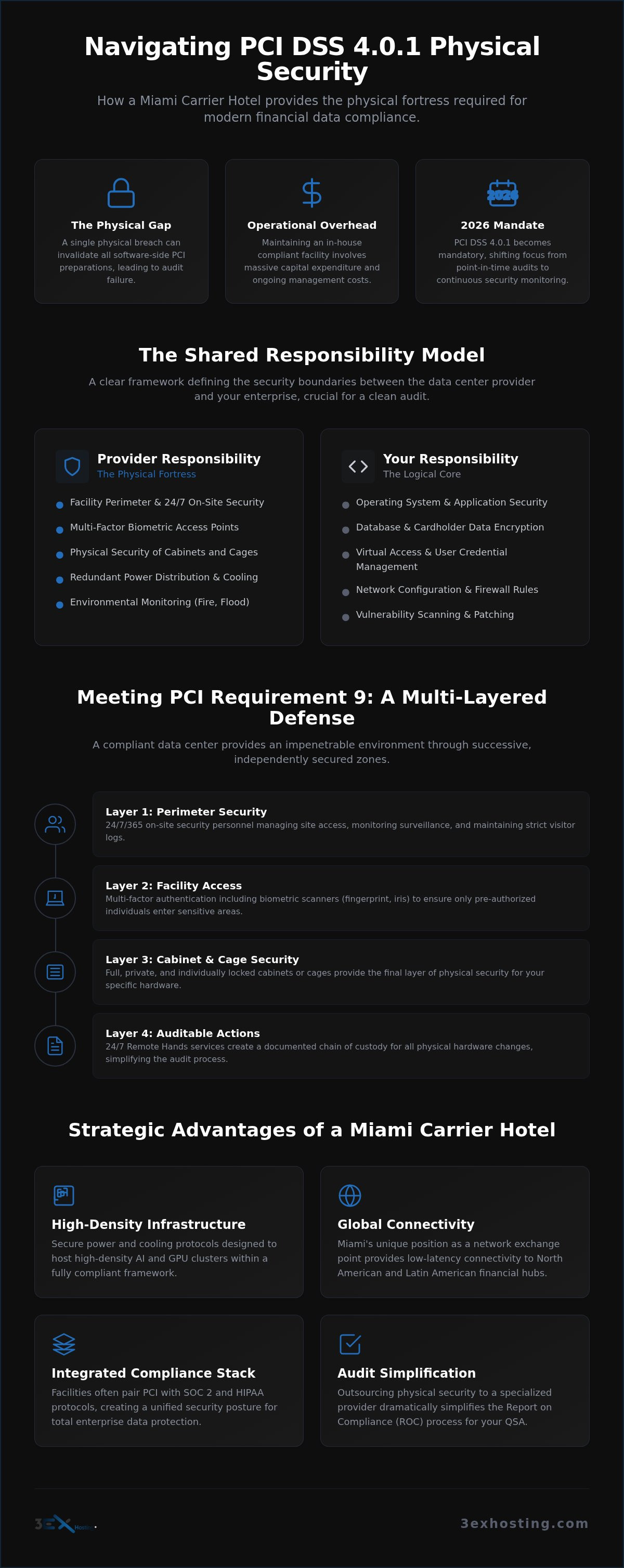
The core of any colocation agreement rests on the Shared Responsibility Model. This framework defines exactly where the provider’s duties end and yours begin. While we maintain the physical fortress, you retain control over the logical environment. Selecting a provider in a strategic carrier hotel ensures that your financial network has the necessary low-latency connectivity to global clearinghouses while remaining anchored in a facility that satisfies the most rigid regulatory demands.
The Evolution of PCI Compliance in 2026
The 4.0 standard has moved the goalposts from static checklists to a model of proactive risk management. In 2026, auditors look for evidence of ongoing compliance, which is why carrier-neutral facilities are increasingly favored for their built-in redundancy. These environments allow for seamless failover, ensuring that a single point of failure doesn’t lead to a security breach or a compliance lapse. For many enterprises, a PCI compliant data center Miami solution is often paired with SOC2 and HIPAA protocols. This “compliance stack” provides a unified security posture that protects sensitive financial data alongside personal health information, creating a total enterprise protection layer that scales with your growth.
Physical vs. Logical Security Boundaries
Understanding the boundaries of responsibility is critical for a clean audit. If you don’t clearly document these lines, you risk an audit failure during the Report on Compliance (ROC) process. The provider manages the “outer shell,” while the tenant manages the “inner core.”
- Provider Responsibility: This includes the facility perimeter, 24/7 on-site security personnel, biometric access points, and the physical security of the cabinet colocation units.
- Tenant Responsibility: You remain responsible for the operating system, application-level security, database encryption, and managing who has virtual access to the hardware.
Requirement 9 serves as the definitive standard for colocation physical security, focusing on the prevention of unauthorized physical access to any system that stores or transmits cardholder data. By placing your hardware in a professional data center, you effectively outsource the most difficult parts of Requirement 9 to experts who specialize in physical sovereignty.
Physical Security: Meeting PCI Requirement 9 in a Carrier Hotel
While logical security protects data in transit, Requirement 9 of the PCI standard mandates that the physical environment is impenetrable. A PCI compliant data center Miami facility must provide more than just a locked door; it requires a multi-layered defense starting at the building perimeter and ending at the individual rack. Meeting the latest PCI DSS 4.0 compliance requirements involves rigorous physical access controls that most in-house server rooms simply can’t match without massive capital expenditure. In a high-traffic carrier hotel, 24/7/365 on-site security personnel act as the first line of defense, managing visitor logs and ensuring that only pre-authorized individuals move past the lobby.
Physical sovereignty in 2026 isn’t just about keeping people out; it’s about documenting exactly who was there and what they touched. This level of transparency is what simplifies the audit process for your QSA (Qualified Security Assessor). By utilizing a professional facility, you offload the burden of maintaining these logs and surveillance systems, allowing your team to focus on core technical operations.
Biometrics and Access Control Systems
Entry into the white space requires multi-factor authentication. We don’t rely on simple key cards that can be lost, cloned, or stolen. Instead, modern facilities utilize iris scanners or fingerprint biometrics at every critical junction. These systems generate granular, timestamped access logs that are automatically archived for compliance reporting. For organizations requiring an extra layer of isolation, cage solutions provide a secondary physical barrier. Within these cages, custom configurations can include dedicated biometric readers for your specific racks, ensuring that even other authorized data center users cannot approach your hardware. This creates a “facility within a facility” that satisfies the most stringent financial audits.
Surveillance and Environmental Monitoring
Video surveillance is a cornerstone of Requirement 9. PCI DSS 4.0.1 mandates a minimum 90-day retention period for all security footage, a standard we strictly uphold. High-definition cameras monitor every entry point, exit point, and individual aisle with overlapping fields of view to eliminate blind spots. This creates a permanent, verifiable audit trail that covers every moment your hardware is in the facility.
Security doesn’t stop during a power event. N+1 power redundancy ensures that surveillance, biometric readers, and electronic locks remain fully operational even if the local grid fails. In Miami, this physical integrity is further bolstered by hurricane-hardened infrastructure. Facilities are designed to withstand Category 5 conditions, protecting the physical hardware from external environmental threats while maintaining the strict access protocols required for compliance. If your enterprise handles high-volume financial transactions, you might consider private colocation suites to achieve the highest level of physical isolation and audit-ready security.
The Role of 24/7 Remote Hands in PCI Compliance Audits
When you operate in a PCI compliant data center Miami facility, the physical handling of your servers is scrutinized as heavily as your firewall settings. Technical staff acting as your “eyes and hands” on-site provide much more than just hardware labor. Their primary value during an audit is the creation of a documented chain of custody. Every time a technician interacts with your gear, whether it’s a simple server reboot or a complex cable swap, a digital record is created. This ensures that no physical change happens in a vacuum, providing auditors with the transparency they demand.
The PCI Security Standards Council emphasizes strict control over physical access to system components. A professional PCI compliant data center Miami provider employs on-site experts who understand these stakes. They handle physical media and hardware changes using specific, audit-ready protocols that mitigate the risk of unauthorized tampering. This level of support is particularly vital for remote teams who cannot be physically present to witness every hardware interaction. Compliance begins on day one with professional move-in assistance, ensuring your racks are configured to enterprise standards before the first packet is ever sent.
Documenting Physical Hardware Interactions
Ticketing systems serve as the definitive “who, what, and when” for PCI auditors. When a remote hands support request is executed, the resulting logs prove that only authorized personnel accessed the hardware. This documentation is critical when handling failed hard drives or other storage media. Technicians follow rigid data destruction or secure storage protocols to ensure cardholder data never leaves the facility in an unencrypted or accessible state. For a deeper look at how these workflows enhance your operational uptime, you can review our Remote Hands Support guide.
Emergency Response and Compliance Continuity
In a crisis, speed often compromises security. However, technicians trained for compliant environments maintain the security perimeter even during emergency hardware failures. They ensure that “quick fixes” don’t bypass biometric checkpoints or skip logging requirements. This level of discipline maintains your compliance continuity 24/7/365, regardless of the situation on the ground. Many enterprises now integrate these physical controls with managed cloud hosting to create a hybrid infrastructure. This approach ensures that your security posture remains consistent across both virtual and physical layers, simplifying the overall audit process for your organization.
Compliance for High-Density AI and GPU Infrastructure
Financial institutions are increasingly integrating large-scale AI models for real-time fraud detection and predictive analytics. These workloads require immense computational power, usually delivered through dense GPU clusters. Managing these systems in a PCI compliant data center Miami facility presents unique engineering challenges. High-density hardware generates significant thermal loads that must be mitigated without breaching the physical security perimeters defined in PCI Requirement 9. We provide the infrastructure to support these AI workloads while maintaining the rigid security standards your auditors expect.
The transition to high-density GPU colocation involves more than just extra cooling. It requires specialized power distribution units (PDUs) with integrated security features. In a compliant environment, these PDUs serve as a monitored endpoint. Secured, metered PDUs prevent unauthorized access to power controls and provide the granular data logs required for thorough compliance reporting. This level of technical oversight ensures that your AI infrastructure remains as secure as your core transaction databases.
Securing the AI Infrastructure Stack
High-value GPU hardware represents a significant capital investment and a potential security target. We recommend housing these assets in private colocation suites to ensure absolute physical isolation. Within these suites, network cross-connects are strictly managed and secured to prevent any data interception between AI nodes and your primary financial records. Thermal management protocols are also a compliance factor. Maintaining optimal temperatures protects hardware longevity and ensures that systems don’t fail during critical processing windows, which could lead to a gap in your continuous compliance monitoring.
Power Density and Redundancy for Financial AI
Financial AI models can’t afford downtime, especially when they’re processing live transactions. N+1 power redundancy is the non-negotiable baseline for AI-driven financial modeling. This ensures that even if a power component fails, the GPU clusters continue to operate within their secure environment. Metered power is used to provide transparent and compliant energy reporting, which is essential for modern enterprise audits. For detailed technical specifications on how we handle these massive power demands, you can refer to our High-Density GPU Colocation guide.
If you’re ready to scale your financial AI workloads in a secure environment, you can request a custom quote for AI GPU hosting today.
Strategic Colocation: Why PCI Compliance Starts with 3EX Hosting
Choosing a PCI compliant data center Miami provider is a strategic decision that affects your long-term operational scalability. As a premier carrier hotel, we offer more than just space and power; we provide a technical partnership designed to simplify your compliance journey. For enterprises requiring total environment control, full cabinet colocation remains the gold standard. It allows you to manage your own internal security protocols within a facility that already meets the most rigid physical standards for 2026. This combination of physical sovereignty and high-performance infrastructure is essential for financial institutions and payment processors.
Miami serves as the critical gateway for both North American and Latin American financial markets. By positioning your hardware here, you gain a low-latency advantage that is impossible to replicate in inland facilities. This strategic location ensures that your compliant infrastructure is perfectly placed to handle international transaction traffic with maximum efficiency. We invite you to get a custom quote today to see how our Miami facility can support your specific enterprise requirements.
Customizable Security Solutions
Every audit is different, and your infrastructure needs to be flexible enough to meet specific auditor requests. While scaling startups often begin with cage colocation to balance cost and security, larger organizations frequently transition to enterprise private suites. These suites provide the ultimate level of isolation, allowing you to implement custom biometric controls and dedicated surveillance that go beyond standard requirements. Our team works directly with your technical staff to ensure that every rack setup is audit-ready from the moment you move in.
The 3EX Hosting Advantage
Stability is the foundation of our service. Our hurricane-hardened facility is engineered to maintain 100% uptime, ensuring that your compliance monitoring never goes dark during a storm. With N+1 power redundancy and 24/7 on-site support, your hardware is protected by experts who understand the nuances of financial data security. We maintain a carrier-neutral environment, which prevents vendor lock-in and allows you to choose the best connectivity providers for your global network. This flexibility is a key component of a resilient, compliant infrastructure strategy. Contact 3EX Hosting today to secure your infrastructure in a facility built for the future of financial technology.
Future-Proofing Your Financial Infrastructure in Miami
Securing mission-critical hardware in 2026 requires a facility that understands the multi-layered requirements of the latest PCI DSS 4.0.1 standards. We’ve explored how a PCI compliant data center Miami environment provides the essential physical foundation for your logical security; from biometric access control to high-density GPU cooling. By offloading Requirement 9 responsibilities to a professional provider, you eliminate the overhead of maintaining in-house compliant rooms while ensuring your audit process remains seamless and documented.
Success in the global financial market depends on infrastructure that scales without compromising security. With our hurricane-hardened carrier hotel, N+1 power redundancy, and 24/7 on-site remote hands, your systems remain audit ready at all times. Whether you’re deploying private suites for maximum sovereignty or scaling AI clusters, the right technical partner makes compliance a competitive advantage rather than a burden. For organizations also managing physical logistics or off-site equipment storage, Atlanta Container & Trailer provides the robust, secure units necessary to protect your hardware assets during transit or expansion. Take the next step in securing your enterprise’s digital future today.
Secure Your Compliant Infrastructure – Get a Quote Today
We’re here to ensure your transition to enterprise-grade compliance is simple, fast, and secure.
Frequently Asked Questions
Is 3EX Hosting a PCI-certified data center?
Our Miami facility is designed to be PCI DSS 4.0 audit-ready, providing the necessary physical security controls required for your certification. We maintain the infrastructure and documentation needed for you to satisfy Requirement 9 of the standard. It’s important to remember that compliance is a shared responsibility; we secure the facility perimeter while you manage the logical security of your data and applications.
What is PCI Requirement 9 and how does it apply to colocation?
Requirement 9 focuses on the prevention of unauthorized physical access to systems that store, process, or transmit cardholder data. In a colocation environment, this applies to the facility’s biometric entry points, 24/7 security staffing, and visitor logging protocols. We handle these rigorous physical standards on your behalf, allowing you to offload the massive operational overhead of maintaining a compliant on-site server room.
Does a PCI-compliant data center protect me from all cyber threats?
No facility can protect against every cyber threat, as PCI compliance specifically targets the protection of cardholder data through specific controls. While we provide a secure physical foundation, you remain responsible for logical security layers like firewall configurations, encryption, and patching. Our role is to ensure no unauthorized person can physically access your hardware, which is a critical component of a multi-layered security strategy.
How long is video surveillance footage kept in a PCI-compliant facility?
We maintain a 90-day minimum retention period for all video surveillance footage, as mandated by the latest PCI DSS standards. High-definition cameras monitor every entry point, exit point, and individual aisle within the facility with overlapping fields of view. This creates a permanent, verifiable audit trail that your Qualified Security Assessor (QSA) can review during your annual Report on Compliance (ROC) assessment.
Can I use a shared cage for PCI-compliant hardware?
You can use shared environments, but private colocation suites are the preferred choice for enterprises seeking a PCI compliant data center Miami solution. Shared spaces require additional internal controls to ensure other tenants cannot approach your specific racks. Private suites or dedicated cages simplify the audit process by providing absolute physical isolation and allowing for custom biometric access logs dedicated solely to your hardware.
What role do remote hands play in my PCI audit?
Remote hands technicians provide a documented chain of custody for every physical interaction with your infrastructure. Our ticketing system records exactly who accessed your equipment and what actions were performed, such as hardware reboots or drive replacements. This digital record is essential for proving to auditors that physical security protocols were strictly followed by authorized personnel 24/7/365, even when your team is off-site.
Does PCI compliance affect the density of my GPU hosting?
Compliance doesn’t limit density, but it requires that the supporting power and cooling infrastructure remain secure and redundant. High-density GPU clusters generate significant heat, and your cooling systems must be N+1 redundant to prevent outages that could trigger a compliance lapse. We use secured, metered PDUs to monitor power usage while maintaining the physical perimeter around your high-value AI hardware in our PCI compliant data center Miami facility.
How does hurricane hardening contribute to PCI compliance?
Hurricane hardening ensures the physical integrity and continuous availability of your security systems during extreme weather. PCI standards require that access controls, such as biometric readers and surveillance cameras, remain fully operational at all times. Our Category 5 rated facility and N+1 power redundancy ensure that your security perimeter remains impenetrable even if the local grid fails, preventing any window of unauthorized access during a storm.