 SUPPORT


 3EX United States
 Blog
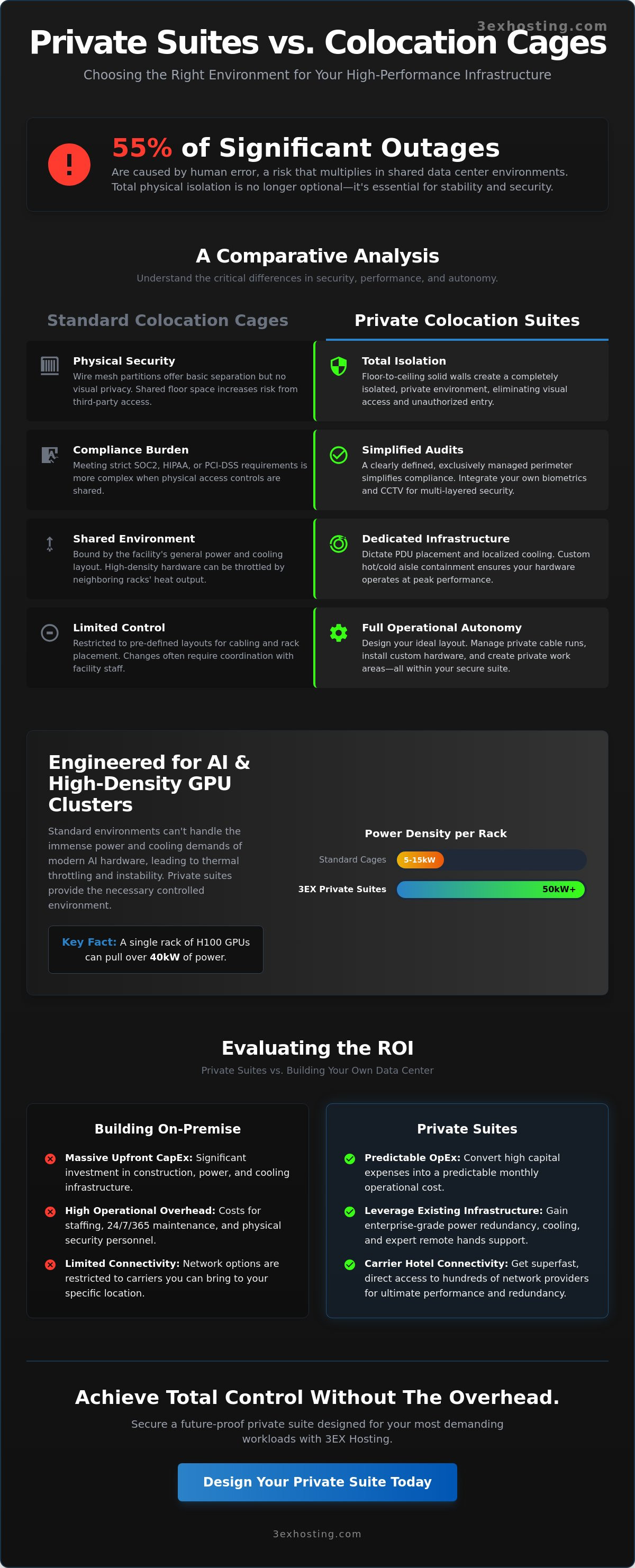
According to the Uptime Institute’s 2023 Annual Outage Analysis, 55% of significant data center outages are caused by human error, a risk that significantly increases in shared environments where third-party contractors access common floor space. You’ve likely felt the tension of balancing strict compliance with the need for high-density hardware. It’s frustrating when you can’t push your GPU clusters to their limit because of power density caps or when you worry about who has physical access to the rack next to yours. You need stability and a professional environment that doesn’t compromise on security.
This guide shows how private colocation suites provide the absolute physical autonomy of an on-premise facility while leveraging the superfast connectivity and enterprise-grade redundancy of a modern carrier hotel. You’ll learn how to secure a future-proof environment for AI and high-performance computing while maintaining predictable operational costs. We’ll break down the technical parameters of dedicated infrastructure to ensure your systems remain stable, secure, and ready for any workload. This is the path to achieving total control over your environmental variables without the overhead of building your own site.
Key Takeaways
- Understand the critical security advantages of floor-to-ceiling partitions over standard mesh cages for meeting strict regulatory compliance.
- Learn how to future-proof your infrastructure with power density standards designed to support 50kW+ per rack for next-generation hardware.
- Analyze the ROI of private colocation suites versus the hidden maintenance and staffing costs of building and operating an on-premise data center.
- Discover how to achieve full operational autonomy through a tailored design process and 24/7/365 expert remote hands support.
What are Private Colocation Suites and Why Do They Matter?
A private colocation suite is a fully enclosed, floor-to-ceiling partitioned environment within a data center. Unlike shared halls or mesh cages, these suites provide a physical perimeter that completely isolates your hardware from other tenants. This setup represents the gold standard for enterprises managing sensitive data or high-performance workloads that require more than just a locked cabinet. You aren’t just renting space in a Colocation centre; you’re securing a dedicated facility designed for total environmental control.
The industry is seeing a massive shift toward private colocation suites as regulatory demands tighten. In 2023, the average cost of a data breach reached $4.45 million globally, forcing enterprises to rethink physical security. For organizations handling healthcare or financial records, meeting SOC2, HIPAA, or PCI-DSS requirements is significantly simpler when you control the entire room. Scaling enterprises move beyond standard cabinets because they need to manage their own cooling, cable runs, and security protocols without interference from neighboring hardware.
Strategic placement within a “Carrier Hotel” adds another layer of value. These suites combine the privacy of a dedicated room with superfast, direct access to hundreds of network providers. It’s a configuration that offers the isolation of an on-premise data center with the massive interconnection options of a global hub.
The Anatomy of a Private Data Center Suite
The physical boundaries of a suite replace standard wire mesh with reinforced, solid walls. This creates a distinct thermal and security zone. Cooling isn’t shared with the rest of the floor; instead, suites feature dedicated vents and private cable runs to prevent cross-talk and unauthorized physical access. Security moves beyond a simple badge reader. Most suites utilize biometric scanners and localized CCTV systems. You can also tailor the interior with private work areas and custom rack layouts to optimize your 2025 infrastructure plans.
Suites as the Foundation for AI and GPU Clusters
Modern AI hardware generates immense heat that standard data center configurations can’t handle. A single rack of H100 GPUs can pull over 40kW of power, requiring specialized airflow management. Private suites allow for precise hot and cold aisle containment within a closed loop. This physical isolation ensures your hardware doesn’t thermal throttle due to the heat output of surrounding racks. It’s the only viable environment for high density GPU colocation where controlling every cubic foot of air is a technical necessity for stability.
Private Suites vs. Colocation Cages: A Comparative Analysis
Choosing between a cage and a suite isn’t just about floor space; it’s about the level of control your IT team requires. Standard cages utilize wire mesh partitions. These provide excellent airflow but offer zero visual privacy. Private colocation suites replace mesh with solid, floor-to-ceiling walls. This physical barrier stops unauthorized eyes from seeing your hardware configurations, cable management, or port connections. It’s a fundamental shift from shared visibility to total environmental isolation.
Operational autonomy also varies significantly between these two options. In a cage, you’re bound by the facility’s general cooling and power distribution layout. Suites grant you the authority to dictate internal PDU placement and localized cooling strategies. You control the environment. This level of customization ensures that high-density clusters get the exact thermal management they need without affecting neighboring tenants.
Security and Privacy Benchmarks
Visual privacy is a non-negotiable requirement for many enterprises handling sensitive intellectual property or high-value financial data. A solid-walled suite prevents “shoulder surfing” and unauthorized photography of equipment labels. When evaluating physical security, organizations often look to Critical Infrastructure Standards to define their internal access policies. Suites simplify physical security compliance audits because the perimeter is clearly defined and exclusively managed. You can integrate your own IP cameras and biometric scanners within the suite, creating a multi-layered security zone that exists independently of the data center’s primary security desk.
Flexibility and Future-Proofing
Scalability in a shared cage is often limited by the proximity of other customers. If you need to expand, you might have to jump to a different row. Modular designs, such as those found in our Private Data Center Suites, allow for “move-in ready” expansion. You can reconfigure rack layouts, install custom cabinets, or add workbenches for on-site technicians without permission from the tenants next door. This setup supports long-term growth by providing a predictable path for hardware refreshes and density increases.
- Cage Colocation: Best for 1-5 racks where budget efficiency is the priority and visual privacy isn’t a regulatory requirement.
- Private Suites: Ideal for 10+ racks, high-compliance industries, or teams requiring dedicated workspace within the data center.
Deciding which path to take depends on your three-year growth projections and compliance framework. If your current trajectory suggests a need for dedicated infrastructure and custom security protocols, it’s time to request a custom suite consultation to lock in your dedicated footprint. For organizations still evaluating whether to start with enclosures before graduating to full suites, our detailed breakdown of cage solutions datacenter implementation strategies for 2026 provides a clear roadmap for designing, securing, and scaling custom enclosures. For a deeper technical breakdown of how enterprise private suites deliver colocation sovereignty for high-density workloads, our 2026 guide covers the full architecture in detail.
Critical Infrastructure Standards for Private Suites
Modern private colocation suites must accommodate the rapid shift toward high-density computing. By 2026, enterprise hardware for AI and machine learning will regularly demand between 20kW and 50kW per rack. This power density requires specialized cooling strategies, such as rear-door heat exchangers or liquid-to-chip systems, alongside traditional N+1 or 2N climate control. Humidity levels must stay within the ASHRAE A1 to A4 standards to prevent electrostatic discharge or hardware corrosion. Fire suppression in these dedicated spaces utilizes pre-action pipes or clean agent systems like Novec 1230, which extinguish fires without damaging sensitive electronics. These systems ensure that a localized incident doesn’t compromise the entire data center’s integrity.
Security and environmental monitoring are equally vital. Facilities should provide 24/7 biometric access and individual cage or suite-level surveillance. Environmental sensors track temperature and airflow at the rack level, providing real-time data to prevent hot spots. This level of granular control is what separates a standard cage from a professional suite environment. Enterprises that prioritize these standards see a 25% reduction in hardware failure rates over a five-year lifecycle.
Reliability and Redundancy Architecture
Redundancy defines the stability of any enterprise environment. An N+1 power configuration ensures that even if a single UPS or generator fails, the system continues to operate at full capacity. Connectivity follows a similar logic through diverse fiber entry points. These physical paths prevent a single trench cut from taking the entire suite offline. Concurrently maintainable infrastructure allows for any component to be removed from service for planned maintenance or testing without impacting the critical load of the suite. This architecture supports 99.999% uptime requirements for mission-critical workloads that can’t afford a single second of downtime.
Interconnection and Superfast Networking
Performance depends on how quickly data moves between systems. A private colocation suite in a carrier-neutral facility provides access to a vast ecosystem of cross-connect services. By utilizing these direct links, enterprises bypass the public internet to reach cloud providers and peering partners with sub-millisecond latency. High-tier facilities often function as carrier hotels, reducing network hops for national data distribution. Direct cloud on-ramps allow for seamless integration between private hardware and hybrid cloud environments, ensuring superfast data transfers and consistent bandwidth. This connectivity model reduces egress costs by up to 30% compared to standard internet-based cloud connections.
- Direct Cross-Connects: Dedicated physical links to 100+ network providers.
- Peering Exchanges: Access to local and international traffic exchange points.
- Hybrid Integration: Low-latency bridges to AWS, Azure, and Google Cloud.
Evaluating the ROI: Private Suites vs. Building Your Own Data Center
Deciding between building an on-premise facility and utilizing private colocation suites often comes down to how a business manages its capital. Constructing a private data center requires a massive Capital Expenditure (CapEx) that ties up liquidity for years. According to 2023 data from the Uptime Institute, building a Tier III-compliant facility can cost over $12,000 per kilowatt of IT load. This doesn’t include the price of land or ongoing property taxes. Choosing a private suite transitions these heavy upfront costs into a predictable Operational Expenditure (OpEx) model, allowing you to scale without the initial multi-million dollar hit.
The hidden costs of on-premise management frequently surprise enterprise leaders. Maintaining specialized HVAC systems, upgrading power grids to handle high-density hardware, and hiring 24/7 security personnel add layers of complexity. It’s not just about the hardware; it’s about the people. Statistics show that nearly 70% of data center outages result from human error. By leveraging a professional provider’s 24/7 technical expertise, you mitigate these risks. You gain a team of specialists who live and breathe infrastructure, ensuring your systems remain stable while you focus on growth.
Time-to-market is another critical differentiator. A ground-up data center build typically takes 12 to 18 months from planning to commissioning. In a fast-moving digital economy, that delay is a competitive liability. We offer a superfast transition, where a dedicated suite can be fully operational within 30 days. This agility allows your business to deploy new services and respond to market demands almost instantly.
The Economics of Scale in Colocation
Professional facilities operate on a scale that individual enterprises can’t match. We leverage massive power purchasing agreements to reduce the per-kilowatt cost for every tenant. You benefit from industrial-grade cooling and redundant power architectures that are cost-prohibitive for most single-user builds. Our billing models are transparent. You can manage power and cooling costs without the shock of unexpected repair bills or utility spikes. We back this with 100% uptime SLAs, providing the technical certainty your stakeholders demand.
Strategic Focus: IT Innovation vs. Facility Management
Your IT team’s value lies in developing core business applications, not troubleshooting a failing chiller unit. Outsourcing the “ping, power, and pipe” allows your best minds to innovate. Integrating remote hands support into your strategy further optimizes efficiency by reducing travel costs and onsite maintenance hours. This approach ensures business continuity through built-in disaster recovery features and 24/7 monitoring. It’s a move toward a more modern, efficient, and resilient infrastructure model.
Implementing Your Dedicated Infrastructure with 3EX Hosting
Transitioning to private colocation suites requires more than just square footage. It demands a partnership built on technical precision and operational reliability. 3EX Hosting provides a tailored design process where every detail, from redundant power circuits to biometric security protocols, aligns with your specific enterprise requirements. We don’t offer generic, one-size-fits-all solutions. Instead, we build stable, high-performance environments that serve as the foundation for your mission-critical data. Our national reach ensures that your infrastructure remains resilient across multiple geographic hubs, providing the low-latency connectivity your users expect.
Managed Deployment and Support
Deploying complex hardware shouldn’t result in extended downtime or service interruptions. Our team provides white-glove move-in assistance to manage the intricate logistics of hardware migration. This service handles the physical heavy lifting, allowing your internal engineers to focus on software configuration and network logic. Once your equipment is racked and stacked, 3EX Hosting serves as a seamless extension of your IT department. By integrating Remote Hands, you gain instant access to on-site technicians who manage hardware swaps, cabling, and physical troubleshooting. 3EX Hosting offers 24/7 technical expertise for all suite clients. This means a qualified professional is always available to interact with your gear. This immediate response capability is vital for maintaining the high availability standards that modern enterprises demand.
Get Started with Your Private Suite
The path to a dedicated environment begins with a thorough consultation. We start with capacity planning to determine your current power draw and future growth projections. Our engineers then move to the final build-out stage, where we configure the cooling, power distribution, and security access of your private colocation suites. This structured approach eliminates the guesswork from infrastructure scaling. We focus on creating a superfast environment where your hardware can perform at its peak without thermal throttling or power constraints. You can request a custom quote to receive a detailed breakdown based on your specific density needs and space requirements. Secure your infrastructure with 3EX Hosting’s private colocation suites today to ensure your enterprise data remains fast, stable, and protected.
Secure Your Enterprise Future with Dedicated Infrastructure
Choosing the right data center model defines your operational resilience for the next decade. private colocation suites offer the physical security of a standalone facility without the massive capital expenditure required to build from scratch. You gain total control over your environment while offloading the high costs of facility management. It’s the most efficient way to scale without compromising on privacy or compliance standards.
Reliability depends on the underlying architecture. Our facility utilizes an N+1 redundant power and cooling architecture to ensure your hardware stays online during any component failure. We maintain a carrier-neutral facility with superfast cross-connects to provide the low-latency connectivity your applications demand. If an issue arises at 3:00 AM, our 24/7/365 On-site Remote Hands Support is ready to assist immediately. You don’t have to worry about uptime when the foundation is built on technical excellence.
Design your custom private colocation suite with 3EX Hosting
Your infrastructure deserves a partner that prioritizes stability and speed. Let’s build a foundation that supports your growth today and tomorrow.
Frequently Asked Questions
What is the minimum power density available in a private colocation suite?
Standard private colocation suites typically require a minimum power density of 5kW per rack to ensure efficient cooling and power distribution. Most enterprise-grade facilities design these spaces to support 10kW to 15kW as a baseline for modern server hardware. This prevents hotspots and ensures your hardware runs at peak performance without thermal throttling. It’s a stable foundation for scaling your infrastructure as your power needs grow over time.
How long does it typically take to deploy a custom private suite?
You can expect a custom private suite deployment to take between 4 and 12 weeks from the final design approval. This timeline accounts for physical partition installation, dedicated power circuit routing, and carrier-neutral cross-connect setup. If your configuration requires specialized cooling or custom floor loading, the process might extend toward the 90-day mark to meet exact engineering specifications. We prioritize speed without compromising the structural integrity of your build.
Can I install my own security cameras and biometric access in my suite?
You have the right to install independent security cameras and biometric access controls within your private colocation suites. Providers typically offer 24/7/365 access to your dedicated space while allowing you to integrate your own logging systems. This ensures your internal compliance team has direct oversight of every entry event without relying solely on the data center’s general security logs. It’s a professional way to maintain total control over your physical hardware assets.
Is a private colocation suite more expensive than a cage?
Private colocation suites generally carry a higher price point than standard cages due to the added construction of full-height walls and dedicated cooling zones. While a cage uses shared airflow and wire mesh, a suite provides a physical perimeter that enhances acoustic dampening and thermal isolation. You’re investing in a 100% private environment that eliminates the risks associated with shared floor space. This setup is the gold standard for enterprises requiring maximum security. For enterprises evaluating whether to start with an intermediate approach, understanding how to properly implement enterprise cage solutions in a datacenter environment can help you benchmark the cost-to-security ratio before committing to a full suite build-out.
What kind of fire suppression is used in dedicated enterprise suites?
Dedicated enterprise suites utilize dual-interlock pre-action dry pipe systems or clean agent suppression like Novec 1230. These systems prevent accidental water discharge by requiring two independent triggers before activation. Clean agents are preferred for high-value hardware because they extinguish fires by removing heat without leaving residue or damaging sensitive electronics. Your equipment stays dry and functional even if a fire occurs elsewhere in the building, ensuring your business continuity remains intact.
How does remote hands support work for a private, locked suite?
Remote hands support works through a strictly managed key escrow system or pre-authorized access lists you provide to the facility. When you request a reboot or cable swap, technicians use a logged physical key or biometric override to enter your locked suite. Every action is recorded on video, and most providers deliver a timestamped report within 15 minutes of task completion. You’ll get the support you need without sacrificing the privacy of your dedicated environment.
Are private suites available for high-density GPU and AI clusters?
Private suites are ideal for high-density GPU and AI clusters that require 30kW to 50kW per rack. These spaces support advanced cooling technologies like rear-door heat exchangers or direct-to-chip liquid cooling. By isolating these high-heat loads in a dedicated room, the facility manages airflow more effectively, ensuring your AI training models don’t suffer from performance dips. It’s the most reliable way to house the latest hardware from manufacturers like NVIDIA or AMD.
What certifications should I look for in a private suite provider?
Look for providers maintaining SOC 2 Type II and ISO 27001 certifications to ensure rigorous operational and security standards. If you handle financial or healthcare data, verify they have PCI DSS and HIPAA compliance audits completed within the last 12 months. These third-party validations prove the facility meets the 99.999% uptime and physical security requirements necessary for mission-critical enterprise infrastructure. Choosing a certified provider reduces your risk and simplifies your own internal auditing processes.