 SUPPORT


 3EX United States
 Blog
In 2026, your data center’s physical location is the primary factor determining whether your AI models scale or stall. If you’re struggling with high latency for South American traffic or racks that can’t handle the 20kW power demands of modern GPU clusters, you’re not alone. Managing hardware remotely while ensuring 100% uptime feels like a constant uphill battle. Securing reliable rack colocation miami is no longer just about finding a place for your servers; it’s about strategic positioning within a high-density, carrier-neutral ecosystem.
We understand that technical stability and speed are your top priorities. This guide demonstrates how to leverage high-density infrastructure at a premier carrier hotel to achieve sub-millisecond latency and enterprise-grade scalability. You’ll learn how to secure a full cabinet that meets 2026 power standards while ensuring 24/7 technical support for all hardware maintenance. We’ll also cover the essentials of high-speed cross-connectivity and how to navigate Florida’s evolving data center regulations to keep your operations secure and compliant.
Key Takeaways
- Understand why a carrier-neutral facility is the essential foundation for sub-millisecond latency and national network redundancy.
- Identify the specific power density and cooling requirements needed to sustain high-performance AI and GPU clusters in 2026.
- Compare the security and operational advantages of a dedicated full cabinet versus shared rack colocation miami environments.
- Learn how 24/7 remote hands services streamline hardware maintenance and audits without requiring on-site staff.
- Discover how to transition from individual racks to private colocation suites to support long-term enterprise scalability.
Understanding the Strategic Value of Rack Colocation in Miami
Rack colocation serves as the architectural foundation for enterprise IT scalability. It involves housing your proprietary hardware in a third-party colocation centre to leverage industrial-grade power, cooling, and physical security. Unlike resold or “virtual” presence solutions, direct physical ownership within a primary carrier hotel ensures your infrastructure remains under your control while benefiting from a massive connectivity ecosystem. This strategic placement is essential for business continuity. It isolates your hardware from local office outages and provides the N+1 redundancy protocols necessary for 24/7 operations.
The Role of Carrier-Neutral Interconnection
Vendor neutrality is a non-negotiable requirement for modern enterprises. A carrier-neutral facility allows you to choose from dozens of telecommunications providers rather than being restricted to a single ISP. This flexibility prevents provider lock-in and enables you to negotiate better rates and service levels. Diverse fiber entry points further bolster uptime by ensuring that a single line cut doesn’t take your entire operation offline. Cross-connect services serve as the high-speed backbone of low-latency networking by facilitating direct, physical links between your equipment and your chosen carriers.
Miami as a Global Connectivity Gateway
Miami’s geographic position makes it the primary hub for data traffic moving between North America, Latin America, and Europe. By utilizing rack colocation miami, enterprises can capitalize on proximity to major subsea cable landings. This physical closeness significantly reduces international hop counts and minimizes signal degradation. While some providers claim a Miami presence through virtualized dark fiber links from distant cities, these can’t match the sub-millisecond latency of a physical footprint in a local carrier hotel. Having your gear where the cables actually meet the shore is the only way to guarantee the speed required for real-time applications and high-frequency data exchange. Strategic placement in a data center Miami facility ensures your systems are resilient against regional disruptions while maintaining peak performance for global users.
High-Density Infrastructure: Power and Cooling for AI Workloads
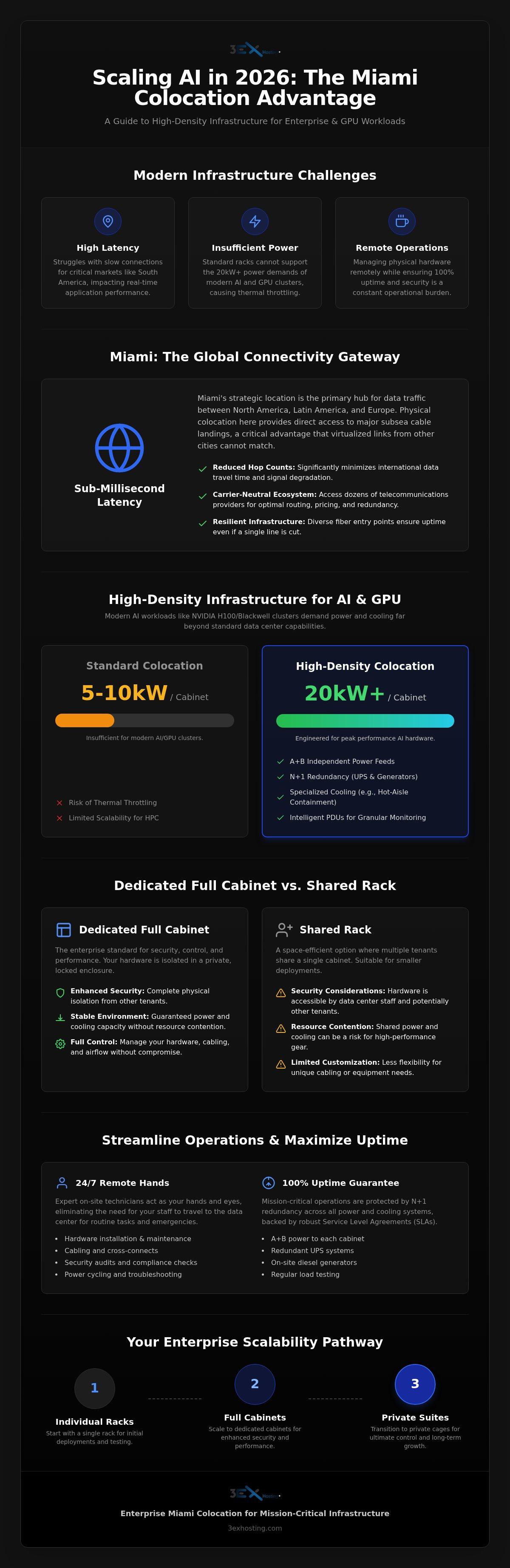
Standard rack deployments often cap at 5kW or 10kW per cabinet. This is no longer sufficient for 2026 AI workloads. Modern GPU clusters require significantly higher power density, often exceeding 20kW per rack. Achieving this requires a facility designed specifically for high-performance computing (HPC). When evaluating rack colocation miami, you must look beyond floor space. You need a partner capable of delivering the thermal management and electrical overhead required by NVIDIA H100 or Blackwell architectures. Large-scale infrastructure strategies, similar to those outlined in the Data Center Optimization Initiative, emphasize the need for efficient power utilization to sustain growth. High-density environments demand specialized cooling solutions, such as hot-aisle containment or liquid-to-chip systems, to prevent thermal throttling. Without these, your expensive hardware won’t perform at its rated capacity.
Optimizing for GPU Server Hosting
AI infrastructure hosting presents unique thermal challenges. GPU servers generate intense, concentrated heat that standard perimeter cooling can’t always dissipate. You need rack-level airflow optimization and intelligent Power Distribution Units (PDUs). These PDUs must handle high-amperage draws while providing granular monitoring at the outlet level. This allows technicians to identify power spikes before they trigger a breaker. For a deeper technical dive, consult our High-Density GPU Colocation guide. It details how we manage the specific electrical and thermal profiles of next-generation AI hardware.
Redundancy and Uptime in High-Density Environments
Mission-critical loads require absolute electrical stability. We utilize A+B power feeds to ensure that your hardware has two independent paths to the power source. If one circuit fails, the other maintains the load without interruption. This is backed by N+1 redundancy across all UPS systems and on-site diesel generators. These systems are tested under load to guarantee 100% uptime during utility outages. Power Usage Effectiveness (PUE) impacts your long-term operational costs by determining how much energy is actually reaching your servers versus being lost to cooling or conversion. If you’re planning a high-density deployment, you can request a custom quote to see how our rack colocation miami facility supports enterprise-grade AI workloads.
Comparing Full Cabinet vs. Shared Rack Colocation
Selecting the right deployment model is a critical decision for IT directors. Shared racks offer a low entry point for small-scale operations, but they introduce operational risks that enterprises can’t afford. In a shared environment, your hardware sits alongside other tenants’ equipment. This increases the risk of accidental cable disconnection or human error during third-party maintenance. For enterprise-grade rack colocation miami, a full cabinet is the standard for operational integrity. It provides a dedicated power circuit and isolated airflow. This ensures your high-density workloads don’t impact or get impacted by neighboring hardware.
The Benefits of Full Cabinet Sovereignty
Physical security is the primary driver for moving to a dedicated setup. A dedicated cabinet allows you to implement your own lock standards and access logs. You can also customize internal cable management to improve airflow and reduce mean time to repair (MTTR). For companies with specific hardware requirements, Full Cabinet Colocation offers the flexibility to install custom shelving or specific PDU orientations that shared racks simply cannot accommodate. This level of control is vital for maintaining the technical stability required in modern data environments.
Selecting Between Cages and Private Suites
As your infrastructure grows, even a single cabinet might become a bottleneck. Cage solutions provide a physical perimeter around multiple racks. This adds a layer of security essential for HIPAA or PCI-DSS compliance. When your deployment reaches a scale where you require dedicated cooling zones or private workspace for on-site staff, Private Colocation Suites become the logical next step. These suites offer the highest level of future-proofing. They allow for rapid hardware expansion without the constraints of a shared data center floor.
Total Cost of Ownership (TCO) often favors the full cabinet model once you exceed 10 rack units. While the initial monthly commitment is higher, the cost per rack unit drops significantly. You also eliminate the hidden costs of shared environments, such as the increased risk of downtime due to third-party proximity. Investing in a full rack colocation miami deployment ensures that your infrastructure costs remain predictable as your data processing needs scale toward 2027. This strategic move provides the megbízhatóság and stability your enterprise requires for long-term success.
Operational Efficiency Through Managed Remote Hands
For national enterprises, the primary obstacle to rack colocation miami is the geographical distance between the IT team and the physical hardware. Sending a senior engineer across the country for a simple power cycle or a cable swap is a massive drain on company resources. Managed remote hands services bridge this gap. They provide on-site technicians who act as your eyes and ears on the data center floor. These experts handle essential tasks including physical reboots, cable management, and hardware audits. By leveraging local expertise, you eliminate travel costs and ensure that your infrastructure is managed by professionals who understand the specific layout of the carrier hotel.
Response times are the lifeblood of enterprise uptime. Service Level Agreements (SLAs) define exactly how quickly a technician will respond to your ticket. In a mission-critical environment, you can’t afford to wait hours for a physical intervention. Professional 24/7 support means that whether it’s 2 PM or 2 AM, an on-site expert is ready to troubleshoot your equipment. This level of responsiveness is vital for maintaining the technical stability that global users expect.
Maximizing Uptime with On-Site Expertise
Proactive infrastructure management prevents outages before they happen. Technicians perform regular thermal scans and cable integrity checks to ensure your high-density environment remains stable. They also manage port mapping and labeling, which is crucial for remote troubleshooting. Our Remote Hands Support guide provides a comprehensive look at how these protocols maintain site-wide efficiency. Proactive inventory management ensures that you always know exactly what hardware is in your rack and where it’s connected.
Deployment and Move-In Assistance
The transition to a new facility is often the most labor-intensive phase of a deployment. Utilizing Move-In Assistance streamlines this process. You can ship your hardware directly to the Miami facility, where on-site staff will unbox and inventory every component. Professional rack-and-stack services ensure that your servers are installed according to your exact specifications and thermal requirements. This professional handling is especially important for sensitive GPU hardware that requires precise airflow management. The ROI of remote hands is best measured as a direct reduction in Mean Time to Repair (MTTR).
If you need expert support for your Miami deployment, explore our Remote Hands solutions to ensure your hardware stays online and optimized.
Scaling with 3EX Hosting: Enterprise Miami Colocation
3EX Hosting provides enterprise-grade infrastructure within one of the most interconnected carrier hotels in the United States. Unlike competitors that offer virtualized presence or resold space, 3EX maintains direct physical control over the environment. This ensures that when you secure rack colocation miami, you’re getting the technical excellence of a facility designed for maximum throughput and redundancy. Our facility is a strategic hub for global data exchange, offering the stability and speed required for the most demanding digital operations.
We provide a range of options from individual full cabinets to large-scale Private Colocation Suites. Each deployment is tailored to your specific power and network requirements. For mission-critical workloads, 3EX offers a 100% uptime guarantee. This is supported by N+1 power redundancy protocols and a robust cooling infrastructure that manages the thermal output of high-density AI and GPU clusters. Our goal is to provide a stable technical foundation so you can focus on your core business goals without worrying about hardware availability.
Enterprise Disaster Recovery Integration
Technical stability isn’t just about current performance; it’s about long-term resilience. 3EX Hosting integrates colocation with advanced Disaster Recovery Solutions to protect your data against regional disruptions. By utilizing our cross-connect services, enterprises can achieve real-time data replication between physical hardware and managed cloud environments. This hybrid approach ensures that your business continuity plan is both robust and geographically diverse. Local and cloud-based backups provide multiple recovery points. This allows for rapid restoration of services and maintains data integrity across your entire network.
Requesting a Custom Colocation Quote
Every enterprise deployment has unique technical parameters. Our consultation process begins with a detailed evaluation of your current and future power density needs. If you’re planning for high-density AI or GPU workloads, we analyze your thermal management requirements and network hop counts to ensure optimal performance. This data-driven approach removes the guesswork from infrastructure planning. You can Get a custom rack colocation quote today to begin tailoring a solution that fits your strategic goals for 2026. Our team of experts is ready to help you navigate the complexities of power allocation and global connectivity to ensure your systems remain secure, fast, and scalable.
Future-Proofing Your Digital Infrastructure
Success in 2026 depends on your ability to scale infrastructure without compromising on speed or security. Strategic rack colocation miami placement provides the direct access to global carrier ecosystems necessary for sub-millisecond latency. By prioritizing high-density capabilities and cabinet sovereignty, you ensure your hardware is ready for the intense power demands of next-generation AI workloads. You don’t have to manage these technical complexities alone. Leveraging professional on-site expertise allows your team to focus on innovation while your physical systems remain in expert hands.
3EX Hosting provides the technical stability your enterprise requires. With N+1 power redundancy protocols and 24/7 on-site remote hands support, your mission-critical data is always protected. Our facility offers the high-density cooling and connectivity you need to maintain a competitive edge in an increasingly data-driven market. It’s time to move beyond standard floor space and invest in a strategic partnership that grows with your business.
Request a Custom Rack Colocation Quote today to optimize your infrastructure for the year ahead. We’re ready to help you build a resilient, high-performance foundation for your future growth.
Frequently Asked Questions
What is the difference between a standard data center and a carrier hotel?
A carrier hotel is a highly interconnected facility where multiple telecommunications providers maintain a physical presence to exchange traffic. While a standard data center may only offer a few ISP choices, a carrier hotel provides direct access to hundreds of networks and subsea cable landings. This density of providers ensures maximum network redundancy and significantly lower latency for global data exchange. It’s the preferred choice for enterprises requiring diverse fiber entry points and vendor neutrality.
How does rack colocation in Miami benefit international businesses?
Businesses with global operations use rack colocation miami to capitalize on the city’s role as a gateway between North America, Latin America, and Europe. This geographic positioning reduces international hop counts and minimizes signal degradation for real-time applications. By placing hardware at the intersection of major subsea cables, international firms achieve sub-millisecond latency that virtualized dark fiber links can’t replicate. It provides a stable technical foundation for high-frequency data exchange across continents.
What power density can 3EX Hosting support for GPU server hosting?
We specialize in high-density infrastructure designed to sustain the intense electrical and thermal demands of modern GPU clusters. While standard facilities often cap power at 5kW or 10kW per rack, our Miami facility supports deployments exceeding 20kW per cabinet. This is achieved through N+1 power redundancy protocols and advanced cooling strategies like hot-aisle containment. These specialized configurations prevent thermal throttling and ensure your AI hardware performs at its maximum rated capacity.
Do you provide 24/7 remote hands support for hardware troubleshooting?
Yes, 3EX Hosting provides 24/7 on-site remote hands support to handle mission-critical hardware tasks at any hour. Our technicians act as your local eyes and ears, performing physical reboots, cable management, and hardware audits. This service is essential for national enterprises that need to reduce their Mean Time to Repair (MTTR) without sending staff to the facility. Having expert on-site management ensures that hardware troubleshooting is handled according to strict enterprise protocols.
What are the security standards for your private colocation suites?
Private colocation suites offer the highest level of physical security and access control within the data center. Each suite features a dedicated physical perimeter and customizable lock standards to meet stringent enterprise compliance requirements like HIPAA or PCI-DSS. Access logs are maintained for every entry, and the suites are isolated from the general colocation floor traffic. This setup provides the cabinet sovereignty and environmental control necessary for managing sensitive hardware and proprietary data.
How do cross-connect services improve network performance?
Cross-connect services provide direct, physical fiber or copper links between your equipment and your chosen carriers or service providers. By bypassing the public internet, these connections eliminate the congestion and variability that cause high latency. This is the high-speed backbone of low-latency networking, ensuring that data travels the shortest possible physical distance. Enterprises use cross-connects to achieve predictable network performance and secure, private data exchange with cloud providers and financial hubs.
What is included in the move-in assistance for new full cabinets?
Move-in assistance is designed to streamline the transition of your hardware into our facility. Our on-site staff handles unboxing, inventory logging, and professional rack-and-stack services according to your exact thermal and electrical specifications. This service ensures that your full rack colocation miami deployment is correctly configured from day one. By outsourcing the physical labor of the initial setup, your IT team can focus on the logical configuration and software deployment of your systems.
Can I integrate managed cloud hosting with my physical colocation rack?
You can easily integrate managed cloud hosting with your physical colocation rack to create a robust hybrid infrastructure. We facilitate this through high-speed cross-connect services that allow for real-time data replication between your hardware and the cloud environment. This integration is a key component of a resilient disaster recovery plan, providing multiple recovery points and high availability. It allows your enterprise to combine the control of physical hardware with the scalability of managed cloud services.