 SUPPORT


 3EX United States
 Blog
Imagine your enterprise scaling a massive AI workload only to hit a wall because your data center can’t provide the 30kW per rack your GPUs demand. For many organizations, the bottleneck isn’t the software; it’s the physical connectivity. Choosing the right carrier hotel Miami is no longer just about finding floor space. It’s about securing a strategic gateway that bridges North American innovation with European and Latin American markets. You need a facility that eliminates the high latency barriers to São Paulo while offering the power density required for modern compute.
You likely already know that vendor lock-in and rigid power tiers are the biggest threats to your infrastructure’s agility. We understand that technical stability and speed are the foundations of your success. This guide explores how a Miami carrier hotel provides the carrier-neutral flexibility and high-density colocation necessary for 2026’s demands. We’ll examine the shift toward specialized GPU hosting, the impact of Florida’s latest data center energy regulations, and how to build a network that scales without compromise.
Key Takeaways
- Understand why Miami’s “Gateway of the Americas” status offers unmatched sub-100ms latency to major international markets like São Paulo.
- Learn how to evaluate N+1 power redundancy and high-density cooling systems to support the 30kW-per-rack requirements of modern GPU server clusters.
- Discover why a carrier-neutral carrier hotel Miami is essential for preventing vendor lock-in and reducing network transit costs through competitive ISP access.
- Identify the technical specifications needed for AI infrastructure, including floor load capacity and specialized cooling for high-performance compute.
- See how 24/7 Remote Hands support provides an essential layer of security and operational continuity for national enterprises managing remote hardware.
What is a Carrier Hotel and Why is the Miami Hub Critical?
A carrier hotel is a highly specialized facility where multiple network service providers, internet service providers (ISPs), and content delivery networks (CDNs) house their physical hardware. Instead of data traveling across hundreds of miles of public infrastructure to reach a partner network, it moves across a single fiber optic cross-connect. This centralized environment allows enterprises to bypass third-party intermediaries and keep traffic local and direct. A What is a Carrier Hotel is essentially the physical foundation of the global internet, providing the space and power for diverse networks to meet.
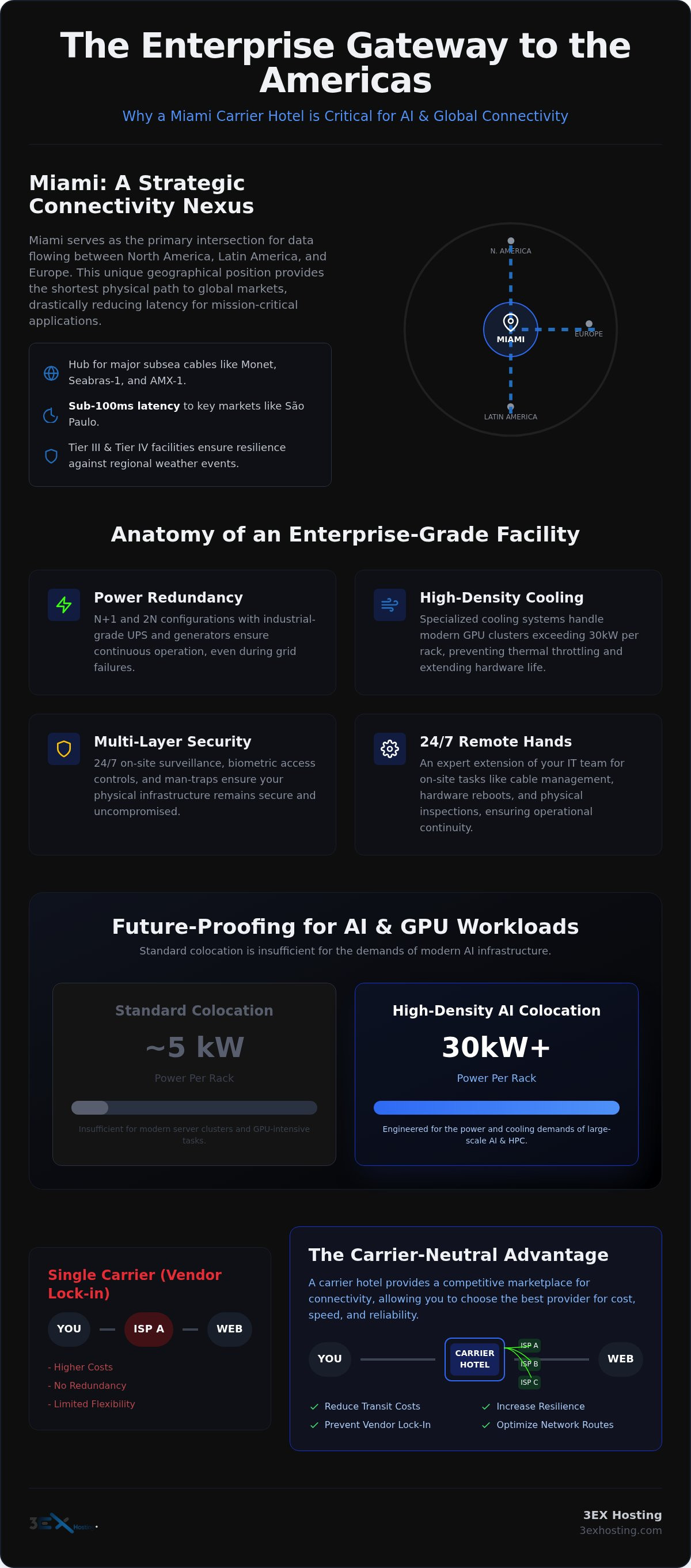
Miami holds a unique position in this global infrastructure. Often called the “Gateway of the Americas,” it serves as the primary intersection for data flowing between the United States, Latin America, and Europe. For any enterprise managing high-density AI workloads or large-scale international traffic, a carrier hotel Miami provides the shortest physical path to global markets. This proximity isn’t just about convenience; it’s about the physics of speed and the reduction of latency for sensitive applications.
The Evolution of Interconnection in Major Markets
Carrier hotels have undergone a massive transformation over the last two decades. Originally, these facilities were simple central offices owned by a single telecommunications monopoly. They’ve evolved into high-density data centers that prioritize enterprise resilience and carrier-neutrality. This shift ensures you aren’t locked into one provider’s pricing or performance limitations. Instead, you can switch between dozens of carriers to find the most efficient route for your specific traffic. A carrier hotel is a physical location where diverse networks interconnect to maximize speed and minimize costs.
Miami as a Strategic Nexus for National Enterprises
National companies don’t just use South Florida for regional reach. They treat Miami as a primary hub or a secondary failover location for their entire national network. This strategy relies on the city’s massive subsea cable infrastructure. Cables such as Monet, Seabras-1, and AMX-1 land here, providing direct links to international economic centers. Because Florida is prone to tropical weather, enterprise-grade facilities must adhere to strict standards. Tier III or Tier IV ratings are non-negotiable for mission-critical continuity. These facilities provide the structural integrity and redundant power systems needed to stay online when the local grid fails. A carrier hotel Miami ensures that your global connectivity remains stable, regardless of local environmental factors or regional power issues.
Anatomy of an Enterprise Carrier Hotel: Power, Cooling, and Security
A world-class carrier hotel Miami provides more than just rack space. It offers the physical resilience required for mission-critical continuity. For enterprises, this starts with power redundancy. Facilities typically offer N+1 or 2N configurations. N+1 ensures that if a single power component fails, a backup is ready to take the load. 2N provides two completely independent power systems, offering the highest level of protection against grid failure. These systems are backed by industrial-grade generators and Uninterruptible Power Supply (UPS) units to bridge the gap during transitions.
High-density cooling is equally vital. Modern GPU clusters for AI training generate heat far beyond the capacity of traditional data centers. In 2026, cooling systems must handle deployments exceeding 30kW per rack. Without precise climate control, hardware lifespan shortens and performance throttles. Advanced facilities use hot and cold aisle containment to maximize efficiency and maintain stable operating temperatures for sensitive hardware.
Security is managed through multi-layer protocols. This includes 24/7 on-site surveillance, biometric access points, and man-traps to prevent unauthorized tailgating. These physical safeguards ensure that only verified personnel interact with the infrastructure. For national enterprises that aren’t physically present in Florida, Remote Hands Support acts as a professional extension of their internal IT team. This service handles everything from cable management to hardware reboots at any hour of the day.
Power Density: Beyond the Standard Rack
Standard colocation often caps power at 5kW per rack, which is insufficient for enterprise-grade server clusters. Modern facilities offer high-density power options to support intensive compute requirements. Transparency is maintained through metered power billing. This allows you to pay only for the energy your equipment actually consumes. Learn more about Full Cabinet Colocation specs to see how these power tiers support scalable growth.
The Meet-Me Room (MMR): Where Connectivity Happens
The Meet-Me Room is the nervous system of the carrier hotel Miami. It’s a dedicated, highly secure space where different carriers and customers physically connect their networks. Diverse fiber entry points are a standard requirement here. By bringing fiber in through different physical locations in the building, the facility prevents a single accidental cut from taking down your entire network. This infrastructure is essential for the low-latency cross-connects that power financial trading and real-time AI inference.
The Carrier-Neutral Advantage: ROI and Network Resilience
Carrier neutrality is a core requirement for any enterprise seeking long-term network flexibility. In a carrier-neutral carrier hotel Miami, the facility owner doesn’t force you to use a specific internet service provider. Instead, you have the freedom to choose from dozens of local and international carriers. This environment prevents vendor lock-in, where a single provider’s price hikes or service degradations could trap your operations. You maintain complete control over your network pathing and cost structures.
Competition works in your favor within these hubs. When multiple ISPs operate under one roof, they must compete for your business. This naturally drives down transit costs and encourages better service level agreements (SLAs). You can leverage this competition to negotiate better rates or performance tiers that match your specific traffic patterns. Resilience is another major benefit. By utilizing multiple carriers, you can implement BGP optimization to ensure your data always takes the most efficient path. If one provider experiences an outage, your traffic automatically reroutes through another, maintaining 100% uptime.
Scalability is significantly easier in a neutral environment. Your infrastructure needs will change as you grow. With carrier neutrality, you can add or switch carriers by simply requesting a new cross-connect in the Meet-Me Room. You don’t have to move your physical servers or endure the downtime associated with a full migration. This agility is vital for enterprises scaling high-density workloads that require diverse network paths to different global regions.
Reducing Latency and Transit Costs
Direct peering is the most effective way to reduce hop counts. When your servers connect directly to a carrier’s backbone within the facility, data avoids the congested public internet. This results in significantly lower latency and higher throughput. While public transit might seem cheaper upfront, the ROI of professional cross-connect services becomes clear through improved application performance and reduced packet loss. Explore our Data Center Infrastructure to see how we facilitate these high-performance connections.
Disaster Recovery and Business Continuity
Miami’s position makes it a premier location for disaster recovery. National enterprises often use a carrier hotel Miami as their primary DR site for workloads sensitive to outages in other regions. Carrier diversity ensures “always-on” connectivity even during regional network failures. This strategy is a cornerstone of Strategic Disaster Recovery for Enterprise Continuity. It provides the peace of mind that your global services stay online even when individual providers face technical difficulties.
Future-Proofing for AI: High-Density GPU Colocation
AI training and inference demand a fundamental shift in data center architecture. Traditional facilities often struggle with the sheer intensity of GPU dedicated servers, which require far more than standard power and cooling. A modern carrier hotel Miami provides the necessary floor load capacity and high-density power that these clusters require. It’s not just about finding space; it’s about the ability to deliver 30kW or more to a single rack without compromising thermal stability. Miami’s infrastructure has evolved to support this surge, making it a primary hub for high-performance AI cloud computing.
Scaling these workloads requires a path from a single high-density cabinet to full private suites. As your AI clusters grow, the physical weight of the hardware and the heat generated become critical engineering challenges. Facilities designed for 2026-era hardware account for these variables from the ground up. By housing your AI infrastructure in a strategic carrier hotel Miami, you ensure that your compute power is directly adjacent to the world’s most robust network backbones, minimizing the latency between your model and your end users.
Infrastructure for AI and Machine Learning
Cooling is the primary challenge for AI clusters. While advanced air cooling with hot/cold aisle containment is standard, many high-performance deployments now utilize liquid-to-chip cooling to manage the extreme thermal output of modern GPUs. This ensures that your hardware maintains peak performance without thermal throttling. Additionally, the physical proximity of nodes within the facility allows for ultra-low-latency interconnects. These high-speed links are vital for distributing training tasks across multiple nodes efficiently. For a deeper dive into these requirements, see our sibling article: High-Density GPU Colocation: The Enterprise Guide to AI Infrastructure in 2026.
Private Suites and Cage Solutions for AI Security
As AI models become a company’s most valuable intellectual property, physical security and data sovereignty move to the forefront. Many firms are bypassing shared floors in favor of private colocation suites. These environments offer a dedicated physical perimeter, ensuring that specialized hardware remains isolated and secure. Custom cage configurations also allow for non-standard rack sizes and weight distributions common in AI infrastructure hosting. You can Explore Private Data Center Suites to understand how these layouts protect your sensitive AI assets.
If you’re ready to deploy high-density hardware in a secure, carrier-neutral environment, request a quote for AI-ready colocation today.
3EX Hosting: Your Enterprise Gateway in the Miami Carrier Hotel
3EX Hosting serves as the premier provider for full cabinet colocation within the strategic carrier hotel Miami ecosystem. We bridge the gap between high-density technical requirements and local operational execution. Our facility is engineered for the 2026 enterprise, offering the stability needed for AI clusters and global network performance. We don’t just provide space. We provide a managed foundation for your most critical infrastructure.
Managed cloud hosting and disaster recovery integrations are standard components of our enterprise service suite. We understand that modern networks are hybrid, requiring low-latency links between physical servers and virtualized environments. Our team facilitates these connections through high-performance cross-connects that bypass the public internet. To ensure a smooth transition, we offer white-glove move-in assistance. This includes technical auditing of your hardware upon arrival and precision cabling to your exact specifications. This level of detail eliminates the common errors that occur during remote deployments.
Unrivaled Support and Managed Services
Managing hardware from a different time zone shouldn’t be a risk factor for your business. Our remote hands support acts as your local IT team, providing immediate eyes and ears on the data center floor. We handle everything from basic reboots to complex fiber patching and hardware swaps. This high-touch approach ensures that technical issues are resolved before they impact your service level agreements. You can rely on our 24/7 Remote Hands Support Services to maintain your infrastructure around the clock.
Customizable Enterprise Solutions
Every organization has unique density and security requirements. We offer a range of solutions from single full cabinets to custom cage configurations and private suites. Our environment provides direct access to a diverse ecosystem of carriers and cloud on-ramps, ensuring your data takes the most efficient path. By choosing a carrier-neutral carrier hotel Miami provider like 3EX Hosting, you gain the ability to pivot between carriers as market conditions change. We maintain the physical security and technical redundancy required for Tier III standards, ensuring your private suites remain online. Get a custom quote for your Miami colocation needs to secure your position in the city’s most connected hub.
Securing Your Place in the Gateway of the Americas
Choosing a carrier hotel Miami is a strategic decision that impacts your enterprise’s global reach and technical agility. The shift toward high-density AI workloads and the need for sub-100ms latency to international markets requires more than just floor space. It demands a facility that offers N+1 redundant power and cooling alongside a truly carrier-neutral ecosystem. This flexibility prevents vendor lock-in and ensures your network scales as rapidly as the technology it supports.
3EX Hosting provides the technical stability and professional support necessary for these complex deployments. With 24/7 on-site remote hands support, your infrastructure is never left unattended. We offer the high-performance cross-connects and specialized GPU hosting environments modern enterprises need to maintain a competitive edge. It’s time to move your mission-critical data to a hub that prioritizes speed and reliability. We’re ready to help you optimize your infrastructure for the demands of 2026.
Request a Custom Colocation Quote for Your Enterprise and take the first step toward a more resilient network. Your global connectivity starts here.
Frequently Asked Questions
What makes a data center a “carrier hotel”?
A carrier hotel is a facility that houses a high density of network service providers, ISPs, and content delivery networks. Unlike standard data centers that focus primarily on storage, these hubs prioritize interconnection. They serve as central meeting points where diverse networks exchange traffic directly through physical cross-connects, which maximizes speed and reduces the need for expensive third-party transit.
How does a carrier hotel in Miami benefit a national company not based in Florida?
It provides a strategic gateway for reaching Latin American and European markets with minimal latency. National firms use these facilities for geo-redundancy and as a primary failover site. By placing hardware in a Miami hub, companies can leverage direct access to major subsea cable landings, ensuring their global services remain stable even if regional outages occur elsewhere.
What is the difference between carrier-neutral and carrier-specific colocation?
Carrier-neutral facilities allow you to connect with any provider operating within the building. This freedom encourages price competition and prevents vendor lock-in. In contrast, carrier-specific sites restrict you to one network’s pricing and performance. Neutrality gives you the agility to switch carriers or add redundant paths without the downtime or cost of moving your physical server hardware.
Can a Miami carrier hotel support high-density GPU hosting for AI?
Yes, specialized facilities in the region are engineered to handle the extreme power and cooling demands of AI infrastructure. A modern carrier hotel Miami can support 30kW per rack or more. This capacity is essential for GPU dedicated servers that generate significant heat. These environments ensure that your AI training and inference clusters maintain peak performance without thermal throttling.
What are “Remote Hands” and why are they necessary in a carrier hotel?
Remote Hands are on-site technical experts who perform physical tasks on your infrastructure. They act as a local extension of your IT team, which is vital for national companies that aren’t physically present. These technicians handle everything from simple reboots and cable management to complex hardware swaps and audits, ensuring your equipment stays operational at any hour of the day.
How do cross-connect services improve network performance?
Cross-connects provide a direct fiber optic link between your equipment and a carrier’s backbone within the same building. This physical connection bypasses the congested public internet, which significantly reduces hop counts and packet loss. For enterprises, this results in ultra-low latency and more predictable throughput, which is critical for financial applications and real-time data processing.
What security standards should an enterprise carrier hotel meet?
An enterprise-grade facility must feature multi-layer physical security protocols. This includes 24/7 on-site surveillance, biometric access points, and man-traps to prevent unauthorized entry. Tier III or IV standards are also essential, as they guarantee high levels of redundancy for power and cooling. These measures protect your hardware from both physical threats and environmental failures during severe weather events.
Is there move-in assistance for shipping hardware to a Miami facility?
Professional providers offer white-glove move-in assistance to simplify the deployment process for national clients. This service includes receiving your hardware, conducting a technical audit upon arrival, and performing precision installation. Utilizing this support ensures your carrier hotel Miami setup is cabled and configured correctly from the start, reducing the risk of errors that often occur during unassisted remote deployments.