 SUPPORT


 3EX United States
 Blog
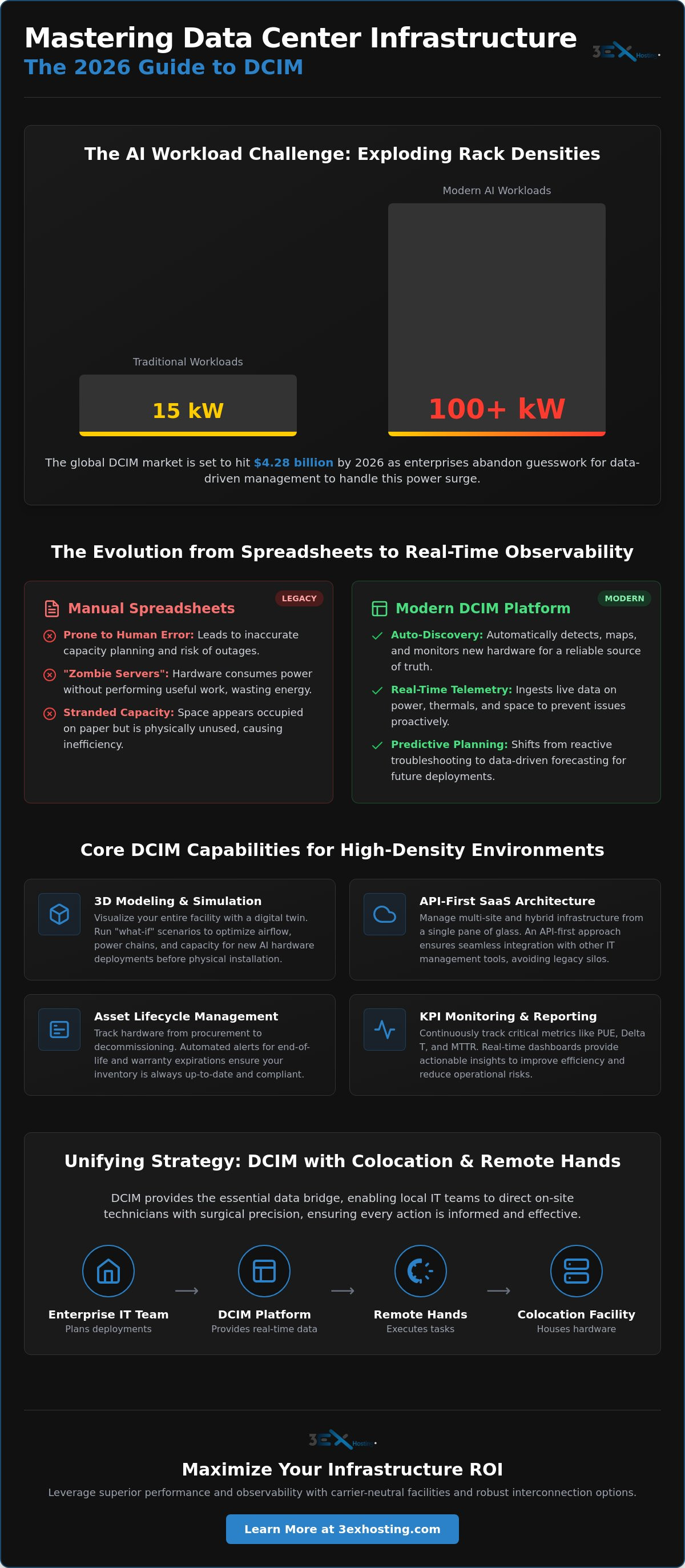
With the global DCIM market hitting $4.28 billion in 2026, enterprises are finally abandoning the era of manual spreadsheets. The explosion of AI workloads has pushed rack densities from 15 kW to over 100 kW, making it impossible to manage assets through guesswork. Many organizations now leverage colocation with remote hands to bridge the gap between local teams and distant hardware, but even the most skilled technicians need precise data to prevent outages. Without real-time visibility into power density, your infrastructure is at risk.
It’s frustrating to manage capacity limits when you’re relying on fragmented data and static reports. You deserve a clear view of your environment to ensure stability and efficiency. This guide will help you master these complexities by identifying the DCIM tools that provide a single pane of glass for your operations. We’ll examine how automated asset tracking and real-time PUE monitoring can transform your strategy, moving you from reactive troubleshooting to predictive, data-driven planning for a more resilient data center.
Key Takeaways
- Understand how modern DCIM bridges the gap between physical facility infrastructure and logical IT workloads to enable proactive, automated observability.
- Learn to use 3D floor modeling and what-if simulations to optimize airflow and capacity for high-density AI hardware deployments.
- Discover why an API-first, SaaS-based architecture is essential for managing multi-site infrastructure without the limitations of legacy monolithic suites.
- Master the strategy of combining colocation with remote hands to deploy physical sensors and maintain rack-level visibility from any location.
- Identify how carrier-neutral facilities and robust interconnection options maximize your infrastructure ROI through superior performance and observability.
What are DCIM Tools? Defining the Convergence of IT and Facilities
DCIM tools represent the critical intersection where physical facility infrastructure meets logical IT workloads. For years, these two domains operated in silos; facilities teams managed the power and cooling while IT teams focused on servers and applications. Modern Data Center Infrastructure Management (DCIM) platforms break these silos by providing a unified platform that offers real-time visibility into the physical layer. This integration is essential for maintaining stability as rack densities climb toward 100 kW. By 2026, the industry has moved beyond simple reactive monitoring toward proactive, automated observability. This shift allows operators to see not just what is happening now, but what will happen if power loads increase or cooling systems fluctuate.
Effective management relies on constant telemetry. DCIM tools ingest data points like power consumption, thermal metrics, and rack space availability to create a comprehensive digital twin of the environment. For enterprises utilizing colocation with remote hands, this visibility is indispensable. It provides the data necessary to guide on-site technicians with surgical precision. When you have real-time data, physical changes to the infrastructure are based on exact metrics rather than outdated documentation or guesswork.
The Evolution from Spreadsheets to Real-Time Monitoring
Relying on manual Excel-based tracking is a liability in high-density enterprise environments. Manual updates are prone to human error, which often leads to “zombie servers” that consume power without performing work. These inaccuracies create stranded capacity, where space appears occupied on paper but remains unused in reality. Modern DCIM solutions solve this through auto-discovery. These systems automatically detect new hardware, map its location, and monitor its health. This creates a reliable source of truth that keeps pace with the dynamic nature of modern hardware deployments.
Key Performance Indicators (KPIs) Managed by DCIM
Observability centers on specific KPIs that define operational success. Power Usage Effectiveness (PUE) remains the primary metric for efficiency, especially as national sustainability goals become more stringent in 2026. DCIM tools also track Delta T, the temperature difference between the front and back of a rack. Monitoring this ensures that cooling systems are working efficiently and prevents thermal hotspots that could damage expensive GPU clusters. By improving visibility, these tools significantly reduce Mean Time to Repair (MTTR). When a fault occurs, technicians know exactly where the problem is and what hardware is affected before they even step onto the data center floor.
Core Capabilities: Real-Time Monitoring and Capacity Planning for AI
AI workloads have fundamentally changed the physical requirements of the data center. Traditional 2D rack elevations no longer suffice when rack densities are jumping from the traditional 7-15 kW to 30-100+ kW. Modern DCIM platforms utilize 3D floor and rack modeling to provide a digital twin of your infrastructure. This visualization is critical for airflow optimization. It allows you to see exactly how cold air moves through the aisles and where hot air might get trapped. When you’re managing high density GPU colocation, thermal mapping is the only way to prevent hardware throttling or premature failure.
Simulation is another core capability that separates modern tools from legacy systems. DCIM tools now simulate what-if scenarios for complex hardware deployments. You can virtually “install” a new cluster of AI servers to see its immediate impact on the power chain and cooling capacity. This planning happens from the utility entrance down to the individual PDU outlet. By mapping the entire power chain, you eliminate the risk of tripped breakers during peak computational loads. For enterprises using colocation with remote hands, these simulations ensure that every physical move is backed by data, reducing the need for onsite trial and error.
Asset Lifecycle Management and Inventory Control
Effective management begins at procurement and ends at decommissioning. DCIM tools track the entire lifecycle of your hardware with automated alerts. You’ll know exactly when a server is reaching its end-of-life or when a warranty is about to expire. For national deployments, managing spare parts becomes a logistics challenge. Automated inventory alerts notify you when stock levels for critical components drop below a defined threshold. This automation ensures compliance and audit readiness. You can generate reports with accurate serial numbers and asset locations in seconds; this is a significant improvement over manual audits.
Predictive Capacity Planning for Scalability
Scalability requires foresight. Predictive capacity planning uses historical trend analysis to forecast your future power and cooling needs. It identifies stranded capacity; those pockets of the data center where floor space is available but the power density has already reached its limit. This insight is vital when planning for high-density AI clusters. You won’t waste time trying to fit high-demand hardware into racks that can’t support the load. If you’re ready to optimize your footprint, you can request a personalized capacity assessment to see how your current deployment measures up against future growth.
Legacy vs. Next-Generation DCIM: Choosing an API-First Architecture
Legacy DCIM suites were often monolithic, on-premise installations that required months of manual configuration. These systems were essentially digital filing cabinets that only provided value if someone remembered to update them. In contrast, next-generation observability platforms are built on an API-first architecture. These modern tools are frequently delivered as a SaaS model, which is ideal for managing multi-site infrastructure. If you manage assets across several facilities using colocation with remote hands, a cloud-based DCIM provides a centralized view without the need for complex VPNs or local server maintenance at every site.
AIOps is a defining feature of this new generation. By applying machine learning to historical telemetry data, these platforms perform predictive failure analysis. They can identify a power supply that is starting to oscillate or a fan that is losing RPMs before the hardware actually fails. This allows you to schedule maintenance proactively. Many enterprises hesitate to adopt DCIM because they believe deployment is too difficult. Modern platforms eliminate this barrier through auto-discovery. Using protocols like SNMP and Redfish, these tools scan your network and automatically populate your inventory. This ensures your data is always accurate and reflects the current state of your racks.
API Integration and the Ecosystem Approach
Next-gen DCIM doesn’t exist in a vacuum. It acts as the physical source of truth for your entire IT stack. By connecting your DCIM to ITSM tools like ServiceNow or Jira, you can automate work orders. For example, if a sensor detects a thermal threshold breach, the system can automatically generate a ticket for your colocation with remote hands provider. Integration with virtualization layers like VMware or Nutanix allows you to see exactly which virtual machines are running on a specific physical host. You can also export this data via open APIs to custom business intelligence dashboards, giving stakeholders a high-level view of infrastructure ROI.
The Rise of Open-Source DCIM Solutions
Open-source tools have gained traction among developer-heavy teams who require deep customization. These platforms offer flexibility and a lower initial cost, but they come with trade-offs. While you gain full control over the code, you also inherit the responsibility for security and maintenance. Self-hosted platforms require rigorous security protocols to prevent unauthorized access to your physical infrastructure data. Most importantly, open-source solutions lack the enterprise-grade SLAs and dedicated support found in commercial products. For mission-critical environments where every minute of downtime is costly, the stability of a supported vendor often outweighs the perceived savings of a community-driven tool.
Implementing DCIM in a Colocation Framework with Remote Hands
Implementing DCIM within a colocation framework requires a clear understanding of where the provider’s responsibility ends and yours begins. The facility operator uses DCIM to manage the building’s critical infrastructure, such as industrial chillers and backup generators. However, this high-level view rarely extends to the granular power draw of your specific servers. To gain true observability, you must deploy your own rack-level monitoring. This is where remote hands support becomes a strategic asset. These technicians handle the physical installation of thermal sensors and intelligent PDUs, allowing you to monitor your environment without being physically present in the data center.
Effective colocation with remote hands relies on a seamless flow of data between you and the provider. In 2026, regulatory shifts like the EU’s Energy Efficiency Directive (EED) mandate that providers report metrics such as Power Usage Effectiveness (PUE) and Water Usage Effectiveness (WUE) directly to tenants. Your DCIM tool should be capable of ingesting this facility-level data alongside your own internal metrics. This creates a holistic view that is essential for compliance and sustainability reporting. When selecting a platform, prioritize tools that support hybrid environments. You need a single pane of glass that manages your remaining on-premise hardware and your distributed colocation assets simultaneously.
Managing Full Cabinets and Private Suites
The level of monitoring depends on your deployment type. In full cabinet colocation, your focus is on rack-level power consumption. Monitoring individual outlets helps you identify underutilized servers that are “vampire” loads. For those utilizing private suites, the scope expands to environmental control. You can deploy independent humidity and leak detection sensors to protect high-value AI infrastructure. Additionally, modern DCIM integrates with physical access control systems. This allows you to log every time a cage door is opened, providing a verifiable audit trail for security compliance.
The ROI of DCIM for Colocation Tenants
Measuring actual power draw instead of relying on contracted nameplate ratings is the fastest way to reduce over-provisioning costs. Many enterprises pay for power they never use. DCIM identifies this gap immediately. Optimized thermal management also extends the lifespan of your hardware. By maintaining an ideal Delta T, you prevent the thermal stress that leads to component failure. Accurate physical-to-logical mapping streamlines troubleshooting. When a virtual machine fails, your team can instantly locate the exact physical server and port involved. If you want to ensure your infrastructure is built for maximum observability, explore our high-performance colocation options today.
Maximizing Infrastructure ROI with 3EX Hosting Solutions
3EX Hosting serves as the physical foundation for high-performance, observable infrastructure. While DCIM software provides the data, our facilities provide the stability and speed required to act on those insights. We operate carrier-neutral environments that support complex interconnections. This allows your team to monitor diverse network paths and ensure redundancy is maintained at every layer. By combining modern observability tools with our technical expertise, you create a resilient environment where performance is measured and optimized in real time.
High-Density Ready Infrastructure
Our facilities are engineered to handle the intense power requirements of AI and GPU workloads. In 2026, rack densities have reached levels that traditional data centers simply can’t support. We provide specialized cooling solutions designed for these modern clusters, preventing the thermal throttling that can derail a project. By offering N+1 or 2N redundancy, we ensure that the physical layer remains as reliable as the software monitoring it. This level of infrastructure readiness is essential for enterprises that cannot afford even a millisecond of downtime.
Expert Support for Physical Deployments
Visibility starts at the moment of installation. We offer move-in assistance to ensure that your asset tracking and documentation are accurate from day one. Our team works with you to map every server and connection, creating a reliable source of truth for your DCIM platform. For ongoing maintenance and sensor deployment, our colocation with remote hands provides the physical presence your team needs. Whether you’re installing new thermal probes or managing complex cable runs, our technicians act as an extension of your own staff. This level of support is vital for maintaining the physical-to-logical mapping that keeps your infrastructure observable. As a user of colocation with remote hands, you understand that precision in the rack is just as important as precision in the code. Ready to scale your infrastructure? Get a custom colocation quote today.
Future-Proofing Your Data Center Strategy
Modern infrastructure management requires a shift from static tracking to real-time observability. You’ve seen how API-first DCIM tools provide the visibility needed to manage high-density AI clusters and optimize power consumption. By integrating these platforms into a colocation framework, you eliminate the blind spots that lead to stranded capacity and thermal hotspots. Precision in the digital layer is only effective when matched by precision in the physical layer.
Choosing a provider that understands this synergy is critical for maintaining mission-critical continuity. At 3EX Hosting, we provide the technical foundation and stability your enterprise requires. Our high-density GPU ready facility and strategic carrier-neutral connectivity ensure your hardware performs at its peak. When you combine our infrastructure with colocation with remote hands, you gain a partner capable of executing complex sensor deployments and maintenance tasks 24/7. It’s time to move beyond guesswork and embrace data-driven operations.
Optimize your enterprise infrastructure with 3EX Hosting and secure the reliability your workloads demand. We’re ready to help you build a more resilient, observable future.
Frequently Asked Questions
What is the difference between DCIM and CMDB?
DCIM focuses on the physical infrastructure layer, such as power, cooling, and rack space availability. In contrast, a Configuration Management Database (CMDB) tracks logical IT assets, including software versions, licenses, and application dependencies. While DCIM ensures the physical environment is healthy, CMDB manages the relationships between digital services and their configurations.
Can DCIM tools help reduce energy costs in a colocation facility?
DCIM tools reduce energy costs by identifying underutilized servers and optimizing airflow to prevent over-cooling. By measuring actual power draw versus your contracted capacity, you can eliminate over-provisioning fees. These tools provide the real-time data needed to maintain an efficient Power Usage Effectiveness (PUE) rating and prevent expensive power overages.
Is DCIM software necessary for a single-rack deployment?
Software-based DCIM is rarely necessary for a single-rack deployment unless that rack supports high-density AI or GPU workloads. Basic PDU monitoring is usually sufficient for low-density environments. However, enterprises with mission-critical hardware often use DCIM for its automated thermal alerts and predictive failure analysis to protect expensive components.
How do DCIM tools integrate with existing IT Service Management (ITSM) systems?
Modern DCIM platforms integrate with ITSM tools like ServiceNow or Jira via RESTful APIs. This connection allows physical infrastructure alarms to trigger automated service tickets. For example, a power threshold breach can automatically alert your colocation with remote hands provider to investigate the physical hardware without any manual intervention from your team.
What are the security risks of using a cloud-based DCIM platform?
The primary risk involves the potential for unauthorized access to sensitive infrastructure telemetry data. You should mitigate this by ensuring your provider uses multi-factor authentication and maintains SOC2 compliance. SaaS-based DCIM often offers superior security through regular, automated patching that on-premise installations frequently lack because of maintenance neglect.
Do I need special sensors for DCIM to work effectively?
Effective DCIM requires intelligent PDUs and environmental sensors for temperature, humidity, and airflow. Many tools also ingest data directly from server management ports like iDRAC or ILO using protocols like SNMP and Redfish. These sensors provide the granular data necessary for accurate thermal mapping and predictive capacity planning within the rack.
How much time does it typically take to implement a modern DCIM solution?
Implementation for modern, API-first DCIM solutions typically takes between a few days and a few weeks. This speed is possible because of auto-discovery features that scan your network to populate asset lists automatically. It’s a significant improvement over legacy systems that often required months of manual configuration and tedious data entry.
Can DCIM tools assist with regulatory compliance like SOC2 or HIPAA?
DCIM tools assist with compliance by providing automated audit logs and physical security monitoring within your colocation with remote hands environment. They track rack access events and maintain environmental stability records. These logs are essential for proving that physical security and uptime requirements meet the standards of SOC2 or HIPAA audits during annual reviews.