 SUPPORT


 3EX United States
 Blog
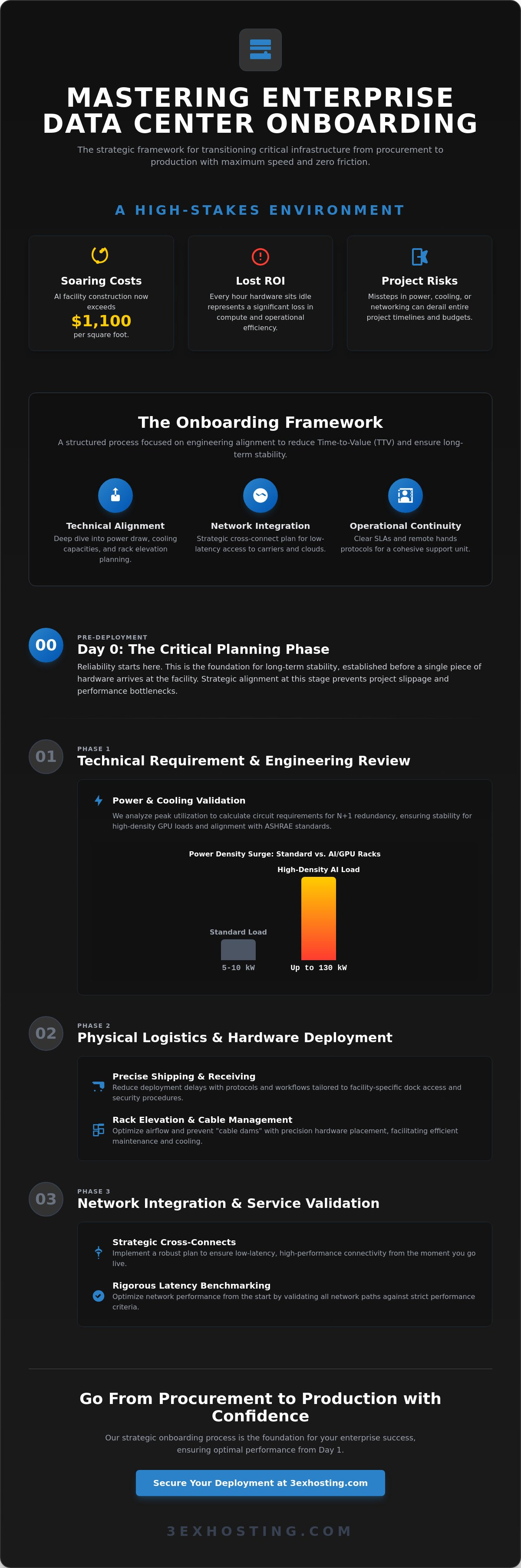
With data center construction costs for AI-optimized facilities now exceeding $1,100 per square foot, the margin for error during the data center onboarding process has effectively vanished. Every hour your hardware sits idle in a crate represents a significant loss in potential compute and operational efficiency. You likely recognize the mounting pressure of a go-live deadline while navigating the complexities of facility-specific cooling protocols and third-party network cross-connects. It’s a high-stakes environment where a single misunderstanding about power density or cable management can derail your entire project timeline.
We’ve designed this guide to help you master your deployment by shifting the focus from administrative checklists to strategic engineering alignment. You’ll learn how to establish a predictable schedule that accounts for the latest NEC 2026 grounding standards and high-density power requirements. We’ll walk through the technical steps to ensure optimal network performance from Day 1 and show you how to build a seamless workflow with on-site remote hands support. This framework provides the technical clarity needed to transition your enterprise infrastructure from procurement to production with total confidence.
Key Takeaways
- Learn why “Day 0” planning is the most critical phase for ensuring long-term enterprise reliability and technical stability.
- Master the data center onboarding process by aligning power draw, heat dissipation, and weight specifications before hardware arrives.
- Reduce deployment delays by implementing precise shipping protocols and unboxing workflows tailored to facility-specific dock access.
- Optimize network performance from the start with a strategic cross-connect plan and rigorous latency benchmarking.
- Ensure a seamless transition to production through structured hand-offs to remote hands support and regular infrastructure audits.
Defining the Strategic Data Center Onboarding Framework
The data center onboarding process is far more than a series of administrative approvals or a simple move-in checklist. It represents the critical bridge between contract execution and full operational status. For enterprise organizations, this phase serves as the foundation for long-term technical stability. Effective onboarding ensures that every piece of hardware is integrated into a broader ecosystem of data center management where power, cooling, and connectivity work in total harmony.
Reliability starts at Day 0. This is the planning phase that occurs before a single rack is bolted to the floor. While standard colocation setups might focus on basic space and power, a strategic framework prioritizes engineering alignment. It’s about anticipating the unique demands of your specific hardware stack. If you don’t account for these variables early, you risk project slippage and performance bottlenecks that can take months to resolve. Precision at this stage translates directly into operational peace of mind.
The primary goal is reducing Time-to-Value (TTV). High-performance server hardware represents a massive capital investment. Every day those assets remain unconfigured or underutilized, your ROI drops. A structured data center onboarding process eliminates the guesswork, allowing your team to hit the ground running with a predictable go-live timeline. We focus on getting your systems from the shipping dock to the production environment with maximum speed and zero friction.
The Pillars of Successful Enterprise Onboarding
- Technical Engineering Alignment: This involves a deep dive into power draw requirements, cooling capacities, and rack elevation planning to prevent thermal hotspots.
- Network Ecosystem Integration: We establish a clear cross-connect strategy, ensuring low-latency access to carriers and cloud providers from the moment you go live.
- Operational Continuity: Defining clear SLAs and support protocols ensures that your internal teams and our remote hands engineers operate as a single, cohesive unit.
Why Standard Processes Often Fail High-Density Loads
Generic onboarding frameworks often underestimate the thermal and power demands of modern AI and GPU clusters. These high-density workloads require specialized infrastructure that goes beyond standard rack configurations. At 3EX Hosting, we align these specific needs during the initial intake phase. Whether you require a single rack or full cabinet colocation, our engineers validate your power density and cooling requirements to ensure your high-performance hardware operates at peak efficiency without the risk of thermal throttling.
Phase 1: Technical Requirement Alignment & Engineering Review
Phase 1 moves the project from conceptual planning to technical reality. This stage of the data center onboarding process focuses on a rigorous engineering review. We don’t rely on generic estimates. Instead, our team gathers exact specifications for power draw, heat dissipation, and equipment weight. This data ensures that the physical environment can support your hardware’s operational profile without thermal throttling or electrical overloads.
Validating power density is the priority for enterprise-grade deployments. We examine your requirements for N+1 redundancy and metered power distribution. For modern AI and GPU workloads, power requirements have surged from 5-10 kW to as high as 130 kW per rack. Our engineers verify that the electrical path can sustain these high-density loads while maintaining the stability your applications demand. We also finalize rack elevations at this stage. Precision placement of hardware optimizes airflow and facilitates efficient cable management, preventing “cable dams” that can trap heat and degrade performance.
Power and Cooling Validation
During onboarding, Power Usage Effectiveness (PUE) serves as a vital benchmark for measuring how efficiently the facility’s cooling infrastructure supports your specific hardware load. We calculate circuit requirements for high-density GPU hosting by analyzing peak utilization scenarios rather than idle states. This technical diligence ensures that all thermal management strategies align with ASHRAE standards. By maintaining these strict environmental controls, we protect your hardware investment from the risks of inconsistent cooling or humidity fluctuations.
Security and Compliance Mapping
Physical security is integrated into the engineering review rather than added as an afterthought. We establish Access Control Lists (ACLs) to designate exactly which personnel have authorization to enter your space. This protocol typically includes biometric access and RFID tracking to create a detailed audit trail. For organizations in regulated industries, we map specific compliance requirements such as SOC2, HIPAA, or PCI directly to your physical cage solutions datacenter. This ensures your infrastructure meets both internal security policies and external regulatory mandates from the moment of deployment.
If your team requires a high-density environment with specific compliance needs, you can request a custom engineering quote to start your technical review.
Phase 2: Physical Logistics and Hardware Deployment
Once the engineering review is finalized, the data center onboarding process shifts to physical execution. This phase is often the most logistically complex part of the deployment. It requires tight coordination between your equipment vendors, third-party logistics partners, and our facility operations team. Our team manages dock access and delivery windows to ensure your hardware moves directly from the transport vehicle to a secure, climate-controlled staging area. Proper unboxing protocols are essential. We remove all cardboard and packing materials in designated staging rooms to prevent debris from entering the sterile data hall environment.
Physical racking involves more than just sliding servers into rails. For high-density AI and GPU clusters, precision placement is a safety requirement. We calculate floor loading and rack weight distribution to ensure structural stability. Heavy chassis are positioned at the bottom of the cabinet to maintain a low center of gravity and prevent tipping risks. Simultaneously, we implement a structured cable plant. Whether you’re running 100G fiber or Cat6a copper, our technicians use precise routing and labeling. This level of organization maintains optimal airflow and simplifies future troubleshooting or hardware refreshes.
The Deployment Checklist
- Step 1: Finalize the shipping manifest and coordinate delivery windows to avoid dock congestion and ensure staff availability.
- Step 2: Conduct a thorough hardware inspection and perform asset tagging upon arrival to maintain a clear inventory of all components.
- Step 3: Execute professional racking and stacking, ensuring every unit aligns with the engineering elevations established in the previous phase.
Leveraging Move-In Assistance
Professional move-in assistance significantly reduces deployment risk by providing expert hands during the most vulnerable part of the equipment lifecycle. On-site technicians don’t just rack equipment; they verify physical connectivity and power-up status immediately. This validation prevents “dead on arrival” scenarios that can stall a project for weeks. Integrating remote hands support at this stage allows for unescorted maintenance and rapid response to physical layer issues. For a deeper dive into how this impacts operational efficiency, see our sibling guide on Remote Hands Support. These services ensure your infrastructure is production-ready without requiring your internal team to be physically present for every minor adjustment.
Phase 3: Network Integration and Service Validation
After the physical hardware is secured and powered, the data center onboarding process enters the network integration phase. This is where your infrastructure connects to the global digital ecosystem. We don’t just plug in cables. We execute a precise interconnection strategy designed for low latency and high availability. This phase focuses on the physical layer of connectivity, establishing direct links between your equipment and your chosen carriers or cloud providers.
Validation is the cornerstone of this stage. We perform rigorous throughput testing and latency benchmarking to ensure your network performs as engineered. We also configure out-of-band (OOB) management interfaces, such as IPMI or iDRAC. This provides a secure, secondary path for remote troubleshooting, ensuring your team maintains control even if the primary network is unavailable. Finally, we finalize IP allocation and DNS record updates. This ensures that your services are reachable and ready for the official go-live transition.
The Economics of Cross-Connect Services
Deploying within a premier carrier hotel provides access to a dense ecosystem of network providers. This proximity allows you to utilize physical cross-connects, which bypass the public internet entirely. By using these direct paths, you gain superior security and significantly higher speeds. Direct peering within the data center ecosystem offers a high ROI by reducing transit costs and eliminating the latency inherent in multi-hop internet routing. It’s a strategic move that ensures your high-performance workloads, like AI or financial services, operate with the lowest possible round-trip times.
Service Verification and Testing
We don’t consider the network “up” until it’s verified under stress. Our engineers conduct post-deployment power load testing to ensure circuit stability when hardware is running at peak utilization. We also perform network failover simulations. By intentionally dropping a primary link, we verify that your redundant paths engage instantly without packet loss. This level of testing is standard in our data center overview and operational protocols. It guarantees that your “Day 1” performance matches your technical specifications.
Ready to secure high-performance connectivity for your enterprise? Get a quote for cross-connect services today and optimize your network path from the start.
Post-Onboarding: Transitioning to Operational Excellence
The successful completion of the data center onboarding process is not the finish line; it is the starting point for your infrastructure’s operational lifecycle. Transitioning from the deployment phase to Day 2 operations requires a formal engineering hand-off. At this stage, the project team transfers all technical documentation, rack elevations, and port maps to our 24/7 technical support staff. This ensures that the engineers monitoring your systems have the exact same level of technical context as the team that performed the initial installation. It’s a structured process that guarantees continuity and eliminates the information gaps that often plague enterprise migrations.
Operational excellence also means planning for a hybrid future. Many organizations choose to integrate their physical hardware with managed cloud hosting to handle burstable workloads or development environments. This hybrid approach provides the flexibility of the cloud with the predictable performance of dedicated colocation. As your compute requirements expand, our framework supports a seamless transition from individual cabinets to private suites. This path for growth ensures that your infrastructure can scale alongside your business without the need for a costly secondary migration.
Maintaining High-Density Performance
In high-performance environments, infrastructure audits are a monthly necessity, not an annual one. We utilize metered power monitoring to track utilization in real time, preventing circuit overloads before they occur. This data is vital for managing the extreme thermal demands of AI clusters. Ongoing remote hands support plays a critical role here, handling everything from routine component swaps to complex hardware lifecycle management. For teams scaling specialized AI workloads, our High-Density GPU Colocation guide provides deeper insights into maintaining these specialized environments.
The 3EX Hosting Advantage
The 3EX Hosting commitment centers on an engineering-led approach to every deployment. We don’t just provide space; we provide a stable, high-performance foundation built on technical expertise and national infrastructure. Our team understands the nuances of enterprise-grade connectivity and power redundancy, ensuring your systems remain online and optimized. By choosing a partner that prioritizes technical stability and speed, you ensure that your data center strategy remains a competitive advantage rather than an operational burden.
Ready to secure a predictable and high-performance home for your enterprise hardware? Get a custom colocation quote today and start your journey toward operational excellence.
Securing Your Infrastructure Foundation for Long-Term Scale
A successful data center onboarding process transforms a complex migration into a predictable engineering milestone. By prioritizing technical alignment early, you eliminate the risks of thermal bottlenecks and network latency that often stall enterprise deployments. You’ve seen how precise logistics coordination and rigorous service validation create the stability required for modern, high-density workloads. This framework ensures your capital investment starts delivering value immediately rather than sitting idle on a shipping dock. It’s about moving from procurement to production with zero friction.
To celebrate the successful launch of your new infrastructure or to support your team during the final stages of the deployment, you can explore Event and Corporate Catering Services options to provide a premium experience for your stakeholders and engineers.
We’re here to help you navigate this transition with total confidence. Our facilities provide High-Density AI & GPU Ready Infrastructure backed by N+1 Power and Cooling Redundancy for maximum uptime. With 24/7 On-Site Remote Hands Support, your hardware is in expert hands from the moment it arrives at our facility. We understand the technical pressure of enterprise deployments and provide the stability you need to scale.
Request a Custom Onboarding Consultation and Quote to begin your deployment strategy. Let’s build a technical foundation that supports your enterprise growth from Day 1.
Frequently Asked Questions
How long does the data center onboarding process typically take?
Standard enterprise deployments usually take 15 to 30 days to reach full operational status. This timeline depends on the complexity of your network cross-connects and the total volume of hardware being deployed. Efficiency during the data center onboarding process is driven by the speed of the initial engineering review. Providing accurate technical data early allows our team to finalize power and cooling allocations without project delays.
What technical information do I need to provide before onboarding begins?
You must provide exact specifications for peak power draw, thermal output (BTU/hr), and total equipment weight for every chassis. We also require detailed rack elevation diagrams and your specific network interconnection requirements. This data allows our engineers to validate that the physical environment supports your hardware’s operational profile. Accurate documentation at this stage is the foundation for long-term technical stability and performance.
Can I use my own technicians for the physical hardware deployment?
Yes, your authorized personnel are welcome to perform the physical hardware deployment within your designated cage or suite. All technicians must adhere to facility security protocols, which include biometric registration and RFID access control. Many clients choose a hybrid approach where their team manages the configuration while our on-site engineers handle the initial racking and stacking to accelerate the go-live timeline.
What are cross-connect services and why are they necessary during onboarding?
Cross-connect services are physical layer connections that link your equipment directly to a carrier or cloud provider within the facility. They are necessary because they bypass the public internet, providing significantly lower latency and higher security for your data. Establishing these links is a core part of the data center onboarding process to ensure your network performs at the speeds your enterprise applications require.
Does 3EX Hosting provide assistance with shipping and receiving hardware?
3EX Hosting provides comprehensive assistance with shipping and receiving, including dock management and secure staging. We coordinate specific delivery windows to ensure your hardware moves directly from the transport vehicle to a climate-controlled environment. Our team also manages the removal of all packing materials. This prevents debris from entering the data hall and ensures your equipment is ready for immediate installation.
How is power redundancy verified during the onboarding phase?
Power redundancy is verified through post-deployment load testing and failover simulations conducted by our engineering team. We monitor metered power distribution units to ensure that N+1 redundancy remains stable even when your hardware is running at peak utilization. This verification process protects your systems from unexpected circuit overloads. It ensures that your power path is fully resilient before you transition to a production environment.
What happens if my hardware requirements change during the onboarding process?
If your hardware requirements change, we conduct an immediate technical re-evaluation to ensure the new specifications align with facility capacities. Our engineers will review the updated power draw and cooling needs to prevent thermal hotspots or electrical imbalances. While significant changes may adjust the project timeline, this review is essential for maintaining the safety and reliability of your infrastructure. We prioritize engineering integrity over a rushed deployment.
Is remote hands support available immediately after the hardware is racked?
Remote hands support is available 24/7 immediately after your hardware is racked and powered. Our on-site technicians are ready to perform unescorted maintenance, component swaps, and physical layer troubleshooting at your direction. This service provides an extra layer of security and operational flexibility. It allows your internal team to manage the infrastructure remotely without needing to be physically present at the facility for routine tasks.