 SUPPORT


 3EX United States
 Blog
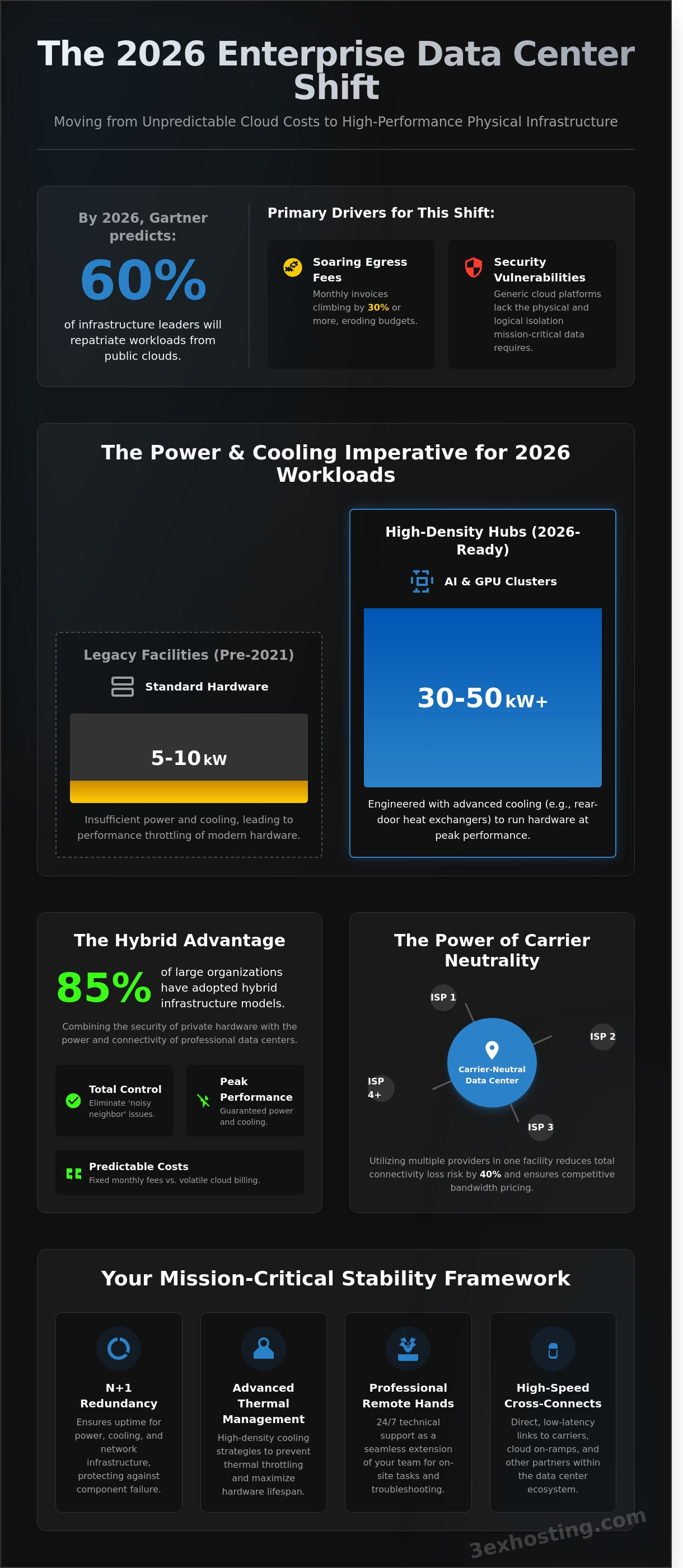
A 2024 Gartner report reveals that 60% of infrastructure leaders expect to repatriate workloads from public clouds by 2026 due to soaring egress fees and security vulnerabilities. You’ve likely noticed your own monthly invoices climbing by 30% while your AI clusters struggle in facilities that lack the power density required for modern H100 deployments. It’s frustrating to pay a premium for generic hosting that doesn’t offer the physical security or technical stability your mission-critical data demands.
This guide helps you identify the precise enterprise data center solutions that align with your 2026 growth targets. We’ll show you how to move beyond unpredictable cloud costs toward a high-performance physical environment built for high-density compute. You’ll learn how to secure direct connectivity to major carrier hotels and implement 24/7 technical support that acts as a seamless extension of your own team. From power-hungry AI workloads to ironclad physical security, we’re covering the technical essentials for a stable, superfast infrastructure.
Key Takeaways
- Understand the shift toward high-density hubs and how to integrate hybrid infrastructure for maximum scalability.
- Evaluate the total cost of ownership to find the most efficient enterprise data center solutions for your specific workload.
- Master the essentials of mission-critical stability, including N+1 redundancy and advanced thermal management strategies.
- Optimize operational performance by leveraging professional remote hands and high-speed cross-connect services.
- Apply a strategic framework to audit potential partners based on technical stability, uptime history, and financial security.
The Evolution of Enterprise Data Center Solutions in 2026
By 2026, the traditional view of server storage has become obsolete. Modern enterprise data centers have transformed into high-density hubs designed to power the next generation of digital business. They don’t just hold hardware; they provide the specialized environment necessary for high-performance computing. Today, 85% of large organizations have abandoned “on-premise only” models in favor of hybrid enterprise data center solutions. This shift allows companies to keep sensitive data under tight control while leveraging the massive power and cooling capacities of professional facilities.
The 2026 landscape demands more than just floor space. It requires infrastructure that can support AI-ready cooling systems and ultra-low latency requirements. For most businesses, the goal is reaching sub-1ms response times for edge applications. Achieving this level of performance isn’t possible in a standard office server room. It requires a strategic move to facilities that prioritize technical stability and super-fast connectivity as their core mission.
High-Density Infrastructure vs. Legacy Facilities
Legacy data centers built before 2021 often fail to support 2026 workloads. These older sites typically provide 5kW to 10kW of power per cabinet, which is insufficient for modern hardware. Current GPU-heavy clusters used for machine learning and real-time data analytics require 30kW to 50kW per rack. If a facility can’t deliver this density, your hardware’s performance will be throttled or the cooling systems will fail.
Transitioning to high-density cabinet colocation is now a standard operational requirement. These modern environments use rear-door heat exchangers or direct-to-chip liquid cooling to manage the intense thermal output of 2026 server configurations. This level of engineering ensures that your “super-fast” hardware actually runs at its rated speed without thermal degradation. It’s a shift from simple space rental to high-performance environment management.
The Role of Carrier Neutrality in Connectivity
Carrier neutrality has become the backbone of effective enterprise data center solutions. A carrier-neutral facility doesn’t restrict you to a single telecommunications provider. Instead, it offers a diverse ecosystem of ISPs and network fabrics. This independence is vital for maximizing ROI and ensuring 100% uptime. Relying on a single carrier creates a dangerous single point of failure that can paralyze a business during a network outage.
- Multi-Carrier Strategies: Utilizing at least three different providers reduces the risk of total connectivity loss by 40%.
- Cost Optimization: Direct competition between providers within the same facility keeps bandwidth costs low and service quality high.
- Global Reach: Accessing international backbones directly from the data center floor ensures your services remain stable for users worldwide.
In 2026, connectivity is about more than just being online; it’s about the quality and path of every packet. Professional facilities provide the cross-connects needed to bypass the public internet when necessary, linking your private infrastructure directly to cloud on-ramps. This creates a secure, low-latency bridge that defines modern enterprise agility.
Choosing Between Colocation, Private Suites, and Managed Cloud
Selecting the right infrastructure requires balancing capital expenditure (CapEx) against operational flexibility. While public cloud offers speed, 72% of enterprises in 2025 reported repatriating some workloads to private hardware to control costs and security. Your choice of enterprise data center solutions impacts your TCO over a five-year lifecycle. You need to weigh the immediate cost of hardware against the long-term predictability of a fixed monthly colocation fee.
Physical isolation remains the gold standard for high-security sectors. Logical separation in a cloud environment relies on software-defined networking, which introduces different risk profiles. Gartner reviews of data center and cloud networking solutions highlight that hybrid models often yield the best performance-to-cost ratio for 2026 deployments. Control is the deciding factor; managing your own hardware eliminates the “noisy neighbor” effect common in shared cloud environments.
Full Cabinet Colocation: When to Control Your Own Hardware
Standardizing on full cabinet colocation gives you 42U of dedicated space. This allows for precise airflow management using hot and cold aisle containment. You manage the hardware; the provider ensures 99.999% power uptime. It’s the most efficient way to scale for companies with predictable 24/7 workloads. Standardized rack configurations make remote management simpler, as your technicians know exactly where every cable and switch sits.
Private Suites and Cage Solutions for Enhanced Compliance
For organizations handling sensitive financial or medical data, cage colocation provides a physical barrier that meets strict regulatory standards. This is vital for meeting HIPAA or PCI-DSS 4.0 requirements. Large-scale operations often upgrade to private data center suites. These offer biometric access and dedicated cooling zones. You get a customized security perimeter that’s entirely under your control, ensuring only authorized personnel ever touch your equipment.
Managed Cloud and Disaster Recovery Integration
2026 data strategies rely on agility. Managed cloud handles burstable workloads during peak traffic, while core databases stay on-site. Disaster recovery isn’t an afterthought; it’s integrated into the primary strategy. Modern enterprise data center solutions use low-latency cross-connects to sync data between physical and virtual environments in under 5 milliseconds. This hybrid approach ensures that if a localized failure occurs, your failover to the cloud is instantaneous and transparent to users.
Mission-Critical Infrastructure: Power, Cooling, and Redundancy
Enterprise data center solutions in 2026 must support an “always-on” environment where even a single second of downtime is unacceptable. For most large-scale operations, N+1 redundancy is the bare minimum. This standard ensures that for every critical component, there is a backup ready to activate instantly. It’s not just about power; it covers cooling units, network paths, and hardware modules. Physical security protocols have also evolved. Modern facilities use 24/7 surveillance, mantraps, and multi-factor authentication to protect the hardware layer from any unauthorized physical access.
- Six-layer security: Perimeter fencing, 24/7 on-site guards, and biometric access controls are standard.
- Power density: Modern racks now support 50kW to 100kW to handle AI-driven compute loads.
- Fire suppression: Very Early Smoke Detection Apparatus (VESDA) systems detect particles before flames appear, protecting sensitive circuitry.
Understanding N+1 vs. 2N Redundancy Standards
Redundancy levels define how a facility reacts to a power grid failure or equipment malfunction. N+1 means there’s one extra unit for every N units required. 2N redundancy is more robust, offering a fully mirrored system with two independent power sources. If one side fails, the other carries the full load without interruption. 3EX Hosting maintains uptime through redundant infrastructure, utilizing industrial-grade UPS systems and backup generators that kick in within 10 to 15 seconds. These systems ensure your data remains accessible even during localized blackouts or scheduled equipment maintenance.
Thermal Management for High-Density AI and Compute Loads
High-performance computing generates massive heat loads that can destroy hardware if not managed correctly. By 2026, hot-aisle and cold-aisle containment have become standard strategies to separate air streams and maximize cooling efficiency. This precision reduces your Power Usage Effectiveness (PUE) score, which directly lowers your monthly energy bill. We monitor environmental variables like humidity and ambient temperature every few seconds. This proactive approach prevents hardware degradation and ensures your enterprise data center solutions perform at peak speed consistently. Effective cooling can reduce operational costs by 15% to 20% compared to legacy setups.
Operational Excellence: Remote Hands and Connectivity Services
Modern enterprise data center solutions rely on more than just floor space and power. They require immediate, skilled intervention. For a national enterprise, sending a senior engineer across the state for a simple hardware reset is a massive waste of resources. It costs an average of $1,200 per site visit when you factor in travel, lodging, and lost productivity. Having professional on-site assistance eliminates these overheads while keeping your internal team focused on high-level architecture.
Operational excellence in 2026 is measured by the Mean Time To Repair (MTTR). When a critical component fails, every minute of downtime can cost a Tier 1 enterprise upwards of $9,000. Professional on-site technicians reduce this window by providing immediate eyes and ears on the ground. They don’t just follow instructions; they apply certified expertise to ensure hardware is handled correctly, preventing the secondary failures often caused by inexperienced handling.
The Strategic Value of 24/7 Remote Hands Support
A reliable remote hands support service acts as an extension of your own IT department. These experts are available 24/7 to perform tasks that require physical presence. This includes everything from complex cable management to simple power cycles. By utilizing on-site staff, you ensure that your gear is managed by technicians who understand the specific cooling and power requirements of a high-density environment.
- Hardware Maintenance: Swapping failed drives, installing NICs, or replacing power supplies.
- Physical Audits: Visual interface checks and port logging to ensure compliance.
- Inventory Management: Labeling equipment and organizing patch cables to maintain a clean, airflow-efficient rack.
- Emergency Troubleshooting: Immediate response to hardware alarms without waiting for your team to arrive.
Data from 2025 shows that enterprises using dedicated on-site support see a 35% improvement in long-term hardware reliability. This is due to consistent, professional handling and proactive environment monitoring.
Cross-Connect Services and Low-Latency Performance
Connectivity is the lifeblood of any modern infrastructure. High-speed cross-connects allow your equipment to link directly to carriers, cloud providers, or other tenants within the same facility. These enterprise data center solutions bypass the public internet entirely. This results in a significant boost in security and a drastic reduction in latency. In a direct connect scenario, latency often drops to sub-1ms levels, which is essential for real-time data processing and high-frequency applications.
Scaling your connectivity shouldn’t be a bottleneck. Direct cross-connects offer a physical, dedicated path that can scale from 1Gbps to 100Gbps as your traffic grows. It’s a stable, predictable way to manage data movement without the jitter or packet loss associated with traditional ISP routing. Your data stays within a controlled environment, reducing the attack surface for external threats.
Ensure your infrastructure stays online and performs at peak levels with our expert-led services. Explore our professional data center services today.
Selecting Your Enterprise Partner: A Strategic Framework
Selecting a provider for enterprise data center solutions requires a technical deep dive that goes beyond basic pricing. You need a partner that acts as an extension of your own IT department. Start with a comprehensive site audit. This assessment must verify floor load capacities, seismic bracing, and the redundancy of the electrical distribution. Data from 2025 indicates that 64% of enterprise outages were preventable through better initial infrastructure vetting before the hardware was even racked.
Evaluate the provider’s financial health and historical uptime. A facility with a 15-year history of zero unplanned outages is a safer bet than a brand-new site with unproven operational staff. Review Service Level Agreements (SLAs) with a focus on “five nines” availability. These agreements shouldn’t just be vague promises. They must cover power, cooling, and network connectivity with clear, predefined financial penalties for any breach. If a provider won’t stand behind their 100% power uptime guarantee with significant credits, they aren’t ready for enterprise workloads.
Assess the connectivity ecosystem within the facility. High-density environments with direct access to Tier-1 carriers and major cloud providers reduce transit costs and latency. You should know exactly who else is in the building. A rich ecosystem of telecommunications providers and peering exchanges makes your network more resilient. Finally, establish a migration plan. Use a “swing space” approach to move workloads in phases. This strategy ensures your services remain online while hardware is transitioned, keeping downtime to an absolute minimum during the 2026 hardware refresh cycles.
Key Performance Indicators (KPIs) for Data Center Providers
Efficiency is no longer optional. Look for a Power Usage Effectiveness (PUE) rating of 1.3 or lower. Lower PUE directly translates to lower operational costs for your cooling and power overhead. Uptime percentages are equally critical. A 99.999% uptime guarantee limits your total annual downtime to just 5.26 minutes. It’s the difference between a minor blip and a catastrophic business disruption. Verify that technical support teams hold current certifications like BICSI or CDCP. Support response times for “Level 1” emergencies should never exceed 15 minutes in a professional environment.
Implementing a Future-Proof Infrastructure Strategy
Your needs will change as your business grows. Flexible contract terms allow you to scale your footprint without massive penalties or long-term lock-ins that don’t serve your interests. Integrating managed IT infrastructure with your physical colocation provides a unified management layer for your entire stack. This hybrid approach simplifies operations and lets your team focus on software rather than hardware maintenance.
When you’re ready to secure your assets, taking the next step is simple. You can schedule a consultation for custom cage solutions or private data center suites to ensure your enterprise data center solutions are built for long-term stability and performance. Professional hosting is about more than just space; it’s about the technical excellence that keeps your business running at full speed.
Securing Your Infrastructure for the 2026 Digital Economy
Navigating the 2026 landscape requires more than just floor space; it demands a precise synergy of power and connectivity. Modern workloads now require high-density power configurations to handle intensive AI-driven processing and massive data throughput. You’ve seen how carrier neutral connectivity hubs eliminate single points of failure while maintaining global latency benchmarks. Selecting the right enterprise data center solutions means prioritizing 24/7/365 remote hands support so your internal team focuses on growth rather than hardware maintenance. It’s about finding a partner that balances technical stability with super-fast deployment. Our facility provides the modern infrastructure needed to keep your operations stable and secure through the next decade. With specialized power setups and a robust carrier neutral hub, your business stays ahead of the 2026 curve. Don’t leave your mission-critical data to chance when professional expertise is a click away.
Explore our Enterprise Data Center Solutions and get a custom quote today
Your digital foundation is ready for the next level of performance.
Frequently Asked Questions
What are the primary benefits of enterprise data center solutions over public cloud?
Enterprise data center solutions offer predictable cost structures and total hardware sovereignty that public clouds can’t match. Organizations often see a 30% reduction in long-term TCO by moving predictable workloads off the public cloud. You own the hardware and control the exact firmware versions, which eliminates the “noisy neighbor” effect. This level of transparency is vital for meeting 2026 compliance standards and ensuring your data stays exactly where you put it.
How do I determine the power density requirements for my server cabinets?
Determine your power density by totaling the peak kilowatt (kW) draw of all components and adding a 20% buffer for growth. High-performance racks in 2026 regularly exceed 20kW per cabinet due to intensive GPU processing and AI workloads. Accurate calculations prevent cooling inefficiencies and localized hotspots. You’ll ensure 100% uptime by matching your power distribution units to these specific thermal and electrical requirements rather than using estimated averages.
What is the difference between a cage and a private suite in colocation?
A cage provides physical separation using mesh partitions in a shared hall, whereas a private suite is a dedicated room with solid walls. Cages are ideal for deployments of 5 to 15 racks that need basic security and restricted access. Private suites offer enhanced privacy and custom environmental controls for larger enterprises. Most Tier III facilities charge a 15% premium for suites because they provide exclusive floor space and specialized cooling paths.
Why is carrier neutrality important for enterprise data centers?
Carrier neutrality is vital because it lets you choose from multiple fiber providers to ensure 100% network availability. Facilities with at least 10 on-site carriers prevent vendor lock-in and drive down transit costs by roughly 25% through market competition. These enterprise data center solutions allow for instant failover between ISPs. You won’t be stranded if a single provider experiences a regional fiber cut or a major routing outage.
How does 24/7 remote hands support improve my infrastructure reliability?
Remote hands support improves reliability by providing 24/7 on-site technical expertise for immediate physical troubleshooting and hardware maintenance. Having a technician available to swap a failed drive or reset a switch within 15 minutes reduces your downtime risks significantly. It eliminates the 2-hour travel time your internal team might face during a midnight emergency. This rapid response is essential for maintaining a 99.999% uptime guarantee for your mission-critical infrastructure.
What security certifications should I look for in a data center provider?
You should prioritize providers holding SOC 2 Type II, ISO 27001, and PCI-DSS certifications to ensure rigorous data protection. These frameworks require annual third-party audits to prove the facility follows strict access control and environmental monitoring protocols. In 2026, 95% of top-tier providers also maintain HIPAA compliance for healthcare data. Verifying these credentials protects your brand from the legal and financial repercussions of a physical security breach.
Can I integrate my existing managed cloud with physical colocation?
You can bridge physical colocation with managed cloud services using low-latency cross-connects or dedicated private links. This hybrid approach allows data to move between your private servers and the cloud in under 2 milliseconds. It’s an efficient way to keep high-security databases on your own hardware while using the cloud for burstable web traffic. Most enterprises use this strategy to optimize their 2026 infrastructure performance and maintain a flexible scaling model.