 SUPPORT


 3EX United States
 Blog
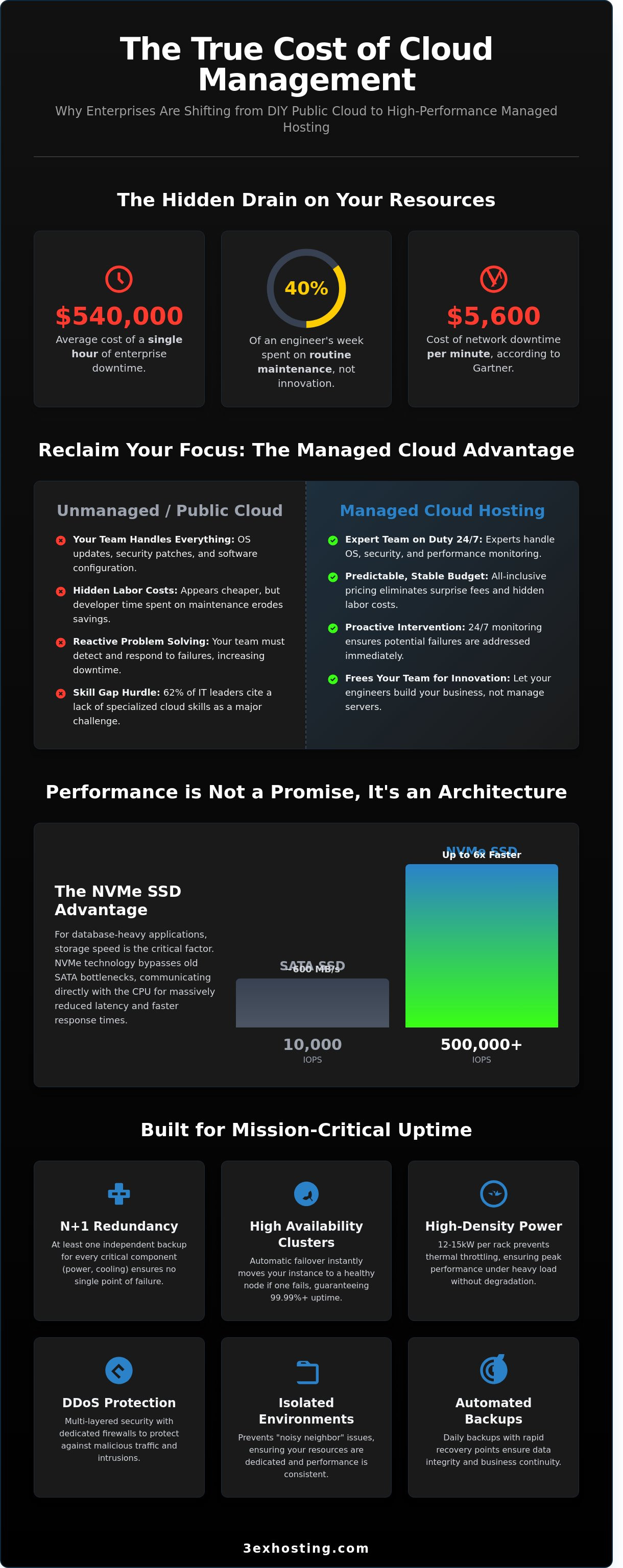
A single hour of enterprise downtime in 2026 now costs an average of $540,000 in lost revenue and recovery efforts. You likely already know that public cloud flexibility often masks a nightmare of unpredictable egress fees and security patches that drain your internal team’s focus. It’s frustrating when your brightest engineers spend 40% of their work week on routine server maintenance instead of innovation. This guide shows how managed cloud hosting eliminates these technical bottlenecks to provide 100% uptime for your mission-critical applications while stabilizing your monthly budget.
We’ll explore how combining 24/7 expert support with superfast NVMe storage creates a high-performance environment that acts as a seamless extension of your own technical team. You’ll discover the specific architecture needed to achieve sub-100ms latency and why moving away from unmanaged environments is the only way to secure your data against modern vulnerabilities. By the end of this guide, you’ll have a clear roadmap to transition from infrastructure management to pure business agility without the hidden costs of the big-box providers.
Key Takeaways
- Understand why enterprises are shifting from unmanaged public clouds to managed models to reclaim business agility and technical focus.
- Discover why the “superfast” promise requires NVMe SSD storage and N+1 redundancy to eliminate hardware-level bottlenecks and ensure reliability.
- Compare the “Big Three” public cloud providers with specialized solutions to find the perfect balance between infrastructure control and performance.
- Learn how to evaluate SLAs and Tier 3/4 data center standards to select a managed cloud hosting partner that guarantees mission-critical reliability.
- Explore how carrier-neutral connectivity and strategic carrier hotel locations provide the low-latency foundation needed for global scalability.
What is Managed Cloud Hosting? Defining the Enterprise Standard
Traditional web hosting service models often leave the technical heavy lifting to your internal team. Managed cloud hosting shifts this burden to the provider. While a standard VPS gives you a virtual slice of a server, it’s often unmanaged, meaning you’re responsible for the operating system, security updates, and software configurations. Managed cloud hosting provides a professional layer of support where experts handle OS patches, security hardening, and 24/7 performance monitoring.
Enterprises are moving away from DIY public cloud models because the complexity has become unmanageable. A 2023 industry survey found that 62% of IT leaders cite a lack of specialized cloud skills as their biggest hurdle. By choosing a managed partner, you ensure that security patches are applied within hours of release, not weeks. You must distinguish between “Managed” and “Fully Managed” options. Managed services typically cover the software stack, while fully managed solutions include the entire infrastructure layer, from the physical hardware to the virtualization layer.
Managed vs. Unmanaged Cloud: The Real Cost of Ownership
Unmanaged instances often seem cheaper at first glance. However, the hidden labor costs quickly erode those savings. If your team spends 10 hours a month on server maintenance, you’re losing thousands in productive developer time. Gartner research indicates that the average cost of network downtime is $5,600 per minute. Managed solutions provide 24/7 expert intervention, ensuring that mission-critical applications stay online. The value isn’t just in the hardware; it’s in the immediate response to potential failures.
Key Characteristics of Enterprise-Grade Cloud
True enterprise environments rely on High Availability (HA) clusters. These systems use automatic failover mechanisms; if one physical node fails, your instance moves to another healthy node instantly. This ensures 99.99% uptime for your operations. Scalability is equally important. You can grow your resources, like RAM or NVMe SSD storage, without the need to migrate to a new physical server. Security-first architecture is the final pillar, featuring:
- Dedicated firewalls and DDoS protection layers.
- Isolated environments to prevent “noisy neighbor” issues.
- Automated daily backups with rapid recovery points.
For businesses seeking this level of stability, 3EX Hosting delivers the technical foundation required for modern web applications.
The Architecture of Performance: Hardware and Infrastructure Specs
Performance isn’t a vague promise; it’s a direct result of specific hardware choices. While many providers still rely on older SATA-based SSDs, a premium managed hosting benefits from NVMe (Non-Volatile Memory Express) technology. SATA drives are limited by interface speeds originally designed for spinning disks, capping at roughly 600 MB/s. Modern NVMe drives communicate directly via the PCIe lane, delivering data transfer speeds up to 6 times faster than traditional SSDs. This hardware foundation ensures that your managed cloud hosting environment remains responsive even under heavy loads.
The NVMe Advantage for Database-Driven Apps
Database-heavy applications like WordPress or Magento require high Input/Output Operations Per Second (IOPS) to function efficiently. Standard SSDs might handle 10,000 IOPS, but NVMe drives frequently reach 500,000 IOPS or more. This massive increase in throughput reduces latency for the end-user, ensuring that complex database queries don’t hang or time out during peak traffic. NVMe storage accelerates web application response times by eliminating the bottleneck between the processor and the data layer.
Redundancy and Reliability at the Core
Uptime depends on N+1 redundancy in power and cooling systems. This configuration ensures that if a cooling unit or power module fails, a backup immediately takes over without service interruption. For enterprise-grade managed cloud hosting, we focus on high-density infrastructure that supports 12kW to 15kW per rack. This power density is vital for modern CPUs that generate significant heat when processing thousands of concurrent requests. It prevents thermal throttling, which can silently degrade your site’s performance during busy periods. Understanding your actual power consumption through metered power billing models helps optimize both performance and operational costs.
- N+1 Redundancy: At least one independent backup for every critical component.
- 2N Redundancy: Two completely independent power paths for maximum business continuity.
- High-Density Racks: Supporting resource-intensive applications without overheating.
- Tier 1 Connectivity: Direct access to global backbone providers like Lumen and Telia.
Network throughput is the final piece of the speed puzzle. By connecting to Tier 1 backbone providers, data travels across the most direct paths on the internet. This reduces the number of hops between the server and the visitor, often keeping international latency below 50ms. High-performance cross-connect services within the facility allow for 10Gbps or 100Gbps port speeds, ensuring that traffic spikes don’t cause congestion. Learn more about our enterprise data center standards to see how these systems protect your data.
If you’re ready to move your site to a platform built for stability and speed, view our high-performance plans to find your perfect fit.
Managed Cloud vs. Public Cloud vs. Colocation: Finding Your Fit
Choosing the right infrastructure determines your operational overhead and long-term scalability. While the “Big Three” (AWS, Azure, and GCP) dominate the market, they aren’t always the most efficient choice for businesses that lack a massive, in-house DevOps team. Finding your fit requires looking past the brand names to evaluate support depth and cost predictability.
Managed Cloud vs. Public Cloud (AWS/Azure/GCP)
The “Support Gap” is the biggest hurdle in the public cloud. Giants like AWS operate on a shared responsibility model. They ensure the physical data center stays powered, but you’re responsible for everything inside your virtual instance. If your database corrupts at 3 AM, an automated status page won’t help you. You’ll need to pay for enterprise support tiers that often start at $15,000 per month just to speak with a human. Managed cloud hosting closes this gap by providing 24/7 expert monitoring and hands-on management included in your plan.
Financial traps are another concern. Public clouds use complex, variable billing models where data egress fees can spike your costs unexpectedly. In a 2023 survey, 34% of IT managers cited “bill shock” as their primary cloud frustration. Managed providers use predictable, flat-rate pricing. You’ll know exactly what your bill looks like before the month starts, regardless of traffic fluctuations.
When Colocation is the Better Choice
Virtualization isn’t the answer for every workload. If your industry requires strict physical hardware isolation for SOC2 or HIPAA compliance, full cabinet colocation is the professional standard. It gives you 100% control over the silicon and networking gear. You aren’t sharing a hypervisor with other tenants, which eliminates “noisy neighbor” performance issues and satisfies the most rigid regulatory audits. With colocation, you can implement metered power solutions that provide granular visibility into your actual energy consumption, helping optimize both performance and operational costs.
Many modern enterprises now adopt a hybrid model. They integrate their existing colocation footprint with managed cloud hosting environments. This setup allows you to keep sensitive, legacy databases on private hardware while using the cloud’s agility for web front-ends and API layers. It’s a strategic way to balance the absolute control of physical hardware with the rapid deployment capabilities of the cloud. You don’t have to choose one or the other; you can bridge them to create a high-performance, stable architecture.
Key Criteria for Selecting a Managed Cloud Hosting Partner
Selecting a provider requires looking past flashy marketing banners. You must scrutinize the technical fine print of the Service Level Agreement (SLA). A 99.9% uptime guarantee sounds impressive, but it actually permits 8.77 hours of downtime every year. For a high-traffic e-commerce site, those nine hours can result in thousands of dollars in lost revenue. Seek partners offering 99.99% or higher, which limits annual downtime to just 52 minutes. This level of accountability separates professional managed cloud hosting from entry-level services.
Data center tiering provides the physical foundation for these guarantees. Tier 3 facilities offer N+1 redundancy, meaning every power and cooling component has a backup. Tier 4 facilities take this further with 2N+1 redundancy, ensuring the system survives even a total unplanned failure of one path. 3EX Hosting utilizes these high-tier environments to ensure your infrastructure remains stable regardless of external conditions. Hardware doesn’t just need to be fast; it needs to be redundant.
Evaluating Disaster Recovery and Continuity
Disaster recovery should never be a secondary thought. It’s a core feature of a resilient managed cloud hosting strategy. You must define your Recovery Time Objective (RTO) and Recovery Point Objective (RPO). RTO is the duration of time within which a business process must be restored. RPO is the maximum age of files that must be recovered from backup storage for operations to resume. 3EX Hosting maintains continuity by utilizing automated, off-site backups and rapid failover protocols. We target RPOs of less than 15 minutes for mission-critical databases to prevent data loss during unforeseen events. For organizations requiring comprehensive business continuity planning, implementing enterprise disaster recovery solutions ensures your infrastructure can withstand any crisis while maintaining predictable operational costs.
Technical Support and Remote Hands
Support is more than an online chat bot. True managed service includes 24/7 remote hands. This term refers to on-site technicians who perform physical tasks like server reboots, hardware replacements, and cable management. Outsourced call centers often lack the authority or physical access to fix hardware issues quickly. 3EX Hosting prioritizes on-site expertise to ensure hardware replacements occur within a 2-hour window. This immediate physical presence eliminates the delays associated with third-party vendors and ensures your superfast NVMe SSD storage stays online and performant.
Ensuring your technical team can get on-site quickly is another logistical layer to consider. For teams operating in major hubs like Minneapolis-St. Paul, having reliable transport partners such as Edina Taxi MN for airport and data center commutes is part of a holistic business continuity plan.
Build your digital infrastructure on a foundation of technical excellence and human expertise. Explore our Tier 3+ data center specifications today.
Optimizing Your Growth with 3EX Hosting’s Managed Cloud Solutions
3EX Hosting delivers a high-performance environment by merging carrier-neutral connectivity with enterprise-grade cloud hardware. We operate within a Tier III carrier hotel, which provides direct access to over 50 global network providers. This strategic location ensures your data takes the shortest path possible, reducing latency to under 10 milliseconds for local traffic. Reliability isn’t just a goal; it’s a structural requirement. Our infrastructure supports 99.999% uptime, which translates to less than 6 minutes of downtime per year. This stability forms the bedrock of your digital success, ensuring your services remain available during peak traffic spikes.
- Direct access to a 10Gbps network backplane for rapid data transfer.
- Redundant power feeds and cooling systems to prevent hardware failure.
- Proactive monitoring that identifies bottlenecks before they impact users.
A Tailored Approach to Infrastructure
Scaling a business requires flexibility that generic providers can’t offer. We move beyond “one-size-fits-all” models by offering highly customizable configurations. Whether you need a standard managed cloud hosting setup or dedicated private data center suites, our team builds to your exact specifications. The synergy between our networking services and cloud layers means data moves faster between your database and the end user. For enterprises seeking comprehensive regional infrastructure solutions, our South Florida managed IT infrastructure provides the carrier-neutral connectivity and N+1 redundancy that modern businesses require. 3EX Hosting’s managed cloud hosting eliminates technical debt by assuming total responsibility for hardware lifecycles and kernel-level security updates, freeing your internal resources for high-value development.
Getting Started with 3EX Hosting
Switching providers shouldn’t paralyze your operations. We’ve refined our migration process to ensure a transition with minimal downtime, often completing data transfers in a single maintenance window. You’ll start with a direct consultation where our engineers analyze your current resource usage. We don’t guess; we use actual traffic data to design your optimal cloud environment. This precision prevents over-provisioning and keeps your monthly costs predictable. Our experts are available 24/7 to ensure your environment stays optimized as your user base grows. Contact 3EX Hosting for a custom managed cloud quote to secure your infrastructure today.
Scale Your Enterprise Infrastructure for the 2026 Digital Landscape
The transition toward 2026 demands more than just standard server space. It requires a resilient architecture that eliminates single points of failure. By choosing managed cloud hosting built on N+1 power and cooling redundancy, you ensure your operations remain online during 100% of critical peak periods. Performance isn’t just about raw speed. It’s about the Tier 1 carrier neutral connectivity that slashes latency across global markets while maintaining 99.99% uptime standards for your mission-critical applications.
While this digital backbone is essential for reaching global markets, expanding a business’s physical supply chain presents its own set of challenges. Service-oriented export trading companies like Global Exclusive Trading (GET) specialize in facilitating these connections, helping businesses navigate international trade logistics.
You don’t have to manage these technical complexities alone. Our team provides 24/7 on-site remote hands support to resolve hardware issues in under 15 minutes. This technical stability allows your internal developers to focus on innovation rather than infrastructure maintenance. We’ve engineered our solutions to handle the enterprise loads of tomorrow with the superfast NVMe storage your systems require today. Every millisecond saved in 2026 will translate directly into improved user retention and higher conversion rates for your business.
Secure Your Enterprise Future with 3EX Managed Cloud
Start building a more stable and high-performing digital environment that grows alongside your ambitions.
Frequently Asked Questions
What exactly is included in ‘managed’ cloud hosting?
Managed cloud hosting includes 24/7 server monitoring, OS patching, security updates, and expert technical support. We manage the infrastructure layer to ensure your environment stays optimized. This service eliminates the need for an in-house sysadmin team, saving businesses an average of $80,000 annually in salary costs. You get a fully configured environment ready for your application without the technical burden.
How does managed cloud hosting differ from a standard VPS?
Managed cloud hosting differs from a standard VPS by providing automated scaling and professional infrastructure management. While a VPS relies on a single physical server, cloud environments utilize a cluster of 3 or more nodes for high availability. This setup prevents downtime if one hardware component fails. You get expert-level maintenance instead of managing the command line yourself.
Can I scale my resources instantly with a managed cloud plan?
Yes, you can scale your CPU and RAM resources in under 60 seconds via the control panel. Managed cloud plans provide vertical scaling to handle sudden traffic surges without downtime. This flexibility ensures your application remains stable during high-demand events. You won’t need to migrate data or change settings to increase your server’s power.
How do you ensure data security in a managed cloud environment?
We secure your data using hardware-level firewalls, 256-bit AES encryption, and automated malware scanning. Our security team applies critical OS patches within 4 hours of their release to mitigate zero-day threats. Every plan includes free SSL certificates to protect user data. This multi-layered approach ensures your environment meets modern 2024 security standards.
What is the typical uptime guarantee for enterprise managed cloud?
Our enterprise managed cloud service provides a 99.99% uptime guarantee backed by a Service Level Agreement. This translates to less than 53 minutes of total downtime per year. We use redundant 10Gbps network connections and dual power feeds to maintain this stability. If availability drops below this 99.99% mark, we issue credits to your account.
Does managed cloud hosting include automatic backups and disaster recovery?
Yes, we perform automatic daily backups with a 14-day retention period. Disaster recovery protocols allow for a full system restoration in under 30 minutes during an emergency. We store these backups on independent storage clusters to prevent data loss. You can also create manual snapshots through the dashboard before performing software updates.
Is managed cloud hosting more expensive than public cloud?
Managed cloud hosting typically costs 25% more than unmanaged public cloud, but it lowers your total operational expenses. You save the $6,500 monthly salary of a dedicated sysadmin because our team handles the technical labor. The price includes premium security tools and 24/7 expert support. It’s a cost-effective way to access high-end infrastructure without the management headache.
How does NVMe storage improve my application’s performance?
NVMe storage delivers up to 5 times higher throughput than traditional SATA SSDs. This technology reduces data latency to under 20 microseconds, which accelerates database-heavy applications like WordPress or Magento. Your site visitors experience faster load times and smoother interactions. Our superfast NVMe drives provide the hardware performance needed for modern, high-traffic websites.