 SUPPORT


 3EX United States
 Blog
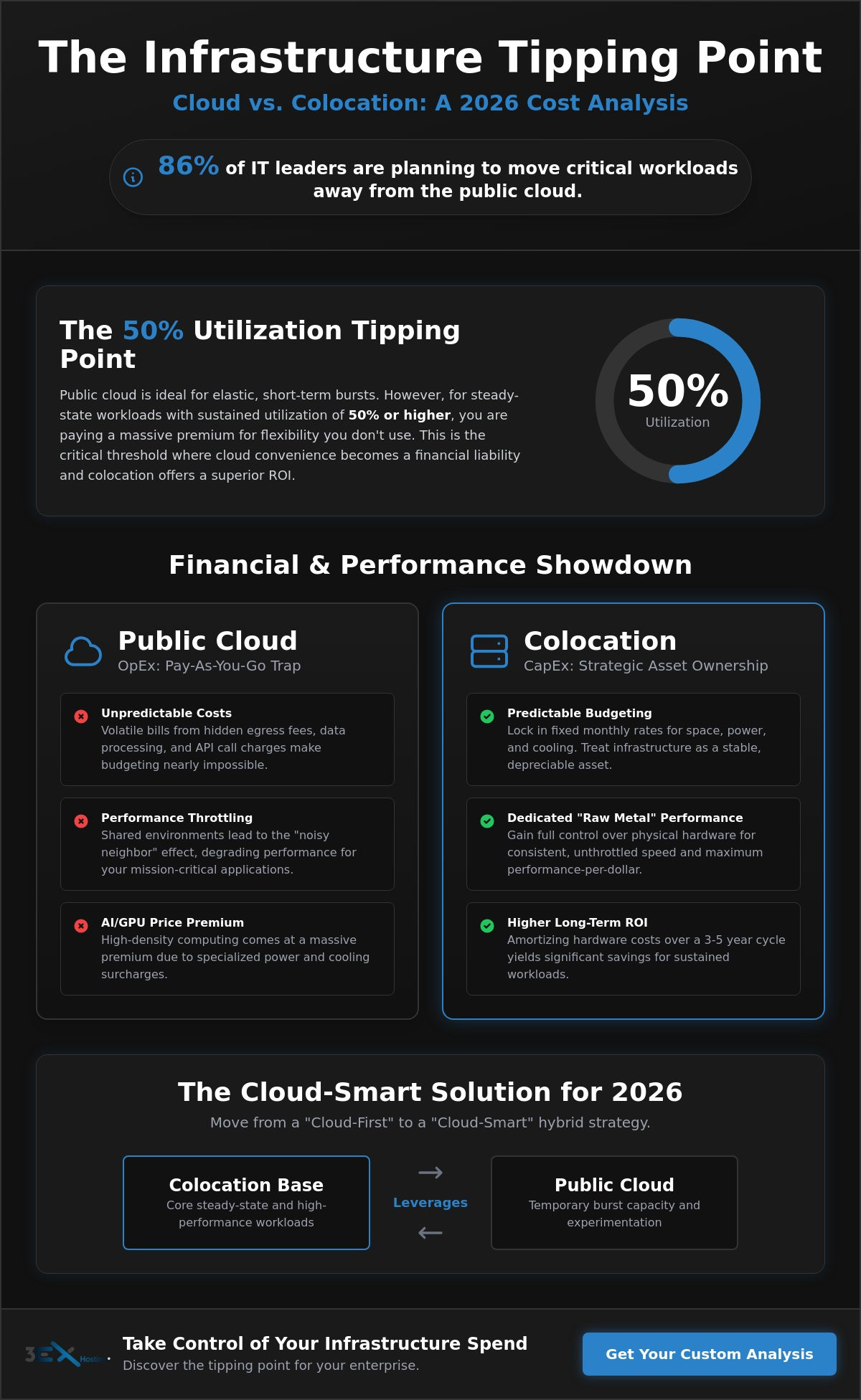
Did you know that 86% of enterprise IT leaders are currently planning to move critical workloads away from the public cloud and back to private infrastructure? You likely adopted the cloud for its agility, but now you’re facing monthly bills inflated by unpredictable egress fees and hidden processing charges. It’s frustrating to lose physical hardware control while paying a premium for multi-tenant environments that often throttle performance. We know that for modern scaling, technical stability and cost predictability are non-negotiable requirements.
This cloud vs colocation cost analysis provides the exact financial framework you need to identify your infrastructure tipping point in 2026. You’ll discover the specific scale where hardware ownership yields a higher ROI than public cloud instances, especially for compute-intensive AI and GPU loads. We’ll break down the real-world math behind data transfer costs and power density. This guide ensures your next architectural decision leads to a stable, high-performance environment where your budget finally aligns with your technical needs.
Key Takeaways
- Identify the 50% utilization threshold where steady-state workloads transition from a cloud asset to a significant financial liability.
- Use our cloud vs colocation cost analysis framework to calculate the impact of hidden egress fees and NAT gateway processing charges on your total cost of ownership.
- Understand why high-density AI and GPU workloads require specialized cooling and power infrastructure that public clouds often provide at a massive price premium.
- Master the hybrid infrastructure strategy that leverages public cloud for temporary burst capacity while maintaining a predictable, high-performance colocation base.
- Restructure your infrastructure spend to move away from volatile OpEx models toward a stable, high-ROI physical hardware environment.
The 2026 Infrastructure Shift: Why Enterprises are Re-evaluating Cloud Costs
The 2026 fiscal year marks a definitive turning point for enterprise infrastructure. Many organizations are moving away from a cloud-first mandate toward a “cloud-smart” strategy. This trend, commonly known as cloud repatriation, isn’t a retreat from modern technology. Instead, it’s a calculated financial response to the rising costs of public utility computing. A rigorous cloud vs colocation cost analysis reveals that the initial promise of cloud agility often disappears under the weight of “cloud sprawl.” This phenomenon occurs when unmanaged instances, forgotten snapshots, and unoptimized storage tiers create a massive, invisible drain on IT budgets.
The global landscape has changed. New 2026 energy efficiency standards have forced many data center providers to upgrade their cooling and power delivery systems. While these upgrades improve sustainability, public cloud giants are passing these infrastructure costs directly to the consumer through increased instance pricing and hidden surcharges. In contrast, fixed-cost colocation models allow enterprises to lock in rates and benefit from modern, high-efficiency facilities without the variable “processing fees” found in the cloud. You gain the benefits of modern hardware without the price volatility.
The OpEx vs. CapEx Debate in Modern IT
CFOs are increasingly looking to move away from purely consumption-based models for their core services. While OpEx provides short-term liquidity, it lacks the long-term price stability required for enterprise scaling. Owning depreciable hardware assets provides a clear path to lower total cost of ownership over a three to five-year cycle. The “pay-as-you-go” model is excellent for experimentation, but it’s a trap for sustained, high-volume workloads. Transitioning to a Colocation centre allows your finance team to treat infrastructure as a predictable asset rather than a volatile monthly expense. This shift ensures that your technical growth doesn’t outpace your budget.
Performance-per-Dollar: Cloud Throttling vs. Raw Metal
Shared environments introduce the “noisy neighbor” effect, where other tenants’ resource spikes directly impact your application’s speed. This performance throttling is a hidden cost that degrades user experience and increases processing time. Mission-critical workloads require dedicated physical resources to maintain consistent output. You can’t afford performance variance when running complex calculations or real-time services. Integrating these workloads into a managed it infrastructure ensures that every dollar spent translates into raw compute power. Dedicated hardware provides the stability and speed that multi-tenant clouds simply cannot match in 2026.
The Tipping Point: Quantifying the Cost of Cloud vs. Colocation
Achieving true economies of scale requires looking beyond the monthly bill and accounting for the hardware lifecycle. While colocation requires an initial investment in physical servers, amortizing that cost over a three to five-year refresh cycle often results in significant savings. Unlike the cloud, where you pay for every gigabyte of RAM every hour, colocation allows you to maximize the output of your physical assets. By deploying full cabinet colocation, you can densify your compute resources without the incremental “per-instance” price hikes found in multi-tenant environments.
Modeling the Monthly Spend
To build an accurate model, you must compare two very different cost structures:
- Public Cloud: Includes VM instance rates, premium managed services, and the volatile cost of data egress.
- Colocation: Consists of rack space, metered power, cross-connect bandwidth, and occasional remote hands support.
The infrastructure tipping point is reached when the fixed costs of rack density and power cooling become lower than the variable hourly rates of equivalent cloud compute instances.
Scale Transitions for Enterprise Growth
As your data footprint expands, your infrastructure needs to evolve. Small deployments might start in shared environments, but growth eventually dictates a move to more isolated setups. Transitioning from a single rack to private colocation suites provides the physical security and custom power configurations necessary for large-scale operations. For organizations with strict regulatory requirements, the ROI of cage solutions is found in the simplified compliance audits and enhanced physical barrier controls. If you’re unsure where your workloads sit on this curve, you can request a custom infrastructure assessment to see the numbers for your specific configuration.
The Hidden Cost Killers: Egress Fees vs. Remote Hands ROI
A comprehensive cloud vs colocation cost analysis isn’t complete without investigating the operational expenses that don’t appear on a standard instance price list. While compute and storage are easy to model, variable fees often disrupt even the most disciplined IT budgets. In 2026, the primary “hidden” expense remains data egress. Public cloud providers frequently charge between $0.087 and $0.12 per GB for data leaving their network. If your enterprise moves 50TB of data monthly, you could be looking at thousands of dollars in “exit taxes” alone. This volatility makes financial forecasting nearly impossible for data-intensive organizations.
Carrier-neutral colocation facilities provide a direct solution to this problem. By utilizing cross-connect services, you can establish direct links to multiple providers without the per-gigabyte penalty. This environment allows you to negotiate bandwidth rates directly with carriers, turning a variable cloud tax into a predictable fixed cost. Additionally, maintaining reliability doesn’t require a premium managed service tier. Standard N+1 redundancy in power and cooling ensures your hardware remains operational without the “high-availability” surcharge typical of public cloud platforms.
Egress Fees: The Public Cloud Tax
The true cost of cloud data movement often includes layers of hidden processing. For example, AWS currently charges a NAT Gateway processing fee of $0.045 per GB on top of standard egress rates. These micro-charges accumulate rapidly in modern microservices architectures. Colocation removes these layers by providing transparent bandwidth models. You gain low-latency interconnections and the freedom to move data between your infrastructure and partners without fear of a massive end-of-month bill. It’s about moving from a consumption-based penalty to an infrastructure-based advantage.
Remote Hands: Eliminating the Travel Premium
Staffing a data center with internal employees is a significant capital and operational drain. Beyond the base salary, you must account for benefits, training, and the “travel premium” when issues arise after hours. Leveraging remote hands support changes this equation. With industry-standard hourly rates ranging from $165 to $175, you only pay for the technical expertise you use. This model provides 24/7 on-site support for tasks like hardware troubleshooting, cable management, and inventory audits.
By utilizing remote hands support, your senior engineers can focus on high-level architecture instead of physical maintenance. You can even simplify your initial setup phase with specialized move-in assistance. This service ensures your racks are professionally configured and labeled from day one, reducing the risk of human error during deployment. It’s a pragmatic approach to staffing that prioritizes technical stability while controlling long-term labor costs.
High-Density AI and GPU Hosting: A Specialized Cost Analysis
Artificial Intelligence workloads are the primary disruptors of traditional IT budgeting in 2026. While the public cloud offers immediate access to specialized hardware, the price premium for on-demand GPU instances has become a significant barrier to enterprise scaling. A detailed cloud vs colocation cost analysis shows that for persistent machine learning tasks, the markup on cloud-based NVIDIA H100 or B200 instances can be three to five times higher than the cost of owning the same hardware. When these chips run at 80% or 90% utilization for model training, the “pay-as-you-go” model quickly becomes a financial drain.
The challenge isn’t just the cost of the silicon. It’s the infrastructure required to keep it running. High-density AI clusters often demand 15kW to 50kW per rack, which far exceeds the capabilities of standard enterprise data centers. Specialized high density GPU colocation facilities are designed specifically for these thermal loads. They utilize advanced containment and liquid cooling technologies to prevent performance throttling. This ensures your expensive GPU assets operate at peak clock speeds without the thermal overhead costs that hyperscalers bake into their hourly rates.
AI Infrastructure: Build vs. Rent
Deciding between renting cloud GPUs and building your own cluster depends on your training cycle duration. While renting is ideal for short-term experimentation, any workload lasting longer than nine months typically favors ownership. You must also factor in the high-performance cooling requirements. Dedicated GPU server hosting in a colocation environment provides the physical control needed to optimize your hardware for specific neural network architectures. This long-term ROI is driven by avoiding the 200% to 400% margin that public cloud providers add to their hardware procurement and management costs.
Scalability for Machine Learning
Managing the power costs of massive AI training sets requires a granular approach to infrastructure. High-density environments prevent performance bottlenecks by placing compute resources in close physical proximity, which reduces latency in NVLink or InfiniBand fabrics. Specialized cabinets designed for high-kilowatt loads allow you to pack more compute power into a smaller footprint. This density reduces your overall data center spend while providing the technical stability your AI models require. If you’re planning an AI rollout, you can request a technical consultation to model your specific GPU power and cooling requirements.
Developing Your Cost-Optimized Hybrid Infrastructure
Developing a robust cloud vs colocation cost analysis requires looking at your infrastructure as a unified ecosystem rather than separate silos. The most successful enterprises in 2026 don’t choose one over the other; they adopt a “Best of Both Worlds” strategy. This model uses the public cloud for highly elastic, temporary burst capacity and colocation for the predictable, steady-state base load. By moving your high-utilization workloads to a fixed-cost environment, you eliminate the volatility that plagues modern IT budgets. It’s a pragmatic shift that prioritizes technical stability and long-term financial health.
Auditing your current cloud bill is the first step toward optimization. Look for instances that have been running 24/7 for more than six months. These are your primary candidates for repatriation. You should also identify services with high data gravity, such as large databases or AI training sets, where egress fees are disproportionately high. Transitioning these specific components to physical hardware can slash your monthly spend while improving raw performance. When you’re ready to model these savings, you can get a quote for a custom enterprise solution tailored to your specific rack and power needs.
The Hybrid Cloud Decision Matrix
Classifying your workloads is essential for a successful migration. High-utilization tasks with significant data gravity belong in colocation to avoid the consumption-based penalties of the cloud. Conversely, development environments or seasonal web traffic are better suited for the cloud’s elasticity. To make this work, you must establish secure, low-latency links between your physical hardware and cloud providers. This integrated approach ensures business continuity. It also allows your disaster recovery protocols to span both environments, providing a higher level of resilience than a single-provider strategy can offer.
Future-Proofing Your Infrastructure
Infrastructure planning must look beyond the current fiscal year. As we move toward 2027 and 2030, power requirements and rack densities will only increase. Choosing a facility with carrier hotel access is vital for maintaining network flexibility. This allows you to switch carriers or adjust bandwidth without physical relocation. Before finalizing your transition, use this checklist to ensure success:
- Identify all “always-on” instances with >50% sustained utilization.
- Calculate total monthly egress fees across all cloud regions.
- Verify the power density capabilities for your next-generation hardware.
- Establish a clear timeline for hardware procurement and move-in assistance.
- Audit your security and compliance requirements for physical isolation.
A well-executed hybrid model provides the technical foundation your business needs to scale. It’s about taking control of your hardware while retaining the agility to innovate. This balance is the hallmark of a mature, cost-optimized enterprise infrastructure.
Master Your Infrastructure ROI for 2026 and Beyond
Finding the right balance between agility and stability is the key to successful enterprise scaling. This cloud vs colocation cost analysis highlights that steady-state workloads and data-heavy AI training sets are significantly more efficient on physical hardware. By addressing the hidden drain of egress fees and the performance limitations of multi-tenant environments, you can secure a more predictable financial future. Transitioning to a hybrid model allows you to maintain the flexibility of the cloud while enjoying the raw power and cost-efficiency of dedicated infrastructure.
We provide the technical foundation required for these high-performance operations. Our facilities feature carrier hotel connectivity for maximum network flexibility and high-density AI/GPU ready racks to support your most demanding compute cycles. With 24/7 Remote Hands Support, your systems are always in expert hands. This allows your team to focus on high-level innovation rather than physical maintenance. You can request a custom colocation cost analysis from 3EX Hosting to see exactly how much your organization can save. Take control of your infrastructure today and build a foundation that supports your long-term growth.
Frequently Asked Questions
Is colocation always cheaper than the public cloud for small businesses?
How do egress fees impact the total cost of ownership (TCO) in the cloud?
Egress fees act as a variable tax that can inflate your monthly bill by 20% to 30% depending on your data movement. In a comprehensive cloud vs colocation cost analysis, these fees are often the primary driver for repatriation. While cloud providers charge per gigabyte to move data out, colocation bandwidth models are usually based on fixed port speeds or 95th percentile billing, providing much greater budget stability.
What is the typical ROI period when moving from cloud to colocation?
Most enterprises achieve a full return on investment within 9 to 18 months of migrating. This timeline accounts for the initial capital expenditure of purchasing hardware and the one-time setup fees at the facility. Once the hardware is amortized, the monthly operational savings are substantial. For steady-state workloads, the long-term cost of ownership is frequently 40% to 60% lower than equivalent cloud services.
Does colocation require me to have my own IT staff on-site at the data center?
You don’t need to maintain a local presence at the data center to manage your infrastructure effectively. Professional facilities provide remote hands services to perform physical tasks like hardware reboots, cable management, and component replacements. Your internal team can focus on high-level system administration and architecture from your primary office while the data center staff handles the physical layer 24/7.
How does high-density power usage affect my monthly colocation bill?
Power is a significant component of colocation pricing, usually billed via a fixed circuit rate or metered consumption. While high-density AI and GPU loads require more power and specialized cooling, the cost per kilowatt in a data center is far more efficient than cloud compute pricing. Modern facilities use advanced containment to manage these thermal loads without passing on the massive “premium instance” surcharges found in public clouds.
Can I integrate my existing AWS or Azure environment with a colocation cabinet?
Yes, you can easily build a hybrid environment by using direct cloud on-ramps or dedicated cross-connects. This allows you to keep sensitive databases and high-utilization compute on your own physical hardware while using the public cloud for burst capacity or global content delivery. It’s an effective way to optimize costs without losing the agility of cloud-native services for specific development tasks.
What are the primary “hidden costs” I should look for in a colocation contract?
You should carefully review the contract for cross-connect fees, setup charges for new circuits, and minimum billing increments for remote hands. Some providers also include annual power rate escalators or “inbound” logistics fees for receiving hardware shipments. Understanding these small charges upfront ensures your cloud vs colocation cost analysis remains accurate over the entire three to five-year lifecycle of your hardware.
How does the cost of GPU cloud hosting compare to owning the hardware in a data center?
Owning GPU hardware is significantly more cost-effective for any workload that runs consistently. Public cloud providers often charge a 300% to 500% markup on GPU instances to cover their own infrastructure and management overhead. For enterprises running 24/7 AI training or rendering cycles, the savings from owning the hardware and colocating it in a high-density rack can often pay for the equipment in under 12 months.