 SUPPORT


 3EX United States
 Blog
In 2026, your data center location isn’t just about real estate; it’s about the speed at which your enterprise interacts with the global market. You’ve likely felt the friction of high latency when reaching international traffic or struggled to find a facility that doesn’t throttle your AI and GPU hardware. Choosing the right Miami colocation services is no longer a luxury for national enterprises. It’s a strategic necessity to ensure your infrastructure can scale without hitting a power or connectivity ceiling.
We understand that managing remote infrastructure often feels like working with one hand tied behind your back, especially when on-site support is unresponsive. This article demonstrates how to leverage high-density Miami colocation to scale your national enterprise infrastructure with maximum uptime and seamless connectivity. We’ll examine the benefits of N+1 redundancy, the impact of direct dark fiber access to major carrier hotels like the NAP of the Americas, and how 24/7 technical support acts as a true extension of your team. You’ll see how a stable technical foundation and expert support can turn your infrastructure into a competitive advantage.
Key Takeaways
- Understand how Miami’s status as a carrier hotel hub reduces latency for international traffic and strengthens national network topology.
- Learn how 24/7 remote hands support acts as an extension of your team, eliminating the need for costly IT travel for routine maintenance.
- Compare full cabinet colocation and private suites to determine the most secure and scalable footprint for your enterprise data requirements.
- Discover how to leverage high-density Miami colocation services to meet the specialized power and cooling demands of AI and GPU clusters.
- Identify the critical role of N+1 redundancy and high-performance cross-connects in maintaining maximum uptime for mission-critical applications.
Why Miami Colocation Services are a Strategic Hub for National Scaling
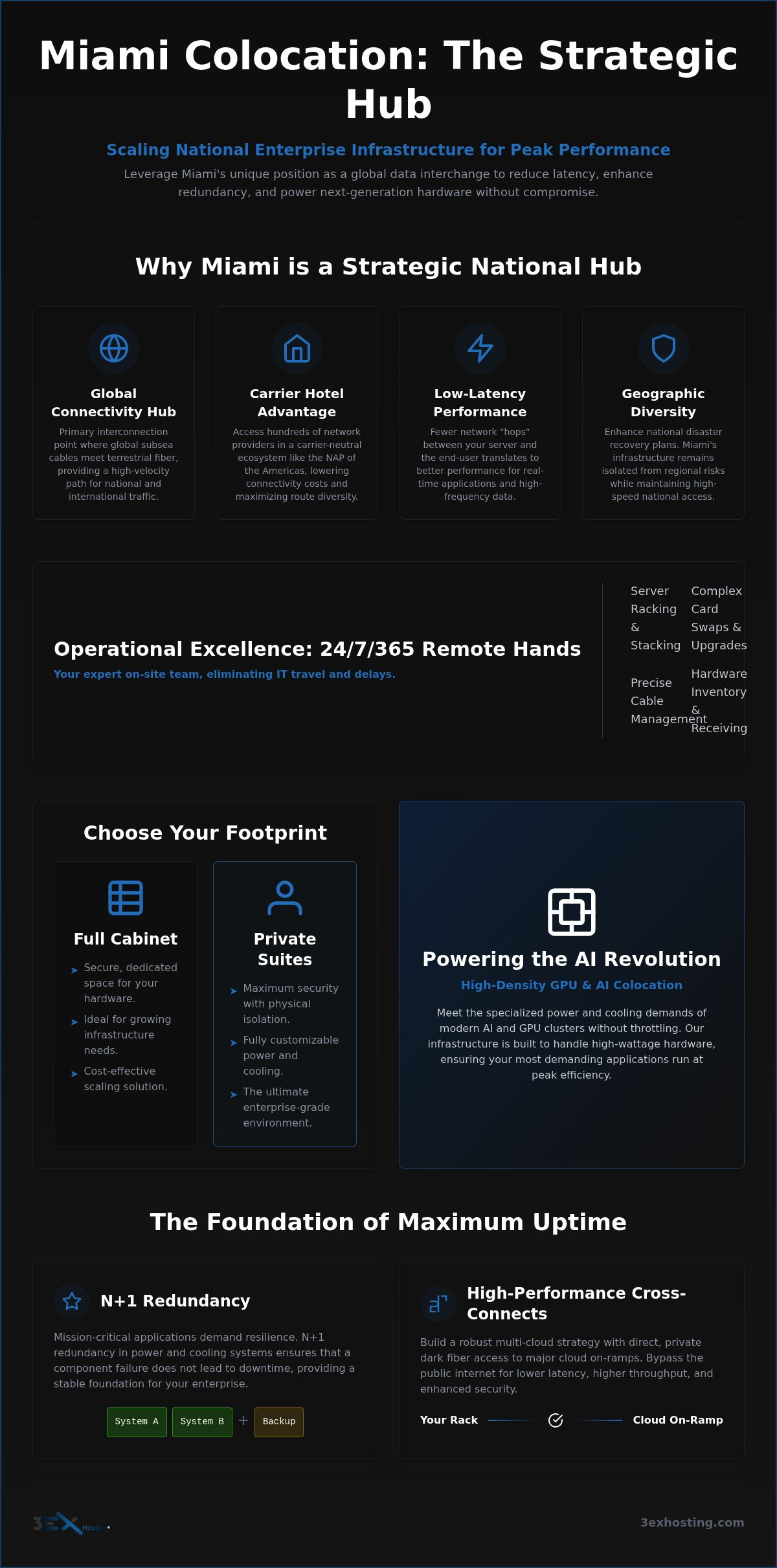
National enterprises often view Miami solely as a regional gateway to Latin America. This narrow perspective overlooks its role as a critical pillar in North American network topology. For a firm headquartered in the Northeast or Midwest, Miami colocation services provide a strategic advantage that inland data hubs simply cannot replicate. The city serves as a primary interconnection point where global subsea cables meet terrestrial fiber backbones. This creates a high-velocity environment for data that requires both national reach and international low-latency routing. It’s a technical foundation built for speed and long-term expansion.
The Carrier Hotel Advantage
A colocation centre with carrier hotel status functions as a massive network ecosystem. In these facilities, hundreds of network providers, ISPs, and content delivery networks converge in a single location. This density is a primary driver for national scaling. Carrier-neutral environments allow you to negotiate directly with multiple providers. This lowers long-term connectivity costs compared to single-provider sites. The arrival of new subsea cables in 2026 further cements this position. These cables bypass traditional congestion points, providing a direct, high-performance path for national backbone traffic. It’s about more than just proximity; it’s about the sheer volume of available routes and the redundancy they provide.
Positioning for Global and Domestic Traffic
Miami is home to the NAP of the Americas, one of the most significant interconnection points globally. For enterprises, this means fewer “hops” between your server and the end user. Whether you’re handling real-time application data or high-frequency trading, every millisecond saved translates to better performance. By integrating with specialized cross-connect services, your team can build a robust multi-cloud strategy. You gain direct, private access to major cloud on-ramps without the latency or security risks associated with the public internet. This setup ensures that your data moves across the most efficient path possible, regardless of its destination.
Geographic diversity is another critical factor for national infrastructure. Utilizing Miami as part of a national disaster recovery plan ensures business continuity. If a primary site in a different region faces an outage, Miami’s infrastructure remains isolated from those regional risks while maintaining high-speed access to the rest of the country. Unlike inland alternatives that may lack diverse carrier options, this hub offers the redundancy required for mission-critical applications. It provides a stable, high-performance environment that scales as your enterprise grows. You don’t have to sacrifice speed for reliability; in this hub, you get both.
Operational Excellence: Managed IT Infrastructure and Remote Hands
Managing infrastructure from a thousand miles away presents a significant logistical risk. For national enterprises, the long-term success of Miami colocation services depends heavily on the quality of on-site technical support. Remote hands services bridge the gap between your remote engineering team and the physical hardware. By outsourcing tasks like server racking and environment monitoring, you maintain high operational standards without the logistical nightmare of relocating staff. If your business requires a physical move of personnel or assets to the region, you can learn more about professional relocation services that simplify the process. It’s a model that prioritizes uptime and technical stability through a hands-on approach.
The financial benefits of this managed approach are clear. Eliminating travel costs for IT maintenance significantly improves your bottom line. When a critical component fails, waiting for a flight is not an option for mission-critical applications. Having 24/7/365 on-site technicians ensures that your hardware is maintained with the same care your internal team would provide. Consider a scenario where a national logistics provider needed to refresh their entire edge cluster. By utilizing local experts, they completed the migration three weeks ahead of schedule. They didn’t spend a single dollar on airfare or hotel stays.
While remote hands minimize routine travel, certain strategic enterprise initiatives may still require an executive presence in Miami, especially during the city’s high-profile event seasons. For firms coordinating these visits, SP PRIME GROUP offers premium hospitality and logistics for major global events, ensuring that corporate teams have the support they need during peak travel periods.
The Scope of Remote Hands Support
Technical support in a professional facility isn’t limited to simple power cycles. Expert technicians handle everything from precise cable management to complex card swaps and server upgrades. They also provide inventory management, acting as your local receiving department for new hardware rollouts. This ensures that your equipment is inspected and secured the moment it arrives. You can read more about Remote Hands Support to see how these services streamline large-scale deployments for national firms.
Security and Compliance Protocols
Operational excellence requires a multi-layered approach to security. Physical access is restricted through biometric scanners and constant monitoring by on-site security personnel. These environments are designed to meet strict SOC2, HIPAA, and PCI standards, ensuring your infrastructure remains audit-ready at all times. Managing these systems also involves a focus on data center energy efficiency to ensure that high-density hardware operates within safe thermal limits. This level of oversight is critical for national firms integrating managed cloud hosting with physical hardware. If you’re looking to optimize your deployment, our team can help you evaluate your remote support needs today.
Full Cabinet Colocation vs. Private Suites: Choosing Your Footprint
Selecting the right physical footprint is a critical step in building a resilient national infrastructure. While shared racks might work for small-scale projects, national enterprises require the technical sovereignty found in dedicated environments. Scaling your Miami colocation services means moving beyond the limitations of shared space to ensure your hardware has the power and cooling it needs to perform. It’s a decision that impacts everything from your security posture to your ability to deploy high-density hardware clusters without hitting a resource ceiling.
The move from shared racks to dedicated space is often driven by a need for predictable performance. In a shared environment, you have little control over the airflow or power usage of your neighbors. This can lead to thermal hotspots that compromise hardware longevity. By securing a dedicated footprint, you eliminate these variables. You gain a stable environment where every watt and every BTU is accounted for and managed by your team or your on-site support partners. It’s the most effective way to ensure that mission-critical apps stay online 24/7.
Full Cabinet Colocation Benefits
Transitioning to a full cabinet provides total control over your rack layout and airflow management. This is vital for maintaining the thermal health of your servers. By optimizing for full cabinet colocation power density, you can support more hardware in a smaller footprint. You also gain dedicated power circuits and connectivity ports. This isolation prevents the “noisy neighbor” issues that can affect performance in shared environments. With N+1 power redundancy, your cabinet remains operational even during routine maintenance or unexpected circuit failures.
The Sovereignty of Private Colocation Suites
For enterprises handling sensitive data or massive hardware clusters, private colocation suites offer the highest level of physical separation. These suites allow for customizable cooling and power configurations tailored to specialized clusters, such as those used for high-frequency trading or large-scale data processing. It’s the ideal choice for firms that need an audit-ready environment with restricted access. You can explore the Guide to Colocation Sovereignty to understand how private suites support complex security and compliance requirements.
Custom cage solutions act as a middle ground, providing a secured perimeter within the data center floor. This setup is particularly effective for national enterprises that need to isolate specific project clusters, such as AI testing environments or legacy backup systems. It allows you to scale your footprint gradually without the downtime associated with migrating to a different facility. Future-proofing your infrastructure requires planning for these transitions long before your current capacity is reached. By establishing a clear growth path within a carrier hotel, you ensure that your national operations remain stable and responsive. This approach guarantees that your technical foundation is ready for the next generation of hardware deployments.
High-Density GPU Colocation: Powering the AI Revolution
Artificial intelligence and machine learning have fundamentally shifted the requirements for modern data center environments. Traditional infrastructure designed for standard web hosting often lacks the power density and cooling capacity required by modern GPU clusters. For national enterprises, Miami colocation services must provide more than just rack space; they must offer a specialized environment that supports the extreme thermal and electrical demands of AI training and inference. Deploying these high-performance systems requires a facility capable of delivering consistent, high-wattage power while maintaining strict climate controls. It’s a technical challenge that demands a partner with specialized infrastructure.
The transition to AI-driven operations means your hardware will likely exceed the limits of legacy facilities. When your power draw moves beyond the standard 5kW to 10kW per rack, the risk of thermal failure increases exponentially. Specialized Miami colocation services solve this by providing the airflow management and high-amp circuits necessary for stable operations. It’s about protecting your investment in expensive GPU hardware while ensuring that your processing power remains consistent during intensive training cycles.
Infrastructure for AI Training and Inference
Standard data centers typically fail when power requirements exceed 20kW per rack. Cooling these high-density environments is a major technical hurdle that requires advanced thermal management strategies. Without specialized cooling, GPU clusters can quickly experience thermal throttling. This leads to reduced performance or even permanent hardware damage. High-performance cross-connects are also essential here, as they provide the low-latency networking required for distributed GPU computing across multiple racks. You can check our AI Infrastructure Guide for a deeper look at the hardware requirements for modern deployments.
Power Density and Redundancy
Predictable scaling for AI workloads relies on metered power and robust redundancy. When training large models, even a brief power interruption can result in days of lost progress and corrupted datasets. This is why N+1 power redundancy is the absolute baseline for mission-critical AI operations. UPS systems and backup generators must be perfectly synchronized to ensure 24/7 uptime during any external grid event. Designing for the future of AI cloud computing hosting means ensuring that your colocation partner can increase power delivery to your racks as your hardware evolves. It’s about building a foundation that won’t require a costly migration every time you upgrade your GPUs.
Integrating colocation with GPU dedicated servers allows your team to maintain a hybrid environment that balances cost and performance. You can keep your proprietary models on physical hardware while leveraging the cloud for burst capacity. This hybrid approach ensures that your most sensitive intellectual property remains under your direct control within a secure facility. If your enterprise is ready to deploy high-density hardware, you should request a custom quote for GPU colocation to ensure your specific power and cooling needs are met.
Selecting a Miami Colocation Provider: The 3EX Hosting Advantage
Choosing a provider for your national infrastructure requires more than a simple comparison of rack space. It’s about finding a partner that understands the technical nuances of enterprise-scale deployments. Miami colocation services must offer a foundation of carrier-neutral connectivity and high-density power to be viable for modern workloads. At 3EX Hosting, we provide the technical stability and on-site expertise that national firms need to manage their remote environments with total confidence. We don’t just provide space; we provide a resilient technical foundation.
Carrier hotel status is a critical requirement for any enterprise deployment. It provides direct, low-latency access to the global network fabric without the bottlenecks of a single-provider facility. This connectivity is backed by 100% on-site technical expertise. When a configuration change is needed or a hardware issue arises, you don’t have to wait for a third-party contractor. Our technicians act as an extension of your team, providing the immediate response required to maintain mission-critical uptime. It’s a professional approach that prioritizes your system’s health over simple ticket queues.
Enterprise-Grade Reliability
Stability is the core of our service delivery. We provide N+1 power and cooling redundancy as a standard across all cabinets and suites. This ensures that your systems remain online during routine maintenance or utility interruptions. You also gain direct access to high-performance cross-connect services. These private links allow for secure, high-speed data transfer between your infrastructure and major cloud providers or network carriers. Our 24/7 NOC monitoring provides constant oversight, ensuring rapid incident response for every client deployment.
Every enterprise has unique requirements. A one-size-fits-all approach fails because it doesn’t account for the specific power draw of high-performance clusters or the sovereignty needs of sensitive data. We prioritize customization. Whether you need a single full cabinet or a private suite, we tailor the environment to your hardware. This includes managing specific thermal loads and configuring power circuits to match your equipment’s exact specifications. It’s about creating a predictable environment where your hardware can perform at its peak without resource constraints.
Next Steps for Infrastructure Deployment
Transitioning your infrastructure to a new facility shouldn’t disrupt your national operations. We offer specialized move-in assistance for firms that manage their IT remotely. This service is designed for teams who can’t be on-site for the physical deployment. We handle the receiving, unboxing, and racking of your hardware according to your exact layout requirements. If you’re ready to secure your technical foundation in a premier carrier hub, your next step is to Get a Custom Colocation Quote. We’ll work with your engineering team to design a footprint that supports your national scaling goals.
Build a Resilient Technical Foundation in Miami
Scaling national enterprise infrastructure requires a partner that understands the intersection of connectivity and power density. We’ve examined how Miami’s strategic network topology provides the low-latency backbone necessary for global and domestic traffic routing. By leveraging Miami colocation services that offer carrier hotel interconnectivity, you ensure your data moves across the most efficient paths possible. You’ve also seen how a stable technical environment, backed by N+1 redundancy, is the only way to support the extreme demands of high-density AI and GPU hardware.
Operational excellence isn’t just about the physical space; it’s about the expertise available on-site. Our 24/7 remote hands support acts as a seamless extension of your team, providing the immediate response required for mission-critical uptime. Whether you need a full cabinet or a private suite, our facility is high-density AI/GPU ready and designed for your specific scaling needs. Your infrastructure is the engine of your business; it deserves a home that prioritizes stability and performance.
If you’re ready to optimize your national deployment with expert support and world-class connectivity, we can help. Contact 3EX Hosting for Enterprise Colocation Solutions to discuss your custom requirements today. We look forward to supporting your growth.
Frequently Asked Questions
What are the benefits of Miami colocation services for national companies?
Miami serves as a strategic interconnection point for both domestic and international traffic. National firms benefit from reduced latency to Latin American markets and high-speed terrestrial fiber routes to other North American hubs. This location provides geographic diversity for disaster recovery plans while maintaining access to a dense ecosystem of carriers. It’s a technical anchor that supports national scaling without compromising speed or reliability.
How does a carrier hotel improve my network performance?
A carrier hotel improves performance by housing a massive concentration of network providers and ISPs in one facility. This density allows for direct cross-connects between your hardware and the network’s core. By reducing the physical distance and the number of hops data must take, latency is significantly lowered. This setup ensures that your mission-critical applications maintain the fastest possible path to the global internet backbone.
What is the difference between smart hands and remote hands support?
Remote hands typically involve basic physical tasks like power cycling, cable checks, or visual inspections performed by on-site staff. Smart hands services go deeper, including more complex technical work such as hardware configuration, OS installation, or troubleshooting circuit issues. Professional Miami colocation services provide comprehensive 24/7 support that covers both basic and advanced technical requirements to ensure your systems remain stable and accessible.
Can 3EX Hosting support high-density GPU colocation for AI?
Yes, 3EX Hosting is specifically engineered to support high-density GPU colocation for AI training and inference workloads. Our infrastructure handles power draws exceeding 20kW per rack, which is a requirement for modern GPU clusters. We provide the specialized cooling and N+1 power redundancy needed to maintain stable operations during intensive processing cycles. This ensures your AI infrastructure runs at peak performance without the risk of thermal throttling.
How does N+1 redundancy protect my enterprise hardware?
N+1 redundancy ensures that your enterprise hardware remains operational even if a critical power or cooling component fails. This configuration means there is always one extra module beyond what is required for the full load. If one unit goes offline for maintenance or due to a fault, the extra unit immediately takes over. This prevents downtime and protects your equipment from electrical instability or overheating during unexpected events.
What security certifications should I look for in a Miami data center?
National enterprises should prioritize facilities that hold SOC2 Type II, HIPAA, and PCI DSS compliance certifications. These audits verify that the data center follows strict protocols for physical security and operational integrity. Beyond paperwork, look for multi-layered physical security including biometric access, 24/7 on-site guards, and constant video surveillance. These layers ensure that your hardware is protected against unauthorized access and environmental threats at all times.
How quickly can new hardware be deployed using remote hands?
New hardware can often be deployed within 24 to 48 hours when utilizing professional remote hands services. By shipping equipment directly to the facility, you eliminate the need for your own team to travel. On-site technicians handle the unboxing, racking, and initial cabling according to your specifications. This rapid deployment model allows national firms to scale their infrastructure quickly across different regions without logistical delays or travel costs.
Is managed cloud hosting better than traditional colocation?
The choice depends on your specific workload and security requirements. Managed cloud hosting offers flexibility and rapid scaling for variable loads. Traditional colocation provides total control over your physical hardware and predictable costs for steady-state enterprise applications. Many national firms now adopt a hybrid model, using colocation for their core data and high-density AI workloads while leveraging the cloud for burst capacity and distributed edge services.