 SUPPORT


 3EX United States
 Blog
True enterprise performance in 2026 depends on the physical reality of your infrastructure, not just the virtual layer. For organizations operating across the Atlantic gateway, managed cloud hosting south florida has evolved into a strategic necessity that bridges the gap between local hardware and global connectivity. You likely understand the frustration of cross-continental latency and the hidden costs that emerge when unmanaged cloud scaling loses its efficiency. It’s difficult to maintain a high-performance hybrid environment when you lack direct access to carrier-neutral cross-connects or the peace of mind that comes with physical proximity to your data.
We’re here to show you how to regain control of your digital perimeter. This guide explains how to leverage N+1 redundancy and specialized high-density infrastructure to guarantee 100% uptime for your most demanding operations. You’ll discover how to integrate seamless hybrid cloud solutions while utilizing Miami’s status as a premier carrier hotel to slash transfer times. We’ll examine the technical protocols and strategic interconnects that turn your infrastructure from a cost center into a competitive advantage. The focus remains on technical stability, speed, and the reliability your enterprise requires to scale without interruption.
Key Takeaways
- Learn why modern enterprises are moving away from unmanaged public clouds toward strategic hybrid models for improved cost governance and stability.
- Explore the technical requirements for 2026, including N+1 redundancy and the power density needed to support high-performance AI clusters.
- Discover the connectivity advantages of managed cloud hosting south florida when integrated into a regional carrier hotel to minimize global latency.
- Understand how 24/7 Remote Hands and NOC support act as a direct extension of your IT team to ensure continuous operational excellence.
- Master a strategic framework for evaluating hosting partners based on their ability to scale with high-density GPU and specialized infrastructure needs.
Defining Managed Cloud Hosting for the Modern Enterprise
Enterprise infrastructure in 2026 demands more than simple uptime. It requires a strategic fusion of performance and reliability. Managed cloud hosting south florida has become the preferred choice for organizations that have outgrown the limitations of unmanaged public environments. Many enterprises are moving away from pure public models because they lack the granular control needed for complex operations. High-density infrastructure is now essential to support the intense power and cooling requirements of AI and GPU-heavy workloads. This shift allows businesses to maintain the speed of the cloud while enjoying the stability of a dedicated, professionally managed environment.
In the context of modern enterprise infrastructure, managed cloud hosting is a specialized managed hosting service that combines high-performance virtualized resources with expert-level oversight of security, connectivity, and hardware optimization.
Managed vs. Unmanaged: The Operational Gap
Managing cloud infrastructure in-house often reveals a range of hidden costs. You aren’t just paying for the virtual machines; you’re paying for the specialized talent required to secure and optimize them. Hiring and retaining these experts in a competitive market can be prohibitively expensive. Unmanaged environments frequently lead to technical debt, as internal teams often prioritize immediate deployment over long-term architectural stability. Professional management closes this operational gap through several key advantages:
- Automated Security Patching: Systems are kept current without diverting internal resources.
- Compliance Alignment: Expert oversight helps meet standards like PCI DSS 4.0 and FIPA.
- Optimized Performance: Continuous monitoring identifies and resolves bottlenecks before they impact users.
This specialized support is particularly critical in light of the Florida Information Protection Act (FIPA), which requires rapid data breach notification. Entrusting these tasks to a partner reduces risk and allows your internal team to focus on innovation rather than maintenance. It’s a more efficient way to manage complexity as your organization scales.
Hybrid Cloud Synergy with Colocation
The most effective enterprise strategies often involve a blend of private and public resources. Integrating physical server cabinets with virtualized cloud environments provides a level of flexibility that pure cloud models can’t match. By utilizing full cabinet colocation for your hybrid cloud backend, you maintain absolute control over your most sensitive data. This setup ensures data sovereignty through private, dedicated hardware while still benefiting from the rapid scalability of the cloud. It’s a logical approach that pairs physical security with digital flexibility. Direct access to your hardware in a local facility simplifies troubleshooting and allows for custom hardware configurations that are impossible in a public cloud. This hybrid synergy ensures your infrastructure can grow alongside your business without sacrificing performance or security, making it a cornerstone of effective managed cloud hosting south florida.
Technical Pillars of High-Availability Infrastructure
High availability for enterprise operations isn’t achieved through software alone. It requires a robust physical foundation. When selecting managed cloud hosting south florida, you must evaluate the underlying infrastructure that supports your virtual environment. The standard for 2026 has shifted toward N+1 or even 2N redundancy levels. This ensures that even if a critical component fails, your mission-critical applications stay online without interruption. Professional management ensures these transitions happen without manual intervention.
Power density is another crucial pillar. As AI and cloud computing clusters become more prevalent, data centers must support higher kilowatt-per-rack requirements. Modern high-performance cloud nodes generate significant heat. This requires advanced cooling strategies, such as liquid cooling or optimized cold-aisle containment, to prevent thermal throttling. Without these technical foundations, your managed cloud cannot sustain the performance levels required for modern enterprise workloads. We prioritize technical stability by ensuring every rack is engineered for maximum thermal efficiency and power reliability.
Redundancy and Business Continuity
Effective business continuity relies on the mechanics of automated failover. In a professionally managed cloud, this process is invisible to the end user. Your workloads transition to redundant hardware the moment a fault is detected. These disaster recovery solutions are baked into the hosting layer itself. It isn’t enough to have redundant parts; they must be tested. Regular auditing of power and cooling systems is non-negotiable. This proactive approach ensures that redundancy isn’t just a theoretical promise but a functional reality when you need it most.
Security Architecture and Data Protection
Security must be layered from the physical floor to the virtual hypervisor. SOC 2 compliance and biometric access controls provide the first line of defense at the facility level. For organizations with extreme security requirements, implementing cage solutions for their high-security cloud hardware adds an extra layer of physical isolation. This prevents unauthorized physical contact with the servers running your private cloud environment.
Inside the ecosystem, data protection involves encryption at rest and in transit. This ensures that your information remains secure even within the data center’s internal network. By combining physical barriers with sophisticated digital protocols, you create a defensive perimeter that addresses both modern cyber threats and physical vulnerabilities. If you’re ready to see how these technical pillars support your specific goals, you can request a technical consultation to review your infrastructure requirements.
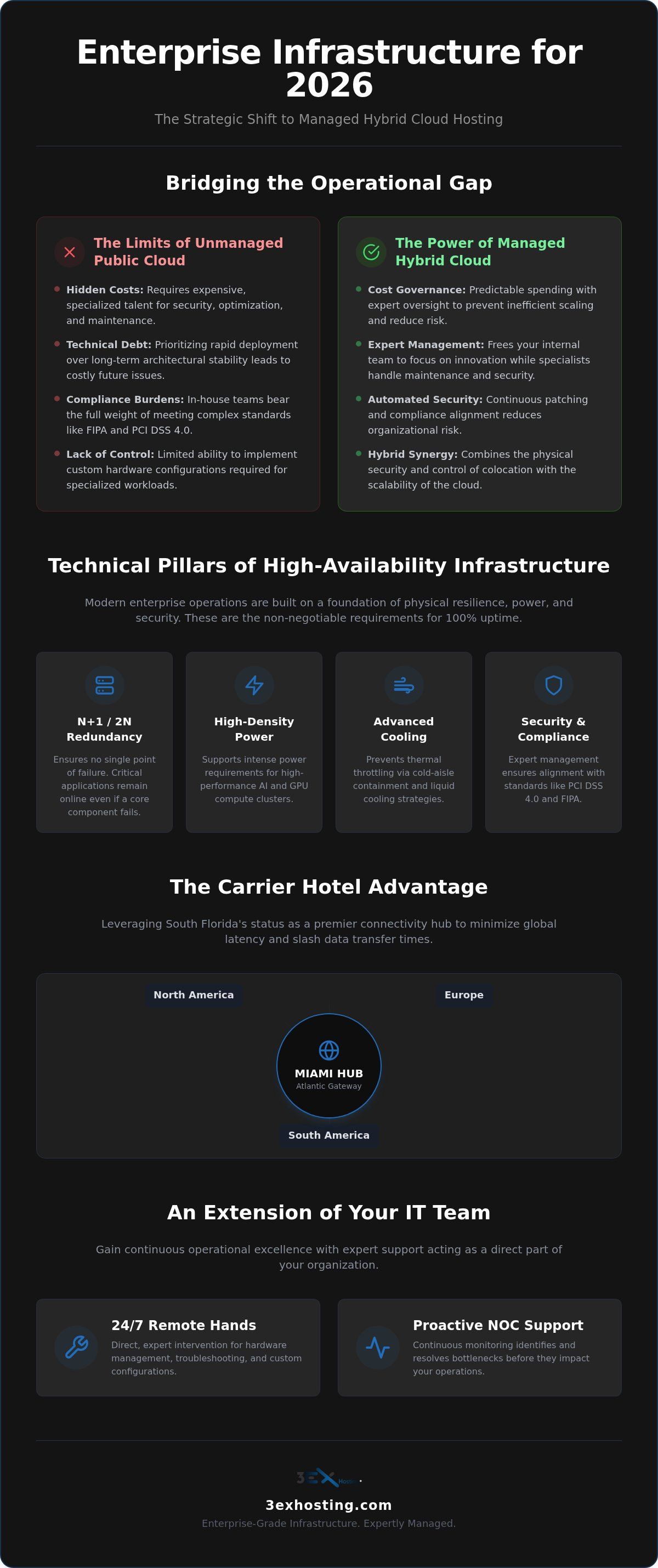
The Carrier Hotel Advantage: Connectivity and Latency
A carrier hotel is a specialized data center facility that houses equipment for a high concentration of network service providers. For organizations utilizing managed cloud hosting south florida, this environment is the engine room of performance. When your cloud nodes reside within a carrier hotel, you gain direct access to a massive ecosystem of global carriers. This physical proximity significantly reduces latency by minimizing the distance data must travel before hitting a major network backbone. It’s a technical advantage that software-only solutions simply cannot replicate. Carrier-neutrality further enhances this by ensuring you aren’t locked into a single provider. Instead, you benefit from a competitive marketplace that drives down costs while increasing network reliability.
Strategic cross-connect services eliminate the “middleman” in network traffic by establishing direct, physical fiber links between your cloud infrastructure and the carrier’s network equipment. This bypasses the unpredictable hops of the public internet entirely. It ensures that your data takes the shortest possible path to its destination, providing a level of speed and security that is essential for enterprise-grade operations.
Low-Latency Cross-Connect Services
Direct fiber interconnections represent the gold standard for network performance. These cross-connect services provide a dedicated, private path for your data. For enterprises with national user bases, this means application response times are measured in low milliseconds. This level of precision is non-negotiable for sectors like high-frequency trading and real-time data analytics. When your business model depends on instant data processing, direct connectivity becomes a critical component of your managed cloud hosting south florida strategy. It removes the variables of the public web and replaces them with predictable, high-speed performance.
Strategic Global Interconnectivity
South Florida, specifically Miami, serves as the primary subsea cable gateway between North America, Latin America, and the Caribbean. By positioning your managed cloud in this regional hub, you leverage a massive concentration of international fiber. This strategic location facilitates rapid scaling to new markets without the need for deploying physical hardware in every country. The architecture includes redundant network paths to prevent single points of failure. Your traffic always finds the fastest and most stable route available. This global interconnectivity ensures your enterprise remains responsive to a worldwide audience while maintaining a centralized, high-performance backend.
Operational Excellence: Remote Hands and NOC Support
Operational excellence in a managed environment relies on the human element. Managed cloud hosting south florida isn’t just a set of virtualized servers; it’s a physical ecosystem that requires constant vigilance. A dedicated Network Operations Center (NOC) provides real-time monitoring of every system, from power distribution units to network switches. This proactive oversight ensures that technical issues are identified and mitigated before they impact your end users. When you offload the burden of physical hardware management, your team can focus on the applications that drive your business forward.
One of the most significant benefits of professional management is the drastic reduction in Mean Time to Repair (MTTR). In an unmanaged environment, a hardware failure might require your internal team to travel to the facility, which often results in hours of unnecessary downtime. With on-site support, specialized data center technicians are available immediately to swap components or troubleshoot physical connections. This level of responsiveness is a cornerstone of a high-availability strategy. It ensures that your infrastructure remains resilient without requiring your staff to be physically present at the data center floor.
Maximizing ROI with Remote Hands Support
Offloading hardware maintenance to remote hands support allows your internal IT staff to focus on high-value development rather than routine maintenance. These technicians act as an extension of your team, performing tasks that would otherwise require emergency travel. Common services include:
- Server reboots and power cycling.
- Physical cable management and port labeling.
- Hardware replacements and upgrades.
- Visual inspections of equipment status lights.
This on-site support eliminates the need for expensive emergency IT travel and ensures that physical issues are resolved in minutes rather than hours. For a deeper look at how this impacts your bottom line, review our case study on the Enterprise Guide to Data Center Efficiency in 2026.
Migration and Move-In Assistance
The transition from an on-premise environment to a managed cloud requires careful planning to avoid service interruptions. Complex infrastructure deployments can be simplified by leveraging move-in assistance. This service covers the physical logistics of getting your hardware racked, stacked, and connected to the high-speed network backbone. Once the migration is complete, the focus shifts to post-migration optimization. Technicians ensure that your cloud environment is tuned for performance, verifying that storage arrays and network routes are operating at peak efficiency. This methodical approach ensures your managed cloud hosting south florida environment is stable from day one.
Streamline your infrastructure management by requesting an operational assessment from our technical team.
Selecting Your Managed Cloud Partner: A Strategic Framework
Selecting a partner for managed cloud hosting south florida requires a framework that accounts for both current performance and future expansion. You shouldn’t view this as a simple vendor selection; it’s a strategic alliance that determines your operational resilience. A primary criterion is the provider’s ability to support specialized, high-performance hardware. If a provider can demonstrate expertise in high-density GPU colocation, they likely possess the power and cooling infrastructure necessary to handle your most demanding cloud clusters. This technical depth is essential as workloads become more resource-intensive.
Compliance and transparency are equally critical. Beyond standard SOC 2 reports, look for alignment with the NIST Cybersecurity Framework (CSF) 2.0, which emphasizes governance as a core pillar of risk management. Your partner must also help you navigate local regulations like the Florida Information Protection Act (FIPA). Transparent Service Level Agreements (SLAs) should provide clear metrics for response times and technical accountability. Avoid generic uptime promises; instead, seek detailed commitments regarding Network Operations Center (NOC) availability and hardware replacement timelines.
As you evaluate potential partners, you can check out Telx Computers to see how they integrate these technical and compliance standards into their managed IT services.
Infrastructure Sovereignty and Private Suites
As your organization scales, the limitations of shared cloud environments often become apparent. Upgrading to private data center suites provides a level of infrastructure sovereignty that shared models cannot match. This move allows you to customize your cloud cage to meet specific regulatory requirements, ensuring that your hardware is physically isolated from other tenants. For a deeper analysis of these benefits, refer to our guide on Enterprise Private Suites: The Comprehensive Guide to Colocation Sovereignty in 2026. This transition ensures you maintain absolute control over your digital perimeter while still benefiting from professional management.
Future-Proofing for AI and High-Density Workloads
Preparing your environment for the AI training demands of 2026 requires careful planning. You must evaluate a provider’s power and cooling headroom to ensure they can support future growth without requiring a disruptive migration. High-density workloads generate extreme heat, so verify that the facility uses advanced thermal management protocols. A partner who understands these requirements today will prevent bottlenecks tomorrow. It’s about ensuring your managed cloud hosting south florida strategy remains viable as technology evolves. If you’re ready to design a solution tailored to your specific technical needs, you can get a custom quote for your enterprise managed cloud needs and begin building a more resilient foundation.
Securing Your Infrastructure for the Next Decade of Growth
Modern enterprise success is no longer just about software efficiency. It’s about the physical stability and connectivity of your backend systems. By integrating managed cloud hosting south florida with a regional carrier neutral hub, you eliminate the latency bottlenecks that often hinder global performance. You’ve seen how N+1 power redundancy and high-density technical specifications ensure that your mission-critical AI and cloud computing clusters remain operational regardless of external variables. These technical foundations are the difference between a reactive IT posture and a proactive growth strategy.
Scale your infrastructure with 3EX Hosting Managed Cloud Solutions today. We’re ready to help you build a more resilient and high-performing future for your enterprise.
Frequently Asked Questions
What is the difference between managed cloud hosting and standard VPS hosting?
Managed cloud hosting provides expert oversight of the operating system, security patching, and hardware optimization, whereas standard VPS hosting is typically self-managed. While a VPS gives you a slice of a server, managed cloud offers a scalable, high-availability environment backed by a professional technical team. This ensures your infrastructure remains secure and performant without requiring your internal staff to handle routine maintenance or troubleshooting.
How does being in a carrier hotel improve cloud latency for my business?
Being in a carrier hotel minimizes the physical distance between your cloud infrastructure and major network backbones. These facilities house a high concentration of carriers, allowing for direct fiber cross-connects that bypass the public internet. In South Florida, this proximity to subsea cable landing points ensures the lowest possible latency for data traveling between North America, Latin America, and the Caribbean.
Can managed cloud hosting support high-density GPU and AI workloads?
Yes, managed cloud hosting south florida is specifically designed to handle the intense power and cooling requirements of AI and GPU clusters. These workloads generate significant heat and require specialized rack configurations. A high-density environment ensures that your hardware operates at peak efficiency without thermal throttling, providing the stability needed for complex AI training and real-time data processing tasks.
What kind of hardware redundancy should I expect from an enterprise data center?
You should expect at least N+1 redundancy for all critical systems, including power, cooling, and network connectivity. This means there’s always a backup component ready to take over if a primary system fails. Enterprise-grade facilities often move toward 2N redundancy for mission-critical applications, ensuring that your virtualized environment stays online even during major equipment maintenance or unexpected hardware faults.
Is it possible to integrate my existing colocation hardware with a managed cloud environment?
Integration is a standard feature of a sophisticated hybrid cloud strategy. You can establish direct, low-latency links between your physical server cabinets and your virtualized cloud resources using internal cross-connects. This allows you to keep sensitive data on private, dedicated hardware while utilizing the cloud for burstable workloads or public-facing applications, creating a seamless and highly secure infrastructure ecosystem.
What are the specific security benefits of SOC 2 compliant managed hosting?
SOC 2 compliance provides independent verification that a provider follows strict protocols for data privacy, security, and operational integrity. It ensures that the facility has documented controls for biometric access, surveillance, and logical security. For enterprises, this certification is essential for meeting regulatory standards like PCI DSS 4.0 or the Florida Information Protection Act, as it proves your data is handled with professional care.
How does 24/7 remote hands support reduce my operational costs?
Remote hands support eliminates the financial and time costs associated with sending your own IT staff to the data center. On-site technicians can perform physical tasks like server reboots, cable swaps, or hardware upgrades at any hour. This reduces your Mean Time to Repair (MTTR) and allows your highly paid developers to focus on core business projects rather than routine physical maintenance.
What should be included in a managed cloud Service Level Agreement (SLA)?
A comprehensive SLA must include specific uptime guarantees, technical support response times, and hardware replacement windows. It should clearly define the provider’s accountability for network availability and environmental stability. When evaluating managed cloud hosting south florida, ensure the agreement is transparent about these metrics, as they’re the only way to guarantee the 100% reliability your enterprise operations require.