 SUPPORT


 3EX United States
 Blog
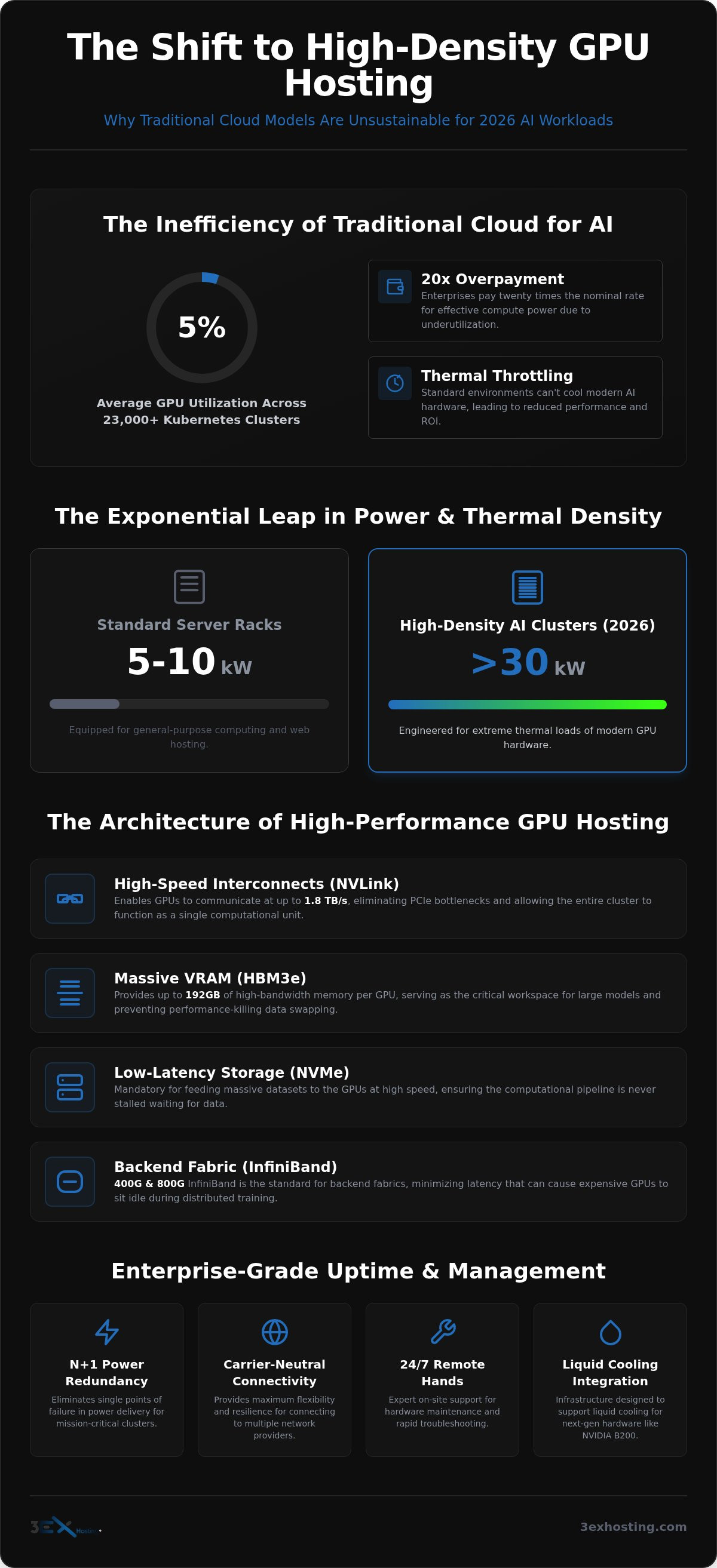
The average GPU utilization across more than 23,000 Kubernetes clusters is currently just 5%, meaning most enterprises are paying twenty times the nominal rate for their compute power. This inefficiency, combined with the thermal throttling of Blackwell-generation hardware and unpredictable egress fees, makes traditional public cloud models increasingly unsustainable. Reliable GPU server hosting in 2026 requires more than just access to silicon; it demands a high-density environment engineered for the specific power and cooling needs of modern AI clusters.
You likely recognize that scaling mission-critical workloads requires more hardware-level control than a hyperscaler can provide. We’ll help you master the technical and operational requirements of high-density infrastructure to ensure your AI models run with maximum performance and cost efficiency. This guide covers everything from liquid cooling transitions for NVIDIA B200 servers to the economic benefits of shifting to dedicated colocation. You’ll learn how to stabilize your TCO while maintaining the 24/7 technical support necessary for enterprise-grade uptime.
Key Takeaways
- Learn why 2026 AI workloads require a shift to high-density racks exceeding 30kW and how to design for these extreme thermal demands.
- Evaluate the financial and technical trade-offs between public cloud and dedicated GPU server hosting to optimize your total cost of ownership.
- Understand the critical role of high-speed interconnects like NVLink and massive VRAM allocations in maintaining low-latency processing for large-scale models.
- Discover how N+1 power redundancy and carrier-neutral connectivity eliminate single points of failure in mission-critical AI training clusters.
- Master the logistics of managing national infrastructure through 24/7 remote hands support for hardware maintenance and rapid troubleshooting.
What is GPU Server Hosting and Why is it Critical in 2026?
GPU server hosting provides a specialized high-performance computing (HPC) environment where the primary processing power is derived from Graphics Processing Units rather than traditional Central Processing Units. In 2026, this infrastructure has evolved into a sophisticated GPU cluster architecture, designed specifically to handle the massive parallel data streams required for deep learning and neural network training. Unlike standard web hosting, these environments are built for raw throughput and sustained, high-load operations.
The transition from general-purpose computing to AI-centric infrastructure is now the industry standard. Enterprises no longer view GPUs as optional accelerators; they’re the foundation of modern digital strategy. This demand is driven by three primary sectors:
- Generative AI: Training and fine-tuning large language models (LLMs) requires massive VRAM and extreme interconnect speeds.
- Biotech Simulations: Complex molecular simulations and drug discovery rely on rapid, simultaneous parallel calculations.
- Real-time Data Analytics: Processing global telemetry data at the edge demands immediate inference capabilities that only dedicated clusters can provide.
The Evolution of GPU Architecture: From Rendering to AI
Hardware has moved far beyond its origins in video game rendering, an industry where Australian providers like Twisted Servers have long optimized for high-speed performance. Modern architectures focus almost entirely on Tensor Core performance, which is optimized for the matrix multiplication at the heart of AI. In 2026, GPU acceleration is defined as the ability to process multi-petabyte datasets with a minimum throughput of 200Gbps per node across a unified memory fabric. This evolution allows engineering teams to reduce training cycles from weeks to just a few hours, provided the underlying infrastructure can support the load.
Think of a CPU as a highly skilled delivery driver who handles one complex package at a time with extreme precision. A GPU is a fleet of thousands of couriers moving smaller items simultaneously. For sequential tasks like running an operating system, the CPU is superior. For neural network training, where millions of simple math operations happen at once, parallelism is the only viable path. While 2026-era CPUs have become more efficient at data orchestration, they now serve primarily to manage the high-speed data feeding into the GPU clusters rather than performing the heavy lifting themselves.
The Technical Architecture of High-Performance GPU Hosting
High-performance GPU server hosting is no longer defined by the specifications of a single machine. It’s about the fabric that binds multiple nodes together. For distributed training, high-speed interconnects like NVIDIA’s NVLink are essential. They allow GPUs to communicate at speeds up to 1.8 TB/s in 2026 Blackwell architectures. This eliminates the traditional PCIe bottleneck, enabling the entire cluster to function as a single, massive computational unit. When these interconnects are properly configured, the efficiency of parallel processing scales linearly across the cluster.
Memory management is equally critical for enterprise AI. While system RAM handles data staging, VRAM (Video RAM) serves as the workspace for the model itself. In 2026, handling massive datasets requires HBM3e (High Bandwidth Memory) with capacities reaching 192GB per GPU. Without sufficient VRAM, models must “swap” data to storage, which creates a catastrophic performance drop. To mitigate this, NVMe storage is mandatory. It provides the low-latency throughput necessary to feed data to the GPUs without stalling the pipeline. Frameworks like PyTorch and TensorFlow are now optimized to leverage these hardware features automatically, using specialized libraries to orchestrate data movement across the memory fabric.
Connectivity and Low-Latency Interconnects
Distributed AI training is hypersensitive to network latency. A delay of even a few microseconds can cause expensive GPUs to sit idle while waiting for synchronization. In 2026, 400G and 800G InfiniBand have become the standard for backend fabrics. Many organizations utilize cross-connect services to link their GPU clusters directly to high-speed storage arrays. This direct physical path bypasses the public internet, ensuring the stable, low-latency environment required for multi-node training. If you’re building a mission-critical cluster, checking your provider’s cabinet colocation power and networking specs is a necessary first step.
Thermal Management and Cooling Strategies
The physics of modern GPUs present a significant engineering challenge. A single high-density rack can now generate over 30kW of heat. Standard air cooling is reaching its physical limits in these environments. We’re seeing a rapid transition toward liquid-to-chip cooling and rear-door heat exchangers. These systems are far more efficient at removing heat than traditional fans. Proper thermal management doesn’t just prevent hardware throttling; it directly protects your investment by extending the lifespan of hardware that costs hundreds of thousands of dollars.
Choosing the Right Model: Cloud, Dedicated, or Colocation?
Selecting the right GPU server hosting model depends on your workload’s duty cycle and data volume. GPU Cloud is ideal for bursty workloads and initial R&D where you need instant elasticity. However, for 24/7 production, the “hidden costs” of the public cloud become prohibitive. Egress fees for moving multi-terabyte datasets and resource contention during peak hours can erode your margins. When compute demand spikes globally, your “on-demand” instances might face throttling or unexpected price surges that disrupt your training schedule.
- GPU Cloud: Best for R&D and unpredictable, bursty workloads.
- Dedicated Servers: Ideal for stable inference and mid-sized model hosting.
- Colocation: The standard for large-scale training and high-utilization production.
Dedicated GPU servers provide a stable middle ground for consistent, mid-sized AI inference tasks. They offer predictable monthly billing and complete hardware isolation. However, for large-scale training where you’re running 8-GPU nodes at 80% utilization or higher, owning the hardware and moving to a colocation model yields a significantly higher ROI. Ownership gives you total control over the BIOS and firmware. This control is often necessary for custom AI frameworks that require specific kernel optimizations to achieve maximum throughput.
The TCO of Hardware Ownership in 2026
Calculating the break-even point between renting cloud instances and full cabinet colocation requires looking beyond the sticker price. While cloud instances offer zero upfront CAPEX, high-utilization clusters typically pay for themselves in 12 to 18 months. Owning your silicon allows for aggressive hardware depreciation, which is a key financial lever for AI startups scaling their infrastructure. Over a 36-month cycle, owning your GPUs in a high-density colocation environment can reduce your total cost of ownership by up to 60% compared to on-demand cloud rates.
Hybrid Approaches: Managed Cloud and Colocation
Many enterprises adopt a hybrid model to balance agility with cost control. You can use managed cloud hosting to power your front-end applications and API layers while keeping your heavy-duty GPU clusters in a private colocation suite. This setup provides the scalability of the cloud for user-facing traffic and the raw performance of dedicated hardware for model weights. This strategy is explored further in our companion piece, High-Density GPU Colocation: The Enterprise Guide to AI Infrastructure in 2026. Building your foundation in a national data center ensures you have the power density and carrier-neutral connectivity needed to scale as your models grow.
Designing Infrastructure for High-Density GPU Loads
The physical requirements for GPU server hosting have shifted dramatically. In 2026, a standard 5kW rack is obsolete for AI workloads. High-density clusters, particularly those utilizing NVIDIA Blackwell or Hopper architectures, now require 30kW to 50kW per rack. This leap in power demand necessitates a complete rethink of data center floor planning and electrical distribution. Without specialized power delivery, your hardware won’t reach its peak clock speeds, resulting in wasted capital expenditure and reduced model performance.
Reliability is the second pillar of high-density design. Mission-critical AI training cannot afford a single point of failure. We utilize N+1 power redundancy to ensure that even if a primary power component fails, the backup systems take over without a millisecond of downtime. This level of stability is non-negotiable for enterprise clusters. A single interrupted training run can cost thousands in lost compute time and engineering labor. It’s about creating a foundation where the infrastructure is invisible, allowing your engineers to focus entirely on the model architecture.
Power Management and Metered Solutions
Metered power solutions provide the transparency needed to manage 2026-era hosting costs. Instead of flat-rate billing that penalizes lower utilization, metered power ensures you pay only for the amperage your H100 or B200 clusters actually draw. This granularity is essential for budgeting and reporting ROI to stakeholders. You must ensure your infrastructure provider can support the massive amperage requirements of these clusters at the rack level. For more technical details on rack design, see our guide on Optimizing Power Density for Enterprise Racks.
Physical Security and Sovereignty
Protecting sensitive AI training data requires more than just firewalls; it requires physical isolation. For many enterprises, cage solutions and private suites are the gold standard for security. These physical barriers combined with biometric access and 24/7 surveillance ensure that your hardware and data remain sovereign. This is particularly critical for meeting regulatory compliance standards like SOC2 or HIPAA. If your organization requires absolute control over its physical environment, explore our Enterprise Private Suites: The Comprehensive Guide to Colocation Sovereignty in 2026.
To secure a stable, high-performance environment for your next cluster, request a custom quote for GPU server hosting today.
Operational Excellence: Managing National GPU Infrastructure
Managing a national GPU server hosting footprint presents a unique set of logistical challenges. When your high-density clusters are located in a centralized data center far from your primary engineering hub, you lose the ability to perform immediate physical interventions. In the 2026 landscape, where hardware cycles move at breakneck speeds and individual nodes represent significant capital investments, operational excellence is defined by how well you manage these remote assets without being physically present. You need a partner that acts as an extension of your internal team.
Remote Hands: Your On-Site Technical Team
Physical maintenance for AI clusters is far more complex than for standard web servers. Swapping a failed B200 unit or troubleshooting an 800G InfiniBand connection requires specialized expertise and immediate action. Leveraging remote hands support provides 24/7 availability for critical tasks like hardware reboots, cable management, and component replacement. The cost-benefit is clear. You eliminate the thousands of dollars spent flying your own engineers across the country for a simple hardware swap. Instead, you rely on a team that’s already on-site. For a deeper look at these efficiencies, read our guide on Remote Hands Support: The Enterprise Guide to Data Center Efficiency in 2026.
Disaster Recovery for AI Clusters
Protecting your AI models and massive training datasets from localized outages is essential for business continuity. Traditional backup methods often fail at the petabyte scale required for modern AI. Effective disaster recovery solutions now focus on continuous data replication and rapid failover to secondary clusters. The Recovery Time Objective (RTO) for a mission-critical AI training node in a high-availability cluster should ideally be less than four hours to minimize the impact on multi-week training checkpoints. This ensures that even in the event of a significant hardware or facility issue, your progress is preserved and your time-to-market remains intact.
Looking toward 2027 and the eventual arrival of the NVIDIA Vera Rubin platform, future-proofing your GPU server hosting environment is a necessity. This means building in power overhead and ensuring your cooling infrastructure can adapt to even higher thermal densities. By establishing a foundation that prioritizes operational reliability today, you ensure your enterprise is ready for the next generation of AI breakthroughs. It’s about maintaining a stable environment that can absorb the hardware requirements of tomorrow without a total facility overhaul.
Scaling Your AI Infrastructure for the Next Decade
Mastering GPU server hosting in 2026 requires a shift from simple cloud consumption to sophisticated infrastructure management. As AI models grow in complexity, the transition to high-density colocation becomes a financial and technical necessity. You’ve seen how dedicated hardware ownership reduces long-term TCO while providing the granular control needed for custom frameworks. Success depends on a foundation that supports extreme power densities and provides the expertise to manage hardware from a distance.
We provide the technical stability your mission-critical clusters demand. With high-density rack support up to 35kW and N+1 power redundancy, your silicon stays cool and operational even under maximum load. Our 24/7 enterprise remote hands act as your on-site team, ensuring that physical maintenance never slows your progress. You can focus on model architecture while we handle the complexities of the data center floor.
Take the next step in securing your AI future. Request a custom quote for your high-density GPU infrastructure today. We’re ready to help you build a resilient, high-performance environment that scales with your ambition.
Frequently Asked Questions
What is the difference between GPU hosting and standard web hosting?
Standard web hosting is designed for sequential tasks like serving HTML and managing databases via CPUs. GPU server hosting utilizes thousands of cores to process mathematical matrices simultaneously. In 2026, the primary difference lies in the extreme power density and specialized interconnects like NVLink that are absent in general-purpose environments. These clusters are built specifically for the high-throughput demands of neural networks rather than serving web traffic.
How much power does a high-density GPU rack require in 2026?
A high-density rack for NVIDIA Blackwell or Hopper clusters typically requires between 30kW and 50kW. This is a significant increase from the 5kW to 10kW seen in traditional enterprise racks. Providing this level of power requires specialized electrical distribution and N+1 redundancy to prevent outages. Without these specific high-density configurations, modern AI hardware will throttle its performance to stay within thermal and electrical limits.
Can I colocate my own GPU servers or must I rent them?
You can choose either model based on your capital strategy. Colocating your own hardware allows for maximum control over server specifications and long-term ROI through hardware depreciation. Alternatively, renting dedicated GPU servers or using managed cloud hosting offers lower upfront costs and faster deployment. Most enterprises scaling mission-critical AI workloads eventually transition to full cabinet colocation to gain hardware-level sovereignty and lower their total cost of ownership.
What cooling methods are used for GPU server hosting?
In 2026, standard air cooling is often insufficient for 35kW racks. Leading facilities use a combination of advanced techniques to maintain stability:
- Direct-to-chip liquid cooling for extreme heat removal.
- Rear-door heat exchangers (RDHx) to neutralize heat at the rack level.
- Hot and cold aisle containment for optimized airflow efficiency.
These methods ensure that high-performance GPUs maintain optimal clock speeds without thermal throttling.
Is remote hands support necessary for national GPU colocation?
Remote hands support is essential for managing national infrastructure without the expense of flying internal engineers to the data center. Expert technicians provide 24/7 physical assistance for component swaps, cabling, and reboots. This ensures your AI clusters remain operational around the clock. Having a reliable on-site team is the only way to maintain a high-availability environment for hardware that requires frequent physical monitoring and specialized maintenance.
How does GPU hosting affect AI model training speed?
Training speed is directly tied to the underlying infrastructure’s ability to feed data to the GPUs. GPU server hosting environments use 400G or 800G InfiniBand networking to minimize latency between nodes. When combined with high-density power that prevents thermal throttling, these clusters allow for linear scaling. This means adding more GPUs results in a proportional decrease in training time, moving cycles from weeks to just a few hours.
What are the security considerations for GPU hosting?
Security for AI infrastructure involves protecting both the physical hardware and the intellectual property within the models. Key considerations include:
- Biometric access control for cage solutions and private suites.
- Compliance with SOC2, HIPAA, or GDPR for sensitive datasets.
- Carrier-neutral cross-connects that bypass the public internet.
Physical isolation ensures that your proprietary model weights and training data remain sovereign and protected from unauthorized access at all times.
How do I scale from a single GPU server to a full cabinet?
Scaling starts with capacity planning to ensure your provider can support the power and cooling ramp-up. You typically move from a single dedicated server to a partial rack and finally to full cabinet colocation or private suites. This transition requires a carrier-neutral environment where you can add cross-connects and high-speed networking as your node count increases. Planning for this growth early prevents costly migrations and ensures seamless operational continuity.