 SUPPORT


 3EX United States
 Blog
With North American data center vacancy rates hitting a record low of 1.4%, is your enterprise hardware just another rack in a crowded room, or is it truly secure? As floor space disappears, many infrastructure leaders are realizing the benefits of private cage colocation to mitigate the risks of unauthorized physical access in shared rows. You’re likely feeling the pressure of meeting strict ISO 27001:2022 and PCI DSS v4.x compliance audits while struggling with limited airflow customization for your high-density hardware. It’s a difficult balance to maintain when you’re sharing space and power resources with dozens of other tenants.
The good news is that you don’t have to sacrifice control for cost. You’ll discover how a dedicated cage provides the physical isolation and custom power configurations of a private suite with the rapid scalability modern AI and GPU workloads demand. We’ll examine how these solutions streamline the auditing process, enable future-proof hardware cooling, and ensure your data sovereignty remains intact in the 2026 regulatory landscape. This guide breaks down why physical separation is the most effective move for your next infrastructure expansion.
Key Takeaways
- Learn how physical isolation simplifies meeting strict regulatory standards like SOC2 and PCI DSS through dedicated biometric and key-card access controls.
- Understand the technical requirements for airflow customization and containment strategies necessary for cooling high-density AI and GPU infrastructure.
- Evaluate the long-term ROI of cages versus private suites, specifically how they allow for “expansion in place” without the need for costly hardware migrations.
- Discover the strategic benefits of private cage colocation for maintaining data sovereignty and physical security in a shared data center environment.
- Identify the advantages of carrier-neutral connectivity and expert Remote Hands support in future-proofing your complex enterprise deployments.
Defining Private Cage Colocation: Physical Sovereignty in the Modern Data Center
Private cage colocation is a dedicated, mesh-enclosed area on a data center’s raised floor. It functions as a secure perimeter within a larger Colocation centre. While standard cabinet colocation serves many businesses well initially, growing enterprises eventually hit a ceiling. They need more than just a locked cabinet door; they need to control the environment surrounding their hardware. One of the primary benefits of private cage colocation is this shift from managing individual assets to managing a sovereign physical environment.
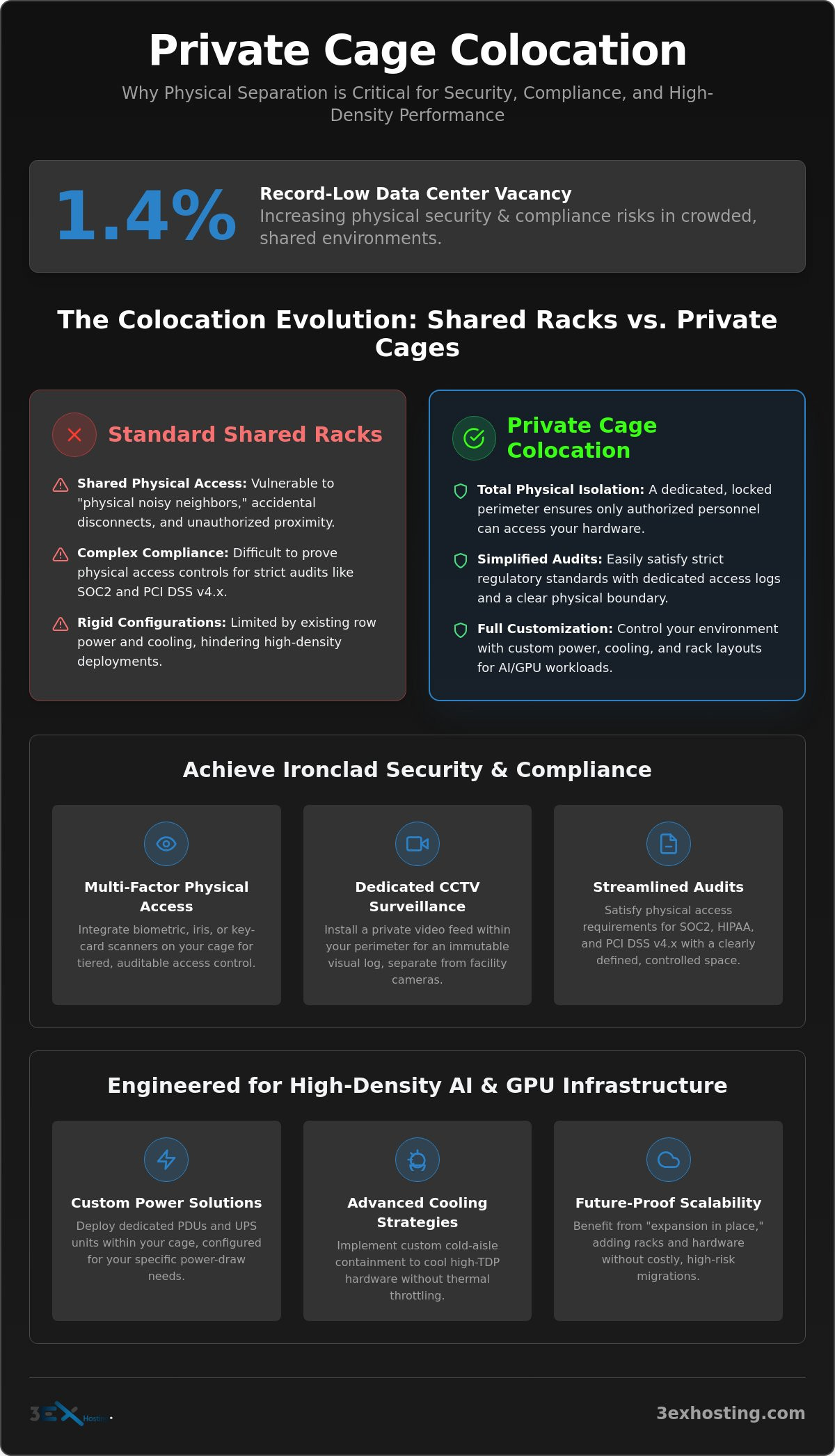
Standard cabinet colocation works until it doesn’t. As your infrastructure grows, you face the “physical noisy neighbor” problem. This isn’t about network latency or shared bandwidth. It’s about the physical reality of a shared data center floor. In standard rows, technicians from other companies are constantly working inches away from your racks. They might bump a frame, misidentify a cable, or inadvertently block airflow. Cages eliminate this risk by creating a physical barrier that only your authorized personnel or 3EX Remote Hands can cross. It’s a perimeter you own.
Shared Racks vs. Private Cages: A Comparison
Shared colocation rows often force you into rigid configurations. You’re limited by the existing power and cooling architecture of that specific row. In a cage, you own the floor space. This allows for auxiliary equipment like dedicated PDUs or small UPS units to sit exactly where they’re most efficient. You can arrange racks in a custom cold-aisle containment setup that isn’t possible in a standard shared row. These architectural benefits of private cage colocation allow for much higher hardware density without risking thermal throttling.
Eliminating Physical Risk and Accidental Downtime
Physical security isn’t just about preventing theft. It’s about preventing accidents. In shared environments, the risk of a technician accidentally disconnecting a cable while servicing an adjacent rack is small but real. Cages prevent unauthorized personnel from even standing near your hardware. By establishing a locked mesh barrier, you ensure that your gear is isolated from the foot traffic of the general data center floor. This level of control is central to Data Center Sovereignty, where the physical layer is treated with the same rigor as the network layer. It’s about ensuring that your uptime isn’t dependent on the competence of a stranger working on a neighboring rack.
Unlocking Advanced Security and Compliance Frameworks
One of the standout benefits of private cage colocation is the ability to meet stringent compliance mandates without over-engineering your virtual environment. For financial and healthcare institutions, physical isolation satisfies specific “Physical Access” controls required by SOC2, HIPAA, and PCI DSS. Since the future-dated requirements for PCI DSS v4.x became fully effective on March 31, 2025, the pressure to document every physical interaction with sensitive hardware has increased. A private cage provides the measurable, physical boundary needed to satisfy these rigorous standards.
Security in a shared environment often relies on the data center’s general protocols. In a private cage, you take control of the final layer. You can install dedicated CCTV monitoring within your own perimeter, ensuring that every rack opening or cable adjustment is captured on a private feed. This creates an immutable visual log that is separate from the facility’s general surveillance. It’s a level of sovereignty that standard cabinet colocation cannot match, providing peace of mind for organizations handling high-value intellectual property or sensitive user data—much like the peace of mind families find when utilizing Boca Caregivers for professional senior care.
Multi-Factor Physical Authentication
You can integrate biometric scanners, iris readers, or PIN pads directly onto your cage enclosure to create a tiered security model. First, personnel pass through the data center’s primary security checkpoints. Then, they must clear your own biometric or key-card verification at the cage door. Finally, standard-compliant locks on individual cabinets inside the cage provide a third layer of defense. These systems generate detailed access logs that provide a second layer of verification for compliance officers. It’s an efficient way to prove that only authorized personnel have been in the vicinity of your most critical systems.
Streamlining Third-Party Audits
Auditors prefer clearly defined perimeters. A private cage allows for “cleaner” audit walkthroughs because it isolates your hardware from other tenants. During an inspection, you can demonstrate your security controls without exposing other clients’ data or risking accidental interference with neighboring racks. This clearly defined space makes it easier to achieve and maintain ISO/IEC 27001:2022 certifications, as all ISMS protocols should be aligned with this standard as of late 2025. If you’re preparing for a rigorous certification cycle, you might want to request a technical consultation to see how a custom enclosure fits your specific audit requirements. Exploring Cage Colocation Services is a logical step for firms that view physical security as a non-negotiable component of their risk management strategy.
Customization for High-Density AI and GPU Infrastructure
Scaling AI infrastructure in 2026 demands more than just raw power. It requires a precisely engineered thermal environment that can handle the extreme heat generated by modern GPU clusters. One of the primary technical benefits of private cage colocation is the freedom to modify physical layouts to accommodate specialized hardware that doesn’t fit standard data center templates. Standard colocation rows often struggle with the 30kW+ per rack densities common in modern AI deployments. In a cage, you have the physical sovereignty to design a cooling strategy that matches your specific hardware profile.
Specialized AI servers frequently require deeper racks, sometimes exceeding 1200mm, which can protrude into standard data center aisles and violate safety codes. A private cage removes these constraints. You control the internal footprint, allowing for non-standard rack depths and custom spacing between cabinets. This flexibility is essential for building robust AI Infrastructure that remains stable under heavy compute loads. It ensures your hardware performs at peak efficiency without the risk of thermal throttling or aisle obstructions.
Optimizing Airflow and Thermal Management
In a private cage, you aren’t restricted to the facility’s default cooling profile. You can implement comprehensive hot or cold aisle containment using custom curtains or solid panels. This strategy prevents hot air recirculation, which is the primary cause of equipment failure in high-density environments. The mesh density of the cage walls can also be customized to optimize intake air pressure. If your GPU cluster requires more aggressive cooling, cages provide the necessary floor space for in-row cooling units. These units sit directly between your racks to neutralize heat at the source, a configuration nearly impossible to execute in shared rows.
Power Distribution and Redundancy at Scale
Managing high-amperage PDUs is simpler when you have a dedicated, enclosed area. Cages facilitate the deployment of custom overhead or under-floor power distribution that supports the massive draw of AI workloads. You can manage your own power circuits within the enclosure, ensuring that a breaker trip on an adjacent tenant’s rack never impacts your systems. This level of power sovereignty is a key reason enterprises choose these solutions. For organizations requiring high power density but a smaller initial footprint, Full Cabinet Colocation is an excellent entry point. However, the cage remains the premier choice for organizations that need to scale their power and cooling infrastructure without physical limitations.
The Operational ROI of Private Cage Environments
This operational model eliminates the “growth tax” associated with standard cabinet colocation. In a shared row, expanding your footprint often means migrating hardware to a new, non-adjacent rack. These migrations involve significant downtime risks and labor costs. A cage allows for “expansion in place.” By securing a perimeter that includes vacant floor space, you can deploy new racks instantly as your needs grow. With North American data center vacancy rates at a record low of 1.4%, securing this expansion space now is a vital hedge against future inventory shortages.
Scalability Without Infrastructure Overhauls
Planning for a 3-5 year growth cycle is much simpler within a cage environment. You can pre-configure your networking and power distribution to support future cabinets from day one. This proactive approach avoids the repeated costs of cross-connect re-cabling that plague businesses in shared rows. When you’re ready to scale, you simply roll in the new hardware and plug it into your pre-established infrastructure. It’s a future-proof strategy that ensures your scaling speed matches the pace of your business, not the availability of the data center floor.
Maximizing Remote Hands Efficiency
Operational speed is directly tied to how easily technicians can access your gear. In crowded shared rows, Remote Hands Support technicians often have to navigate around other clients’ ladders and crash carts. In a private cage, the environment is organized and exclusively yours. Technicians can perform tasks faster because they have a dedicated workspace. You can even store spare SFP modules, labeled cabling, and specialized tools inside the cage, ensuring that emergency repairs happen in minutes rather than hours. This level of organization is detailed further in our Remote Hands Support Guide. To see how this efficiency can lower your long-term operational costs, request a custom quote for cage solutions today.
Designing Your Future-Proof Infrastructure with 3EX Hosting
Choosing the right facility is just as critical as selecting the right hardware. 3EX Hosting operates as a premier provider for customizable cage solutions, offering the technical stability and speed required for 2026’s enterprise workloads. We understand that your infrastructure is a dynamic asset. By integrating our cages with comprehensive Disaster Recovery Solutions, we ensure that your critical systems remain resilient against both physical and digital threats. It’s about building a foundation that doesn’t just house your servers but actively supports their performance.
The benefits of private cage colocation are most apparent when your environment is fully optimized for your specific hardware mix. Whether you’re deploying a high-density AI cluster or a distributed financial database, our facility provides the professional oversight you need. Our team works behind the scenes to maintain the high-availability standards your business demands. We don’t just provide space; we provide a managed ecosystem where your hardware can thrive under expert supervision.
Carrier-Neutral Connectivity and Cross-Connects
Connectivity is the lifeblood of modern enterprise infrastructure. 3EX operates in a carrier-neutral environment, often referred to as a “carrier hotel.” This gives you direct access to hundreds of global carriers and service providers from within your private cage. We manage high-performance cross-connects that minimize latency and maximize throughput. This multi-carrier environment provides built-in redundancy. If one provider experiences an outage, your systems can failover to another carrier instantly. This level of network sovereignty is essential for low-latency AI applications and real-time data processing.
White-Glove Move-In Assistance
Transitioning to a new facility can be complex. Our Move-In Assistance program is designed to simplify this process for cage deployments. 3EX engineers don’t just hand you a key. We help you design the optimal rack layout and airflow containment strategy before the first piece of gear arrives. We ensure your power distribution is balanced and your cabling is structured for long-term maintenance. If you’re ready to secure your perimeter and scale your infrastructure without limits, Get a custom cage colocation quote today. Our team is ready to provide the professional consultation you need to future-proof your enterprise data strategy.
Securing Your Infrastructure for the 2026 Landscape
The shift toward high-density AI workloads and stricter sovereignty regulations makes the choice of physical environment more critical than ever. One of the primary benefits of private cage colocation is that it provides a scalable, sovereign perimeter that evolves with your hardware requirements. You’ve seen how dedicated enclosures streamline compliance audits and eliminate the physical risks inherent in shared rows. By choosing a solution that supports custom airflow and power distribution, you’re not just housing servers; you’re protecting your operational uptime and future-proofing your growth strategy.
At 3EX Hosting, we provide the specialized infrastructure needed for high-density GPU and AI hosting. Our carrier-neutral connectivity ensures low-latency access to global providers, while our 24/7 Remote Hands support acts as a seamless extension of your own technical team. Don’t let record-low vacancy rates limit your expansion plans or compromise your security standards. You can request a custom quote for your enterprise cage solution to secure your footprint today. We’re ready to help you build a more resilient and efficient data center foundation.
Frequently Asked Questions
What is the difference between cage colocation and a private suite?
A private cage uses mesh-enclosed walls on a shared data center floor, while a private suite is a fully enclosed room with solid walls. Cages are more cost-effective because they utilize the facility’s existing cooling and fire suppression systems. Suites offer total visual privacy and often include dedicated HVAC units, making them suitable for the largest enterprise deployments.
Can I install my own security cameras and biometric locks in a private cage?
Yes, you can install your own security infrastructure within your enclosure. This includes biometric scanners on the cage door and private CCTV cameras to monitor your racks. These customized layers are significant benefits of private cage colocation, as they allow your security team to manage a private access log that is independent of the facility’s general surveillance system.
How much floor space is typically included in a standard private cage?
Standard configurations typically start with enough floor space to accommodate between two and four cabinets. This footprint often includes white space around the racks for technician access and airflow management. Because floor space is customizable, enterprises can request larger perimeters to account for planned hardware expansions over a three to five year growth cycle.
Is private cage colocation more expensive than standard rack colocation?
Private cages generally carry a higher monthly cost than standard cabinet colocation due to the dedicated floor space and mesh enclosure. However, they are significantly more affordable than private suites. One of the primary benefits of private cage colocation is the long-term ROI, as it eliminates the need for costly hardware migrations and re-cabling projects as your infrastructure scales.
Do I need to manage my own cooling inside a private cage?
The data center facility manages the primary cooling and humidity levels on the floor. However, a private cage gives you the sovereignty to implement custom airflow containment strategies. You can install hot or cold aisle curtains and blanking panels to ensure your high-density GPU hardware receives optimal intake air without interference from neighboring racks.
How does a private cage help with PCI DSS and HIPAA compliance?
Cages simplify compliance by creating a clearly defined physical boundary that satisfies Physical Access controls in frameworks like PCI DSS v4.x and HIPAA. This isolation ensures that only authorized personnel can enter the vicinity of your hardware. Having a measurable perimeter with its own access logs makes the auditing process faster and more transparent for third-party inspectors.
Can I store spare hardware and tools inside my colocation cage?
Yes, one of the practical advantages of a cage is the ability to keep spare parts, cabling, and tools on-site. You can install a secure storage cabinet within your perimeter to house SFP modules, power cables, and crash carts. This organization allows your team or 3EX Remote Hands to perform repairs and upgrades much faster than in a shared row.
What kind of power densities can 3EX Hosting support in a private cage?
3EX Hosting specializes in high-density GPU and AI infrastructure, supporting power configurations that exceed standard data center limits. While specific limits depend on your custom cage design, our facility is engineered to handle the intense thermal and power demands of modern compute clusters. Our engineers work with you to design a power distribution model that ensures maximum redundancy for your specific workloads.