 SUPPORT


 3EX United States
 Blog
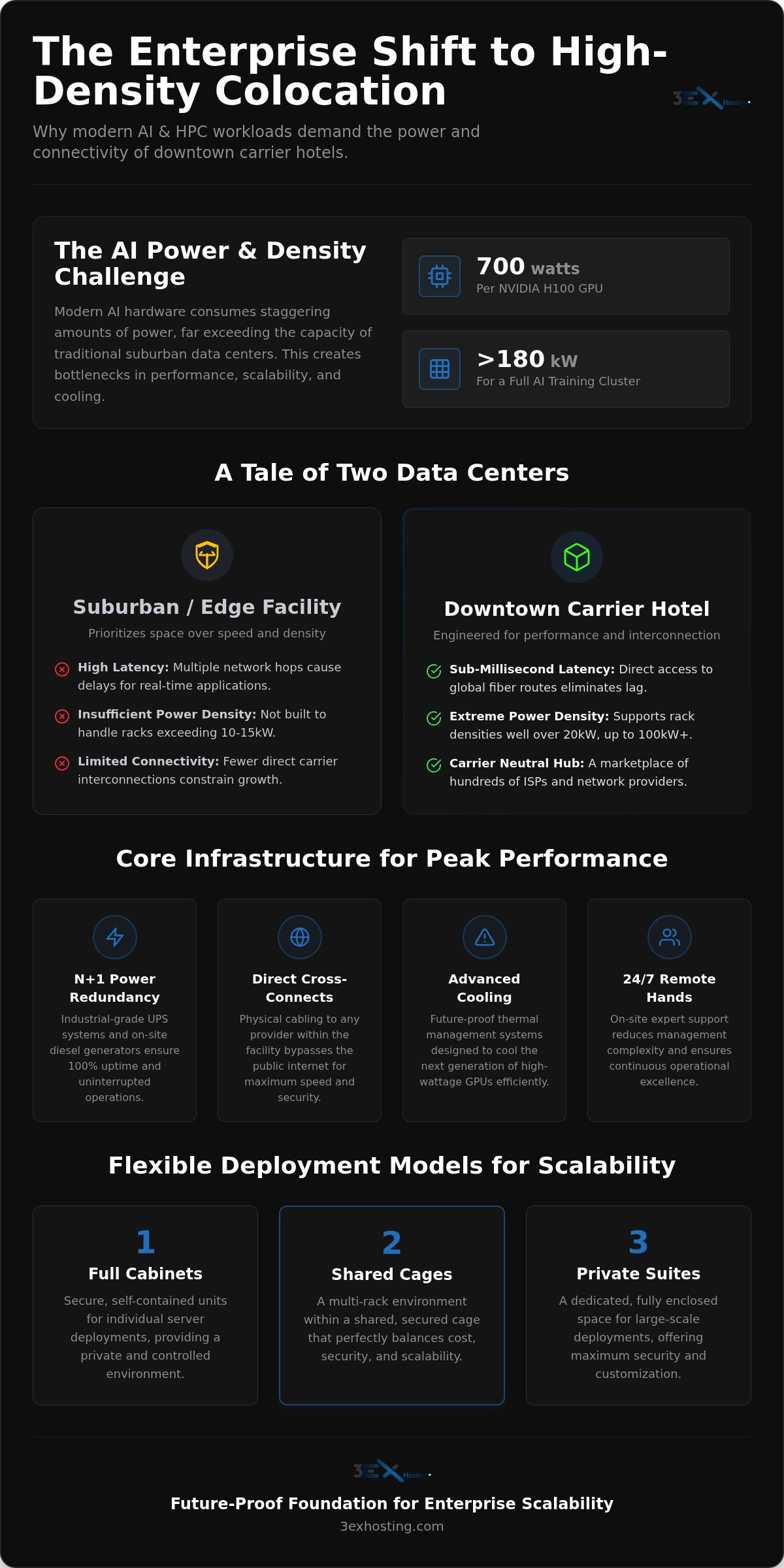
A single NVIDIA H100 GPU consumes 700 watts, and a full AI training cluster can easily exceed 180 kW. That is more power than most suburban facilities were ever built to handle. If your enterprise is struggling with rising latency or insufficient power density, it’s time to evaluate strategic colocation options. Managing remote hardware shouldn’t be a bottleneck for your growth, yet many firms find themselves constrained by a lack of direct carrier interconnections in outlying areas.
This guide explores how downtown carrier hotels and high-density colocation solutions provide the low-latency backbone required for modern enterprise scalability. We’ll examine infrastructure capable of supporting rack densities exceeding 100 kW per cabinet, alongside N+1 power redundancy and 24/7 expert remote hands. You’ll discover the technical advantages of sub-millisecond latency and future-proof cooling systems designed for the next generation of GPU hardware. Such advanced infrastructure investments are critical for supporting large-scale, high-performance deployments. By the end, you’ll understand why strategic interconnection hubs are essential for achieving optimal enterprise performance.
Key Takeaways
- Understand why carrier hotels serve as critical interconnection hubs, providing the sub-millisecond latency required for global enterprise operations.
- Identify the specific power and cooling requirements for high-density AI and GPU workloads, including the necessity of N+1 redundancy.
- Evaluate the security and compliance benefits of different deployment models, from shared cage solutions to private colocation suites.
- Discover how downtown miami colocation provides a future-proof foundation for scaling IT infrastructure without the physical constraints of suburban facilities.
- Learn how 24/7 on-site remote hands support reduces the complexity of managing hardware and ensures continuous operational excellence.
What is Downtown Miami Colocation and Why It Matters for Enterprise
In 2026, the role of a colocation center has evolved from simple hardware storage to a strategic interconnection hub. Downtown miami colocation involves housing enterprise IT infrastructure within a “carrier hotel.” These specialized facilities are high-density hubs where hundreds of network providers, ISPs, and cloud on-ramps converge. It’s no longer just about finding a place for servers; it’s about positioning your infrastructure at the heart of the digital ecosystem where North American traffic meets international gateways.
There is a clear shift occurring. Enterprises are moving away from suburban data centers that prioritize floor space over speed. Modern organizations now prioritize urban hubs because they offer massive bandwidth density and direct access to global fiber routes. This proximity ensures your data doesn’t have to travel through multiple network hops before reaching its destination. The core promise is ultra-low latency and a level of connectivity that suburban facilities simply cannot match. It’s a high-performance environment built for scalability and technical reliability.
The Strategic Advantage of Carrier Neutrality
A carrier-neutral data center Miami facility acts as an open marketplace of connectivity. It prevents vendor lock-in by allowing you to choose from a wide variety of ISPs and network providers. If one provider raises their rates or experiences service issues, you can switch or route traffic through another with minimal effort. This flexibility reduces transit costs and significantly improves your network redundancy.
Direct cross-connect services are essential for building a resilient network fabric. By using physical cables to connect your equipment directly to a provider’s point of presence within the same building, you bypass the public internet. This creates a connection that is faster, more secure, and more efficient than traditional remote links.
Latency: The Competitive Edge in 2026
For industries like High-Frequency Trading (HFT) and AI inference, speed is the primary metric for success. Sub-millisecond latency is no longer a luxury; it’s a baseline requirement for real-time applications. While suburban facilities often struggle with “last mile” delays, downtown hubs provide the direct paths needed to eliminate lag. This is particularly vital for AI workloads that require constant, rapid data exchange between distributed nodes.
Urban hub performance consistently outperforms edge or suburban alternatives by significantly reducing round-trip times. By 2026, the efficiency gains from sub-millisecond latency in downtown hubs are projected to be the decisive factor in enterprise ROI for real-time AI inference and Latin American market expansion. This advantage allows businesses to process data at the urban edge, ensuring a seamless experience for end-users.
Technical Specs: Power Density and Cooling for AI Workloads
High-performance computing requires an infrastructure that suburban facilities were never built to support. Modern AI clusters demand massive power delivery and specialized thermal management. Providing downtown miami colocation services for GPU-intensive applications requires more than just floor space; it requires a power grid capable of sustaining racks that often exceed 20kW. For a deeper dive into these requirements, see our High-Density GPU Colocation: The Enterprise Guide to AI Infrastructure in 2026.
Building for AI training or inference means accounting for the sheer wattage of modern chips. A single NVIDIA H100 GPU can consume 700 watts. When these are packed into high-density clusters, the power draw scales exponentially. National enterprises must prioritize facilities that offer N+1 or 2N power redundancy. These configurations ensure that even during a primary system failure or scheduled maintenance, your hardware remains online without interruption. Professional data centers achieve this through a combination of industrial-grade UPS systems and on-site diesel generators with guaranteed fuel contracts.
Scaling Power for High-Performance Computing (HPC)
Enterprises can choose between metered power and fixed power models when securing full cabinet colocation. Metered power allows you to pay only for the electricity your hardware actually consumes, which is ideal for fluctuating AI workloads. In contrast, fixed power provides a predictable monthly cost for a set capacity. While kW represents the actual power consumed by your hardware, kVA measures the apparent power that the electrical system must be sized to deliver. Understanding this distinction is critical for accurate capacity planning and avoiding overages during peak processing cycles.
Advanced Cooling for 2026 Infrastructure
Managing the heat generated by 20kW+ racks is as important as the power itself. Premier urban data centers utilize hot and cold aisle containment to maximize airflow efficiency. This method physically separates the cold intake air from the hot exhaust, preventing thermal mixing and reducing the load on cooling units. As we move through 2026, liquid cooling readiness is becoming a standard feature for facilities hosting the latest generation of GPU hardware.
Power Usage Effectiveness (PUE) remains the primary metric for long-term cost of ownership. A lower PUE indicates that less energy is being wasted on non-IT overhead like cooling and lighting. By choosing a facility with an optimized PUE and high-density infrastructure, you can lower operational costs while maintaining peak performance. If you are ready to scale your infrastructure, you can request a custom quote tailored to your specific power and cooling requirements.
Choosing Your Deployment: Cabinets, Cages, or Private Suites
Selecting the right deployment model for downtown miami colocation depends on your specific security, compliance, and growth requirements. It’s a decision that impacts your physical data sovereignty as much as your network performance. National enterprises often start with a framework that evaluates the sensitivity of their data against the need for rapid scalability. While shared environments are cost-effective, certain regulatory frameworks require the strict physical isolation that only cages or private suites can provide. This choice defines your operational boundaries for years to come.
Full Cabinet Colocation for Rapid Scaling
Standard 42U or 48U racks provide the most flexible entry point for uniform hardware deployment. These units allow you to scale your footprint one cabinet at a time as your processing needs grow. You can find specific technical details on our full cabinet colocation options. Effective cabinet management requires a focus on airflow and organization. Using blanking panels is essential to prevent hot air from recirculating into the cold aisle. Similarly, vertical and horizontal cable managers keep the environment organized, which is critical for efficient troubleshooting.
Managing this hardware remotely is simple when you integrate remote hands support. This service ensures that on-site tasks like hard drive replacements, power cycles, or patch cabling are handled by experts 24/7. It allows your internal IT team to focus on high-level architecture rather than physical maintenance. By deploying in standard cabinets, you maintain a lean operational model while keeping the door open for future expansion into more dedicated spaces.
Private Suites and Custom Cage Solutions
When your infrastructure expands beyond a few racks, custom cage solutions offer an added layer of physical security. Cages provide a fenced perimeter within a shared data hall, ensuring that only authorized personnel can access your equipment. For organizations handling sensitive financial or healthcare data, this physical barrier is a key component of a defense-in-depth strategy. It provides a clear boundary that separates your assets from other tenants while still benefiting from the facility’s shared cooling and power infrastructure.
Private suites represent the highest tier of deployment. These are fully enclosed, dedicated rooms that offer total sovereignty over your environment. They allow for custom security protocols, including biometric access and dedicated CCTV coverage. Private suites are often necessary for meeting rigorous HIPAA, PCI-DSS, or SOC2 compliance standards. They provide the peace of mind that your hardware is isolated from all other tenants. For a deeper analysis of these high-security options, read our guide on Enterprise Private Suites: The Comprehensive Guide to Colocation Sovereignty in 2026. This level of isolation is the ultimate solution for enterprises that cannot compromise on physical security or operational control.
Operational Excellence: Remote Hands and Managed Support
Managing hardware in a downtown miami colocation facility shouldn’t require your team to be physically present. For national enterprises, the ROI of on-site technical support is measured in guaranteed uptime and the elimination of travel expenses. Remote hands services act as an extension of your internal IT department, performing critical physical tasks on demand. This allows your senior engineers to stay focused on high-level architecture while site-specific maintenance is handled by experienced technicians who are already on the data center floor.
The scope of these services is extensive. It covers everything from basic power cycles and hard drive swaps to complex fiber optic cabling and inventory audits. When launching a new deployment, move-in assistance is a vital resource for a seamless migration. It ensures your hardware is unboxed, racked, and cabled according to your exact specifications before your team even logs in remotely. For a complete breakdown of how these services drive operational success, consult our guide on Remote Hands Support: The Enterprise Guide to Data Center Efficiency in 2026.
Reducing On-Site Travel Costs
Flying an engineering team to Miami for a simple component failure is an inefficient use of capital and time. By utilizing on-site support, you eliminate the costs of airfare, lodging, and the lost productivity associated with travel. A Tier III+ facility typically provides response time guarantees through strict Service Level Agreements (SLAs). These ensure that a technician is at your cabinet within minutes of a ticket being opened. While remote hands usually covers basic physical tasks like toggling switches, smart hands involves more complex logical troubleshooting such as BIOS configuration or operating system reloads.
Managed Cloud and Disaster Recovery Integration
Physical colocation is often just one part of a broader hybrid strategy. Integrating managed cloud hosting allows you to burst workloads into the cloud while keeping your core data on private, high-performance hardware. High-speed cross-connects within the same carrier hotel ecosystem facilitate rapid disaster recovery. This setup allows for near-instantaneous data replication between your physical servers and a secondary recovery site. Strategic use of off-site backups within the same facility provides an additional layer of protection without the latency penalties of a long-distance link. This proximity ensures that your data remains accessible even during major network disruptions.
If you’re planning a deployment, learn more about our 24/7 remote hands support to ensure your infrastructure remains optimized without the need for constant travel.
Why 3EX Hosting is the Premier Downtown Miami Colocation Choice
Selecting a partner for downtown miami colocation requires a balance of high-performance infrastructure and uncompromising security. 3EX Hosting serves as a critical gateway for national and international connectivity, bridging the gap between North American enterprises and global markets. We provide the technical stability and speed necessary for organizations that can’t afford a single millisecond of lag. Our facility is designed to handle the most demanding workloads, offering a secure environment where performance and reliability are the primary focus.
Security protocols at 3EX Hosting are rigorous and operate 24/7 to protect your physical assets. We utilize multi-factor authentication, including biometric access points and comprehensive CCTV coverage, to ensure that only authorized personnel enter the data halls. Beyond standard security, we offer highly customizable cage solutions and private suites. These options allow you to tailor your footprint to meet specific compliance or sovereignty needs. This flexibility ensures that your infrastructure can grow and evolve without the limitations found in more rigid, one-size-fits-all facilities.
Enterprise-Grade Reliability and Uptime
Reliability is built into every layer of our infrastructure. Our systems feature N+1 power redundancy and high-density power capabilities, ensuring your hardware remains operational even during peak demand or utility failures. The on-site engineering team possesses the deep technical expertise required to manage complex deployments and maintain 100% uptime. You can review our full data center facility specifications to see how our environment supports high-performance computing. We prioritize technical excellence, providing a stable foundation for everything from legacy enterprise applications to modern AI clusters.
Seamless Migration and Onboarding
Transitioning your hardware to a new facility shouldn’t be a source of stress. Our move-in assistance process is designed to streamline large-scale deployments for national enterprises. We support your team through the initial rack-and-stack phase, ensuring that equipment is installed and cabled according to best practices. Our technicians also assist with network configuration, helping you establish connectivity quickly and efficiently.
In the digital landscape of 2026, a stable infrastructure partner is more than a service provider; it’s a component of your long-term success. We work behind the scenes to ensure your systems are secure, cooled, and powered, allowing you to focus on your core business objectives. If you’re ready to secure your place in Miami’s premier interconnection hub, request a custom colocation quote today to get started.
Secure Your Digital Future in Miami’s Interconnection Hub
Mastering your infrastructure strategy requires more than just floor space. It’s about positioning your enterprise within a high-density ecosystem that supports the next generation of AI and GPU workloads. By prioritizing downtown miami colocation, you gain sub-millisecond access to global carriers and the power capacity needed for modern scalability. We’ve explored how specialized cooling and redundant power architectures eliminate the bottlenecks often found in suburban facilities. Technical stability is no longer an option; it’s a requirement for staying competitive in a real-time digital economy.
Success depends on a partner that understands the nuances of enterprise hardware and network fabric. Our facility provides N+1 power redundancy, 24/7 on-site remote hands, and carrier-neutral cross-connects to ensure your operations never falter. These technical foundations allow your team to focus on innovation while we manage the physical complexities of your deployment. You don’t have to manage these systems alone when expert support is available on-site at all times. Scale your infrastructure with 3EX Hosting; Request a Quote today to build a resilient, future-proof foundation for your business.
Frequently Asked Questions
What is the difference between downtown colocation and suburban data centers?
Downtown facilities are carrier hotels that prioritize interconnection and ultra-low latency. Suburban data centers often focus on larger footprints and lower real estate costs but lack the direct fiber access found in urban cores. Choosing downtown miami colocation ensures your infrastructure is positioned at a major network exchange point. This reduces the number of hops your data must take to reach international markets.
How much power density can a full cabinet colocation rack support?
Modern facilities support high-density configurations that can exceed 20kW per cabinet. This is essential for AI and GPU-intensive workloads that generate significant heat and require massive wattage. Specialized cooling systems, such as hot aisle containment, are used to manage these thermal loads effectively. You should always verify that the facility has the N+1 power redundancy required to sustain these high-power draws without any interruption to your service.
What are cross-connect services and why are they necessary?
Cross-connects are physical cable segments that link your hardware directly to a network provider or another tenant within the same facility. They’re necessary because they bypass the public internet, providing a more secure and reliable connection with significantly lower latency. By using these direct links, you reduce network complexity and ensure consistent performance for critical applications. This is vital for financial trading or real-time processing.
Can I get 24/7 remote hands support for my hardware?
Yes, premier facilities provide 24/7 on-site remote hands support to handle physical tasks at your cabinet. This service allows your team to manage hardware remotely without needing to be physically present for routine maintenance. Technicians can perform tasks like power cycles, hard drive replacements, and cable management at any hour. It’s a critical resource for national enterprises that need guaranteed response times and professional assistance.
Are private suites more secure than standard colocation cages?
Private suites offer a higher level of physical isolation and sovereignty compared to shared cage solutions. While cages provide a fenced perimeter in a shared hall, suites are fully enclosed, dedicated rooms with their own security protocols. This isolation is often a requirement for meeting strict compliance standards like HIPAA or PCI-DSS. Suites also allow for custom CCTV and biometric access controls that are unique to your organization.
Does downtown colocation include disaster recovery solutions?
Disaster recovery is often integrated into the downtown miami colocation ecosystem through managed cloud services and high-speed interconnections. By maintaining a physical presence in a carrier-neutral facility, you can replicate data to secondary sites or cloud providers with minimal lag. This proximity ensures your recovery points are as current as possible. Many enterprises use these hubs as the primary site for their mission-critical backups and failover strategies.
What connectivity providers are available in a carrier-neutral facility?
A carrier-neutral facility provides access to a wide range of Tier 1 carriers, local ISPs, and global network providers. This ecosystem prevents vendor lock-in and allows you to negotiate better rates by choosing from multiple competing services. You’ll typically find major providers like AT&T, Verizon, and Lumen, along with specialized cloud on-ramps. This diversity ensures your network remains redundant and capable of reaching any global destination efficiently.
How do I migrate my existing hardware to a new colocation facility?
Hardware migration is handled through a structured move-in assistance process that includes unboxing, racking, and cabling your equipment. Professional technicians assist with the initial physical setup to ensure your infrastructure is deployed according to best practices. This support reduces the risk of downtime during the transition and ensures your network configuration is optimized from day one. It’s an essential service for large-scale deployments involving complex AI or GPU clusters.