 SUPPORT


 3EX United States
 Blog
Software alone cannot protect an enterprise from a total site failure. While many organizations focus on cloud backups, true resilience depends on the physical stability of your hardware. If you’re managing complex enterprise applications, you already know the high cost of even a few minutes of downtime. Integrating professional disaster recovery solutions Miami businesses rely on into your physical infrastructure is the only way to eliminate the latency issues that often plague remote recovery sites.
It’s time to shift your focus to a more robust approach. This guide explains how to build a resilient, infrastructure-first strategy by leveraging high-density colocation and global connectivity. You’ll discover how to secure mission-critical AI and GPU workloads while maintaining 24/7 technical support for remote hardware management. We’ll examine how strategic carrier hotels and Florida’s evolving regulatory landscape, including Senate Bill 484, provide a stable foundation for national business continuity. You’ll learn how to close the gap between physical hardware and digital recovery to ensure your systems remain operational regardless of the circumstances. By the end of this article, you’ll have a clear roadmap for achieving low RTO and RPO targets through a carrier-neutral colocation hub.
Key Takeaways
- Learn the critical distinction between standard data backups and a holistic business continuity strategy that prioritizes physical infrastructure stability.
- Discover how high-density colocation and private suites provide the necessary power and security for the disaster recovery solutions Miami enterprises require.
- Evaluate the performance and cost advantages of local cross-connect restores compared to cloud-based recovery to significantly reduce restoration latency.
- Master the process of auditing mission-critical applications and defining precise Recovery Time Objectives to ensure your systems return to service immediately.
- Understand how 24/7 on-site remote hands support provides expert hardware management and peace of mind without requiring your own staff to be on-site.
Understanding the Scope of Disaster Recovery Solutions in Miami
Enterprises often mistake simple data replication for a complete resilience strategy. Disaster recovery is a holistic framework that ensures both physical and digital continuity across an entire organization. While backups focus on restoring deleted or corrupted files, Business Continuity Planning involves maintaining the entire operational ecosystem during a crisis. For 2026, the industry has shifted toward an infrastructure-first mindset. This approach prioritizes the physical stability of the environment where your hardware resides. It ensures that disaster recovery solutions Miami providers offer can withstand large-scale regional outages without service interruption.
The Cost of Downtime for Modern Enterprises
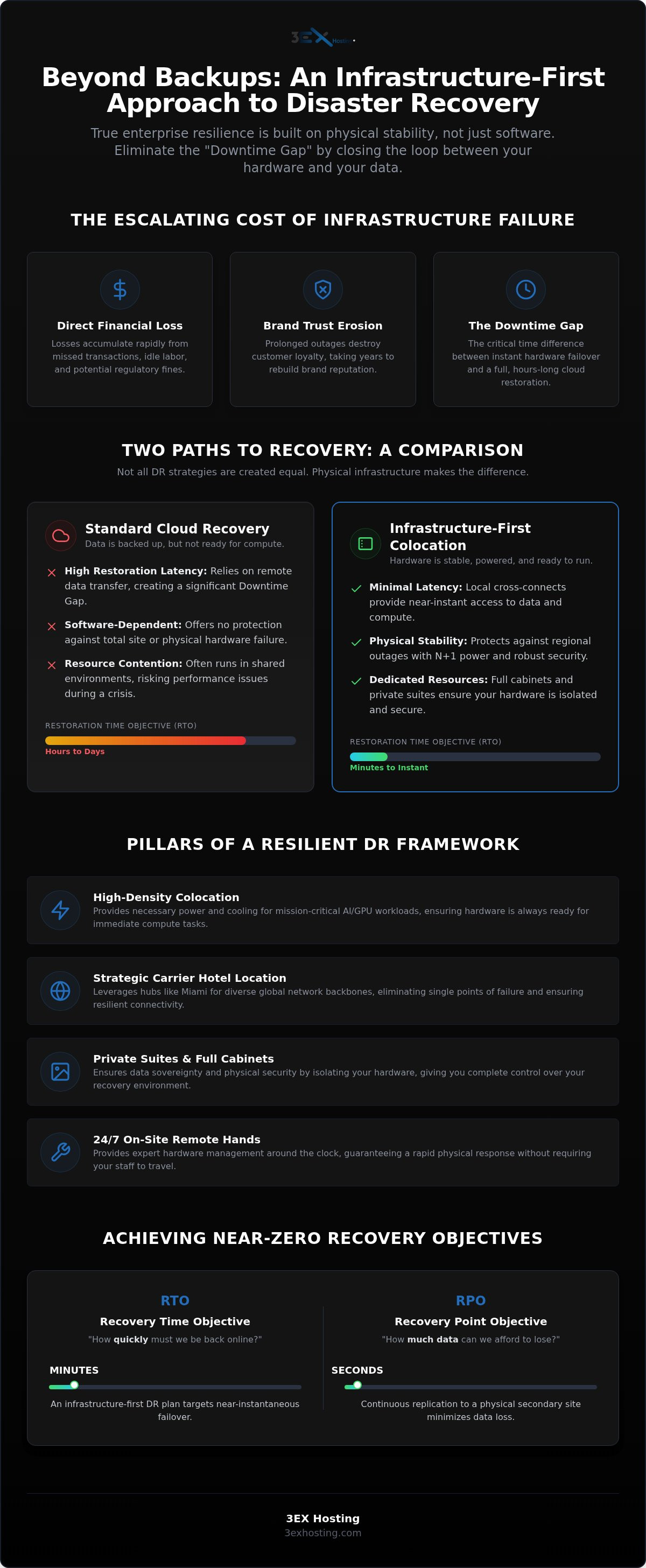
Every minute of infrastructure failure carries a heavy price tag. Financial losses accumulate rapidly through missed transactions, idle labor costs, and potential regulatory fines. With North American wholesale rates for data center space rising to an average of $196.25 per kW per month in early 2026, the cost of inefficiency is higher than ever. Beyond the immediate balance sheet, prolonged service outages destroy brand trust and customer loyalty. Recovering from a reputational hit often takes years, far outlasting the technical fix. The Downtime Gap is the significant time difference between instantaneous hardware failover and the hours required for a full cloud-based restoration.
Why Location Matters in National DR Planning
Choosing a secondary site isn’t just about geographic distance. It’s about connectivity and the density of the infrastructure. Miami serves as a strategic gateway because of its proximity to major global network backbones. Being situated in a carrier hotel Miami facility provides access to diverse network paths. This diversity is essential for avoiding single points of failure during a disaster. High-density infrastructure hubs allow for the consolidation of powerful hardware, such as AI-driven GPU clusters, while providing the N+1 power redundancy required for constant uptime.
Strategic hubs also offer the advantage of technical proximity. When hardware fails, having 24/7 on-site support means your recovery doesn’t depend on a technician’s commute. This physical layer of protection is what separates a resilient enterprise from one that is merely backed up. By focusing on high-density colocation, businesses can scale their disaster recovery efforts without compromising on speed or reliability. You don’t just need your data; you need the power and connectivity to make that data useful when the primary site goes dark.
The Role of Colocation in Enterprise Business Continuity
Physical infrastructure is the bedrock of any resilience strategy. You can’t rely on software alone when hardware failure strikes. For enterprises, this means moving beyond the limitations of shared, low-density environments. High-density colocation provides the power and cooling necessary for heavy workloads like AI or GPU clusters. This is a core component of the disaster recovery solutions Miami enterprises use to maintain national continuity. By establishing a physical secondary site, you ensure that your data is not just backed up, but ready for immediate compute tasks.
Full Cabinet Colocation as a Secondary Site
Shared racks often introduce security risks and resource contention that mission-critical apps can’t afford. Choosing full cabinet colocation gives you total control over your physical environment. You aren’t competing for space or power with other tenants. As your data footprint expands, scaling becomes a simple matter of adding cabinets within your existing footprint. This physical isolation is the first step in a hardened DR plan. It ensures that your secondary site is as secure as your primary office while providing the flexibility to grow with your business.
Ensuring Sovereignty with Private Data Center Suites
Industries like finance and healthcare face strict data sovereignty requirements. Private suites offer a dedicated, walled-off environment within the data center. This setup prevents cross-contamination of hardware issues and ensures your equipment remains accessible only to authorized personnel. It’s the ultimate level of physical security for disaster recovery solutions Miami businesses implement to meet compliance audits. For a deeper look at how these environments meet 2026 standards, see the Enterprise Private Suites guide.
Uptime depends on power stability. N+1 redundancy means if a power component fails, a backup is already active. It’s the standard for mission-critical hardware. Custom cage solutions also play a vital role in multi-tenant environments. They provide a middle ground between individual cabinets and full suites. These solutions offer physical separation without the footprint of a full room. If you’re ready to secure your infrastructure, you can request a custom quote to see how these physical protections improve your business continuity. Every layer of physical security you add reduces the risk of a catastrophic failure.
Managed Cloud vs. Physical Colocation for Data Redundancy
Speed of recovery defines the success of the disaster recovery solutions Miami enterprises deploy. While the public cloud offers rapid provisioning, restoring terabytes of mission-critical data over a standard internet connection often takes days. Physical colocation solves this by using local cross-connects. These direct fiber links provide near-instantaneous data transfer without the bottlenecks of public network traffic. It’s the difference between waiting for a download and having your systems live on the same local area network.
The Economics of Data Egress and Restoration
Public cloud providers often lure businesses with low storage costs but charge high egress fees when it’s time to pull data back. During a major site failure, these hidden costs can devastate a recovery budget. Physical cross-connects eliminate these variable fees entirely. You pay a flat monthly fee for the physical connection rather than a rate per gigabyte. With average North American wholesale data center rates rising to $196.25 per kW in early 2026, controlling these variable costs is vital for long-term total cost of ownership. A hybrid model often works best. Use the cloud for agile, non-critical services and colocation for your core data stability.
High-Density GPU Hosting in a DR Context
Modern AI training models and GPU-intensive applications have unique infrastructure requirements. These workloads generate extreme heat and require specialized cooling systems that many public cloud environments aren’t optimized to handle at scale. Failover strategies for these systems must account for N+1 power redundancy to prevent hardware damage during a power surge or component failure. High-density environments allow you to maintain your compute power locally. This ensures your AI models keep running even if your primary site is compromised. For detailed technical specifications on managing these heavy workloads, consult the High-Density GPU Colocation guide.
Choosing between cloud and physical redundancy shouldn’t be an all-or-nothing decision. Smart enterprises use a tiered approach. They keep sensitive, high-performance data in a Miami colocation facility while using the cloud for less critical, secondary backups. This balance ensures you aren’t overpaying for data egress while still benefiting from the agility of modern disaster recovery solutions Miami providers supply. It’s about placing the right workload in the right environment to ensure maximum uptime at a predictable cost.
Designing a Resilient Recovery Framework for Mission-Critical Data
Designing a framework for disaster recovery solutions Miami enterprises can trust requires a structured, step-by-step approach. It isn’t enough to have a general plan. You need a system that functions under extreme pressure. Start with a comprehensive audit of all mission-critical applications. You must identify which systems require immediate failover and which can wait. This clarity prevents resource waste and ensures your most valuable assets receive the highest level of protection during a crisis.
Defining RTO and RPO for Enterprise Loads
Recovery Time Objective (RTO) is the maximum tolerable duration of an outage before your business faces irreversible damage. Recovery Point Objective (RPO) is the maximum tolerable amount of data loss, measured in time. If your RPO is fifteen minutes, your systems must sync at least that often. Aligning these metrics with your business goals is the foundation of any resilience strategy.
Use this checklist to refine your objectives:
- Identify applications that cause immediate financial loss if they’re offline.
- Determine the exact data synchronization frequency required to meet your RPO.
- Map all inter-dependencies between your hardware and software stacks.
- Assess the human resources needed to execute a full site failover.
The Role of Carrier-Neutral Cross-Connects
Synchronization between your primary site and your secondary hub shouldn’t happen over the public internet. Standard connections are too slow and unpredictable for enterprise loads. Implementing carrier-neutral cross-connects provides a direct, low-latency path to your service providers. This dedicated physical layer ensures your data remains in sync without the jitter or security risks of public traffic. You can view specific connectivity options on our data center page to see how diverse network paths protect your synchronization. Avoiding the public internet is essential for the advanced disaster recovery solutions Miami businesses depend on for national continuity.
Hardware management is the final pillar of your framework. Establish a strict 24/7 remote hands protocol. This ensures that if a physical component fails at 3:00 AM, a professional technician is already on-site to swap parts. This level of remote hands support keeps your RTO within acceptable limits. Finally, you must regularly test these failover procedures in a live environment. A plan that hasn’t been tested is merely a suggestion. Testing reveals the small configuration errors that could lead to a massive failure. If your current framework lacks these physical safeguards, you can request a custom quote today to build a resilient infrastructure that eliminates the risk of extended downtime.
3EX Hosting: Enterprise-Grade Infrastructure and Remote Hands Support
3EX Hosting operates as a premier carrier hotel, providing the physical foundation for the most demanding disaster recovery solutions Miami has to offer. National enterprises require more than just rack space. They need a partner capable of executing complex hardware tasks on their behalf. Strategic placement in a carrier-neutral facility ensures that your secondary site has access to the global connectivity required for instantaneous failover. This infrastructure is designed to handle high-density workloads while maintaining the strict security protocols modern compliance requires.
Maximizing Uptime with 24/7 Remote Hands
Operating a remote recovery site shouldn’t require your internal IT team to travel for every minor adjustment. Professional remote hands support acts as a direct extension of your staff. On-site technicians are available 24/7 to handle critical physical layer tasks. This includes precise cable management, server reboots, and emergency hardware swaps. By delegating these tasks to on-site experts, you reduce your Recovery Time Objective (RTO) significantly. For a deeper look at how this service improves operational reliability, consult the related guide on data center efficiency.
Seamless Migration with Move-In Assistance
Setting up a secondary disaster recovery site from a different state is a significant logistical challenge. The transition from an on-premise data center to a professional colocation environment requires careful planning and execution. 3EX Hosting simplifies this process through dedicated move-in assistance. This service covers the physical logistics of receiving, unboxing, and racking your equipment. It allows national clients to scale their infrastructure in Miami without the need for an expensive, multi-day deployment trip. This streamlined onboarding ensures your recovery site is live and synchronized in the shortest possible timeframe.
The reliability of a Florida-based enterprise facility depends on its ability to withstand environmental and technical stress. With N+1 power redundancy and carrier-neutral cross-connects, the facility provides a stable environment for mission-critical hardware. This level of physical protection is a core component of the disaster recovery solutions Miami businesses use to protect their national operations. Security is maintained through multi-layer access controls, ensuring that your private suites or custom cages remain isolated from unauthorized access. You can trust that your systems are in expert hands, allowing your team to focus on core business objectives while your data remains secure and accessible.
Strengthening Your Enterprise Infrastructure for 2026
True business continuity requires more than just digital backups; it demands a hardened physical foundation. By shifting to an infrastructure-first mindset, you ensure that your most critical applications remain accessible during regional failures. High-density colocation and private suites offer the power and security needed for modern AI and GPU workloads, while carrier-neutral cross-connects eliminate the latency of public internet synchronization.
Implementing the professional disaster recovery solutions Miami enterprises trust means your operations are backed by 24/7 on-site expertise. With remote hands support and enterprise-grade security within a strategic Florida carrier hotel, you can maintain national continuity without the constant need for on-site staff. It’s about achieving technical stability that lets you focus on growth rather than recovery.
Take the next step in hardening your data resilience. Secure your mission-critical infrastructure with a custom DR quote from 3EX Hosting and benefit from high-speed cross-connects and immediate hardware response. Your systems deserve a foundation that is as ambitious as your business.
Frequently Asked Questions
What is the difference between data backup and disaster recovery solutions?
Data backup focuses on saving copies of files to prevent data loss. Disaster recovery is the broader strategy for restoring entire systems and infrastructure after a failure. While backups are about the “what,” disaster recovery solutions Miami providers offer are about the “how” and “how fast.” This includes the physical hardware, network paths, and compute power needed to resume operations immediately. It ensures your business survives a catastrophic site outage without losing operational momentum.
How does a carrier-neutral data center improve disaster recovery?
A carrier-neutral facility allows you to connect to multiple telecommunications providers instead of being locked into one. This diversity is essential for disaster recovery because it eliminates single points of failure in your network. If one carrier experiences a regional outage, you can instantly reroute traffic through another provider. This flexibility ensures your secondary site remains reachable and synchronized with your primary data. It provides the resilience required for constant uptime in a national environment.
Why is high-density colocation necessary for AI and GPU disaster recovery?
AI and GPU workloads require significantly more power and specialized cooling than standard enterprise applications. Standard racks often can’t handle the thermal load or the N+1 power requirements of high-performance clusters. High-density colocation provides the infrastructure designed specifically for these heavy compute tasks. Without this specialized environment, your AI models and GPU-intensive applications risk hardware damage or performance throttling during a failover. It’s the only way to ensure compute-heavy applications remain stable during a crisis.
What are the benefits of using a Miami carrier hotel for national DR?
Miami serves as a strategic national gateway due to its dense concentration of global subsea cables and network backbones. A carrier hotel in this location provides low-latency connectivity that spans across the country. This makes it an ideal secondary site for national businesses looking for geographic diversity. It ensures your disaster recovery solutions Miami infrastructure can maintain high-speed synchronization with primary sites located in different states. You get the benefit of a central hub with global reach.
How do remote hands support services assist in a disaster scenario?
Remote hands act as your on-site technical team during a crisis. If a physical hardware component fails or requires a manual reboot at your secondary site, you don’t have to fly your staff across the country. On-site technicians can perform cable management, swap failed drives, or verify power status 24/7. This immediate response is critical for meeting low RTO targets and ensuring your hardware is ready to take over the workload without any delay. It’s essential for remote site management.
What is an acceptable RTO and RPO for enterprise-level business continuity?
Acceptable targets vary by industry, but mission-critical enterprise applications often require an RTO of less than four hours and an RPO of under fifteen minutes. Financial and healthcare sectors frequently aim for near-zero targets. Achieving these metrics requires high-speed cross-connects and a physical infrastructure that supports rapid failover. You must align these objectives with the financial impact of downtime to determine the right level of investment. It’s a balance between cost and business survival.
Can I combine managed cloud hosting with physical colocation for DR?
Yes, this is known as a hybrid disaster recovery model. You can use managed cloud hosting for agile, front-end applications while keeping your core, data-heavy databases in physical colocation. This approach balances the scalability of the cloud with the predictable performance of physical hardware. It prevents high data egress fees when restoring massive datasets while still providing the flexibility to spin up secondary services quickly. It’s a smart way to optimize your recovery budget while maintaining core stability.
How does N+1 power redundancy impact disaster recovery reliability?
N+1 redundancy ensures that your infrastructure has at least one backup component for every critical power element. If a power supply or cooling unit fails, the redundant system takes over instantly. This level of protection is vital for disaster recovery because it prevents a secondary failure at your backup site. It guarantees that your mission-critical hardware remains operational even during equipment malfunctions. You won’t have to worry about your recovery site going dark when you need it most.