 SUPPORT


 3EX United States
 Blog
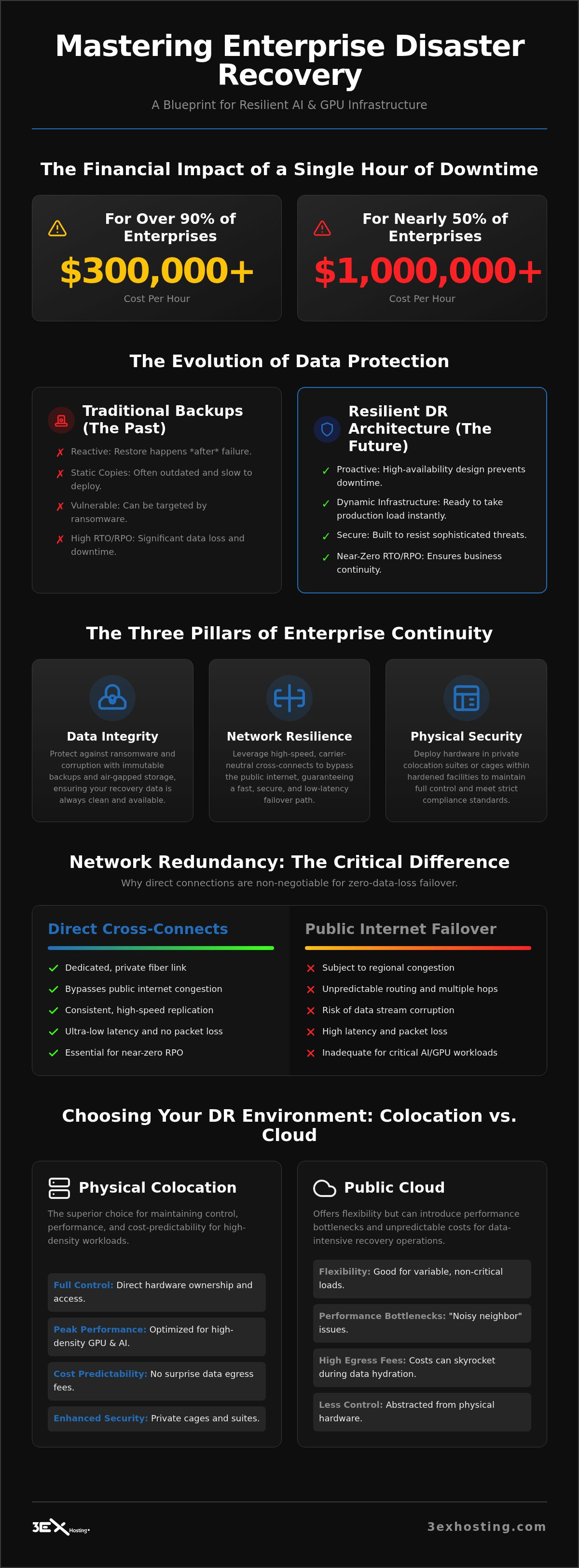
For over 90% of mid-size and large enterprises, a single hour of downtime now costs over $300,000; for nearly half of those organizations, the figure climbs past $1 million. When you are running high-density AI and GPU workloads, the stakes are even higher. You likely recognize that traditional backup methods are no longer sufficient against sophisticated ransomware or inconsistent failover results. Finding reliable disaster recovery solutions Miami offers is about more than just data storage. It’s about maintaining national continuity through hardened, enterprise-grade infrastructure.
We understand that your priority is technical stability and the peace of mind that comes from knowing your systems are resilient. You need a strategy that moves beyond simple off-site copies to a fully orchestrated, high-availability architecture. This article provides a deep dive into mastering enterprise-grade colocation and managed infrastructure to achieve zero-data-loss failover and reduced RTO. We will examine how to implement compliant immutable backup architectures and leverage high-speed cross-connects at a premier carrier hotel. By the end of this guide, you’ll have a clear roadmap for securing your most critical assets against any disruption.
Key Takeaways
- Understand the difference between simple backups and a resilient architecture built within a Miami carrier hotel for national network continuity.
- Evaluate the technical advantages of high-speed cross-connects over public internet failover when building disaster recovery solutions Miami businesses rely on for zero-data-loss.
- Analyze the performance and cost benefits of physical colocation versus cloud environments for maintaining control over high-density GPU and AI workloads.
- Learn a practical framework for executing and testing disaster recovery drills to ensure your team is ready for real-world ransomware or infrastructure failures.
- Explore how managed infrastructure and 24/7 remote hands support provide a scalable foundation for everything from full cabinets to private suites.
The Architecture of Modern Disaster Recovery Solutions
Modern disaster recovery is no longer just about having a copy of your database. In 2026, the distinction between simple backup and the comprehensive disaster recovery solutions Miami enterprises require is the difference between survival and total operational failure. While backups are static copies, a true DR strategy is a dynamic infrastructure capable of assuming the entire production load within minutes. This falls under the broader umbrella of Business continuity planning, which ensures that critical services remain available even when primary systems go offline.
The architecture of these systems relies on the carrier hotel model. By placing your recovery site in a premier Miami facility, you gain access to a strategic national hub for connectivity. This location serves as a primary gateway for traffic between North America and international markets, providing the low-latency routes necessary for real-time data replication. Geographic separation remains non-negotiable for enterprise compliance. Moving workloads to a different power grid and hurricane-resistant infrastructure ensures that a regional event doesn’t compromise both your primary and secondary sites.
RTO and RPO: The Metrics That Define Success
Recovery Time Objective (RTO) measures how quickly you must restore services. For mission-critical AI and GPU workloads, this often needs to be near-zero. Recovery Point Objective (RPO) defines the maximum age of files that must be recovered. High-density infrastructure allows for faster data hydration. You can pull massive datasets from storage to active compute nodes without the bottlenecks typical of public cloud environments. This speed is essential when implementing the disaster recovery solutions Miami businesses use to mitigate threats during the 2026 hurricane season.
The Three Pillars of Enterprise Continuity
Effective continuity rests on three foundations:
- Data Integrity: Use immutable backups and air-gapped storage to protect against ransomware that targets primary backup sites.
- Network Resilience: Leverage carrier-neutral cross-connect services to bypass the public internet. This ensures your failover path is as fast as your primary line.
- Physical Security: Deploy hardware in private colocation suites or cages to maintain hardware control and meet strict regulatory standards.
Selecting the right infrastructure involves moving from reactive recovery to proactive high-availability (HA) architectures. This shift ensures that your systems don’t just recover from a disaster; they resist it entirely.
Network-Layer Redundancy: The Role of Cross-Connects
Public internet failover often fails when it’s needed most. During regional disruptions, such as the 2026 hurricane season, local internet infrastructure experiences extreme congestion and unpredictable routing changes. For enterprises running high-density AI or GPU workloads, even minor packet loss can corrupt data replication streams. This is why the most resilient disaster recovery solutions Miami organizations implement rely on direct physical interconnections rather than the public web.
The technical advantage of a cross-connect is simple: it’s a dedicated fiber link between two points within the same facility. This bypasses the multiple hops and latency spikes of the open internet. By maintaining a private connection between your primary production environment and your secondary recovery site, you ensure that data replication remains consistent and high-speed. This level of control is a fundamental requirement for achieving near-zero Recovery Point Objectives (RPO).
Direct Interconnections for Rapid Failover
Cross-connect services provide a stable bridge between different infrastructure types. You can integrate your managed cloud hosting with physical hardware via these direct links, creating a hybrid environment that is both flexible and secure. Leveraging Colocation Data Centers for these interconnections allows you to avoid the high egress fees and performance bottlenecks associated with public network failover. While private links require a specific physical setup, the cost-benefit analysis favors this approach for any business where an hour of downtime exceeds the six-figure mark. It’s a predictable, fixed-cost solution for a high-stakes technical problem.
Carrier Neutrality and Provider Diversity
A single point of failure at the carrier level can render even the best backup plan useless. Carrier-neutral environments allow you to connect to multiple bandwidth providers simultaneously. This diversity ensures that if one global carrier experiences a backbone failure, your systems can automatically reroute traffic through an alternative path. Miami’s role as a strategic gateway for international traffic makes this provider density particularly valuable. You can Learn more about our Data Centre connectivity to see how diverse path redundancy protects your national operations.
By utilizing multiple high-performance carriers, you gain the network agility required for modern business continuity. If you’re ready to harden your network layer, you can request a custom connectivity map for your disaster recovery site. This proactive approach ensures your infrastructure is ready for the technical demands of 2026 and beyond.
Colocation vs. Cloud: Choosing Your DR Environment
Choosing between public cloud and colocation for your recovery site is a decision that dictates your long-term operational costs and restoration performance. While many providers push cloud-only models, the TCO for high-scale environments often favors a physical approach. Public cloud DRaaS estimates for 2026 suggest costs between $50 and $200 per VM monthly, but these figures don’t account for the massive egress fees triggered during a full-scale failover. By utilizing the disaster recovery solutions Miami colocation facilities provide, you lock in predictable infrastructure costs. This allows you to scale your recovery environment without the financial volatility of consumption-based cloud billing.
Performance benchmarks reveal that high-density workloads, particularly those involving AI and GPU clusters, require the physical control only colocation can offer. Virtualized cloud environments often introduce a “noisy neighbor” effect or hypervisor overhead that slows down data hydration. In a disaster, every second matters. Having direct access to your hardware ensures that your restoration speeds aren’t limited by a third-party’s shared resources. Many enterprises now adopt hybrid models where colocation acts as the primary recovery anchor, using the cloud only for non-critical, burstable services.
The Sovereignty of Private Data Centre Suites
Physical isolation is a cornerstone of modern compliance. For businesses handling sensitive financial or medical data, a shared cloud environment might not meet strict regulatory requirements. Deploying your DR infrastructure in private colocation suites provides a dedicated perimeter. You can implement custom cage configurations to satisfy HIPAA or PCI-DSS standards. This level of sovereignty ensures your secondary site is as secure as your primary office. For a deeper look at these requirements, see our Enterprise Private Suites Guide.
High-Density Colocation for GPU and AI Workloads
Secondary AI training clusters require specialized power and cooling that standard data centers can’t always provide. When building out your disaster recovery solutions Miami strategy, you must account for the thermal demands of modern GPUs. A facility equipped for high-density hosting ensures your backup compute nodes don’t throttle during a failover event. You can Explore Cabinet Colocation Options that support the specific kilowatt-per-rack requirements of your hardware. This ensures your AI infrastructure is ready to resume operations the moment a primary site failure occurs.
Executing the DR Plan: Testing and Remote Management
A written disaster recovery plan is merely a hypothesis until it’s tested under stress. Many enterprises discover a significant “Paper vs. Reality” gap during a crisis, where documented procedures fail to account for hardware dependencies or physical access limitations. Real-world disaster recovery solutions Miami providers facilitate must bridge this gap through rigorous, scheduled drills. These exercises move beyond simple data restoration to include full-scale network rerouting and hardware failover validation.
A functional DR drill framework follows a logical sequence. First, trigger the failover without prior notice to the operational team to test response times. Second, verify data integrity across high-density AI clusters. Third, validate that network routing through cross-connects is active. Fourth, confirm that end-users can access mission-critical applications. Finally, document every bottleneck encountered. This process transforms a static document into a dynamic, battle-tested runbook.
The Critical Role of Remote Hands Support
Physical logistics often become the primary failure point when staff cannot travel to a facility during regional outages. This is where Remote Hands Support becomes an essential component of your infrastructure. On-site technicians can execute physical reboots, perform cable swaps, or manage hardware deployments on your behalf. Having 24/7 access to expert support ensures that physical hardware troubleshooting doesn’t stall your recovery. For a deeper look at maximizing these services, read our Remote Hands Support Efficiency Guide.
Developing a Ransomware-Resilient Recovery Runbook
While Remote Hands manages the data center, the movement of physical media or critical documents between sites remains a logistical challenge. For those needing secure transport across Canada, you can learn more about Sameday Express Inc. to see how professional courier services maintain the flow of physical assets during operational shifts.
Modern threats require more than just a standard restore. With the global average cost of a data breach reaching $4.44 million in 2025, your runbook must include forensic recovery protocols. Define “Clean Room” environments within your cage solutions where data can be restored and scanned for dormant malware before it touches the production network. Implementing air-gapped recovery zones ensures that even if your primary site is compromised, your immutable backups remain secure. Validating backup integrity before restoration prevents the accidental re-infection of your secondary environment.
Don’t wait for a real disruption to find the flaws in your strategy. You can schedule a consultation to audit your DR runbook and ensure your Miami-based infrastructure is fully optimized for rapid execution.
Future-Proofing Continuity with 3EX Hosting
Building a resilient framework for national continuity requires a partner who understands that physical hardware control is the bedrock of recovery. 3EX Hosting integrates colocation with the managed disaster recovery solutions Miami enterprises need to maintain uptime. By operating out of a premier carrier hotel, we provide the physical and network foundations that software-only providers cannot match. Our facility serves as a strategic national hub. This ensures your data remains accessible even if regional infrastructure elsewhere is compromised.
Scalability is central to our approach. We support organizations at every stage of their growth, offering everything from Full Cabinet Colocation to Private Colocation Suites. This flexibility allows you to right-size your recovery environment based on current mission-critical loads while maintaining a clear path for future expansion. Our Remote Hands Support team acts as your on-site eyes and ears. They execute the physical tasks that ensure your DR plan works in reality, not just on paper.
High-Density Infrastructure for AI-Era DR
The shift toward AI-driven operations demands more from a data center than ever before. We provide the high-density infrastructure required for the next generation of AI GPU hosting. Our facility maintains N+1 power redundancy as a baseline. This ensures that your secondary AI training clusters have the stable power they need during a failover. For technical specifications on managing these specialized loads, consult our High-Density GPU Colocation Guide.
Start Your Infrastructure Audit
True resilience begins with a clear understanding of your current limitations. Auditing your existing disaster recovery solutions Miami involves a deep look at cabinet density, network diversity, and recovery time objectives. Our technical experts are available to help you map out a geographically redundant strategy that meets 2026 compliance standards. You can Get a Quote for DR Solutions tailored to your specific infrastructure needs today. Taking this step now ensures your business remains operational regardless of the challenges the 2026 hurricane season or global cyber threats may bring.
Harden Your Infrastructure for National Resilience
Building a resilient enterprise doesn’t happen by accident; it’s the result of strategic infrastructure choices. We’ve explored how physical colocation, dedicated cross-connects, and rigorous testing cycles form the backbone of a modern continuity plan. For organizations managing high-density AI workloads, the choice of a facility with enterprise-grade N+1 power redundancy and carrier-neutral interconnectivity is essential. These technical foundations ensure that your disaster recovery solutions Miami strategy can withstand both regional disruptions and targeted cyber threats.
3EX Hosting provides the professional support and technical stability your national operations require. Our 24/7 on-site remote hands team acts as an extension of your own staff, ensuring physical hardware is always reachable. Don’t leave your uptime to chance. You can secure your enterprise continuity with 3EX Hosting DR solutions and build a foundation that’s ready for whatever challenges the future holds. Your mission-critical data deserves the highest level of protection and performance.
Frequently Asked Questions
What is the difference between backup and disaster recovery solutions?
Backup involves creating static copies of your data to protect against accidental deletion or corruption. In contrast, the disaster recovery solutions Miami enterprises implement focus on the entire infrastructure needed to restore operations. While backups are just the data, disaster recovery is the orchestrated plan and environment that includes compute power, network rerouting, and failover protocols. It ensures your business remains functional during a primary site failure.
How does a carrier-neutral data centre improve disaster recovery?
A carrier-neutral facility provides access to multiple bandwidth providers instead of locking you into a single vendor. This improves disaster recovery by eliminating single points of failure at the network layer. If one global carrier experiences a backbone outage, you can instantly reroute traffic through an alternative provider. This provider diversity is essential for maintaining national continuity and ensuring your recovery site remains reachable during regional disruptions.
What are the benefits of colocation for disaster recovery over public cloud?
Colocation offers predictable costs and physical control that public cloud environments often lack. For high-density AI workloads, colocation prevents performance degradation caused by shared hypervisors or “noisy neighbors.” You also avoid the massive egress fees associated with pulling large datasets out of the cloud during a failover. Physical hardware ownership ensures you can customize security protocols and meet specific regulatory compliance standards that multi-tenant cloud platforms don’t support.
How often should an enterprise test its disaster recovery plan?
Enterprises should conduct full-scale drills for their disaster recovery solutions Miami at least once every quarter. Testing more frequently is necessary after any significant infrastructure changes or hardware updates. Regular drills help bridge the gap between documentation and reality by identifying bottlenecks in failover orchestration. This consistent validation ensures that your team is prepared to execute the recovery runbook under the high-pressure conditions of a real-world outage.
What is Remote Hands support and why is it vital for DR?
Remote Hands support consists of on-site technicians who perform physical tasks on your hardware at the data center. This service is vital during a disaster when your own staff might be unable to travel to the facility due to weather or travel restrictions. Technicians can execute physical reboots, swap cables, or deploy new hardware on your behalf. This ensures that physical layer issues don’t stall your recovery efforts when time is critical.
Can 3EX Hosting support high-density GPU infrastructure for DR?
Yes, 3EX Hosting is specifically engineered to support high-density GPU and AI infrastructure. Our Miami facility provides the specialized power and cooling required for secondary AI training clusters and compute-heavy recovery nodes. We maintain enterprise-grade N+1 power redundancy as a standard to ensure your mission-critical loads remain stable. This capability allows you to maintain a recovery site that matches the performance requirements of your primary production environment without throttling.
How do cross-connects reduce RTO in disaster scenarios?
Cross-connects reduce Recovery Time Objective (RTO) by providing direct, low-latency fiber links between infrastructure components. These private connections bypass the congestion and unpredictable routing of the public internet. By creating a dedicated path for data replication, you ensure that your recovery site is always synchronized with your primary site. This allows for near-instant failover of network traffic, significantly cutting the time it takes to restore services to your end-users during a disruption.
Is my data secure in a shared colocation environment during a crisis?
Data remains highly secure in a colocation environment through multiple layers of physical and logical protection. Unlike public cloud, where resources are virtualized and shared, colocation allows for physical isolation using private suites or custom cages. These environments are monitored 24/7 and require strict access protocols. During a crisis, these hardened perimeters ensure that your hardware and data are protected from unauthorized access, providing a level of sovereignty required for enterprise compliance.