 SUPPORT


 3EX United States
 Blog
Why does your enterprise cloud feel slower even as your monthly bill continues to grow? In 2026, many enterprises face a sharp disconnect between software agility and the physical reality of the data center. Unpredictable egress costs and network latency aren’t just technical glitches; they’re symptoms of a fragmented infrastructure. If you’re looking for professional managed cloud services, you’ve likely realized that simply “being in the cloud” isn’t enough. You need a strategy that anchors virtual performance to high-density physical hardware.
At 3EX Hosting, we understand the frustration of managing complex hybrid environments across multiple providers. This guide bridges that gap, showing you how professional managed solutions stabilize your overhead and eliminate performance bottlenecks. You’ll discover how the latest AI-ready infrastructure and the evolving regulatory landscape impact your deployment strategy. We’ll examine the technical shift toward liquid-cooled, high-density environments that ensure your business stays performant and secure in an increasingly demanding market.
Key Takeaways
- Understand how professional managed administration removes the daily burden of security patching and resource optimization.
- Learn how to evaluate the managed cloud services Miami offers by auditing physical facility quality and carrier-neutral connectivity.
- Identify the right balance between public cloud scale and private hardware for better data sovereignty and predictable costs.
- Discover why a Carrier Hotel location is the foundation for reducing network latency and maximizing application performance.
- Prepare for the 2026 technology shift by integrating high-density GPU hosting to support modern AI model training.
What are Managed Cloud Services? Defining Enterprise Value in 2026
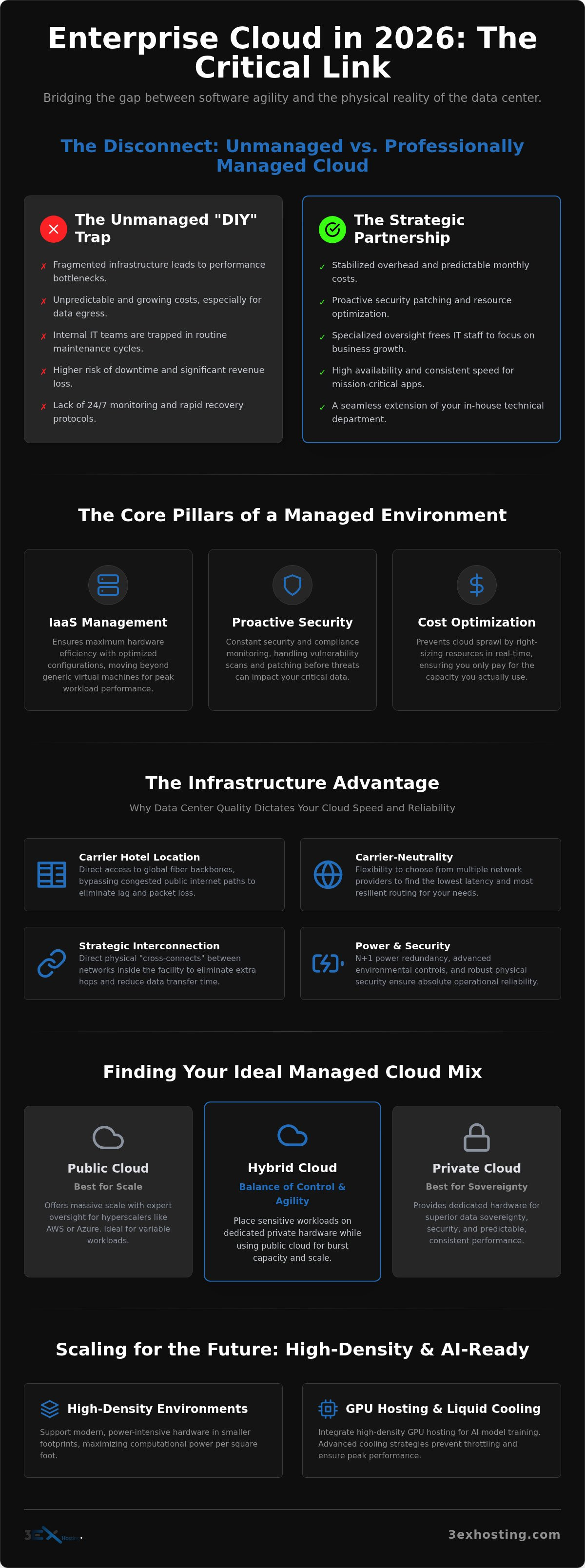
Managed cloud services represent a strategic partnership where a provider takes full responsibility for the administration of your cloud-based infrastructure and applications. In 2026, enterprises are moving away from unmanaged environments. The complexity of modern workloads often exceeds the capacity of standard internal IT teams. When searching for managed cloud services Miami, businesses find that the real value lies in specialized oversight. This ensures high availability and consistent speed without taxing internal resources.
There’s a clear distinction between managed public clouds and managed private cloud infrastructure. Public clouds offer massive scale with expert oversight for hyperscalers like AWS or Azure. Private clouds provide dedicated hardware for superior data sovereignty and predictable performance. These solutions are a specialized subset of Managed Services, where the provider acts as a seamless extension of your technical department.
The Core Pillars of a Managed Environment
Modern managed environments focus on three critical areas to maintain enterprise stability. First, Infrastructure-as-a-Service (IaaS) management ensures maximum hardware efficiency. This means your workloads run on optimized configurations, not just generic virtual machines. Second, providers offer proactive security and compliance monitoring. They handle security patching and vulnerability scans before threats reach your mission-critical data. Finally, cost management prevents cloud sprawl. By right-sizing resources in real-time, managed providers stop you from paying for unused capacity.
Managed vs. Unmanaged: The True Cost of DIY
Choosing an unmanaged cloud might seem cheaper initially, but the hidden overhead is significant. Your internal IT staff ends up trapped in a cycle of routine maintenance and troubleshooting. This diverts them from projects that actually grow the business. The financial impact of downtime in unmanaged environments is another major risk factor. Without 24/7 monitoring and rapid recovery protocols, a single outage can result in hours of lost revenue and a damaged reputation. Managed cloud is the fusion of expert oversight and high-performance hardware.
The Infrastructure Advantage: Why Data Center Quality Dictates Cloud Speed
Many providers treat the cloud as an abstract concept. In reality, your application’s responsiveness depends entirely on the physical facility housing the servers. Cloud performance is fundamentally limited by the latency of the underlying network. When evaluating managed cloud services Miami, you must look at the facility’s status as a Carrier Hotel. This designation means your data has direct access to global fiber backbones. It bypasses the congested public internet paths that cause lag and packet loss. According to IBM’s guide to managed cloud, the infrastructure layer is just as vital as the management layer for maintaining enterprise performance.
Carrier-neutrality is non-negotiable for enterprise-grade services. It allows you to choose from multiple network providers to find the lowest latency or most resilient routing. This flexibility is essential for full cabinet colocation deployments that form the backbone of a hybrid cloud. By placing your most sensitive workloads on dedicated hardware while using the cloud for scale, you achieve a balance of control and agility that software alone cannot provide.
Strategic Interconnection and Low-Latency Networking
Cross-connect services are the secret to enterprise speed. These direct physical cables between different networks inside the facility eliminate extra “hops” that slow down data transfer. Proximity to major internet exchange points (IXPs) also reduces network jitter. This is critical for real-time applications, financial transactions, and high-frequency data processing. High-speed fiber paths ensure your data moves across national and international routes with minimal delay, keeping your global operations synchronized.
Physical Security and Power Redundancy
Infrastructure quality isn’t just about speed; it’s about absolute reliability. N+1 power configurations ensure your managed cloud never goes dark. If one power source fails, another is already active to maintain continuous operation. Environmental controls are equally important. Advanced cooling strategies for high-density enterprise racks prevent hardware throttling and extend the life of your equipment. Security at the data center includes biometric access and 24/7 on-site monitoring to protect your physical assets. You might want to review our redundancy specifications to see how we protect mission-critical workloads.
Public, Private, or Hybrid: Finding Your Ideal Managed Cloud Mix
Selecting the right architecture is a critical step in your cloud strategy roadmap. Enterprises often struggle with the trade-off between the infinite scale of public platforms and the rigid security of on-premise hardware. Managed public cloud allows you to leverage hyperscalers while professional administrators handle the complex configuration and security. This oversight is vital to prevent the unpredictable egress costs that often plague unmanaged accounts. Conversely, managed private cloud offers dedicated hardware within a secure facility. This setup provides maximum data sovereignty and predictable performance that shared environments can’t match. For many organizations looking for managed cloud services Miami, the answer isn’t a single platform but a strategic mix.
The hybrid model has become the standard for modern business. It uses cross-connect services to link private assets directly to public cloud nodes. This physical link ensures that data moves between environments at lightning speed without crossing the public internet. You gain the flexibility of the cloud with the stability of dedicated hardware.
When to Choose Managed Private Cloud
Industries with strict regulatory requirements, such as finance and healthcare, often find public clouds too risky or complex for compliance. Private environments eliminate the “noisy neighbor” effect. In shared public clouds, a spike in another user’s traffic can degrade your application’s performance. Dedicated hardware ensures your resources are always available. From a financial perspective, the total cost of ownership (TCO) for consistent, heavy workloads is often lower on private hardware than on variable-rate public instances. It’s about having total control over your environment.
The Rise of the Managed Hybrid Model
Hybrid cloud provides the agility to handle burstable workloads while keeping core data on secure, private infrastructure. You might run your front-end applications on a public cloud for global reach but keep your primary database in a private suite. This integration requires sophisticated managed IT infrastructure support to ensure all components communicate securely. This architecture is particularly effective for disaster recovery solutions. By mirroring private data to a public cloud or a secondary private site, you ensure business continuity. It’s a pragmatic approach that balances cost, compliance, and control.
Critical Selection Criteria for a Managed Cloud Provider
Selecting a partner for managed cloud services Miami demands a systematic audit of their operational foundations. You must first evaluate the physical facility. A carrier-neutral provider offers the best protection against network outages by allowing for multiple fiber paths and redundant connections. Step two involves auditing the security protocols of any provider offering managed cloud services Miami. Look for partners who maintain strict compliance certifications and provide transparent reporting on their environmental controls. Don’t settle for verbal promises; verify that the facility uses N+1 or 2N power configurations to prevent downtime during grid failures. Finally, ensure the provider can scale with your future needs, particularly if you plan to deploy high-density workloads.
The Essential Role of Remote Hands Support
Cloud agility is often an illusion if the provider lacks on-site hardware management. This is why remote hands support is a non-negotiable criterion for enterprise success. Managed cloud isn’t just a software layer; it’s a physical system that requires maintenance, hardware upgrades, and immediate physical intervention when things go wrong. Having 24/7 on-site technical support means that a failed component can be replaced in minutes rather than hours. By integrating remote hands into your operational workflow, you eliminate the need to send your own staff to the data center for routine tasks. This efficiency is what separates elite providers from basic resellers who lack a physical presence.
Security and Disaster Recovery Integration
Business continuity requires more than just storing data off-site. Your provider must offer integrated disaster recovery that replicates data in real-time across geographically diverse nodes. This ensures that even a regional event won’t compromise your operations. Managed cloud providers automate the failover process to ensure continuity. This proactive approach uses load balancers and automated scripts to shift traffic to healthy infrastructure the moment a bottleneck or failure is detected. Beyond failover, check for high-density readiness. As AI workloads expand, your cloud must scale into racks capable of supporting intensive GPU processing and specialized cooling. To see how we handle these critical requirements, explore our Miami data center specifications and support tiers.
Scaling for the Future: High-Density and AI-Ready Managed Cloud
The enterprise landscape in 2026 is defined by the rapid adoption of artificial intelligence and machine learning. Traditional cloud architectures often struggle to keep pace with the massive computational demands of these technologies. If you’re evaluating managed cloud services Miami, your provider must offer more than just standard virtual machines. They need to provide a foundation that supports high-density hardware. Modern AI model training relies on high-density GPU colocation to achieve the necessary processing speeds. This shift represents a convergence of managed software oversight and specialized physical infrastructure.
Managed cloud solutions are now evolving to include dedicated GPU clusters tailored for intensive workloads. These systems allow your business to scale its AI capabilities without the massive capital expenditure of purchasing and maintaining specialized servers. By leveraging a provider’s expert administration, you ensure that these complex resources are optimized for performance and cost from day one.
Preparing Infrastructure for AI and Machine Learning
Managing the heat generated by GPU-dense racks is the primary challenge for modern data centers. Standard cooling methods aren’t enough for racks pulling 20kW or more. Professional facilities use advanced cooling strategies, such as contained cold aisles or liquid cooling, to prevent hardware throttling. This level of environmental control is difficult and expensive to replicate in-house. Additionally, AI training requires massive data ingestion. You need high-speed fiber paths and direct cross-connects to move terabytes of data between storage and processing nodes without delay. Managed GPU hosting provides these technical advantages immediately. It’s a faster, more reliable alternative to building a private AI lab that might be obsolete in two years.
Future-Proofing Your Enterprise Growth
Transitioning from a traditional cloud model to an AI-capable infrastructure doesn’t have to be a disruptive process. A strategic approach involves identifying which workloads benefit most from GPU acceleration and moving them to a managed high-density environment. Managed services play a vital role here. They help you navigate rapid technological shifts by providing the expertise to integrate new hardware into your existing hybrid mix. This ensures your data remains secure and your applications stay performant during the transition. As technology continues to evolve, having a partner who understands both the software and the physical constraints of the data center is essential. Managed cloud isn’t just a utility; it’s the foundation of the modern AI enterprise. If you’re ready to scale your infrastructure for the next generation of computing, request a technical consultation to discuss your high-density requirements.
Secure Your Infrastructure for the Next Wave of Innovation
In 2026, enterprise success depends on a cloud strategy that acknowledges the physical reality of the data center. High-density AI workloads and hybrid environments require more than just software administration. They demand a carrier-neutral interconnection hub that minimizes latency and maximizes reliability. By selecting the right partner for managed cloud services Miami, you bridge the gap between abstract scalability and physical hardware performance. This alignment ensures your costs stay predictable while your application response times remain lightning-fast.
Our facility provides the technical stability your mission-critical applications need to thrive. With N+1 power redundancy, carrier-neutral interconnection, and 24/7 on-site remote hands, we ensure your systems remain online regardless of external conditions. Your growth shouldn’t be limited by infrastructure bottlenecks or poor network routing. It’s time to anchor your digital assets in a facility designed for the future of high-performance computing.
Get a personalized quote for managed cloud and colocation solutions. We’re ready to help you build a resilient foundation that supports your most ambitious business goals.
Frequently Asked Questions
What is the difference between managed cloud and unmanaged cloud?
Managed cloud includes end-to-end administration, patching, and 24/7 monitoring by the provider. Unmanaged cloud gives you the infrastructure, but you’re responsible for the OS, security, and maintenance. Many enterprises choose managed cloud services Miami to shift the burden of routine technical tasks to specialized experts. This allows internal teams to focus on core business development rather than server maintenance or manual software updates.
How do managed cloud services improve enterprise security?
Managed cloud services enhance security through proactive vulnerability scanning, automated patching, and continuous compliance monitoring. Providers implement enterprise-grade firewalls and encryption protocols that are often too costly for individual businesses to manage in-house. By using a managed environment, you benefit from real-time threat detection and rapid response teams who specialize in neutralizing infrastructure-level attacks before they ever impact your sensitive data.
Can managed cloud services help reduce IT operational costs?
Managed cloud reduces costs by eliminating the need for a large internal team dedicated to hardware and OS maintenance. It converts unpredictable capital expenditures into consistent operational costs. You avoid the expense of hiring specialized talent for 24/7 monitoring across multiple shifts. Additionally, providers optimize your resource usage to prevent over-provisioning. This ensures you only pay for the capacity your applications actually require.
What should I look for in a managed cloud service level agreement (SLA)?
An enterprise SLA must specify uptime guarantees, response times for technical support, and clear remediation steps for outages. Look for 99.99% or higher availability as a baseline. The agreement should also define the provider’s responsibility for hardware replacement and security updates. Ensure there are measurable performance metrics for network latency and packet loss, especially if your business relies on real-time data processing or AI workloads.
How does a carrier-neutral data center affect cloud performance?
A carrier-neutral facility allows you to connect to multiple network providers, which prevents vendor lock-in and improves redundancy. It enhances performance by allowing you to choose the provider with the best routing for your specific traffic. If one carrier experiences an outage or congestion, you can quickly switch to another. This flexibility is essential for maintaining the high-speed connectivity required for modern enterprise cloud applications and global data distribution.
Is managed cloud suitable for highly regulated industries like finance or healthcare?
Managed cloud is ideal for finance and healthcare because providers offer dedicated private infrastructure and strict audit trails. You can maintain data sovereignty by ensuring your information remains on specific, high-security hardware. Compliance-focused tiers help meet HIPAA or PCI-DSS requirements through encrypted storage and rigorous access controls. This level of isolation protects sensitive records while providing the scalability needed for large-scale data analysis and secure remote access.
What role does remote hands support play in managed cloud services?
Remote hands support provides on-site technicians to perform physical tasks like server reboots, cable management, or hardware swaps. This service is a vital component of managed cloud services Miami, as it ensures physical issues are resolved without your staff traveling to the facility. Having 24/7 on-site support minimizes downtime by providing immediate intervention for any hardware-level failures, keeping your virtual environment running smoothly at all times.
How does managed cloud facilitate disaster recovery?
Managed cloud facilitates disaster recovery by automating data replication across geographically separate nodes. In the event of a primary site failure, the system triggers an automated failover to a secondary location. This process ensures your applications remain accessible with minimal data loss. Providers manage the complex orchestration of these failover protocols. This allows your business to resume operations quickly after a significant disruption or regional weather event.