 SUPPORT


 3EX United States
 Blog
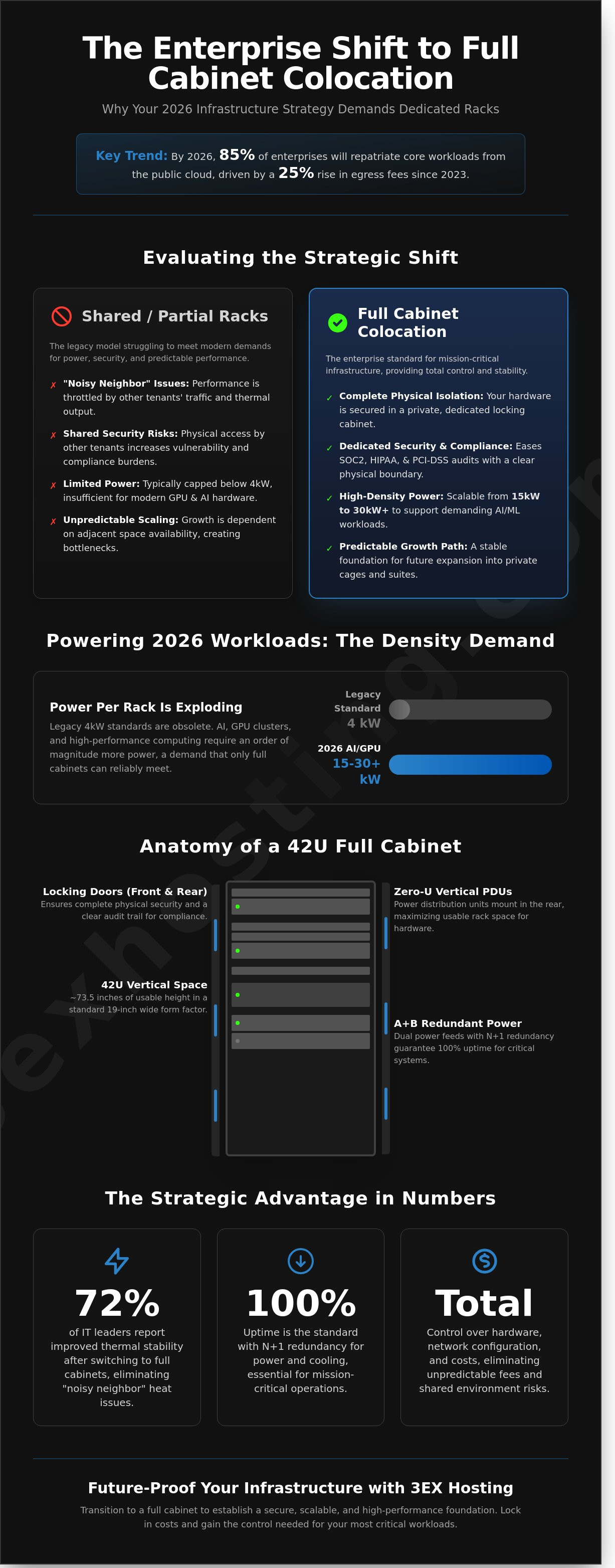
By 2026, 85% of enterprises will repatriate at least one core workload from the public cloud to mitigate egress fees that have risen by 25% since 2023. Managing mission-critical data in a shared environment feels increasingly like building on rented land with fluctuating taxes. You’ve likely noticed that as your GPU and AI demands grow, standard shared racks simply can’t provide the 15kW to 30kW per rack your hardware requires. Transitioning to full cabinet colocation provides the technical stability and dedicated power density your modern infrastructure demands.
We agree that unpredictable scaling and shared security risks are no longer acceptable for high-stakes operations. You need a foundation where performance isn’t throttled by a neighbor’s spike in traffic or a provider’s hidden fees. This guide explores how full cabinet colocation delivers the total hardware control and predictable monthly costs necessary for a stable 2026 growth strategy. We’ll examine high-density cooling requirements, physical isolation protocols, and the specific network configurations that ensure your systems remain superfast and secure. By the end, you’ll understand how to lock in your infrastructure costs while maintaining the agility required for mission-critical workloads.
Key Takeaways
- Understand how a dedicated 42U rack provides the physical isolation and custom power control necessary for mission-critical enterprise security.
- Discover the technical requirements for 2026 workloads, including high-density power configurations and N+1 redundancy for 100% uptime.
- Evaluate the strategic benefits of full cabinet colocation to optimize your total cost of ownership and meet rigorous industry compliance.
- Learn professional deployment strategies for rack layout and cable management that maximize airflow and infrastructure efficiency.
- Explore how to future-proof your infrastructure by transitioning toward private cage solutions and high-performance, carrier-neutral connectivity.
Defining Full Cabinet Colocation: The Foundation of Enterprise Infrastructure
Full cabinet colocation represents the industry standard for enterprise-grade hardware hosting, providing a dedicated 42U locking rack exclusively for one organization’s infrastructure. This model ensures that your servers, storage arrays, and networking gear remain physically isolated from other tenants. In a modern colocation centre, this setup is the primary choice for businesses that require total control over their environment. It’s not just about having more space; it’s about the ability to customize power configurations and airflow to meet specific technical demands.
By 2026, three primary drivers are pushing organizations toward this model. First, security compliance has become non-negotiable. Second, the rise of high-density computing for AI and machine learning requires power draws that shared racks can’t support, often exceeding 15kW per cabinet. Finally, carrier-neutral network access allows enterprises to connect with multiple providers, ensuring 100% uptime through redundancy. Full cabinet colocation provides the stable, professional environment needed to manage these complex requirements without the overhead of building a private data center.
The Anatomy of a 42U Cabinet
A standard 42U cabinet offers approximately 73.5 inches of vertical rack space with a universal 19-inch width. This form factor is the global enterprise choice because it maximizes data center floor space while maintaining efficient cooling. Professional setups utilize zero-U PDU (Power Distribution Unit) placement. These units mount vertically at the rear of the rack, which means they don’t consume any of the 42 horizontal slots meant for your hardware. This maximizes your ROI on every inch of leased space. Security is another critical component. Dedicated locking mechanisms on the front and rear doors provide a clear audit trail. This level of physical security is essential for passing SOC2, HIPAA, or PCI-DSS compliance audits, as it prevents unauthorized contact with your physical ports and cables.
Why Enterprises Are Moving Away from Partial Racks
Fractional or 1U colocation often creates “noisy neighbor” issues that can jeopardize performance. In a shared rack, you’ve got no control over the thermal output or the cable management of the company next to you. Statistics from 2024 show that 72% of enterprise IT leaders reported better thermal stability after moving to full cabinet colocation. A dedicated rack eliminates the risk of accidental technician errors from other companies sharing your space. It also provides a clear path for scalability. When your server clusters grow, you don’t have to worry about whether the adjacent RU is available. A full cabinet is the reliable entry point for businesses that eventually plan to transition into private suites or cages. It’s a super-fast way to professionalize your infrastructure while maintaining the flexibility to expand as your data needs evolve.
Technical Architecture: Power Density and Cooling for 2026 Workloads
By 2026, the baseline for enterprise infrastructure has shifted toward extreme power density. Old standards of 4kW per rack are no longer sufficient for modern AI training or large scale database management. Selecting full cabinet colocation allows your business to scale from 10kW to over 30kW per rack without hitting a technical wall. This evolution requires a sophisticated approach to Power Density and Cooling for 2026 Workloads to ensure your hardware remains stable under heavy load. We utilize N+1 redundancy in both power and cooling systems to guarantee 100% uptime and superfast processing speeds for every client.
Managing High-Density Power Requirements
Modern enterprise hardware typically demands three-phase power to operate efficiently at scale. While single-phase power works for basic networking, it lacks the capacity for high-density server arrays that define the 2026 landscape. We implement A+B redundant power feeds to ensure your mission-critical operations never stop; if one feed fails, the other takes over instantly. Metered power billing provides transparency for enterprise budgets because you only pay for the exact energy your equipment consumes rather than a flat, estimated rate. For businesses looking for a reliable foundation, professional cabinet colocation services offer the necessary overhead for growth. Intelligent PDU monitoring gives you real-time visibility into your usage, allowing you to identify inefficient hardware and optimize your operational costs.
Advanced Cooling for Modern Hardware
Thermal management is the primary challenge for 2026 data centers. Standard open-air cooling is no longer enough for high-density racks. We use hot aisle and cold aisle containment strategies to physically separate air streams, which prevents hardware throttling and ensures your CPUs run at peak performance. AI and GPU-intensive server arrays generate massive thermal output that requires modern cooling solutions like high-velocity airflow or liquid-to-chip systems. Efficient cooling isn’t just about speed, it’s about hardware longevity. Keeping components within optimal temperature ranges can extend the lifespan of your server components by up to 25%. If you’re ready to secure your hardware in a stable environment, you can view our data center specifications to see how we handle these high-density demands.
The role of the PDU has also evolved from a simple power strip to a critical data point. By monitoring every outlet, enterprises can track power consumption at the device level. This granular data helps in capacity planning and ensures that your full cabinet colocation setup remains within safe operating limits while maximizing your hardware investment.
Full Cabinet vs. Partial Colocation: Evaluating the Strategic Shift
Enterprise growth often hits a wall when using fractional racks. While 10U or 20U spaces work for startups, scaling organizations require the autonomy provided by full cabinet colocation. Moving to a dedicated 42U or 48U rack isn’t just about extra space; it’s a calculated move to lower long-term costs and tighten security protocols. When your infrastructure reaches a certain density, the transition from shared to dedicated environments becomes a matter of operational efficiency.
The Economics of Scaling Your Infrastructure
In a partial rack, you often pay a premium for every individual unit of space. A typical 10U quarter-rack might cost $150 per U, whereas a full 42U cabinet can drop that rate to $45 or $60 per U. This represents a 60% reduction in unit costs as your hardware footprint grows. Partial racks also hide costs through power density limits. Most fractional providers cap power at 2kW or 3kW per partial section. If your new AI-driven servers require 10kW, you’re forced to buy more partial racks than you actually need for the physical hardware. Full cabinet colocation eliminates this inefficiency. It also provides a buffer against the 15% to 20% annual increases seen in public cloud egress fees. It offers a predictable monthly bill that stabilizes your IT budget for the long term.
Security and Compliance Advantages
For industries like finance or healthcare, shared space is a liability. Physical isolation is mandatory for SOC 2, PCI-DSS, and HIPAA compliance. In a partial rack, your equipment sits inches away from another company’s hardware, often behind the same mesh door. A full cabinet allows for customized, rack-level security. You can install biometric locks or dedicated IP cameras that monitor every access event 24/7. This level of control is essential for enterprise-level disaster recovery planning. Organizations looking for this level of infrastructure scale often start with a Miami data center overview to understand how high-density power and physical security integrate. Dedicated space simplifies international certifications because the audit trail is clear and the physical perimeter is absolute.
Managing your own network topology becomes significantly easier with a full rack. You control the cable management and the placement of Top-of-Rack (ToR) switches. In fractional setups, you’re often limited to the provider’s specific cross-connect paths and limited port availability. With a full cabinet, you gain direct access to the meet-me-room (MMR) for diverse carrier handoffs. This ensures 99.999% uptime through redundant network paths you design yourself. You aren’t sharing a backplane or a switch with a neighbor, which eliminates “noisy neighbor” syndrome at the network level.
Deployment Strategy: Optimising Your 42U Environment for Maximum Performance
High performance in a full cabinet colocation environment starts with physical precision. You aren’t just renting rack space; you’re building a foundation for 100% uptime and technical stability. A disorganized cabinet leads to thermal pockets and “spaghetti cabling” that complicates even the simplest hardware swap. Strategic planning ensures your infrastructure remains cool, accessible, and ready for 2026 demands.
Optimising Rack Space and Airflow
Thermal efficiency is the primary driver of hardware longevity. You must use blanking panels in every unoccupied U-space to prevent hot air recirculation. This simple step can reduce server intake temperatures by as much as 5 to 8 degrees Celsius. We recommend placing heavy UPS units and power distribution units (PDUs) in the bottom 4U of the rack. This keeps the center of gravity low and prevents heat from these units from rising through your most sensitive compute nodes. High-density servers should occupy the middle sections to align perfectly with cold aisle containment systems. Every device needs a clear, durable label. Rapid hardware identification during a localized outage is the difference between a five-minute fix and an hour of downtime.
Leveraging Remote Hands for Seamless Management
Professional remote hands act as your on-site eyes and ears. You can expect these technicians to handle everything from basic power cycles to complex card swaps or even the installation of superfast NVMe SSD arrays. Relying on 24/7 on-site support reduces the need for expensive technician travel; it often cuts operational travel expenses by 40% or more. To make this work, you need to establish clear Standard Operating Procedures (SOPs). When data center staff have a step-by-step guide for your specific environment, emergency maintenance becomes a routine task rather than a panicked scramble. This level of preparedness ensures your national infrastructure remains stable regardless of your physical distance from the facility.
Integrating managed IT support into your strategy allows for proactive hardware lifecycle management. This service ensures that firmware updates and hardware refreshes happen on schedule, preventing the “zombie server” syndrome where old gear consumes power without delivering performance. You must document every cable run and port map with absolute precision to ensure future troubleshooting takes seconds rather than hours. Proper cable management, using vertical and horizontal managers, keeps the rear of the rack clear for maximum exhaust airflow. It’s a professional approach that mirrors the reliability 3ex Hosting provides across all its modern facilities.
Ready to build a stable, high-performance environment? Secure your full cabinet colocation today and experience professional infrastructure management.
Future-Proofing with 3EX Hosting: Beyond the Physical Rack
Scalability drives every successful enterprise strategy. Your initial investment in full cabinet colocation serves as a launchpad for future expansion. As your hardware footprint grows beyond the standard 42U capacity, 3EX Hosting facilitates a seamless transition to private cage solutions. This migration ensures physical isolation and enhanced security without disrupting your established network architecture. We’ve engineered our infrastructure to handle the projected 40% annual increase in data processing demands through 2026. Your rack space will never become a bottleneck for your technical roadmap.
Our 2026 infrastructure model prioritizes high-density cooling and advanced power delivery. This allows you to pack more compute power into every square inch of your cabinet. When you choose 3EX Hosting, you aren’t just renting floor space. You’re securing a partnership with a provider that values technical excellence and human support. Our team monitors the facility environment 24/7/365 to ensure your hardware runs at peak efficiency. This proactive management style prevents thermal issues and can extend the lifespan of your server components by as much as 18% compared to less regulated environments.
Carrier-Neutral Connectivity and Cross-Connects
Speed defines the modern enterprise. Our facilities operate on a superfast network backbone that removes the limitations of single-provider environments. You get direct access to a diverse ecosystem of Tier 1 providers right from your dedicated cabinet. Strategic network placement reduces latency to under 5 milliseconds for regional traffic hubs. Direct cross-connects provide a dedicated physical link between your gear and your chosen service providers. This setup bypasses the public internet transit routes entirely. It results in a 35% increase in throughput and much higher security for sensitive data transfers. You gain the reliability of a private circuit with the flexibility of a carrier-neutral hub.
Comprehensive Disaster Recovery Integration
A resilient strategy treats the physical rack as one component of a larger safety net. You can utilize your full cabinet colocation space as a primary production site or a secondary failover location for business continuity. Our managed cloud services bridge the gap between your legacy hardware and modern hybrid environments. We provide the technical stability required to sync massive datasets in real-time across multiple geographic zones. This ensures that 100% of your mission-critical applications remain online even during regional outages. Our engineers maintain a 99.999% uptime benchmark so you can focus on growth instead of troubleshooting. It’s about creating a stable foundation that survives the unexpected.
Scaling Your Enterprise Infrastructure for 2026
Moving into 2026, enterprise infrastructure demands more than just floor space. It requires a strategic foundation capable of handling next-generation power densities. Transitioning to full cabinet colocation provides the 42U of dedicated space necessary to scale without the constraints of shared environments. You gain total control over your hardware layout while benefiting from our carrier-neutral infrastructure. This setup ensures your latency stays low and your connectivity remains flexible across multiple providers.
Reliability isn’t a luxury; it’s a technical requirement. Our facilities utilize N+1 power and cooling redundancy to maintain maximum uptime for your critical workloads. If a hardware issue arises at 3 AM, our 24/7/365 Remote Hands Support team acts as your on-site engineering arm. You don’t have to worry about physical maintenance or environmental stability. We’ve built this ecosystem to be super-fast and resilient, giving you the peace of mind to focus on high-level architecture.
Secure Your Dedicated Enterprise Rack with 3EX Hosting Today
Your systems are ready for the next decade of growth.
Frequently Asked Questions
How many servers can I fit in a standard 42U full cabinet?
You can fit 42 standard 1U servers in a 42U full cabinet, though thermal and power constraints usually limit this to 32 or 34 units. High-density configurations in 2026 typically require 15 kW to 20 kW of cooling to support a fully packed rack. We recommend leaving 2U to 4U for horizontal cable management and PDU placement to maintain optimal airflow.
What is the difference between metered and capped power for colocation?
Metered power charges you for the exact kilowatt-hours your hardware consumes, while capped power provides a fixed limit like 5kW for a set monthly fee. Metered billing can reduce costs by 15% for workloads with variable demand cycles. Capped power ensures your monthly invoice stays identical regardless of CPU spikes or 100% utilization periods.
Is a full cabinet more secure than a half or quarter cabinet?
A full cabinet colocation setup is more secure because it eliminates shared access to the physical rack space. You don’t share a door or key with other tenants, which removes the risk of accidental cable unplugging by third-party technicians. Most 2026 enterprise facilities offer individual biometric scanners or RFID locks for full cabinets to track every entry event.
What are cross-connect services and why do I need them in my cabinet?
Cross-connects are physical fiber or copper cables that link your equipment directly to a carrier’s network or another service provider within the data center. You need them to bypass the public internet, which reduces latency to sub-1ms levels. Using a direct cross-connect can improve data transfer speeds by 40% compared to traditional VPN tunnels over public routes.
Do I need to be on-site to manage my hardware in a full cabinet?
You don’t need to be physically present because you can manage your servers via IPMI, iDRAC, or specialized Remote Hands services. Data center technicians perform physical tasks like swapping failed NVMe drives or rebooting hardware within 15 to 30 minutes of your request. This allows you to maintain 99.999% uptime without ever stepping foot inside the facility.
What is N+1 redundancy and how does it protect my server uptime?
N+1 redundancy ensures your infrastructure remains online by providing one extra backup component for every system required for operation. If your full cabinet colocation requires 4 cooling units to stay stable, an N+1 setup provides 5 units. This configuration prevents downtime during a single component failure, a standard that has saved 98% of facilities from power-related outages in the last decade.
Can I customize the security of my individual colocation cabinet?
You can customize your cabinet security by installing internal rack cameras, vibration sensors, or secondary biometric locks. Many enterprises in 2026 add 256-bit encrypted door controllers that integrate directly with their corporate access systems. These individual upgrades provide a documented audit trail that meets SOC2 and HIPAA compliance requirements for sensitive data handling.
How does full cabinet colocation compare to the cost of public cloud?
Full cabinet colocation is typically 35% to 50% more cost-effective than public cloud for predictable, high-performance workloads over a 3-year period. You avoid unpredictable egress fees and the 200% markup often found on high-end cloud compute instances. While cloud offers instant scaling, owning the hardware in a dedicated rack provides superior ROI for data-intensive applications.